
Chinese Journal of Catalysis ›› 2026, Vol. 90: 1-26.DOI: 10.1016/S1872-2067(26)65191-1
• Reviews • Next Articles
Ikram Ullaha, Risheng Duana, Muhammad Aminb, Waqar Ahmad Qureshia, An-Wu Xuc,*( ), Pei Zhaoa,*(), Ning Qina,*()
Received:2026-01-01
Accepted:2026-03-09
Online:2026-11-18
Published:2026-11-19
About author:An-Wu Xu (Hefei National Research Center for Physical Sciences at the Microscale, University of Science and Technology of China) is a Professor at the University of Science and Technology of China. He received his Ph.D. degree in Applied Chemistry from the same University in 1998. He has published more than 270 SCI papers in prestigious journals, including J. Am. Chem. Soc., Angew. Chem. Int. Ed., Adv. Mater., ACS Nano, ACS Energy Lett., ACS Catal., and Adv. Funct. Mater.Supported by:Ikram Ullah, Risheng Duan, Muhammad Amin, Waqar Ahmad Qureshi, An-Wu Xu, Pei Zhao, Ning Qin. Innovative strategies in noble and earth abundant metal single-atom-based photocatalysts for hydrogen production[J]. Chinese Journal of Catalysis, 2026, 90: 1-26.
Add to citation manager EndNote|Ris|BibTeX
URL: https://www.cjcatal.com/EN/10.1016/S1872-2067(26)65191-1
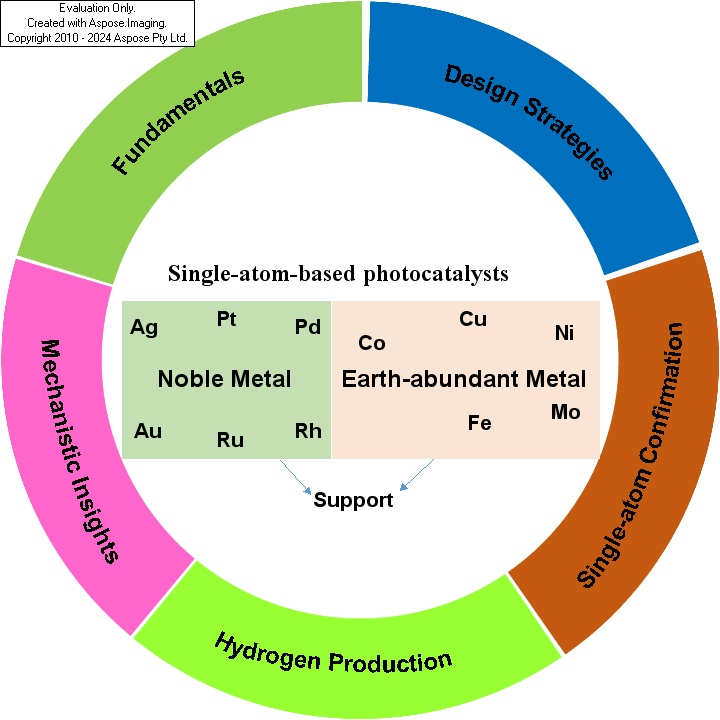
Fig. 1. Schematic diagram presenting the key aspects covered in this review.
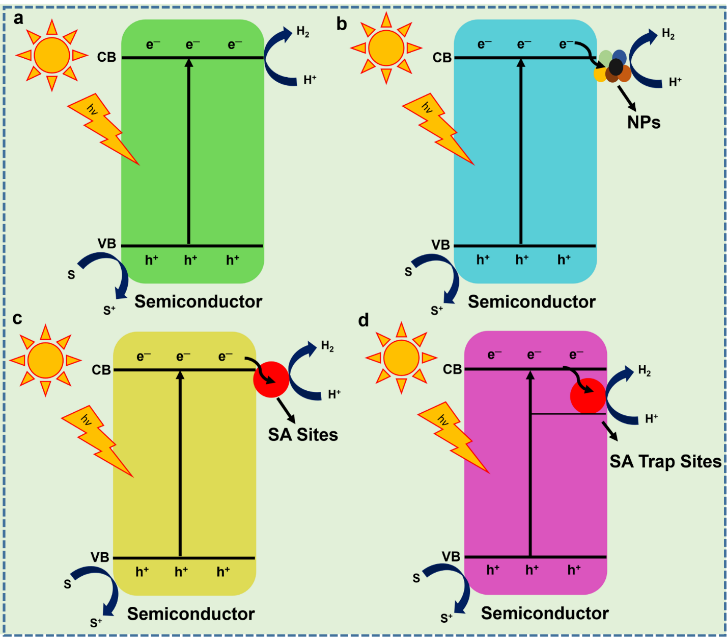
Fig. 2. Typical photocatalytic H2 evolution mechanism on semiconductors (a), semiconductors with nanoparticle cocatalysts (b), semiconductor with SA as cocatalysts (c), and semiconductors with SA as trap sites (d).
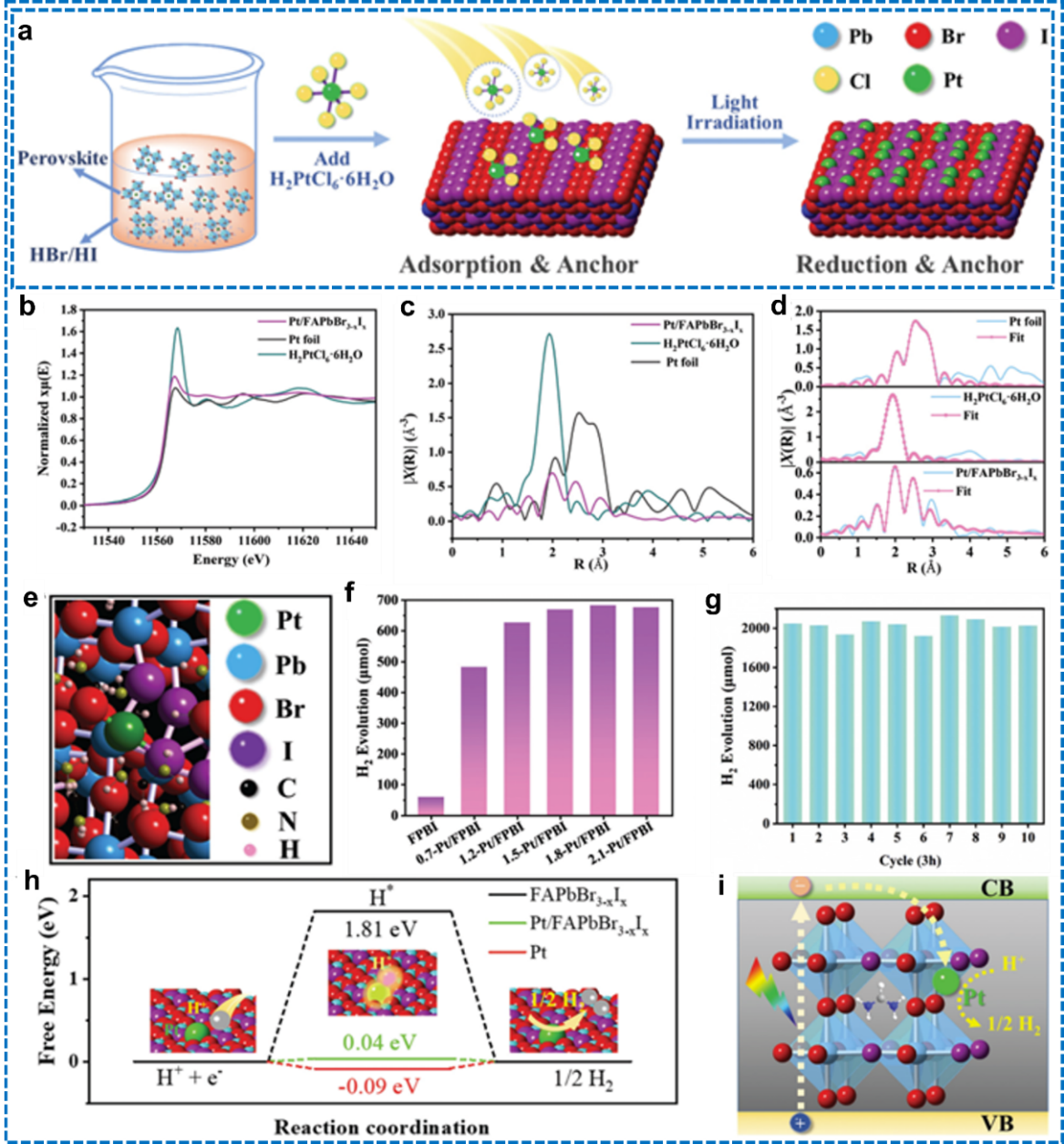
Fig. 3. (a) Preparation mechanism of Pt/FAPbBr3-xIx. (b) XANES spectra at the Pt L3-edge for Pt foil, H2PtCl6, and 1.8-Pt/FAPbBr3-xIx. k3-weighted FT spectra of the EXAFS data (c), R-space data analysis and fitting (d) for 1.8-Pt/FAPbBr3-xIx compared with two reference samples. (e) Simulated model for the configuration of Pt/FAPbBr3-xIx. (f) H2 production rates of different photocatalysts. (g) Stability plots of 1.8-Pt/FAPbBr3-xIx over 10 cycles. (h) Free energy patterns for H* adsorption on Pt, FAPbBr3-xIx, and Pt/FAPbBr3-xIx with the inset illustrating the related mechanism. (i) Schematic diagram of the photocatalytic mechanism in Pt/FAPbBr3-xIx. Adopted with permission from Ref. [49]. Copyright 2022, Royal Society of Chemistry.
| Photocatalyst | Light source | Sacrificial agent | H2 production (mmol h−1 g−1) | AQE (%) | Ref. |
|---|---|---|---|---|---|
| ZOS-SAPt | 300 W Xe lamp (AM 1.5 filter) | Na2S/Na2SO3 | 9.66 | 8.28 at 365 nm | [ |
| 0.72wt% Pt1@TpPa-1 | 300 W Xe lamp (λ ≥ 420 nm) | sodium ascorbate | 0.719 | 0.38 at 420 nm | [ |
| Pt SA-P25 | LED (365 nm) | — | 4.60 | — | [ |
| Pt-SAs@Pd-PCN-222-NH2 | 300 W Xe lamp (λ ≥ 420 nm) | triisopropanolamine | 16.591 | — | [ |
| TiO2-BNS-Pt0.05 | 150 W Xe lamp (AM 1.5G) | methanol | 0.688 | 8.48 at 325 nm | [ |
| Cd-Pt2-SSs | 150 W Xe lamp (UV-Visible) | Na2S/Na2SO3 | 154.68 | ≈91.1 at 365 nm | [ |
| TCOF/Pt SA | 300 W Xe lamp | benzylamine | 0.5018 | — | [ |
| PtSAs-Au2.5/PCN | 300 Xe lamp (λ ≥ 420 nm) | TEOA | 13.70 | — | [ |
| Sb2S3-Pt0.9% | 300 W Xe lamp (simulated) | TEOA | 1.37 | 5.41 at 700 nm | [ |
| VN2c-UCN-Pt | 300 W Xe lamp (λ ≥ 395 nm) | TEOA | 1.774 | 2.43 at 380 nm | [ |
| PFC-1@Pt | 300 W Xe lamp (λ > 420 nm) | ascorbic acid | 2.2025 | — | [ |
| PtSA/TiO2(Pr) | UV | methanol | 196.43 | 42.07 at 365 nm | [ |
| Pt SAs/g-C3N5-x-O | 300 W Xe lamp (λ > 420 nm) | TEOA | 1.8092 | — | [ |
| Pt SA-NS | LED (365 nm) | methanol | 11.7 | — | [ |
| 0.63%Pt1-N-CN1 | 300 W Xe lamp (λ > 320 nm) | TEOA | 30 | 21.3 at 400 nm | [ |
| Au@Pt-SA/CdS Y-S | 300 W Xe lamp (λ > 420 nm) | Na2S/Na2SO3 | 10.9 | — | [ |
| 1.42wt% Pt1/TiO2 | 300 W Xe lamp (200-2500 nm) | methanol | 95.180 | — | [ |
| Pt0.08SAC3N4.6 | 250 W mercury vapor lamp (Vis-light) | TEOA | 64.1 | 25.3 at 420 nm | [ |
| TAPAT-TFP-Pt1-0.31 wt% | 300 W Xe lamp (λ ≥ 420 nm) | ascorbic acid | 2.39 | 0.24 at 500 nm | [ |
| Pt1/CSv | 300 W Xe lamp (λ > 420 nm) | TEOA | 0.8272 | 17.6 at 420 nm | [ |
Table 1 Photocatalytic H2 production over representative Pt SACs.
| Photocatalyst | Light source | Sacrificial agent | H2 production (mmol h−1 g−1) | AQE (%) | Ref. |
|---|---|---|---|---|---|
| ZOS-SAPt | 300 W Xe lamp (AM 1.5 filter) | Na2S/Na2SO3 | 9.66 | 8.28 at 365 nm | [ |
| 0.72wt% Pt1@TpPa-1 | 300 W Xe lamp (λ ≥ 420 nm) | sodium ascorbate | 0.719 | 0.38 at 420 nm | [ |
| Pt SA-P25 | LED (365 nm) | — | 4.60 | — | [ |
| Pt-SAs@Pd-PCN-222-NH2 | 300 W Xe lamp (λ ≥ 420 nm) | triisopropanolamine | 16.591 | — | [ |
| TiO2-BNS-Pt0.05 | 150 W Xe lamp (AM 1.5G) | methanol | 0.688 | 8.48 at 325 nm | [ |
| Cd-Pt2-SSs | 150 W Xe lamp (UV-Visible) | Na2S/Na2SO3 | 154.68 | ≈91.1 at 365 nm | [ |
| TCOF/Pt SA | 300 W Xe lamp | benzylamine | 0.5018 | — | [ |
| PtSAs-Au2.5/PCN | 300 Xe lamp (λ ≥ 420 nm) | TEOA | 13.70 | — | [ |
| Sb2S3-Pt0.9% | 300 W Xe lamp (simulated) | TEOA | 1.37 | 5.41 at 700 nm | [ |
| VN2c-UCN-Pt | 300 W Xe lamp (λ ≥ 395 nm) | TEOA | 1.774 | 2.43 at 380 nm | [ |
| PFC-1@Pt | 300 W Xe lamp (λ > 420 nm) | ascorbic acid | 2.2025 | — | [ |
| PtSA/TiO2(Pr) | UV | methanol | 196.43 | 42.07 at 365 nm | [ |
| Pt SAs/g-C3N5-x-O | 300 W Xe lamp (λ > 420 nm) | TEOA | 1.8092 | — | [ |
| Pt SA-NS | LED (365 nm) | methanol | 11.7 | — | [ |
| 0.63%Pt1-N-CN1 | 300 W Xe lamp (λ > 320 nm) | TEOA | 30 | 21.3 at 400 nm | [ |
| Au@Pt-SA/CdS Y-S | 300 W Xe lamp (λ > 420 nm) | Na2S/Na2SO3 | 10.9 | — | [ |
| 1.42wt% Pt1/TiO2 | 300 W Xe lamp (200-2500 nm) | methanol | 95.180 | — | [ |
| Pt0.08SAC3N4.6 | 250 W mercury vapor lamp (Vis-light) | TEOA | 64.1 | 25.3 at 420 nm | [ |
| TAPAT-TFP-Pt1-0.31 wt% | 300 W Xe lamp (λ ≥ 420 nm) | ascorbic acid | 2.39 | 0.24 at 500 nm | [ |
| Pt1/CSv | 300 W Xe lamp (λ > 420 nm) | TEOA | 0.8272 | 17.6 at 420 nm | [ |
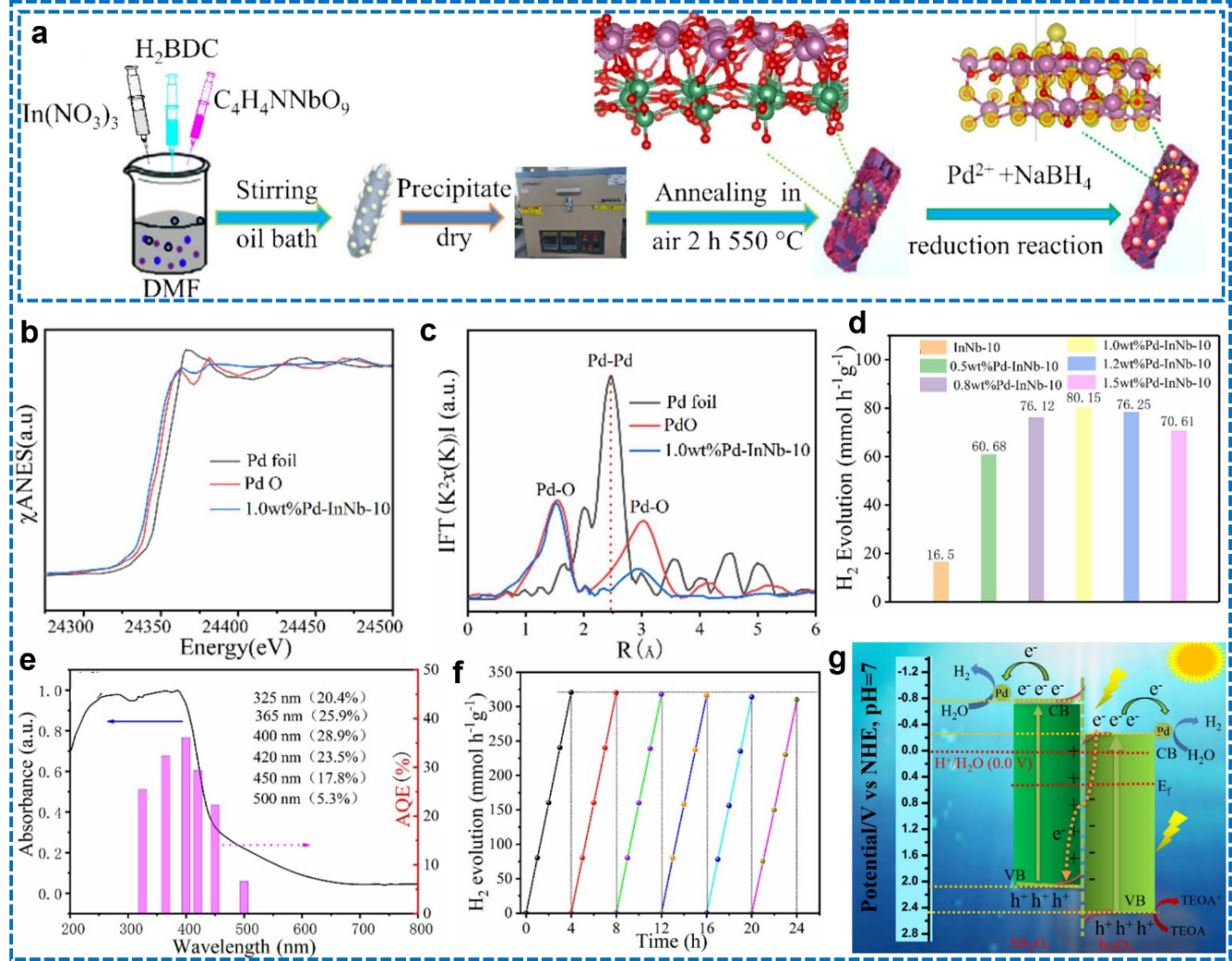
Fig. 4. (a) Diagram of the synthesis process for Pd-InNb-10. Normalized Pd K-edge XANES spectra (b) and k2-weighted Pd K-edge FT-EXAFS spectra (c) in R-space for 1.0 wt%Pd-InNb-10 with reference Pd foil and PdO samples. (d) H2 evolution rate of 1.0 wt%Pd-InNb-10 with varying Pd amounts under simulated solar light illumination. (e) Wavelength-dependent AQE of H2 production. (f) Recycling tests for the optimal sample. (g) Mechanism diagram of the optimal composite upon simulated sunlight driven photocatalytic H2 production. Adopted with permission from Ref. [89]. Copyright 2025, Elsevier.
| Photocatalyst | Light source | Sacrificial agent | H2 production (mmol h−1 g−1) | AQE (%) | Ref. |
|---|---|---|---|---|---|
| 3.5% MAC-1/g-C3N4 | 300 W Xe lamp (λ > 420 nm) | TEOA | 22.3 | 1.61 at 405 nm | [ |
| Pd0.03/ZIS | 300 W Xe lamp (AM 1.5 G) | — | 1.0379 | 4.79 at 380 nm | [ |
| Pd-TiO2 | 300 W Xe lamp | methanol | 24.59 | 23.4 at 365 nm | [ |
| Pd1+NPs/CCN3 | 300 W Xe lamp (λ > 320 nm) | TEOA | 24.1 | 17.1 at 400 nm | [ |
| Pd-MOF | LED (450 nm) | ascorbic acid | 21.3 | — | [ |
| Pd/Cd0.1Zn0.9S | 300 W Xe lamp (λ > 420 nm) | — | 0.6082 | — | [ |
| 0.10PdSA-CuCo2S4 | 250 W mercury vapor lamp | Na2S/Na2SO3 | 39.559 | 15.57 at 420 nm | [ |
| 0.3Pd SA/CdS-H | 300 W Xe lamp (λ > 420 nm) | lactic acid | 22.23 | 16 at 380 nm | [ |
Table 2 Representative Pd SACs for photocatalytic H2 evolution.
| Photocatalyst | Light source | Sacrificial agent | H2 production (mmol h−1 g−1) | AQE (%) | Ref. |
|---|---|---|---|---|---|
| 3.5% MAC-1/g-C3N4 | 300 W Xe lamp (λ > 420 nm) | TEOA | 22.3 | 1.61 at 405 nm | [ |
| Pd0.03/ZIS | 300 W Xe lamp (AM 1.5 G) | — | 1.0379 | 4.79 at 380 nm | [ |
| Pd-TiO2 | 300 W Xe lamp | methanol | 24.59 | 23.4 at 365 nm | [ |
| Pd1+NPs/CCN3 | 300 W Xe lamp (λ > 320 nm) | TEOA | 24.1 | 17.1 at 400 nm | [ |
| Pd-MOF | LED (450 nm) | ascorbic acid | 21.3 | — | [ |
| Pd/Cd0.1Zn0.9S | 300 W Xe lamp (λ > 420 nm) | — | 0.6082 | — | [ |
| 0.10PdSA-CuCo2S4 | 250 W mercury vapor lamp | Na2S/Na2SO3 | 39.559 | 15.57 at 420 nm | [ |
| 0.3Pd SA/CdS-H | 300 W Xe lamp (λ > 420 nm) | lactic acid | 22.23 | 16 at 380 nm | [ |
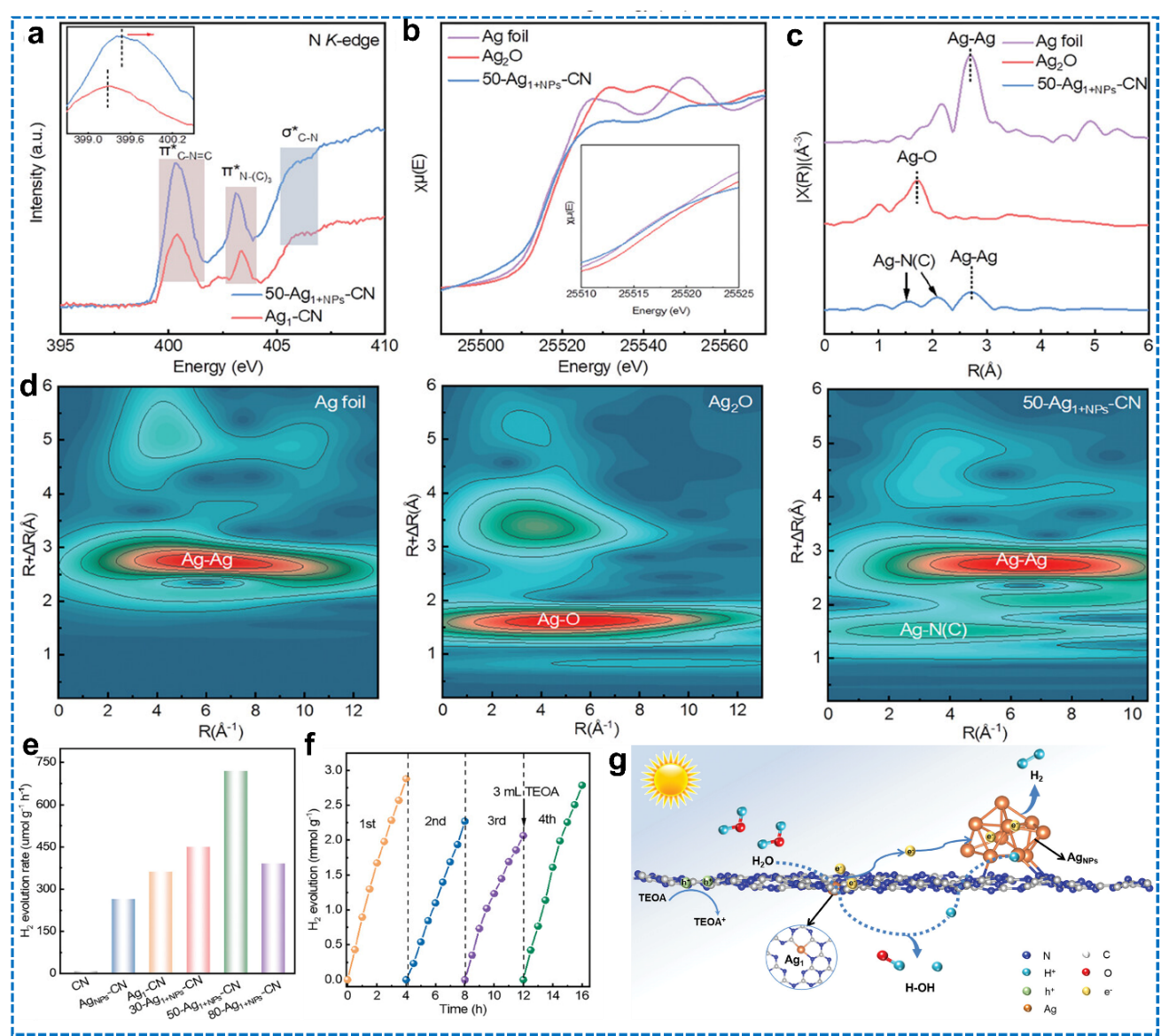
Fig. 5. (a) Normalized N K-edge XANES spectra of Ag1-CN and 50-Ag1+NPs-CN. Ag K-edge XANES spectra (b), FT-EXAFS spectra (c), and WT of the Ag K-edge EXAFS spectra (d) for Ag foil, Ag2O, and the optimal sample. (e) H2 evolution rates of samples. Recycling tests (f) and mechanism (g) of 50-Ag1+NPs-CN upon solar light illumination. Adopted with permission from Ref. [105]. Copyright 2025, John Wiley and Sons.
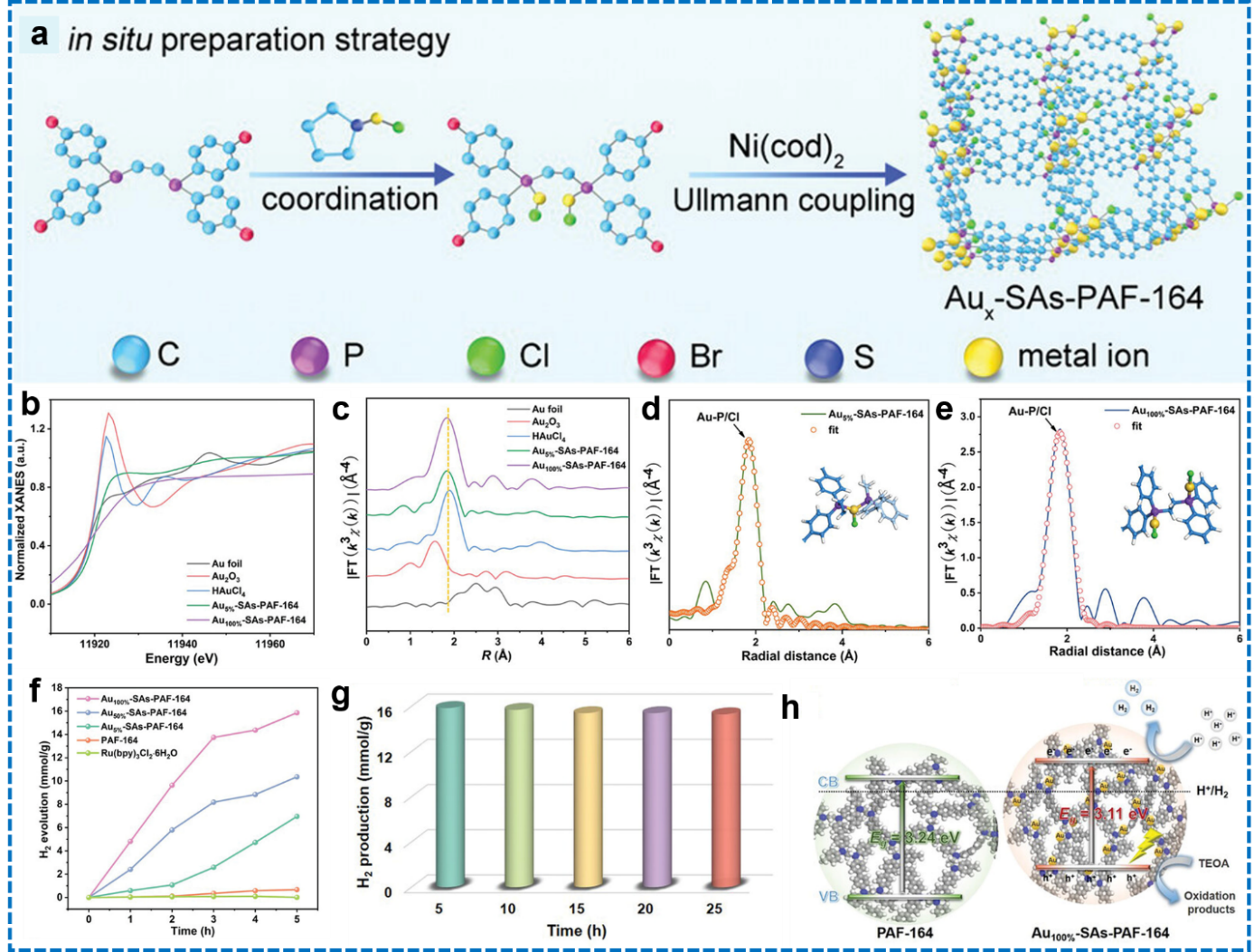
Fig. 6. (a) Schematic of in-situ preparation of Au SAs on PAF-164 by pre-metallated building blocks. Au L3-edge XANES spectra (b) and FT-EXAFS spectra (c) of Au foil, Au2O3, HAuCl4, Au5%-SAs PAF-164, and Au100%-SAs-PAF-164. (d,e) EXAFS fitting plots of Au5%-SAs PAF-164 and Au100%-SAs-PAF-164. (f) H2 production over synthesized photocatalysts. (g) Five-cycle stability test of Au100%-SAs-PAF-164. (h) Charge transfer process in PAF-164 and Aux-SAs-PAF-164 for H2 evolution upon visible-light illumination. Adopted with permission from Ref. [111]. Copyright 2024, John Wiley and Sons.
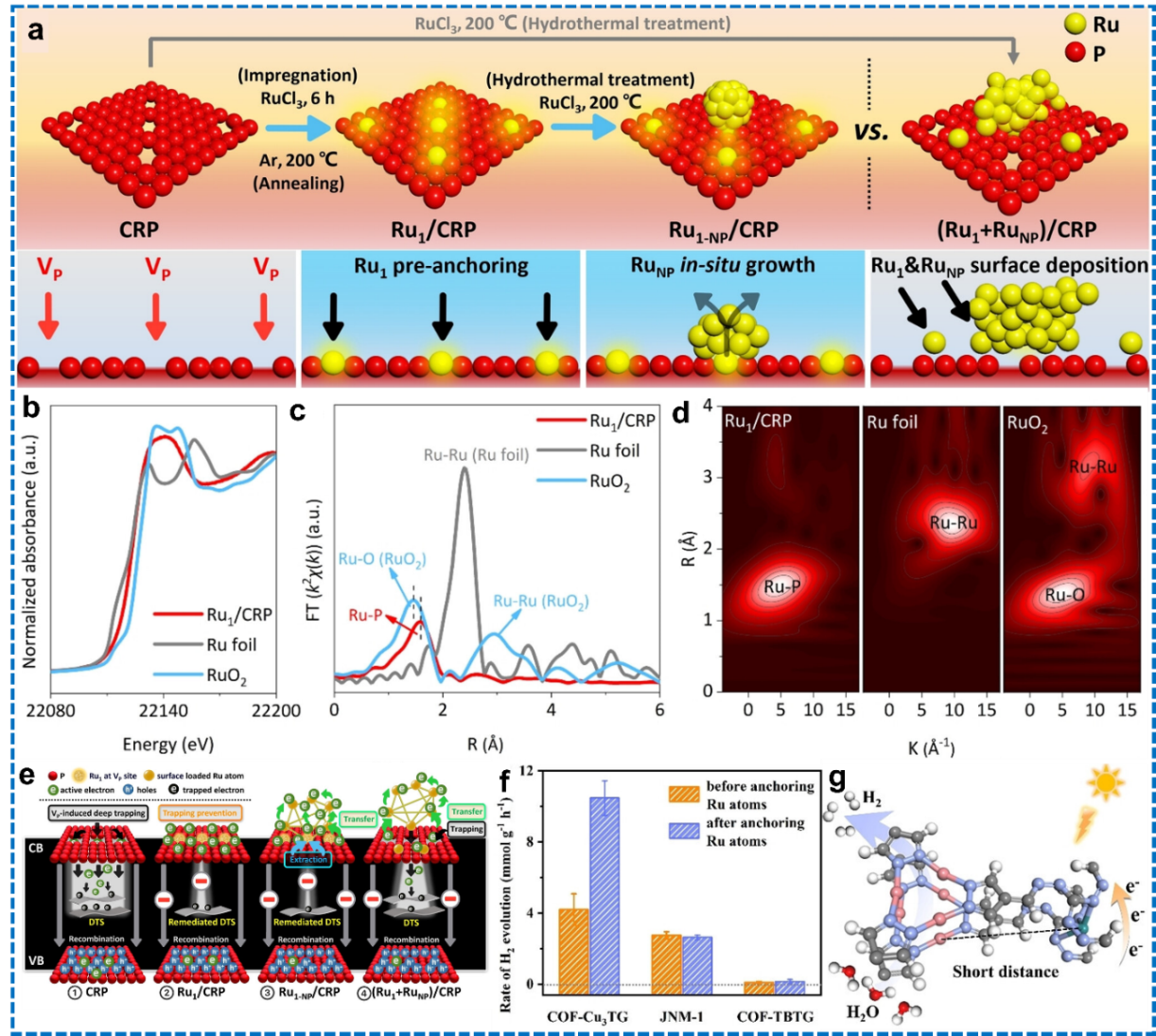
Fig. 7. (a) Scheme for the preparation of photocatalysts. Ru K-edge XANES (b), FT-EXAFS spectra in R-space (c), and WT EXAFS spectra (d) of Ru1/CRP compared with Ru foil and RuO2. (e) Schematic representation of the proposed charge dynamics in CRP, Ru1/CRP, and Ru1-NP/CRP and Ru1+RuNP/CRP. Adopted with permission from Ref. [123]. Copyright 2024, John Wiley and Sons. (f) H2 production rate before and after loading Ru atoms. (g) Schematic illustration of the mechanism of H2 evolution over COF-Cu3TG. Adopted with permission from Ref. [131]. Copyright, 2024, John Wiley and Sons.
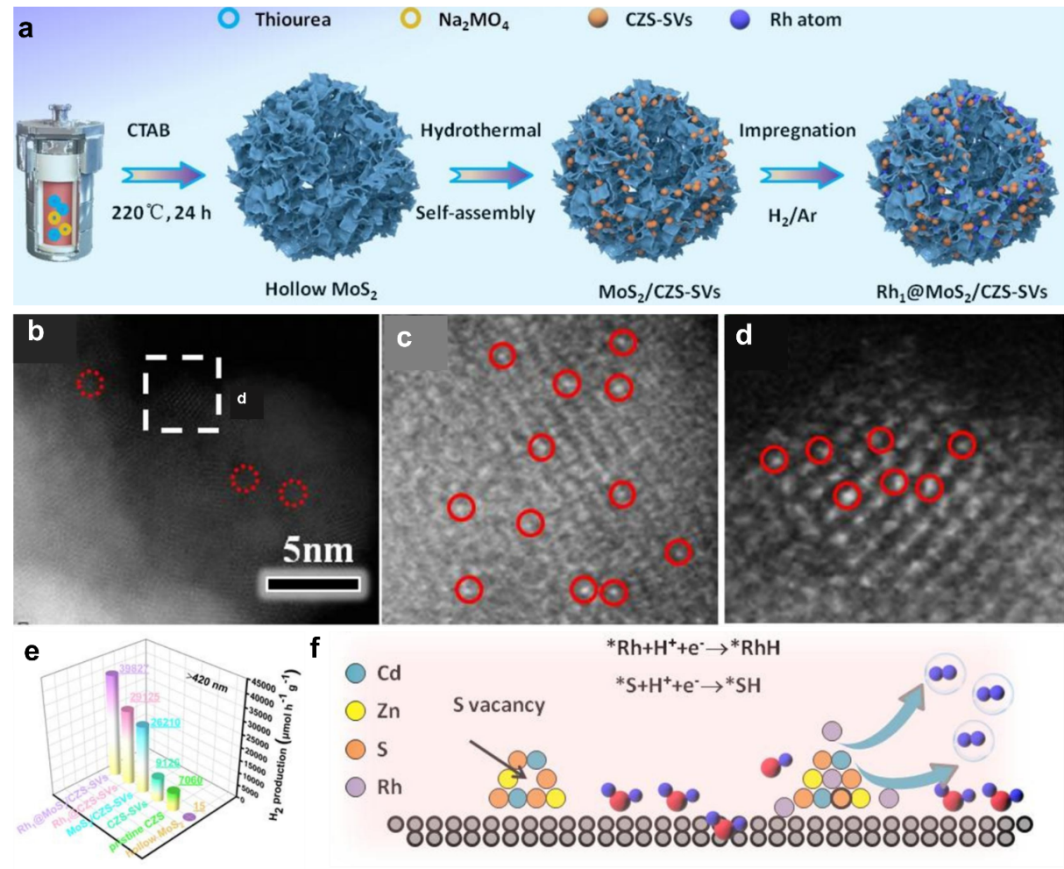
Fig. 8. (a) Synthesis process of Rh1@MoS2/CZS-SVs photocatalyst. (b-d) HAADF-STEM images of Rh1@MoS2/CZS-SVs, where red circles represent atomically dispersed Rh SAs. (e) H2 evolution rates of different samples. (f) Charge transfer mechanism for Rh1@MoS2/CZS-SVs. Adopted with permission from Ref. [132]. Copyright 2025, Elsevier.
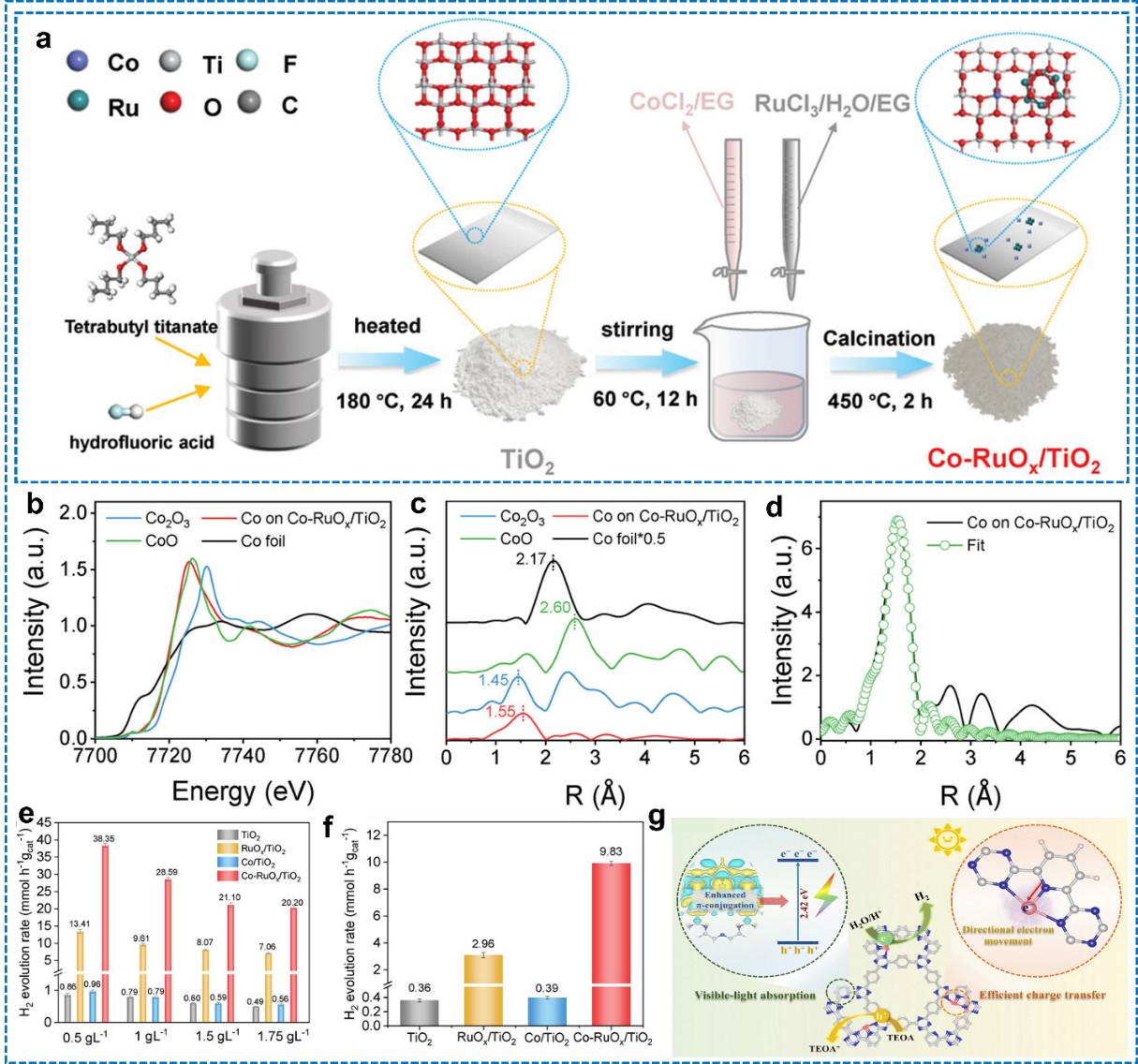
Fig. 9. (a) Illustration of the synthesis of Co-RuOx/TiO2. Co K-edge XANES spectra (b), FT spectra in R-space (c) for Co-RuOx/TiO2 and reference samples. (d) EXAFS fitting plot in R-space for Co-RuOx/TiO2. (e) H2 evolution rates as a function of photocatalyst concentration. (f) H2 production rates in seawater at 1.75 g L−1 for various photocatalysts. Adopted with permission from Ref. [138]. Copyright 2023, John Wiley and Sons. (g) Photocatalytic H2 production mechanism over Co1-PCTF. Adopted with permission from Ref. [149]. Copyright 2024, Royal Society of Chemistry.
| Photocatalyst | Light Source | Sacrificial agent | H2 production (mmol h−1 g−1) | AQE (%) | Ref. |
|---|---|---|---|---|---|
| Co-N-C/g-C3N4 | 12 W LED-lamp (λ = 420 ± 10 nm) | TEOA | 1.180 | — | [ |
| 30%Co@PCMP | 300 W Xe-lamp (λ > 420 nm) | TEOA | 1.72 | 2.05 at 420 nm | [ |
| Co/P/CN-sc | 300 W Xe-lamp (λ > 420 nm) | TEOA | 3.7304 | — | [ |
| Co-CCN-PTI | 300 W Xe-lamp (λ > 420 nm) | TEOA | 3.538 | 20.88 at 425 nm | [ |
| Co0.10-SA/CTF | 300 W Xe-lamp (λ = 420 nm) | TEOA | 1.29318 | 1.72 at 420 nm | [ |
| 1.5%Co/PCN | 300 W Xe-lamp (λ = 400 nm) | TEOA | 0.8925 | — | [ |
| Co(N, S)/C3N4 | 10 W LED-lamp (λ = 420 nm) | ethanol | 9.99 | 15.82 at 420 nm | [ |
| CNA/10Co-dcbpy | 300 W Xe-lamp (λ > 400 nm) | TEOA | 1.016 | 3.43 at 420 nm | [ |
Table 3 outlines latest Co SACs for H2 production.
| Photocatalyst | Light Source | Sacrificial agent | H2 production (mmol h−1 g−1) | AQE (%) | Ref. |
|---|---|---|---|---|---|
| Co-N-C/g-C3N4 | 12 W LED-lamp (λ = 420 ± 10 nm) | TEOA | 1.180 | — | [ |
| 30%Co@PCMP | 300 W Xe-lamp (λ > 420 nm) | TEOA | 1.72 | 2.05 at 420 nm | [ |
| Co/P/CN-sc | 300 W Xe-lamp (λ > 420 nm) | TEOA | 3.7304 | — | [ |
| Co-CCN-PTI | 300 W Xe-lamp (λ > 420 nm) | TEOA | 3.538 | 20.88 at 425 nm | [ |
| Co0.10-SA/CTF | 300 W Xe-lamp (λ = 420 nm) | TEOA | 1.29318 | 1.72 at 420 nm | [ |
| 1.5%Co/PCN | 300 W Xe-lamp (λ = 400 nm) | TEOA | 0.8925 | — | [ |
| Co(N, S)/C3N4 | 10 W LED-lamp (λ = 420 nm) | ethanol | 9.99 | 15.82 at 420 nm | [ |
| CNA/10Co-dcbpy | 300 W Xe-lamp (λ > 400 nm) | TEOA | 1.016 | 3.43 at 420 nm | [ |
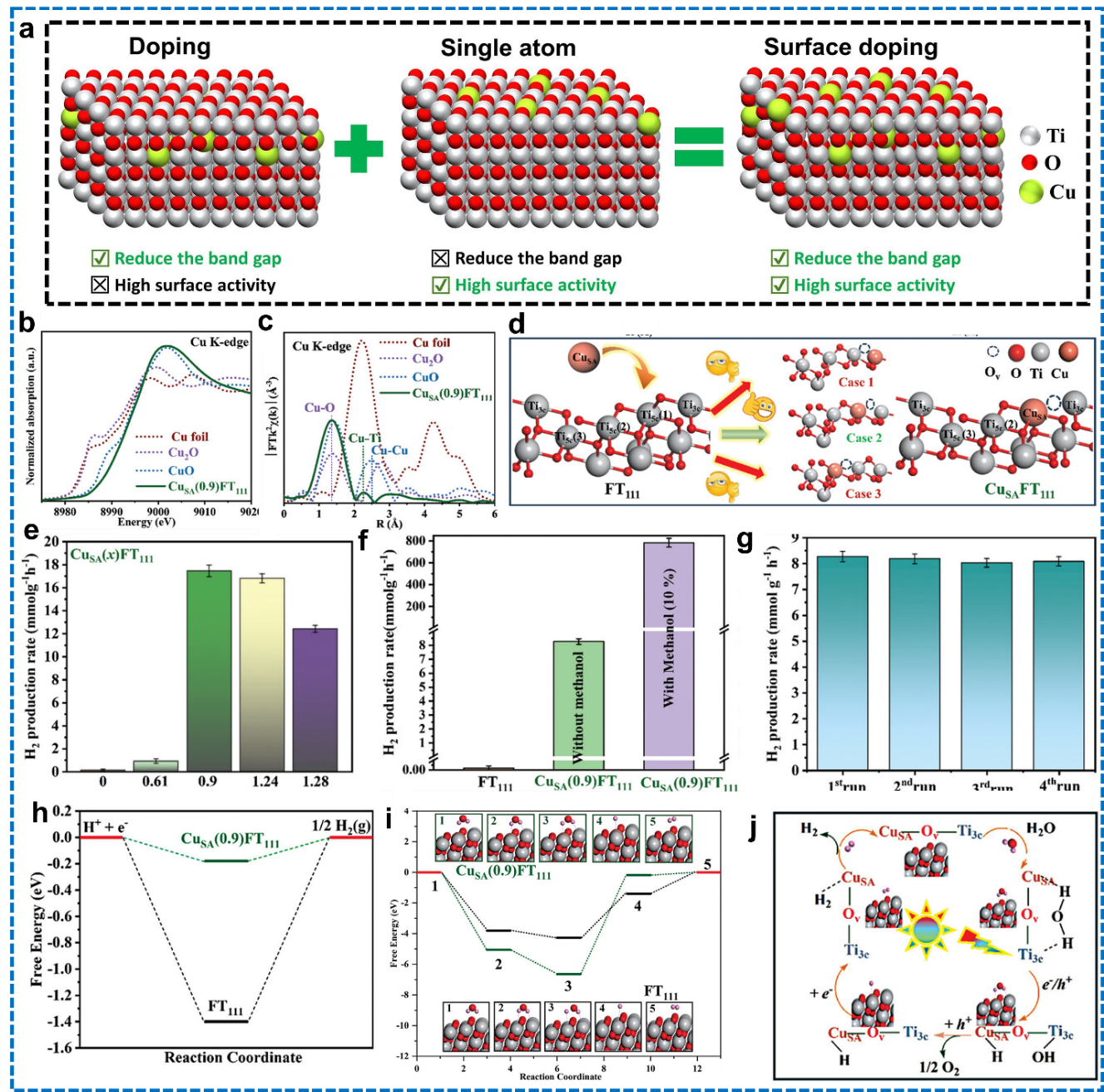
Fig. 10. (a) Schematic representation of Cu SAs on TiO2 via surface doping approach. Adopted with permission from Ref. [166]. Copyright 2023, Elsevier. Normalized Cu K-edge XANES spectra (b) and Cu K-edge K2-weighted FT EXAFS spectra (c) of samples. (d) Illustration of CuSA-OV-Ti3c HAAS construction, displaying CuSA replacement at Ti5c sites next to Ti3c based EXAFS analysis. (e) H2 evolution over HAASC catalysts with various Cu amounts. (f) H2 evolution rates over FT111 and CuSA(0.9)FT111. (g) Photocatalytic H2 production stability test of CuSA(0.9)FT111. (h) Gibbs free energy plot for H2 evolution reaction at CuSA-OV-Ti3c (green) and Ti5c-O-Ti3c (black) sites. (i) Proposed H2O activation path and free energy pattern of intermediates for CuSA-OV-Ti3c HAAS (green) and Ti5c-O-Ti3c AAS (black). (j) Proposed photocatalytic water splitting reaction mechanism over CuSA-OV-Ti3c HAASC (grey, brown, red, and pink color indicate Ti, Cu, O, and H atoms, respectively). Adopted with permission from Ref. [168]. Copyright 2024, John Wiley and Sons.
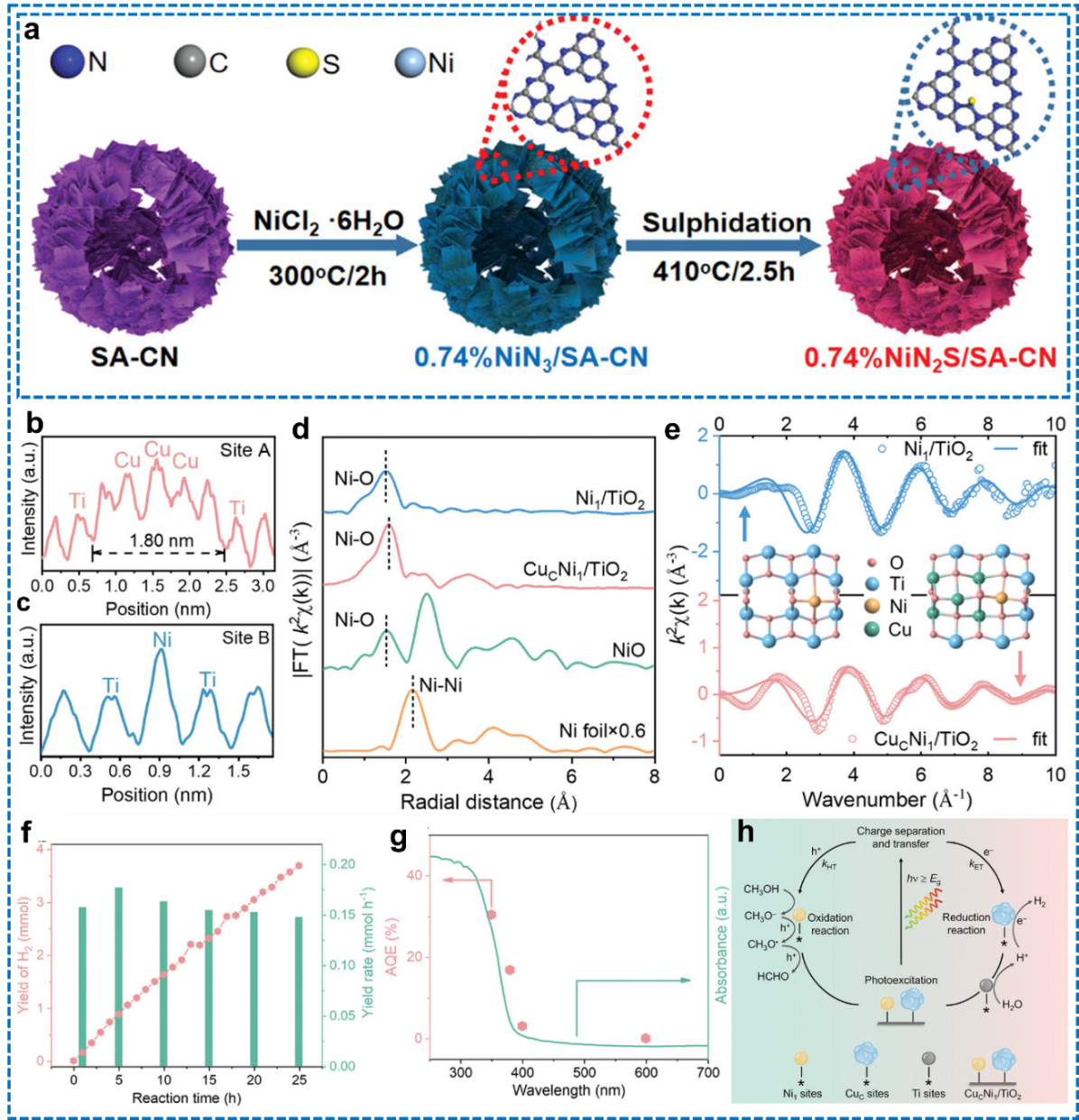
Fig. 11. (a) Schematic illustration for the synthesis of 0.74%NiN2S/SA-CN. Adopted with permission from Ref. [185]. Copyright 2022, John Wiley and Sons. Intensity profiles for site A (b) and site B (c). (d) FT-EXAFS spectra of Ni foil, NiO, CuCNi1/TiO2, and Ni1/TiO2. (e) FT-EXAFS fitting plots of Ni1/TiO2 and CuCNi1/TiO2 in k space. Photocatalytic H2 production stability test (f) and AQE (g) for CuCNi1/TiO2 upon 350 nm. (h) Photocatalytic H2 production mechanism over CuCNi1/TiO2. Adopted with permission from Ref. [187]. Copyright 2024, John Wiley and Sons.
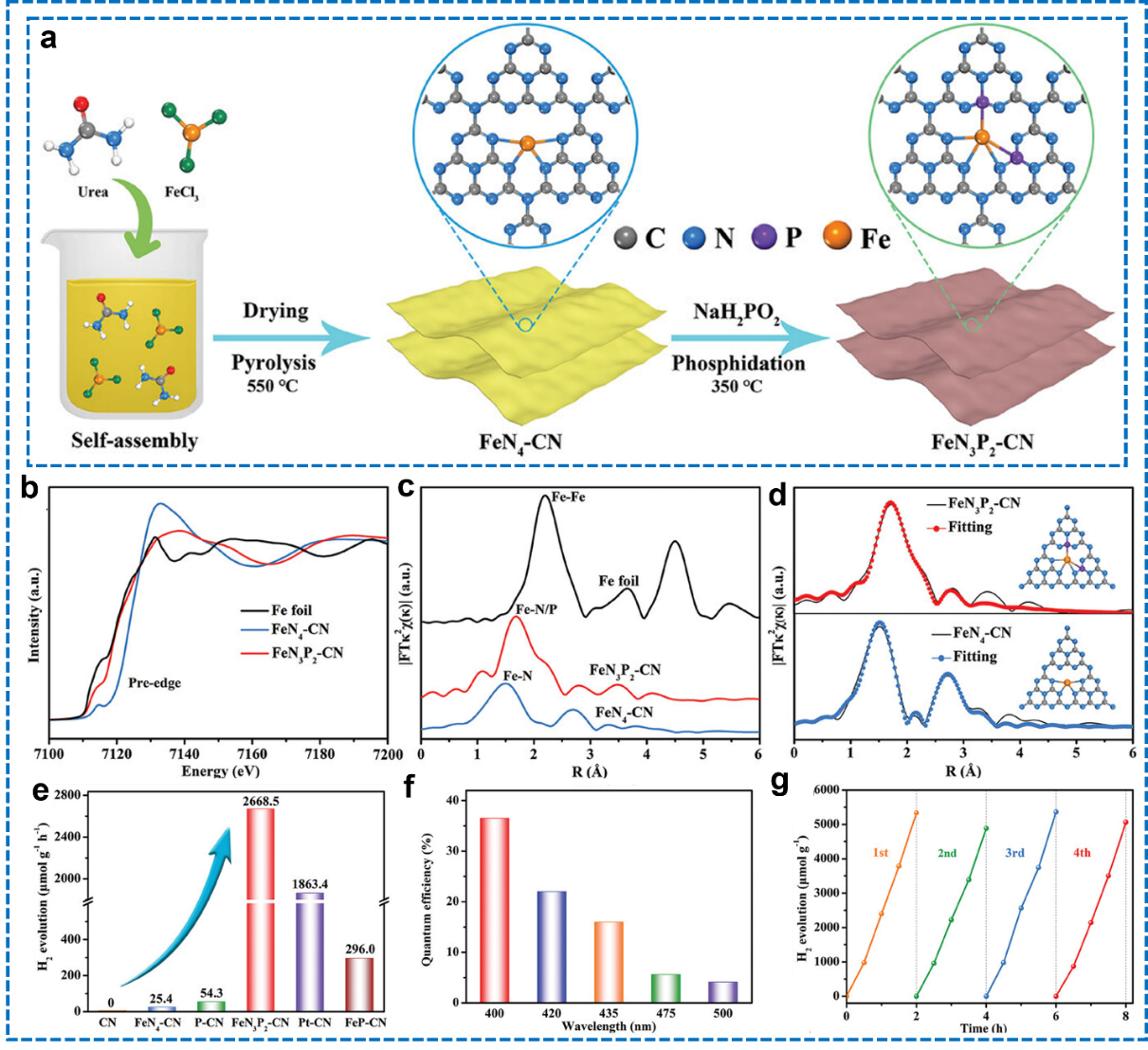
Fig. 12. (a) Schematic representation for synthesis of FeN4-CN and FeN3P2-CN. Fe K-edge XANES spectra (b) and FT K-edge EXAFS spectra (c) of FeN3N2-CN, FeN4-CN, and Fe foil. (d) R space fitting curves of FeN3P2-CN and FeN4-CN. (e) Average H2 evolution rates for various photocatalysts upon visible-light illumination. (f) Quantum efficiency of H2 production for FeN3P2-CN. (g) Cycling durability test of H2 production over FeN3P2-CN. Adopted with permission from Ref. [189]. Copyright 2024, John Wiley and Sons.
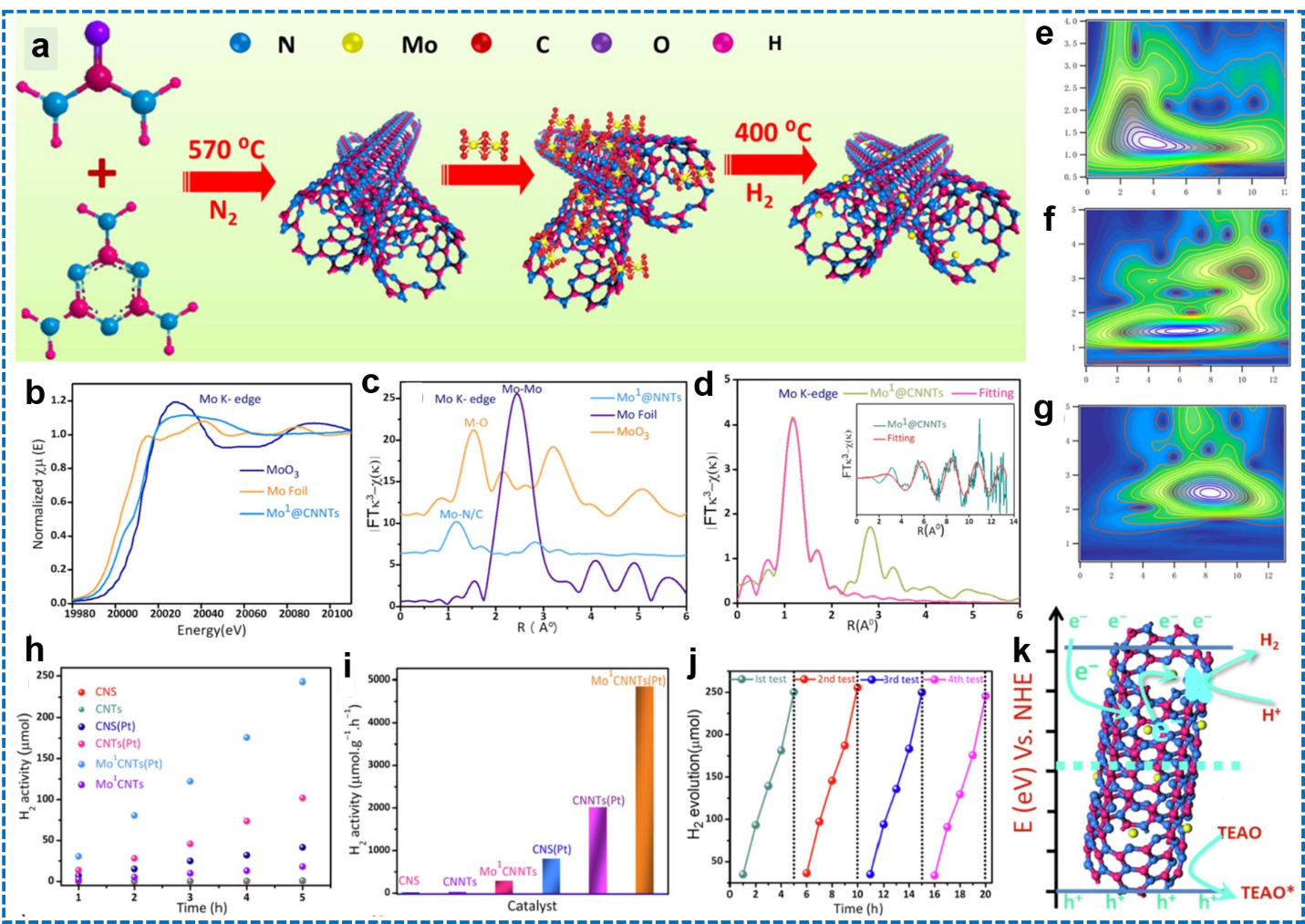
Fig. 13. (a) Schematic illustration of Mo1@CNNTs synthesis. Mo K-edge XANES (b) and K-edge FT-EXAFS (c) spectra of Mo1@CNNTs and reference samples. (d) EXAFS fitting curves in R space with inset in k space. EXAFS WT of Mo1@CNNTs (e), Mo foil (f), and MoO3 (g). (h) Time-dependent H2 production activity over different samples. (i) H2 production rates over various samples. (j) Cycling stability tests of Mo1@CNNT. (k) Possible charge transfer mechanism of H2 production. Adopted with permission from Ref. [201]. Copyright 2025, Elsevier.
|
| [1] | Vladimir I. Kurganskii, Dmitry P. Lubov, Alexander G. Medvedev, Ruihu Wang, Konstantin P. Bryliakov. Bioinspired asymmetric syn-hydroxyazidation of electron-deficient olefins in the presence of nonheme Mn complexes [J]. Chinese Journal of Catalysis, 2026, 88(9): 468-477. |
| [2] | Fengjuan Guo, Chunyao Ma, Yue Huang, Sitong Hang, Junwei Ma, Hongtao Gao. Unveiling the dominant distal-alternating hybrid mechanism in B-modulated Mo2TiC2Tx/MoO2 MXene for highly selective ambient NRR [J]. Chinese Journal of Catalysis, 2026, 87(8): 269-281. |
| [3] | Zhaochun He, Chunli Liu, Yonghua Liu, Tao Wang. Boosting homogeneous ammonia synthesis by balancing N≡N activation and N-H formation [J]. Chinese Journal of Catalysis, 2026, 87(8): 316-326. |
| [4] | Sen Wang, Shiying Li, Rui Geng, Bo Zhou, Pengfei Wang, Zhangfeng Qin, Mei Dong, Jianguo Wang, Unni Olsbye, Weibin Fan. The smallest Ni species triggering selective hydrogenation of CO2 to methane: Ni dimer embedded in MFI and enhancement of MnOx [J]. Chinese Journal of Catalysis, 2026, 87(8): 113-125. |
| [5] | Yang Ding, Yizhen Lu, Tianrong Yu, Mingrui Zhang, Rui Zhao, Ruijie Yang, Qixin Li, Shiqun Wu, Jinlong Zhang. Dual pathways in photo-driven Fischer-Tropsch synthesis for high selective hydrocarbon production [J]. Chinese Journal of Catalysis, 2026, 87(8): 22-46. |
| [6] | Hanxi Li, Zhendong Luo, Qiang Xue, Yunfei Zhi, Jun Du, Xukai Zhou. Engineering channel microenvironment and charge dynamics in covalent organic frameworks through linkage-specific povarov cyclization for enhanced photocatalytic hydrogen evolution [J]. Chinese Journal of Catalysis, 2026, 86(7): 363-374. |
| [7] | Aiyun Meng, Wei Zhong, Miaoli Gu, Xiaoyuan Wu, Weilai Yu, Yaorong Su. Recent advances on CdS-based H2-production photocatalyst [J]. Chinese Journal of Catalysis, 2026, 86(7): 49-76. |
| [8] | Qiurong Wang, Fozia Sultana, Renkun Li, Yan Fang, Selvi Mushina, Mingwu Tan, Tongtong Li, Renhong Li. Chromium-driven lattice oxygen activation in high-entropy oxide for efficient oxygen evolution reaction [J]. Chinese Journal of Catalysis, 2026, 86(7): 277-289. |
| [9] | Shahla Karimi, Mehran Rezaei, Jiguang Deng, Hongxing Dai, Ali Rastegarpanah. Recent advances in noble metal-based catalysts for methane decomposition: Performance, mechanism, and optimization [J]. Chinese Journal of Catalysis, 2026, 86(7): 9-48. |
| [10] | Jiaying Liu, Yu Fang. Unraveling structure-activity relationships in 2-D covalent organic frameworks for photocatalysis: From molecular engineering to high-performance optimization [J]. Chinese Journal of Catalysis, 2026, 85(6): 47-87. |
| [11] | Jingyao Wu, Yujing Lv, Qiang Zhao, Shuo Wang, Ying Wang, Na Wen, Zhengxin Ding, Zizhong Zhang, Jinlin Long. Electron-proton duet in covalent organic frameworks for efficient direct oxygen reduction to hydrogen peroxide [J]. Chinese Journal of Catalysis, 2026, 84(5): 288-300. |
| [12] | Zhiyao Liu, Tangkang Liu, Chuan Qin, Guoliang Liu, Anmin Zheng. Zirconia-mediated interfacial catalysis for CO2 hydrogenation [J]. Chinese Journal of Catalysis, 2026, 84(5): 1-24. |
| [13] | Yu Gu, Shujia Zhang, Minglu Xu, Hao Yan, Minghao Zhou, Lei Wang, Hui Shi. Dehydroaromatization of methane and methane co-aromatization process with propane: Reaction mechanism, catalyst design, carbon deposition and process optimization [J]. Chinese Journal of Catalysis, 2026, 84(5): 25-60. |
| [14] | Haifeng Fan, Di Xu, Ting Zeng, Guoqiang Hou, Yangyang Li, Siyi Huang, Yanfei Xu, Zheng Wang, Xinhua Gao, Xiang-Kui Gu, Mingyue Ding. Highly efficient electron-enriched Y2O3‒x-Ni interfaces boosting low-temperature CO2 methanation [J]. Chinese Journal of Catalysis, 2026, 84(5): 200-213. |
| [15] | Hyunseok Yoon, Hee Jo Song, Yumin Park, Andi Haryanto, Dohun Kim, Kyuri Cho, Chanyeon Kim, Wooyul Kim, Chan Woo Lee, Dong-Wan Kim. Dynamic tuning of acidic oxygen evolution reaction pathways in Ru catalysts via Cu-induced surface restructuring [J]. Chinese Journal of Catalysis, 2026, 83(4): 363-375. |
| Viewed | ||||||
|
Full text |
|
|||||
|
Abstract |
|
|||||


