
Chinese Journal of Catalysis ›› 2026, Vol. 91: 290-303.DOI: 10.1016/S1872-2067(26)65237-0
• Articles • Previous Articles Next Articles
Shijie Lia,b,c,*( ), Yanbo Wanga, Kexin Donga, Fang Yangd, Yang Guoe, Xiaobing Wangf, Yanping Houg,*(), Bin Zhanga,*()
Received:2026-07-15
Accepted:2026-08-18
Online:2026-12-18
Published:2026-10-13
Supported by:Shijie Li, Yanbo Wang, Kexin Dong, Fang Yang, Yang Guo, Xiaobing Wang, Yanping Hou, Bin Zhang. Engineering chemically bonded S-scheme heterojunction between 5,10,15,20-tetrakis(4-sulfophenyl)porphyrin and Bi4O5Br2 for efficient photocatalytic water purification[J]. Chinese Journal of Catalysis, 2026, 91: 290-303.
Add to citation manager EndNote|Ris|BibTeX
URL: https://www.cjcatal.com/EN/10.1016/S1872-2067(26)65237-0
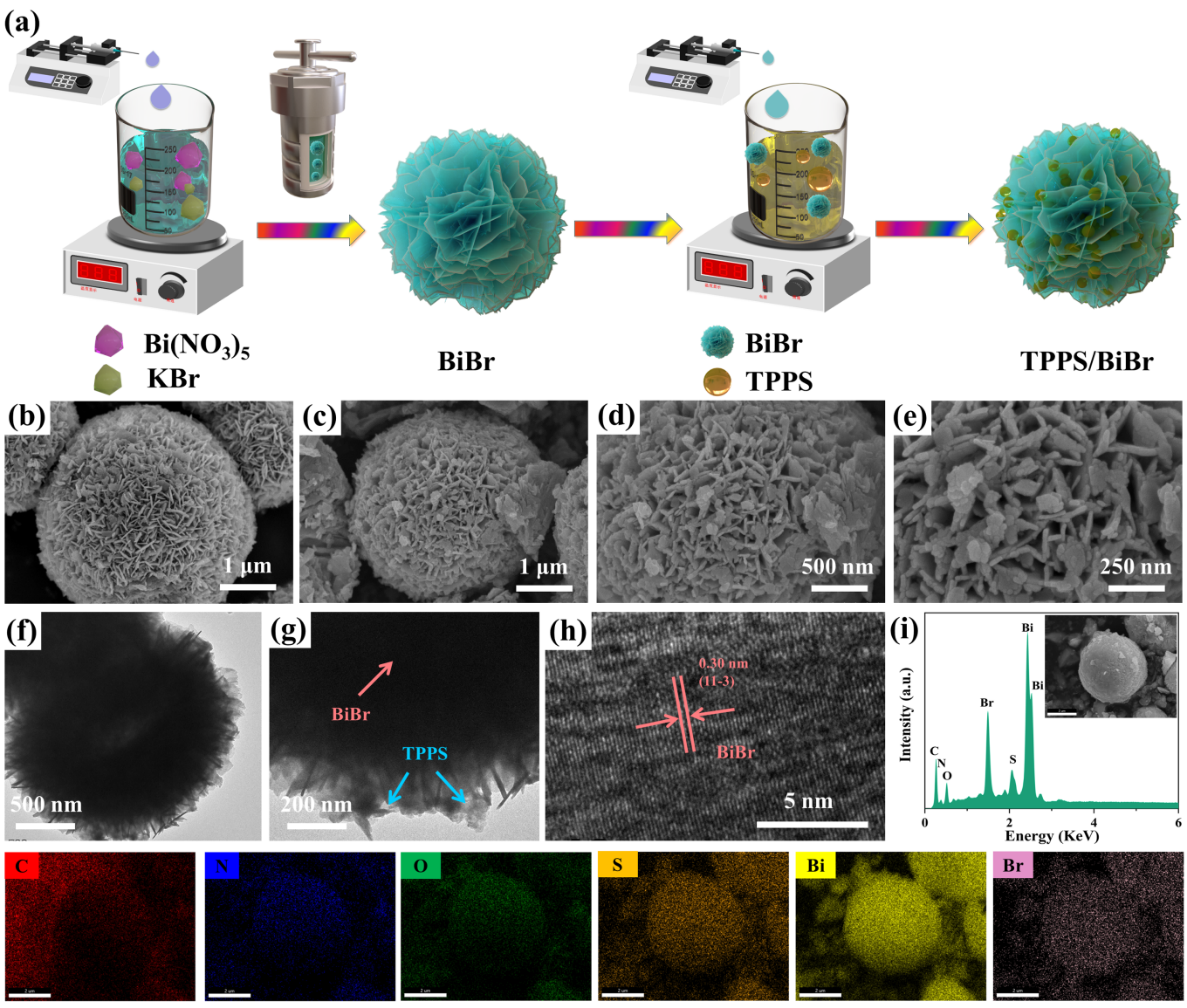
Fig. 1. (a) Schematic representation of the preparation protocol for TPPS/BiBr. SEM images of BiBr (b) and TPPS/BiBr-2 (c‒e). TEM images (f,g) and HRTEM image (h) of TPPS/BiBr-2. (i) EDS spectrum and mapping of TPPS/BiBr-2 for C, N, O, S, Bi, Br.
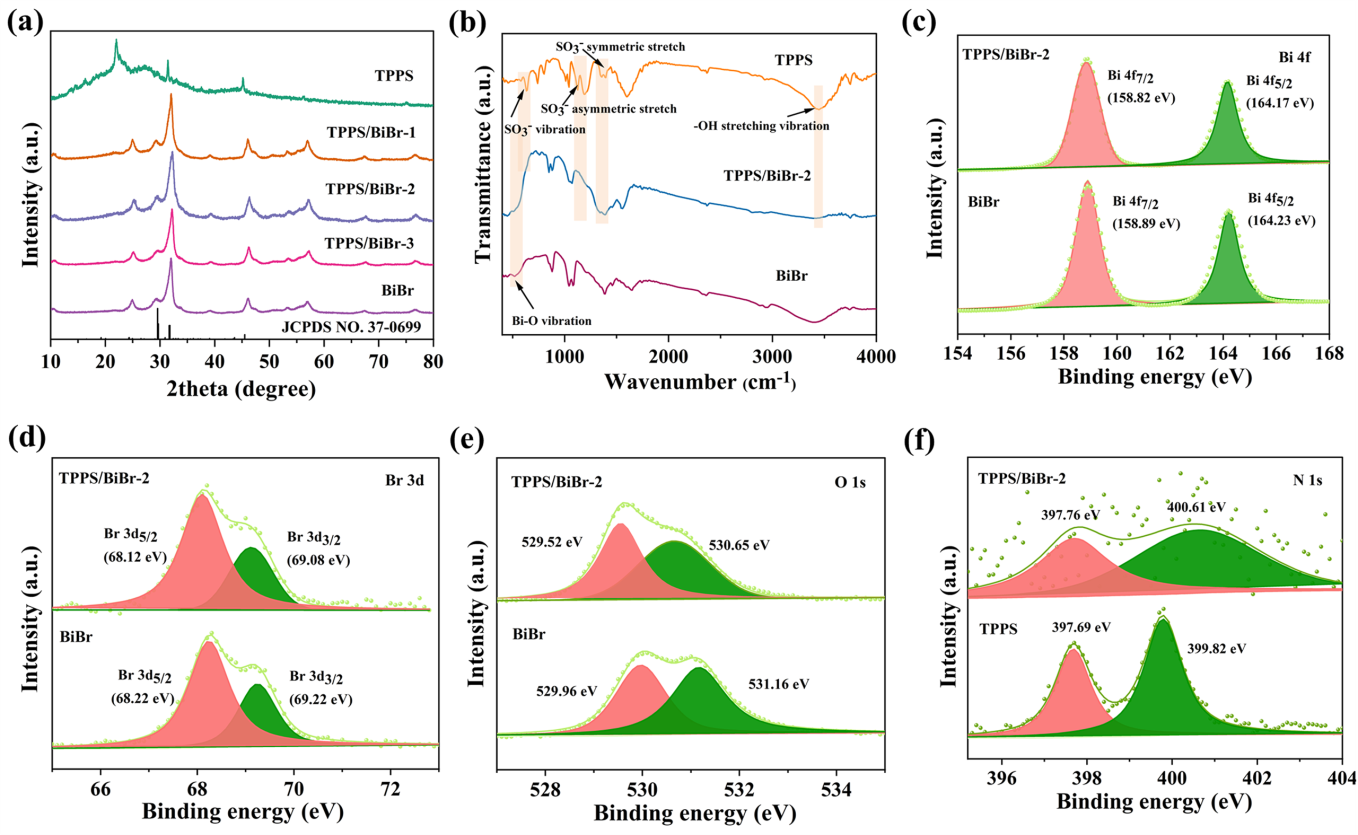
Fig. 2. (a) XRD patterns. (b) FTIR spectrum. XPS spectra of Bi 4f (c), Br 3d (d), O 1s (e) and N 1s (f) on BiBr, TPPS and TPPS/BiBr-2.
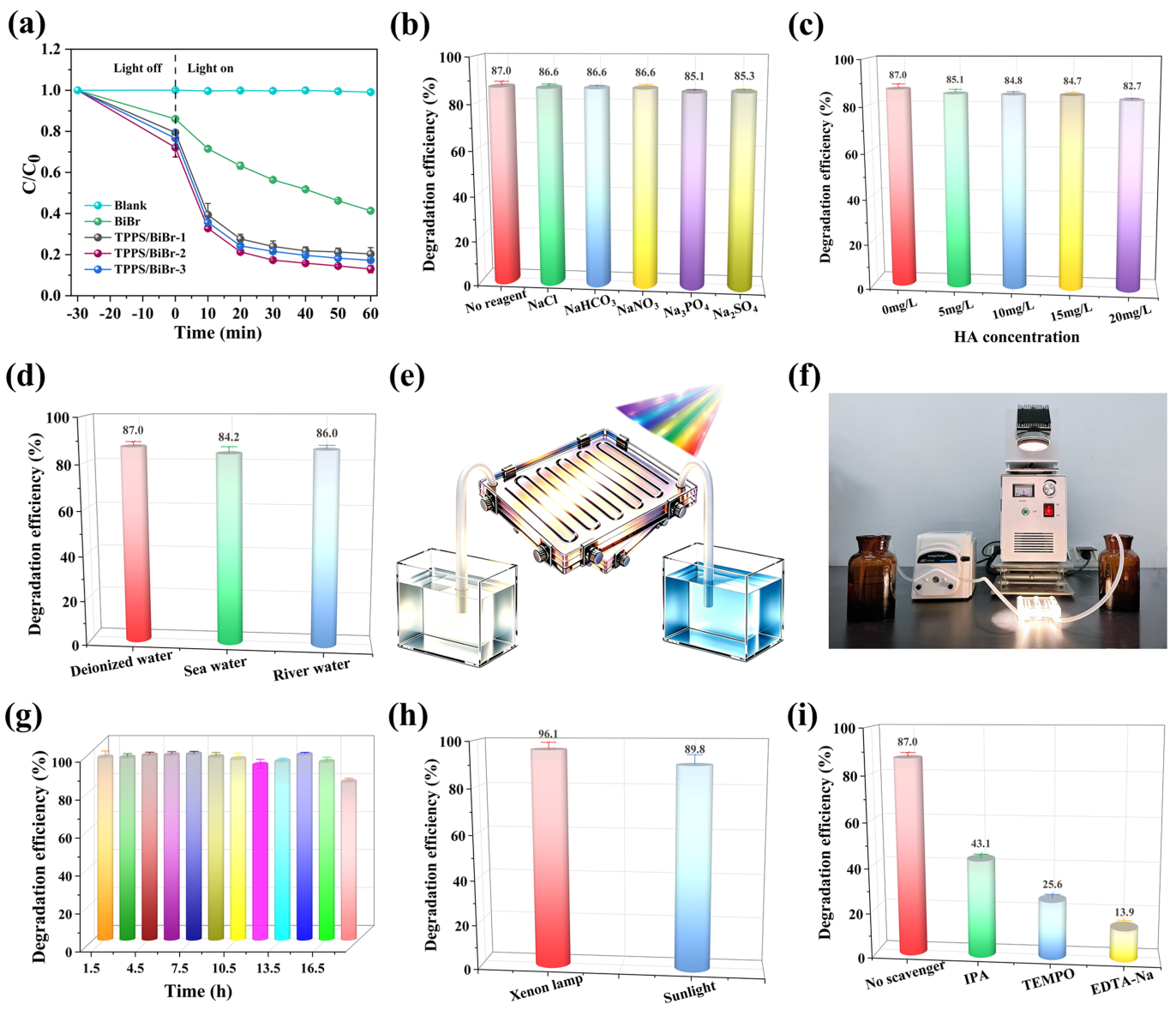
Fig. 3. (a) Comparison of the photocatalytic behaviors of BiBr and TPPS/BiBr heterojunctions in deionized water under visible light. (b,c) Performance of TPPS/BiBr-2 for TC removal in aqueous media containing inorganic ions and HA. (d) TC destruction performance of TPPS/BiBr-2 in real water matrices. (e) Schematic illustration of the fixed-bed reactor system based on TPPS/BiBr-2. (f) The fixed-bed reactor system employing TPPS/BiBr-2 as the immobilized photocatalyst for TC removal under visible light. (g) Sustained photocatalytic TC removal efficiency of immobilized TPPS/BiBr-2 during 18 h of continuous-flow operation. (h) TC removal efficiency of immobilized TPPS/BiBr-2 under the illumination of natural sunlight and Xenon lamp. (i) Radical trapping performance of TPPS/BiBr-2 for TC degradation with different quenchers.

Fig. 4. (a) Transformation routes of TC over TPPS/BiBr-2. (b‒d) Biotoxicity assessment.
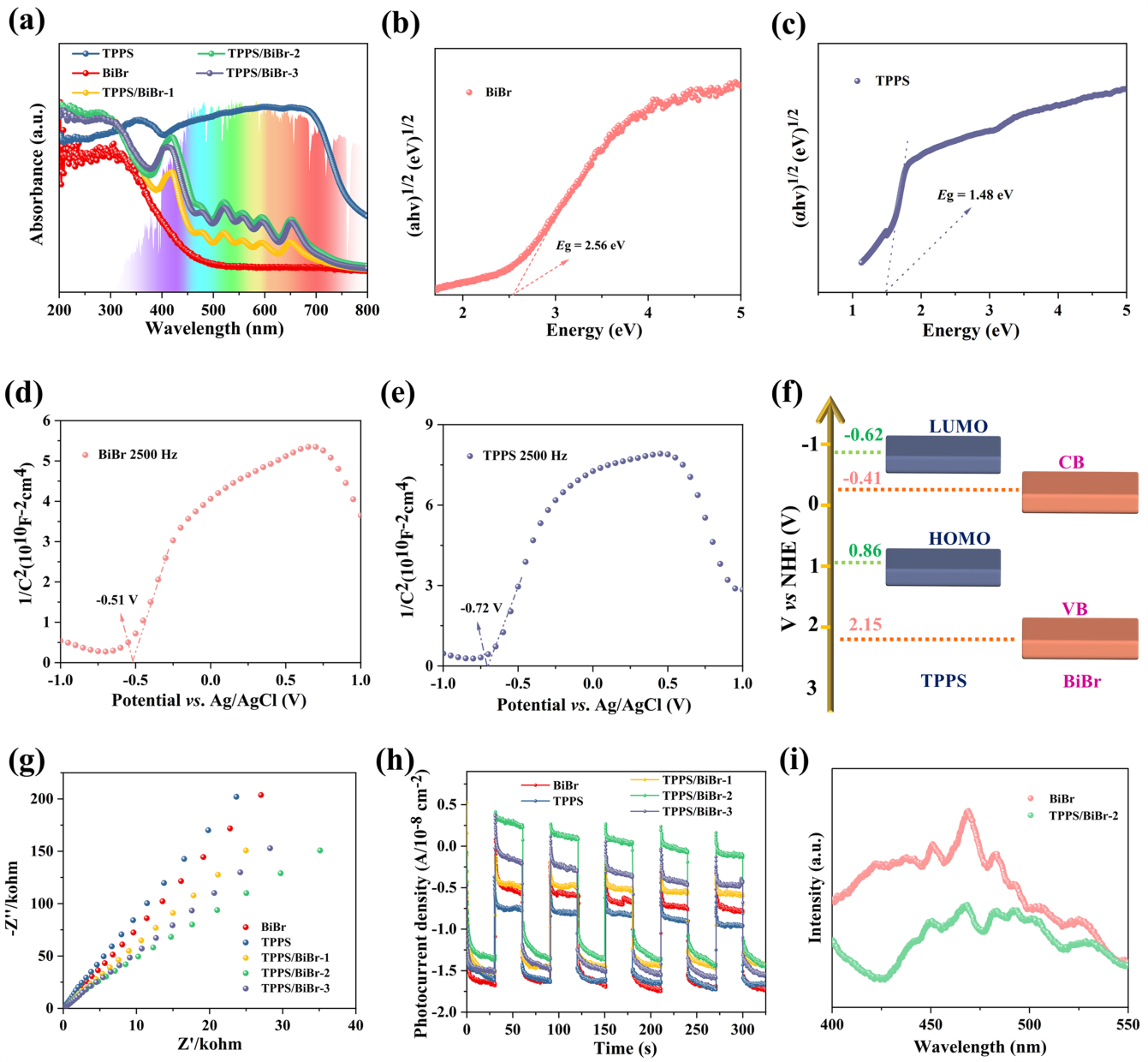
Fig. 5. (a) UV-vis spectra of BiBr, TPPS, and TPPS/BiBr heterojunctions. Optical band gap (Eg) determination via Tauc plots of TPPS (b) and BiBr (c). Mott-Schottky measurements for TPPS (d) and BiBr (e). (f) Energy band diagram of the TPPS/BiBr heterojunction. Impedance (g) and photocurrent (h) behavior of BiBr, TPPS, and TPPS/BiBr heterojunctions. (i) Steady-state PL profiles of BiBr and TPPS/BiBr-2.
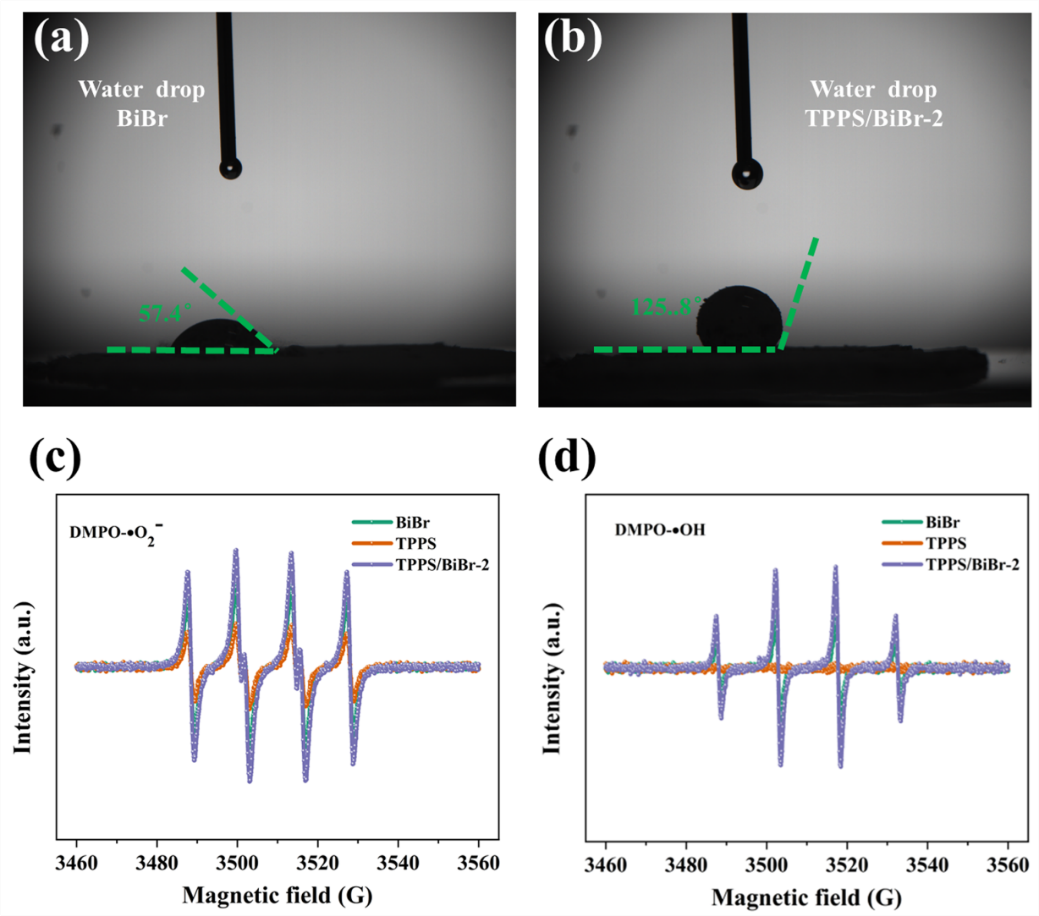
Fig. 6. (a,b) Water contact-angle measurements. (c,d) EPR signals of DMPO-•O2- and DMPO-•OH recorded in the BiBr, TPPS and TPPS/BiBr-2 suspension under light illumination.
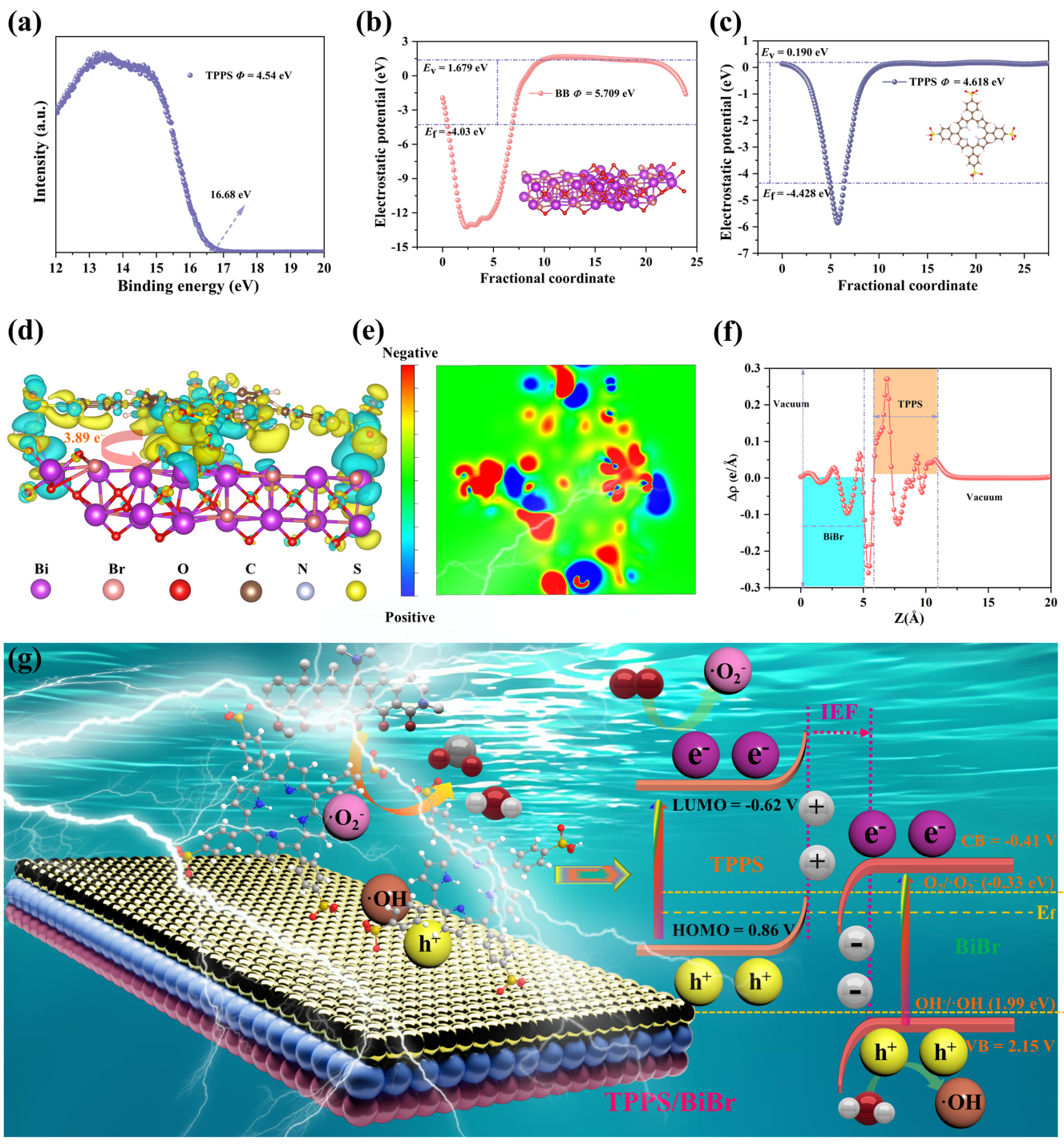
Fig. 7. (a) EPR signals of DMPO-•O2- recorded in the TPPS/BiBr-2 suspension under light illumination. (b,c) Work functions (Φ) of BiBr and TPPS derived from DFT simulations. Three-dimensional (d), two-dimensional (e), and one-dimensional (f) analyses of the interfacial charge redistribution at the TPPS/BiBr junction. (g) Schematic illustration of the photocatalytic water cleanup mechanism over the TPPS/BiBr.
|
| [1] | Wenmin Lei, Yan Zhang, Dalin Sun, Lin Ban, Heng Zhou, Song Yang, Liquan Jing, Jinguang Hu, Heng Zhang. Transition-metals photocatalysts for lignin valorization toward sustainable biofuel production [J]. Chinese Journal of Catalysis, 2026, 88(9): 35-85. |
| [2] | Shufang Liu, Fengyu Chen, Siyuan Li, Yu-Xin Ye, Gangfeng Ouyang. Recent advances in oxygen-centered organic radicals: Characterization, synthesis, and applications [J]. Chinese Journal of Catalysis, 2026, 88(9): 183-206. |
| [3] | Xiangfeng Chen, Siyu Huang, Yuhang Yang, Jiahao Ni, Cheng Fang, Yang-Fan Xu, Dai-Bin Kuang. Hybrid photocatalysis with halide perovskite materials [J]. Chinese Journal of Catalysis, 2026, 88(9): 9-34. |
| [4] | Yueling Chen, Yuling Lin, Ziyan Chen, Xiangyu Kong, Jinhong Bi, Guocheng Huang, Ling Wu. Asymmetric N-Ru-S dipole within covalent organic framework enhances internal electric field for efficient CO2 photoreduction [J]. Chinese Journal of Catalysis, 2026, 87(8): 59-69. |
| [5] | Shijie Li, Rui Li, Yanping Liu, Xin Yu, Deyun Ma, Jianhui Jiang, Xiaosong Zhou, Chunqiang Zhuang, Zaiwang Zhao, Wei Jiang. Augmented reactive oxygen species generation in Ag/AgBr/C3N5 via LSPR-enhanced S-scheme charge transfer for efficient photocatalytic antibiotic wastewater remediation [J]. Chinese Journal of Catalysis, 2026, 87(8): 126-139. |
| [6] | Hua Gao, Yong Zhu, Zhibing Wen, Ran Zhao, Zhi Chen, Siyao Wang, Shuanglin He, Kuang Peng, Yiwen Tang, Licheng Sun, Fei Li. Efficient and selective photocatalytic CO2 conversion enabled by FePc nanosheets in a dye-sensitized system [J]. Chinese Journal of Catalysis, 2026, 86(7): 350-362. |
| [7] | Wei Zhong, Yiyao Gan, Jingtao Wang, Peiyi Yang, Aiyun Meng, Yaorong Su. Achieving near-equilibrium Had adsorption/desorption by introducing asymmetric S-Re-Se modules in a-ReSxSe2-x cocatalysts for enhanced photocatalytic H2 evolution [J]. Chinese Journal of Catalysis, 2026, 85(6): 322-332. |
| [8] | Jia Ruan, Wenjing Chen, Ziqian Li, Peng Hu, Cheng-Yong Su. Intermolecular asymmetric dearomative photocycloaddition of (benzo)furans with excited alkenes via cage-confined catalysis [J]. Chinese Journal of Catalysis, 2026, 85(6): 346-355. |
| [9] | Jing-Yu Li, Yi-Jun Xu. Regioselective ring-opening of epoxides triggered by light [J]. Chinese Journal of Catalysis, 2026, 85(6): 34-46. |
| [10] | Jintao Dong, Rui Zhang, Zhishuai Wang, Shengqun Cao, Lina Li, Gaopeng Liu, Bin Wang, Yixuan Gao, Jiexiang Xia. Construction of S-scheme MnO2/BiOCl heterojunction boosting photocatalytic low-concentration peroxymonosulfate activation for contaminants removal [J]. Chinese Journal of Catalysis, 2026, 85(6): 310-321. |
| [11] | Yi-Wen Han, Run-Yu Liu, Yu-Xin Zhang, Lei Ye, Phuc T. T. Nguyen, Tian-Jun Gong, Xue-Bin Lu, Yao Fu, Ning Yan. Establishing built-in electric field within single-atom-anchored hollow architectures for efficient solar-thermal regulation in plastic photoreforming [J]. Chinese Journal of Catalysis, 2026, 84(5): 301-313. |
| [12] | Ran Sun, Yuqi Zhang, Kunge Hou, Yujie Tan, Xingang Liu, Jianyuan Hou, Weixuan Zhao, Andrew E. H. Wheatley, Renxi Zhang. Designing hydrogen-bonds in covalent organic frameworks: accelerating proton-coupled electron transfer for enhanced photocatalytic H2O2 synthesis [J]. Chinese Journal of Catalysis, 2026, 84(5): 274-287. |
| [13] | Jingyao Wu, Yujing Lv, Qiang Zhao, Shuo Wang, Ying Wang, Na Wen, Zhengxin Ding, Zizhong Zhang, Jinlin Long. Electron-proton duet in covalent organic frameworks for efficient direct oxygen reduction to hydrogen peroxide [J]. Chinese Journal of Catalysis, 2026, 84(5): 288-300. |
| [14] | Peng Liu, Lian Duan, Baopeng Yang, Mingwei Sun, Gen Chen, Xiaohe Liu, Min Liu, Ning Zhang. Tuning surface electronic structure of (CuGa)xZn1‒2xGa2S4 photocatalyst for efficient nitrate-to-ammonia conversion [J]. Chinese Journal of Catalysis, 2026, 83(4): 172-182. |
| [15] | Yixin Li, Jianhao Qiu, Guanglu Xia, Qiying Liu, Biyao Fang, Meng Liu, Chen Chen, Jianfeng Yao. Hollow tubular In2O3 modified carbon nitride for photocatalytic high-yield cleavage of lignin C-C bonds under 395 nm light [J]. Chinese Journal of Catalysis, 2026, 83(4): 209-218. |
| Viewed | ||||||
|
Full text |
|
|||||
|
Abstract |
|
|||||


