
Chinese Journal of Catalysis ›› 2027, Vol. 92: 237-247.DOI: 10.1016/S1872-2067(26)65262-X
• Articles • Previous Articles Next Articles
Xiaolei Liua,1, Yinlan Lianga,1, Jinyu Lia, Huiliang Lib,*( ), Zhaoke Zhengc, Zeyan Wangc, Jianmin Luod, Juan Lia, Baojiang Jiange,*(), Baojun Lia,*(), Zaizhu Loua,*()
Received:2026-03-24
Accepted:2026-05-08
Online:2027-01-02
Published:2026-10-30
Contact:
*E-mail: lxlhl@hebau.edu.cn (H. Li),About author:First author contact:1 Contributed equally to this work.
Supported by:Xiaolei Liu, Yinlan Liang, Jinyu Li, Huiliang Li, Zhaoke Zheng, Zeyan Wang, Jianmin Luo, Juan Li, Baojiang Jiang, Baojun Li, Zaizhu Lou. Plasmonic hotspots-mediated C-C coupling drives selective CO2-to-C2H6 photoreduction[J]. Chinese Journal of Catalysis, 2027, 92: 237-247.
Add to citation manager EndNote|Ris|BibTeX
URL: https://www.cjcatal.com/EN/10.1016/S1872-2067(26)65262-X

Fig. 1. (a) Schematic diagram of the fabrication for the Au/Ni-W18O49 heterostructures with different Au NP sizes. TEM images of Ni0.32-W18O49 (b) and Au1.2/Ni0.32-W18O49 (c). (d-g) EDS elemental mappings of Au1.2/Ni0.32-W18O49. (h) HRTEM images of Au1.2/Ni0.32-W18O49. (i) UV-Vis-NIR DRS of W18O49, Ni0.32-W18O49, and Au1.2/Ni0.32-W18O49. Normalized Ni K-edge XANES spectra (j) and FT-EXAFS spectra (k) of Ni0.32-W18O49, Ni foil, and NiO reference. WT-Ni K-edge EXAFS of Ni foil (l), NiO reference (m), and Ni0.32-W18O49 (n).
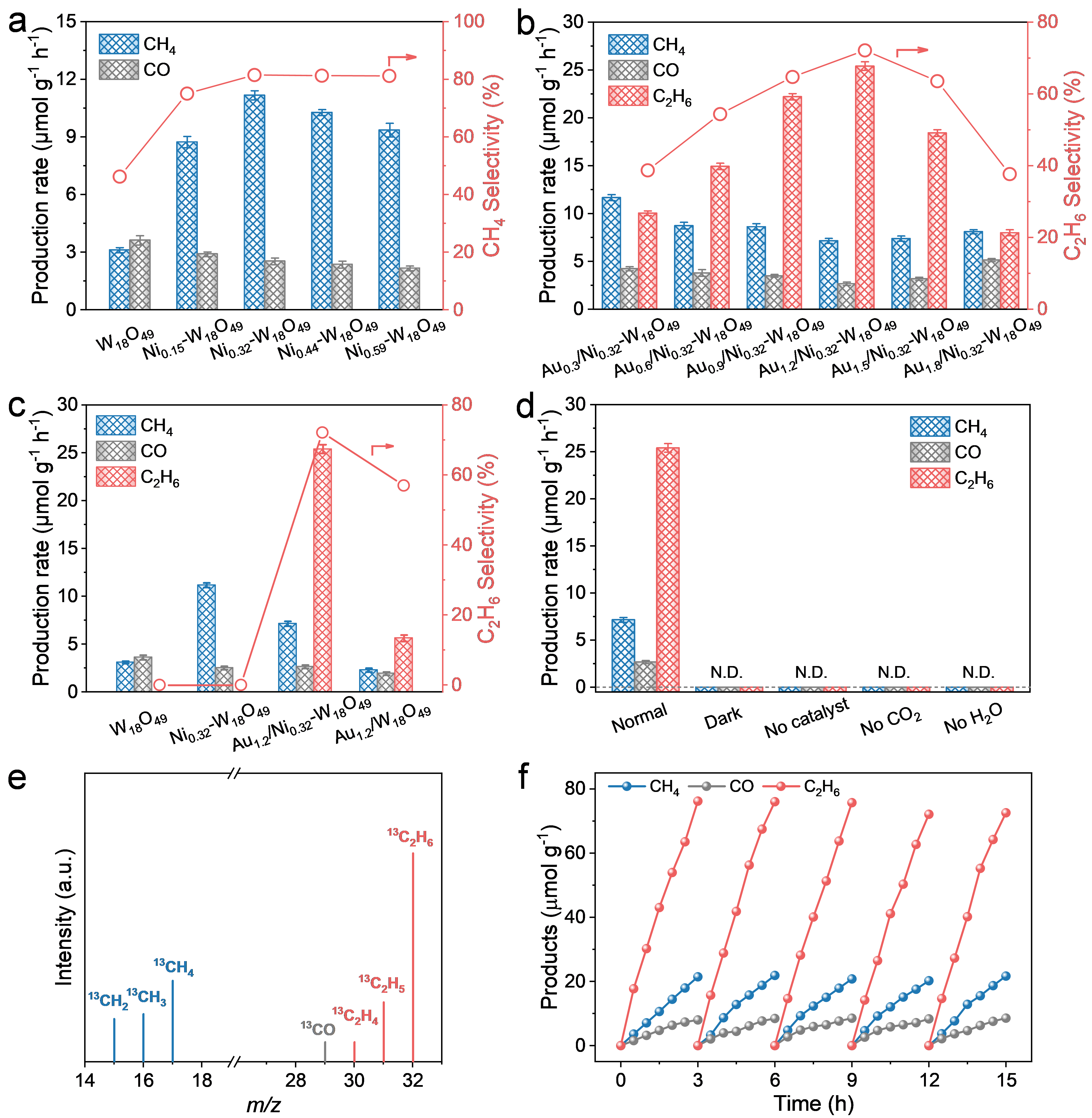
Fig. 2. (a) CH4 and CO production rates and CH4 selectivity of W18O49 and Nix-W18O49 (x = 0.15, 0.32, 0.44, and 0.59). CH4, CO, and C2H6 production rates and C2H6 selectivity of the Auy/Ni0.32-W18O49 heterostructures (y = 0.3, 0.6, 0.9, 1.2, 1.5, and 1.8) (b), and W18O49, Ni0.32-W18O49, Au1.2/Ni0.32-W18O49, and Au1.2/W18O49 (c). (d) Comparative activity of Au1.2/Ni0.32-W18O49 under different conditions. (e) Isotope-labeling MS analysis of products from photocatalytic 13CO2 reduction over Au1.2/Ni0.32-W18O49. (f) Stability test of Au1.2/Ni0.32-W18O49 over five consecutive reaction cycles.
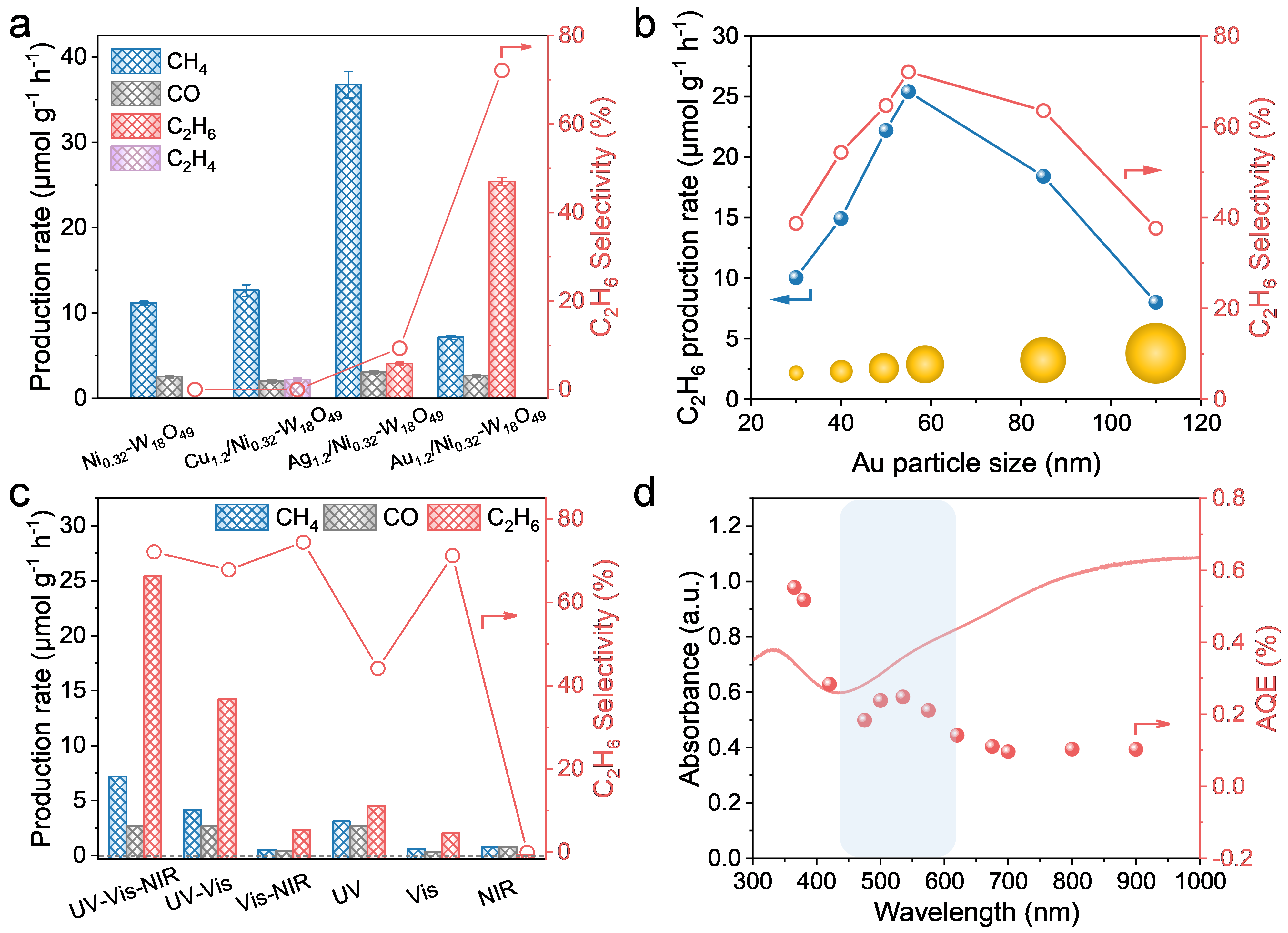
Fig. 3. (a) CH4, CO, C2H4, and C2H6 production rates and C2H6 selectivity of Ni0.32-W18O49, Cu1.2/Ni0.32-W18O49, Ag1.2/Ni0.32-W18O49, and Au1.2/Ni0.32-W18O49. (b) Relation between the size of Au NPs and C2H6 production rate and selectivity over Auy/Ni0.32-W18O49. (c) CH4, CO, and C2H6 production rates and C2H6 selectivity of Au1.2/Ni0.32-W18O49 upon different light irradiations with the same intensity of 300 mW cm-2. (d) UV-Vis-NIR DRS and AQE of Au1.2/Ni0.32-W18O49.
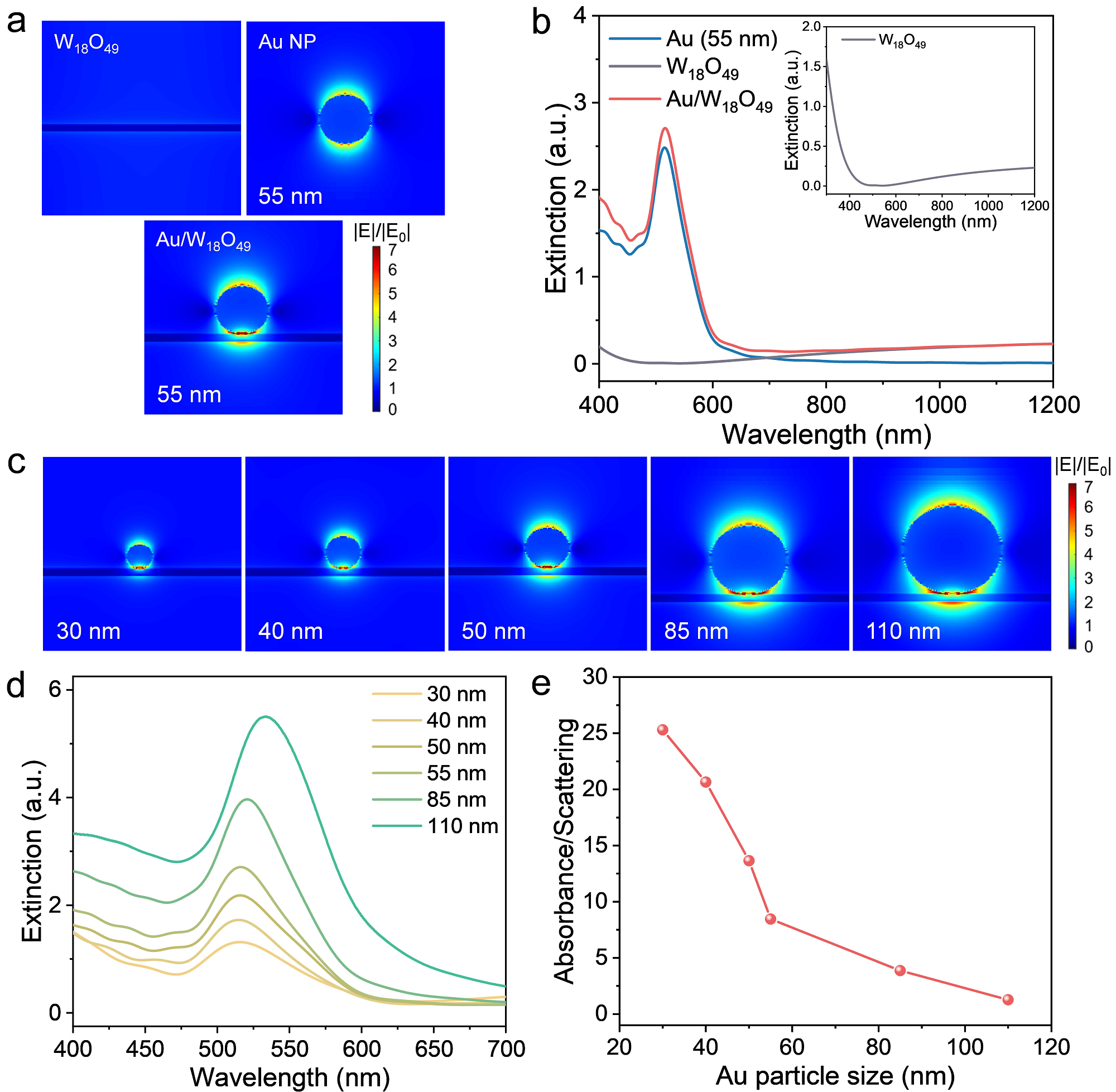
Fig. 4. Spatial distributions of SPR-induced electric fields (a) and extinction spectra (b) of the single W18O49 nanowire (a length of 350 nm and a width of 10 nm), Au NP (55 nm), and 55 nm Au/W18O49 heterostructure from FDTD simulations. (c) Spatial distributions of SPR-induced electric fields of the Au/W18O49 heterostructures with different Au NP sizes of 30, 40, 50, 85, and 110 nm from FDTD simulations. Extinction spectra (d) and the ratio of absorbance to scattering (e) of the Au/W18O49 heterostructures with different Au NP sizes.
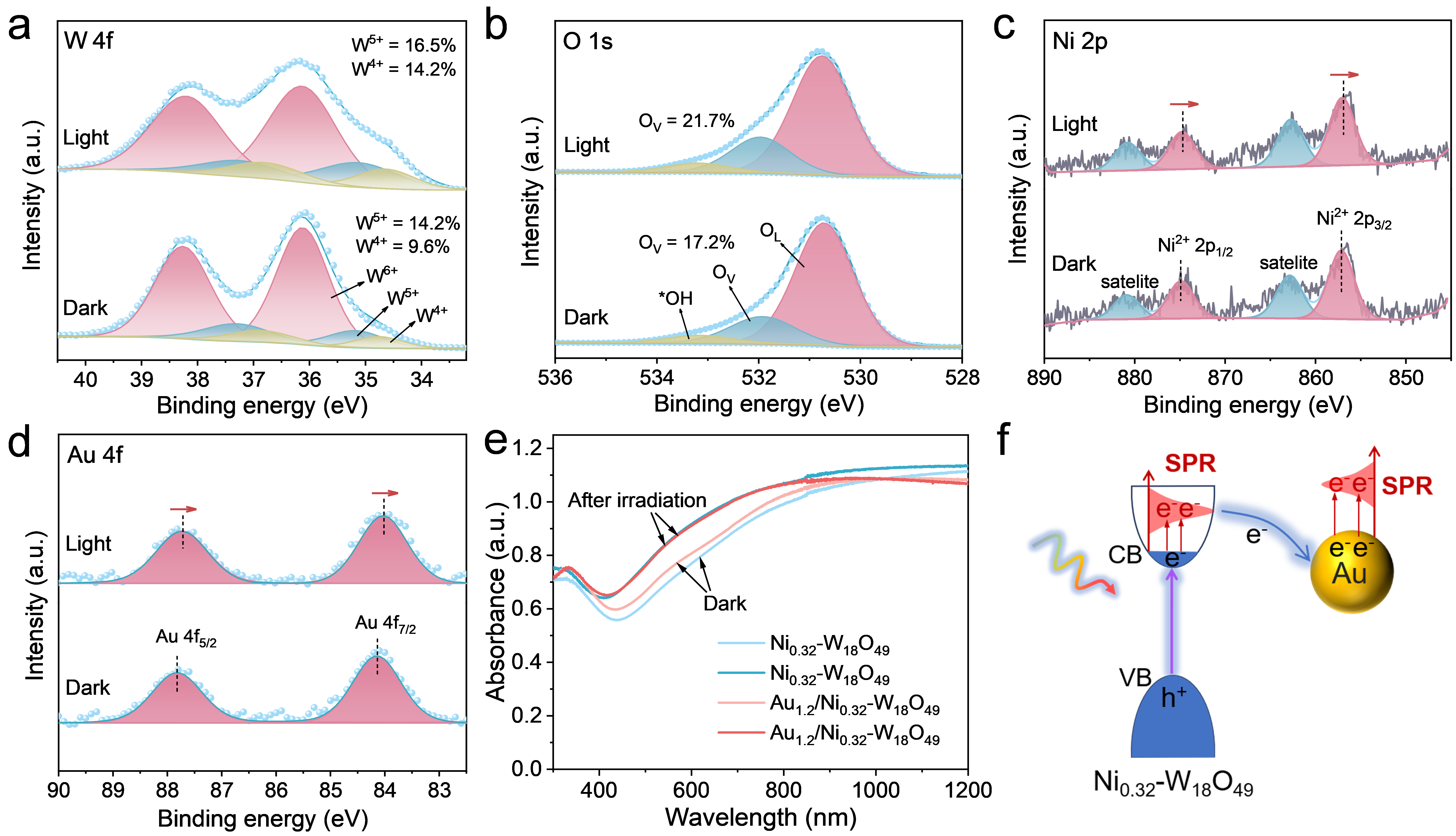
Fig. 5. W 4f (a), O 1s (b), Ni 2p (c), and Au 4f (d) XPS spectra of Au1.2/Ni0.32-W18O49 in the dark and under full-spectrum irradiation (OL: lattice oxygen, *OH: adsorbed hydroxyl species). (e) UV-Vis-NIR DRS of Ni0.32-W18O49 and Au1.2/Ni0.32-W18O49 before and after UV-irradiation for 25 s. (f) Schematic diagram of charge transfer in the Au1.2/Ni0.32-W18O49 heterostructure.
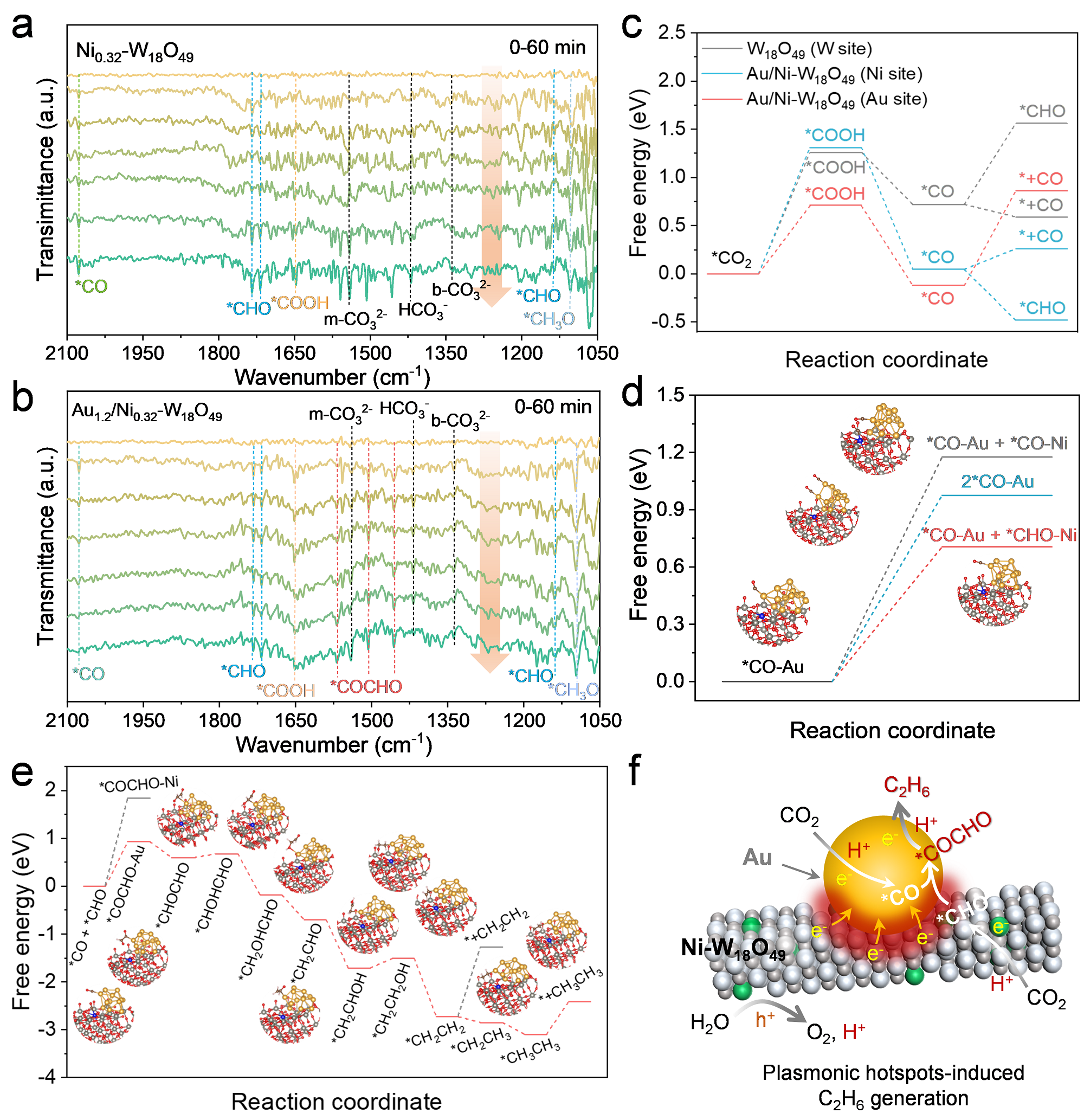
Fig. 6. In-situ FTIR spectroscopy of Ni0.32-W18O49 (a) and Au1.2/Ni0.32-W18O49 (b) under light irradiation in a CO2 and water vapor atmosphere. (c) Free energy diagrams for CO2 reduction to *CHO or CO on the W site of W18O49 and the Ni and Au sites of Au/Ni-W18O49. (d) Free energy diagrams for anchoring two C1 intermediates on different sites in Au/Ni-W18O49. (e) Free energy diagram for coupling of *CO and *CHO into *COCHO and its subsequent protonation to CH3CH3 over Au/Ni-W18O49. The structural models consist of W (gray), Ni (blue), Au (yellow), O (red), C (brown), and H (white) atoms. (f) Schematic diagram of PCR mechanism over plasmonic Au/Ni-W18O49 heterostructures.
|
| [1] | Sathi Chatterjee, Hongmei Li, Kang Liu, Zhang Lin, Liyuan Chai, Min Liu. Single-atom catalysts on two-dimensional (2D) materials for photocatalytic CO2 reduction: Fundamentals, design, and emerging strategies [J]. Chinese Journal of Catalysis, 2026, 88(9): 86-128. |
| [2] | Xiaokang Jiang, Yongze Gao, Bowen Zhang, Xiaodong Yang, Zhimin Yuan, Zhaoning Xu, Bin Sun, Zaiyong Jiang, Guowei Zhou, Enlong Zhou. Built-in electric field coupled with non-noble metal plasma cocatalyst boosts photocatalytic CO2 reduction of MIL-125 [J]. Chinese Journal of Catalysis, 2026, 87(8): 100-112. |
| [3] | Shijie Li, Rui Li, Yanping Liu, Xin Yu, Deyun Ma, Jianhui Jiang, Xiaosong Zhou, Chunqiang Zhuang, Zaiwang Zhao, Wei Jiang. Augmented reactive oxygen species generation in Ag/AgBr/C3N5 via LSPR-enhanced S-scheme charge transfer for efficient photocatalytic antibiotic wastewater remediation [J]. Chinese Journal of Catalysis, 2026, 87(8): 126-139. |
| [4] | Kezhen Lai, Yuxin Sun, Linping Li, Xiaoqing Shi, Xiaosong Zhou, Ning Li, Yangqin Gao, Lei Ge. Defect-mediated dual-site synergy in Zn-CuInS2 enables orbital-tailored high performance photocatalytic CO2-to-ethylene conversion [J]. Chinese Journal of Catalysis, 2026, 85(6): 153-167. |
| [5] | Yanglin Chen, Ruiming Fang, Huibo Zhao, Minjun Feng, Weidong Hou, Tze Chien Sum, Wen Liu, Liang Wang, Lydia Helena Wong, Can Xue. Bipolar photocatalysis for CO generation via biopolyol oxidation and CO2 reduction over brown polymeric carbon nitride nanowires [J]. Chinese Journal of Catalysis, 2026, 84(5): 214-225. |
| [6] | Jinhe Li, Xiaxi Yao, Xiaohui Yu, Xiaosong Zhou, Wei Ren, Lele Wang, Weikang Wang, Qinqin Liu. Simultaneous value-added utilization of photogenerated electrons and holes via plasmon-exciton-phonon synergy in Mo2N QDs/ZnIn2S4 heterojunction [J]. Chinese Journal of Catalysis, 2026, 83(4): 219-230. |
| [7] | Fuhao Yin, Qianyu Zhang, Mao Xu, Shupeng Wei, Yi Li, Pengzuo Chen, Yanying Zhao, Benxia Li. Synergistic Pd species anchored in ordered macroporous In2O3 boosting solar-driven CO2 and H2O conversion [J]. Chinese Journal of Catalysis, 2026, 82(3): 238-250. |
| [8] | Donghang Chen, Junchen Liu, Wei Deng, Biao Gao, Yifu Wang, Motonori Watanabe, Tatsumi Ishihara, Limin Guo. Diffusion-acidity cooperative effect in ZnZrOx/SAPO-34 tandem catalysts for enhanced CO2-to-propylene conversion [J]. Chinese Journal of Catalysis, 2026, 90(11): 145-157. |
| [9] | Ruiqi Zhang, Xintong Yao, Junchang Liu, Zhi Chen, Dafeng Zhang, Xipeng Pu. Interfacial Cu‒S bond and localized surface plasmon resonance modulated Cu3P@Cu/Mn0.3Cd0.7S S-scheme heterojunction for efficient photocatalytic hydrogen evolution [J]. Chinese Journal of Catalysis, 2026, 89(10): 258-268. |
| [10] | Haopeng Jiang, Jinhe Li, Xiaohui Yu, Huilong Dong, Weikang Wang, Qinqin Liu. Interface engineering of covalent β-ketoenamine-bridged S-scheme heterojunction for synergistic solar-powered CO2-to-CO conversion paired with selective alcohol oxidation [J]. Chinese Journal of Catalysis, 2026, 80(1): 113-122. |
| [11] | Xianlong Lu, Lili Wang, Xueyang Zhao, Binbin Pan, Zhendong Li, Xiangfei Du, Shihan Zhang, Fan Dong, Bangwei Deng. Unlocking asymmetric C-C coupling pathways on commercial Cu catalysts via Cu (100) grain boundaries for efficient and durable CO electroreduction [J]. Chinese Journal of Catalysis, 2025, 76(9): 198-209. |
| [12] | Chen Hongjing, Li Yueying, Chen Min, Xie Zhongkai, Shi Weidong. Sulfur electron bridge mediating CuInS2/CuS heterostructure for highly selective CO2 photoreduction to C2H4 [J]. Chinese Journal of Catalysis, 2025, 75(8): 180-191. |
| [13] | Ya-Hui Li, Yu Chen, Jin-Yu Guo, Rui Wang, Shu-Na Zhao, Gang Li, Shuang-Quan Zang. Engineering coordination microenvironments of polypyridine Ni catalysts embedded in covalent organic frameworks for efficient CO2 photoreduction [J]. Chinese Journal of Catalysis, 2025, 74(7): 155-166. |
| [14] | Lin Zhang, Hui Zhang, Jinghong Fang, Jialin Cui, Jie Liu, Hui Liu, Lishui Sun, Qiong Sun, Lifeng Dong, Yingjie Zhao. Highly conjugated and chemically stable three-dimensional covalent organic frameworks for efficient photocatalytic CO2 reduction [J]. Chinese Journal of Catalysis, 2025, 74(7): 144-154. |
| [15] | Rui Li, Pengfei Feng, Bonan Li, Jiayu Zhu, Yali Zhang, Ze Zhang, Jiangwei Zhang, Yong Ding. Photocatalytic reduction of CO2 over porous ultrathin NiO nanosheets with oxygen vacancies [J]. Chinese Journal of Catalysis, 2025, 73(6): 242-251. |
| Viewed | ||||||
|
Full text |
|
|||||
|
Abstract |
|
|||||


