
Chinese Journal of Catalysis ›› 2026, Vol. 88: 393-407.DOI: 10.1016/S1872-2067(26)65133-9
• Articles • Previous Articles Next Articles
Yiwei Zhao, Zuhang Jin, Cheng Tao, Rui Du, Yongzheng Shi, Chao Zhang*( )
)
Received:2025-12-08
Accepted:2026-02-10
Online:2026-09-18
Published:2026-07-18
Supported by:Yiwei Zhao, Zuhang Jin, Cheng Tao, Rui Du, Yongzheng Shi, Chao Zhang. Electrocatalytic hydrodeoxygenation of guaiacol on Pt/TiO2: The modulation on guaiacol adsorption and H spillover[J]. Chinese Journal of Catalysis, 2026, 88: 393-407.
Add to citation manager EndNote|Ris|BibTeX
URL: https://www.cjcatal.com/EN/10.1016/S1872-2067(26)65133-9
| Entry | Catalyst | Con. (%) | Sele. (%) | |||
|---|---|---|---|---|---|---|
| B | C | B+C (KA) | D | |||
| 1 | 5Pt/TiO2 | 49.1 | 23.8 | 42.3 | 67.1 | 32.9 |
| 2 | 5Pt/SiO2 | 28.2 | 0 | 56.0 | 56.0 | 44.0 |
| 3 | 5Pt/C | 65.0 | 16.4 | 33.7 | 50.1 | 49.9 |
| 4 | 5Pt/CuO | — | — | — | — | — |
| 5 | 5Pt/WO3 | — | — | — | — | — |
| 6 | 5Pd/TiO2 | — | — | — | — | — |
| 7 | 5Ru/TiO2 | — | — | — | — | — |
| 8 | TiO2 | — | — | — | — | — |
| 9 | 1Pt/TiO2 | — | — | — | — | — |
| 10 | 3Pt/TiO2 | 42.1 | 28.6 | 36.4 | 65.0 | 35.0 |
| 11 | 7Pt/TiO2 | 52.5 | 24.7 | 40.7 | 65.4 | 34.6 |
| 12 | 10Pt/TiO2 | 46.7 | 25.4 | 39.7 | 65.1 | 34.9 |
Table 1 Electrocatalytic HDO of GUA over various catalysts.
| Entry | Catalyst | Con. (%) | Sele. (%) | |||
|---|---|---|---|---|---|---|
| B | C | B+C (KA) | D | |||
| 1 | 5Pt/TiO2 | 49.1 | 23.8 | 42.3 | 67.1 | 32.9 |
| 2 | 5Pt/SiO2 | 28.2 | 0 | 56.0 | 56.0 | 44.0 |
| 3 | 5Pt/C | 65.0 | 16.4 | 33.7 | 50.1 | 49.9 |
| 4 | 5Pt/CuO | — | — | — | — | — |
| 5 | 5Pt/WO3 | — | — | — | — | — |
| 6 | 5Pd/TiO2 | — | — | — | — | — |
| 7 | 5Ru/TiO2 | — | — | — | — | — |
| 8 | TiO2 | — | — | — | — | — |
| 9 | 1Pt/TiO2 | — | — | — | — | — |
| 10 | 3Pt/TiO2 | 42.1 | 28.6 | 36.4 | 65.0 | 35.0 |
| 11 | 7Pt/TiO2 | 52.5 | 24.7 | 40.7 | 65.4 | 34.6 |
| 12 | 10Pt/TiO2 | 46.7 | 25.4 | 39.7 | 65.1 | 34.9 |
| Entry | Catalyst | Con. (%) | Sele. (%) | |||
|---|---|---|---|---|---|---|
| B | C | B+C (KA) | D | |||
| 1 | Pt/TiO2-200R | 32.1 | 22.8 | 44.5 | 67.3 | 32.7 |
| 2 | Pt/TiO2-400R | 49.1 | 23.8 | 42.3 | 67.1 | 32.9 |
| 3 | Pt/TiO2-600R | 10.5 | 20.2 | 43.9 | 64.1 | 35.9 |
| 4 | Pt/SiO2-200R | 20.7 | 0 | 52.3 | 52.3 | 47.7 |
| 5 | Pt/SiO2-400R | 28.2 | 0 | 56.0 | 56.0 | 44.0 |
| 6 | Pt/SiO2-600R | 9.4 | 0 | 50.9 | 50.9 | 49.1 |
| 7 | Pt/C-200R | 50.8 | 15.6 | 34.8 | 50.4 | 49.6 |
| 8 | Pt/C-400R | 65.0 | 16.4 | 33.7 | 50.1 | 49.9 |
| 9 | Pt/C-600R | 34.3 | 14.9 | 33.9 | 48.8 | 51.2 |
Table 2 Electrocatalytic HDO of GUA over various supported Pt catalysts.
| Entry | Catalyst | Con. (%) | Sele. (%) | |||
|---|---|---|---|---|---|---|
| B | C | B+C (KA) | D | |||
| 1 | Pt/TiO2-200R | 32.1 | 22.8 | 44.5 | 67.3 | 32.7 |
| 2 | Pt/TiO2-400R | 49.1 | 23.8 | 42.3 | 67.1 | 32.9 |
| 3 | Pt/TiO2-600R | 10.5 | 20.2 | 43.9 | 64.1 | 35.9 |
| 4 | Pt/SiO2-200R | 20.7 | 0 | 52.3 | 52.3 | 47.7 |
| 5 | Pt/SiO2-400R | 28.2 | 0 | 56.0 | 56.0 | 44.0 |
| 6 | Pt/SiO2-600R | 9.4 | 0 | 50.9 | 50.9 | 49.1 |
| 7 | Pt/C-200R | 50.8 | 15.6 | 34.8 | 50.4 | 49.6 |
| 8 | Pt/C-400R | 65.0 | 16.4 | 33.7 | 50.1 | 49.9 |
| 9 | Pt/C-600R | 34.3 | 14.9 | 33.9 | 48.8 | 51.2 |

Fig. 1. (a) Conversion and selectivity of the Pt/TiO2 catalysts. (b) TOF of the Pt/TiO2 catalysts. (c) Product selectivity and GUA conversion rate (10 mmol L-1) over the Pt/TiO2-400R catalyst at different current densities. (d) The FE of products on Pt/TiO2-400R catalyst at different current densities. Reaction conditions: 1.0 mg catalyst, 10 mmol L-1 GUA, 10 mL 0.2 mol L-1 HClO4, -20 mA cm-2, 50 °C, 2 h.

Fig. 2. TEM images of Pt/TiO2-200R (a), Pt/TiO2-400R (b), Pt/TiO2-600R (c), Pt/SiO2-200R (d), Pt/SiO2-400R (e), Pt/SiO2-600R (f), Pt/C-200R (g), Pt/C-400R (h), and Pt/C-600R (i) catalysts.

Fig. 3. (a) XRD patterns of Pt/TiO2 catalysts calcined at 400 °C in air followed by subsequent hydrogen reduction at temperatures of 200, 400, and 600 °C. XPS spectra of Pt 4f (b), O 1s (c), and Ti 2p (d) for Pt/TiO2-200R, Pt/TiO2-400R, and Pt/TiO2-600R.

Fig. 4. Nyquist plots (a) and OCP curves (b) of Pt/TiO2-200R, Pt/TiO2-400R, and Pt/TiO2-600R. (c) LSV curves of Pt/TiO2-400R in the presence and absence of 10 mmol L-1 GUA. (d) Tafel slopes derived from polarization data for Pt/TiO2-400R. Reaction conditions: 1.0 mg of catalyst, 10 mmol L-1 of GUA, 10.0 mL of 0.2 mol L-1 HClO4, 50 °C.

Fig. 5. (a) H2-TPD profiles of Pt/TiO2 catalysts reduced at different temperatures. (b) H2-TPD profiles of the Pt-based catalysts on different supports.

Fig. 6. In-situ FTIR spectra of GUA on Pt/TiO2-200R (a), Pt/TiO2-400R (b), and Pt/TiO2-600R (c) catalysts. (d) Adsorption spectra of GUA on Pt/TiO2-200R (black), Pt/TiO2-400R (red), Pt/TiO2-600R (blue) after 180 min.

Fig. 7. Comparative GUA HDO over Pt/TiO2 catalysts. (a) Product selectivity and GUA conversion for Pt/TiO2-400R under electrocatalytic (solid cylinders) vs. thermocatalytic (hollow cylinders) conditions. (b) Product selectivity and GUA conversion over Pt/TiO2 catalysts reduced at 200-600 °C under electrocatalytic (solid cylinders) and thermocatalytic (hollow cylinders) regimes. Reaction conditions: 50 °C, 2 h, HClO4 or H2SO4 solution of equivalent pH. Electrocatalysis: 1 mg catalyst, 10 mmol L-1 GUA, 10 mL 0.2 mol L-1 HClO4, -20 mA cm-2. Thermocatalysis: 2.0 mg catalyst, 20 mmol L-1 GUA, 1 MPa 20% H2/Ar, 10 mL 0.2 mol L-1 HClO4.
| Entry | Reactants | Con. (%) | Sele. (%) | |||
|---|---|---|---|---|---|---|
| B | C | B+C (KA) | D1 | |||
| 1 | GUA | 49.1 | 23.8 | 42.3 | 67.1 | 32.9 |
 | ||||||
| Entry | Reactants | Con. (%) | Sele. (%) | |||
| B | C | B+C (KA) | D2 | |||
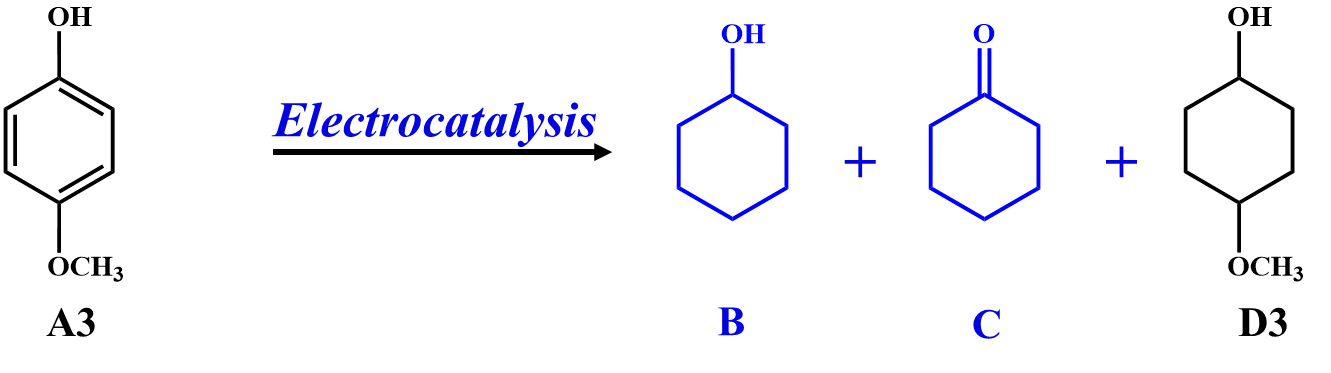
| 2 | 3-Methoxyphenol | 47.7 | 48.6 | 51.4 | 100.0 | - |
 | ||||||
| Entry | Reactants | Con. (%) | Sele. (%) | |||
| B | C | B+C (KA) | D3 | |||
| 3 | 4-methoxyphenol | 46.4 | 64.2 | 35.8 | 100.0 | - |
Table 3 Electrocatalytic HDO of GUA on Pt/TiO2-400R under varying reactants.
| Entry | Reactants | Con. (%) | Sele. (%) | |||
|---|---|---|---|---|---|---|
| B | C | B+C (KA) | D1 | |||
| 1 | GUA | 49.1 | 23.8 | 42.3 | 67.1 | 32.9 |
| | ||||||
| Entry | Reactants | Con. (%) | Sele. (%) | |||
| B | C | B+C (KA) | D2 | |||
| 2 | 3-Methoxyphenol | 47.7 | 48.6 | 51.4 | 100.0 | - |
| | ||||||
| Entry | Reactants | Con. (%) | Sele. (%) | |||
| B | C | B+C (KA) | D3 | |||
| 3 | 4-methoxyphenol | 46.4 | 64.2 | 35.8 | 100.0 | - |

Fig. 8. Possible reaction mechanism for the electrocatalytic HDO of GUA on Pt/TiO2-400R.
| System | Item | Top view | ΔE (eV) | ΔE (KJ mol-1) |
|---|---|---|---|---|
| Pt/TiO2 (101) | Slad-H1* | 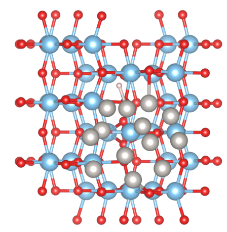 | 2.22 | 2114.42 |
| Slad-H2* | 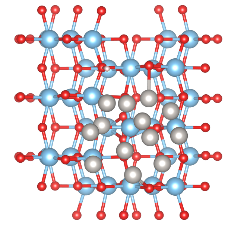 | |||
| Pt/TiO2 (101)-Ov | Slad-H1* | 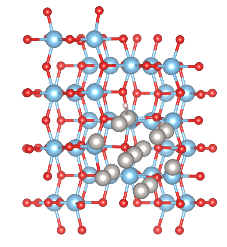 | 2.17 | 210.33 |
| Slad-H2* | 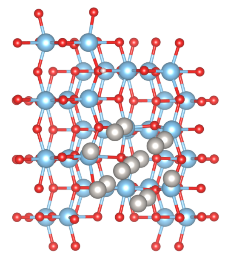 |
Table 4 Calculated adsorption configurations and energetics of hydrogen species on Pt/TiO2(101) and oxygen-deficient Pt/TiO2(101)-Ov surfaces. Blue, gray, red, and pink spheres represent Pt, Ti, O, and H atoms, respectively.
| System | Item | Top view | ΔE (eV) | ΔE (KJ mol-1) |
|---|---|---|---|---|
| Pt/TiO2 (101) | Slad-H1* | | 2.22 | 2114.42 |
| Slad-H2* | | |||
| Pt/TiO2 (101)-Ov | Slad-H1* | | 2.17 | 210.33 |
| Slad-H2* | |

Fig. 9. (a) Stability assessment of the Pt/TiO2-400R catalyst via five consecutive GUA conversion cycles under a constant current density of -20 mA cm-2. (b) LSV curves of Pt/TiO2-400R and used-Pt/TiO2-400R-5 runs in 0.2 mol L-1 HClO4 electrolyte containing 10 mmol L-1 GUA. (c) XRD patterns of Pt/TiO2-400R and used-Pt/TiO2-400R-5 runs. (d) TEM images of used-Pt/TiO2-400R-5 runs. Reaction conditions: 1.0 mg of catalyst, 10 mmol L-1 of GUA, 10.0 mL of 0.2 mol L-1 HClO4, -20 mA cm-2, 50 °C, 2 h.

Fig. 10. (a) H2-TPD profiles of Pt/TiO2-400R and used-Pt/TiO2-400R-5 runs. XPS spectra of Ti 2p (b), O 1s (c), and Pt 4f (d) for fresh Pt/TiO2-400R and used-Pt/TiO2-400R-5 runs.
|
| [1] | Heng Zhou, Longfei Hong, Yan Zhang, Yuyue Zhou, Sheng Chu, Huiyan Zhang, Hui Li, Tianyi Ma, Heng Zhang. Efficient solar-simulated-driven valorization of non-edible oils for biodiesel production via interfacial localized photothermal catalysis [J]. Chinese Journal of Catalysis, 2026, 87(8): 156-169. |
| [2] | Tianchun Li, Tianyang Liu, Yu Jing. Structural origins of selectivity in guaiacol hydrodeoxygenation on copper [J]. Chinese Journal of Catalysis, 2026, 87(8): 376-385. |
| [3] | Yuwei Li, Yuxin He, Zongyao Guo, Jingyi Zhang, Yizhi Wu, Mingkun Jiang, Shiyu Chen, Dan Wu. Dual-site CuS-Co9S8 heterojunctions for efficient and selective glycerol electrooxidation [J]. Chinese Journal of Catalysis, 2026, 85(6): 272-285. |
| [4] | Yao-Yao Xie, Chang-Long Tan, Liang Mao, Zi-Rong Tang, Yi-Jun Xu. Highly efficient hydroxyethyl radicals-mediated photocatalytic benzimidazole synthesis and hydrogen evolution over defect-engineered Pt/Nb2O5 [J]. Chinese Journal of Catalysis, 2026, 83(4): 132-142. |
| [5] | Han-Yue Yang, Jia-Jia Wen, Xue Xiao, Yu Chen. Interfacial charge transfer via SMSI in heterostructured Pd/Bi2O3: A paradigm for sustainable electrochemical biomass upcycling [J]. Chinese Journal of Catalysis, 2026, 91(12): 304-314. |
| [6] | Li Zheng, Zeng Ying, Dong Yuanyuan, Lv Hongjin, Yang Guo-Yu. Metal/H+ sites modulation in the decatungstate+Pd/C catalytic system for photocatalytic generation of furfuryl ethyl ether [J]. Chinese Journal of Catalysis, 2025, 75(8): 137-146. |
| [7] | Qisong Yi, Lu Lin, Huawei Geng, Shaohua Chen, Yuanchao Shao, Ping He, Zhifeng Liu, Haimei Xu, Tiehong Chen, Yuanshuai Liu, Valentin Valtchev. Benefits of H-ZSM-5 zeolite from fluoride-mediated acidic synthesis for liquid-phase conversion of cyclohexanol [J]. Chinese Journal of Catalysis, 2025, 74(7): 97-107. |
| [8] | Wanying Liang, Guangyue Xu, Yao Fu. Accurate restricted transition-state shape selective hydrogenation of furfural over zeolite confined Cu catalyst [J]. Chinese Journal of Catalysis, 2025, 74(7): 71-81. |
| [9] | Wenbing Yu, Xiaoqin Si, Mengjie Li, Zhenggang Liu, Rui Lu, Fang Lu. Catalytic conversion of biomass waste to methane without external hydrogen source [J]. Chinese Journal of Catalysis, 2025, 71(4): 246-255. |
| [10] | Yitong Wang, Chaofeng Zhang, Cheng Cai, Caoxing Huang, Xiaojun Shen, Hongming Lou, Changwei Hu, Xuejun Pan, Feng Wang, Jun Xie. Advances in humins formation mechanism, inhibition strategies, and value-added applications [J]. Chinese Journal of Catalysis, 2025, 71(4): 25-53. |
| [11] | Meng Liu, Caixia Miao, Yumeng Fo, Wenxuan Wang, Yao Ning, Shengqi Chu, Weiyu Song, Ying Zhang, Jian Liu, Zhijie Wu, Wenhao Luo. Chelating-agent-free incorporation of isolated Ni single-atoms within BEA zeolite for enhanced biomass hydrogenation [J]. Chinese Journal of Catalysis, 2025, 71(4): 308-318. |
| [12] | Wentao Su, Shenglong Tian, Huamei Yang, Changzhi Li, Tao Zhang. Refining lignin into aromatic nitrogen-heterocyclic compounds: Sustainable avenue toward value-added chemicals [J]. Chinese Journal of Catalysis, 2025, 78(11): 25-46. |
| [13] | Guipeng Zhang, Yan Bin, Yanxin Wang, Jinzhu Chen. Remote hydrogen-spillover effect on catalytic transnitrilation for biomass-based nitrile synthesis [J]. Chinese Journal of Catalysis, 2025, 77(10): 153-170. |
| [14] | Lulu Sun, Shiyang Liu, Taifeng Liu, Dongqiang Lei, Nengchao Luo, Feng Wang. Engineering the coordination structure of Cu for enhanced photocatalytic production of C1 chemicals from glucose [J]. Chinese Journal of Catalysis, 2024, 63(8): 234-243. |
| [15] | Lujie Liu, Ben Liu, Yoshinao Nakagawa, Sibao Liu, Liang Wang, Mizuho Yabushita, Keiichi Tomishige. Recent progress on bimetallic catalysts for the production of fuels and chemicals from biomass and plastics by hydrodeoxygenation [J]. Chinese Journal of Catalysis, 2024, 62(7): 1-31. |
| Viewed | ||||||
|
Full text |
|
|||||
|
Abstract |
|
|||||


