
Chinese Journal of Catalysis ›› 2026, Vol. 89: 269-278.DOI: 10.1016/S1872-2067(26)65169-8
• Article • Previous Articles Next Articles
Jiahui Xiea, Luyao Gea, Pilang Zhenga, Yuanzhen Kea,*( ), Qihua Yanga,*(), Xiaobo Lia,b,*()
Received:2025-11-23
Accepted:2026-03-22
Online:2026-10-18
Published:2026-09-01
Contact:
E-mail: Supported by:Jiahui Xie, Luyao Ge, Pilang Zheng, Yuanzhen Ke, Qihua Yang, Xiaobo Li. Donor-engineered D-A nanophotocatalyst with dual surfactants-directed assembly for efficient photocatalytic hydrogen evolution[J]. Chinese Journal of Catalysis, 2026, 89: 269-278.
Add to citation manager EndNote|Ris|BibTeX
URL: https://www.cjcatal.com/EN/10.1016/S1872-2067(26)65169-8
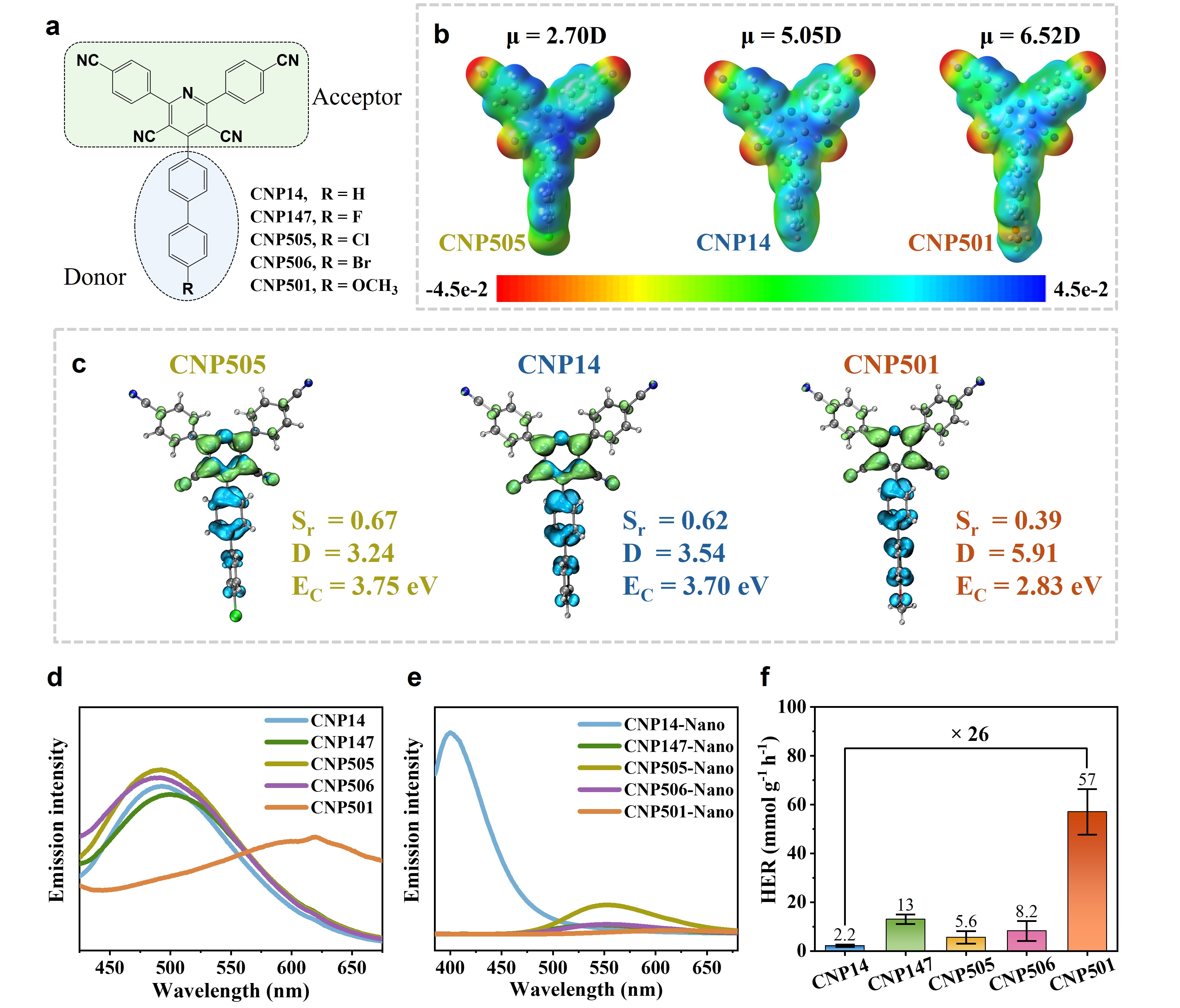
Fig. 1. (a) Chemical structures of donor-acceptor molecules CNP14, CNP147, CNP505, CNP506, and CNP501. (b) Calculated electrostatic potential (ESP) surfaces and molecular dipole moments for CNP505, CNP14, CNP501. Color code: N = blue, C = gray, Cl = green, O = red, H = light gray. (c) Electron-hole distribution analysis for: CNP505, CNP14, CNP501. Color code: N = blue, C = gray, Cl = green, O = red, H = light gray. Blue regions: hole density; Green regions: electron density. (d) Fluorescence emission spectra of CNPs in THF (10 μmol L-1); λexc = 365 nm. (e) Fluorescence emission spectra of quasi-homogeneous photocatalysts prepared by UNP (0.125 mg CNP in 5 mL H2O); λexc = 365 nm. (f) HERs of UNP-prepared quasi-homogeneous photocatalysts. Conditions: 0.125 mg CNP in 5 mL H2O, 5 mmol L-1 AA, 3 wt% Pt; light source = AM 1.5G (58.5 mW cm-2). Error bars: mean ± SD (n = 3).
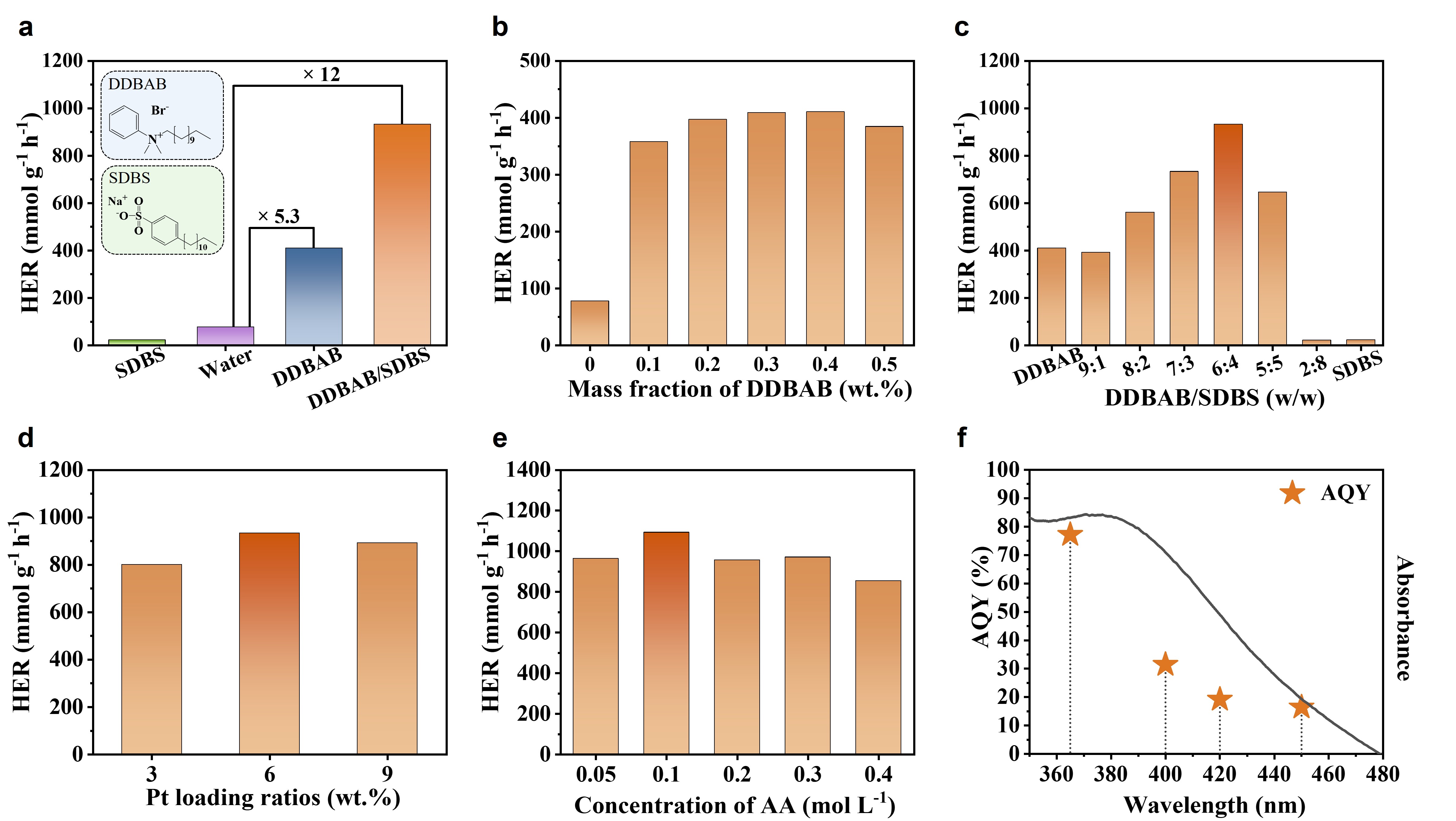
Fig. 2. (a) HERs of CNP501 synthesized by UNP under varied chemical environments, with molecular structures of DDBAB and SDBS surfactants. (b) HERs of CNP501 photocatalysts synthesized in aqueous solutions with different mass fractions of DDBAB. (c) HERs of CNP501 photocatalysts fabricated with varying DDBAB/SDBS mixing ratios. (d) HERs of CNP501/DDBAB/SDBS nanophotocatalysts with varying Pt co-catalyst loading. (e) HERs of CNP501/DDBAB/SDBS nanophotocatalysts at different ascorbic acid concentrations. (f) AQYs of CNP501/DDBAB/SDBS nanophotocatalysts measured at 365, 400, 420, and 450 nm, overlaid with the UV-vis absorption spectrum of the nanophotocatalyst. Conditions: 0.125 mg CNP501 in 15 ml aqueous solution containing 0.4 wt% surfactant (except b), 0.2 mol L-1 AA (except e, f), 6 wt% Pt (except d); light source: AM 1.5G (58.5 mW cm-2).
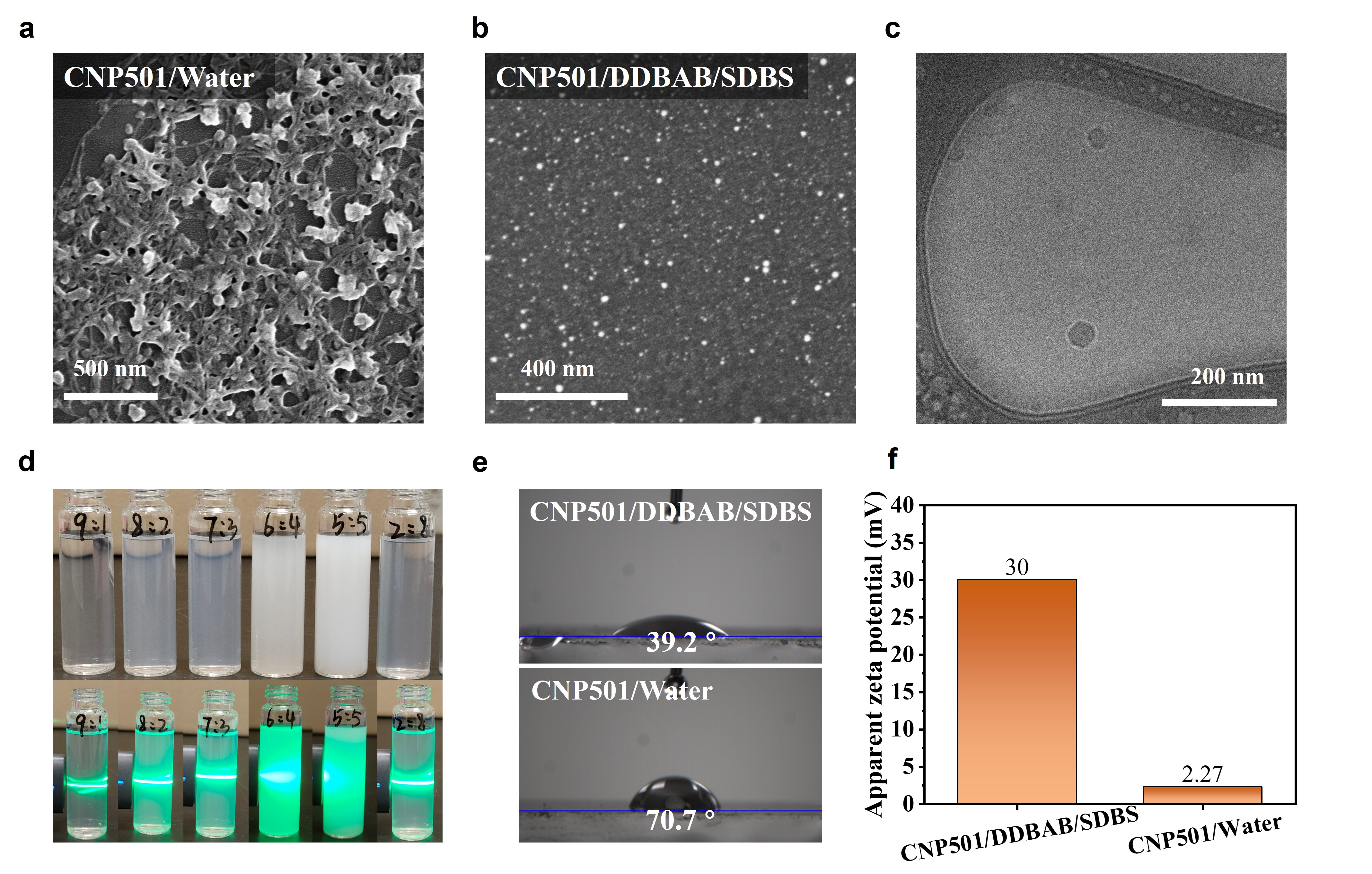
Fig. 3. Structural and interfacial characterization of nanophotocatalysts. SEM images of nanophotocatalysts prepared in pure water (a) and DDBAB/SDBS surfactant solution (b). (c) Cryo-TEM image of CNP501/DDBAB/SDBS. (d) Photographs of post-heated DDBAB/SDBS dual surfactants systems at varied mass ratios and their laser-irradiated counterparts. Surface properties of CNP501 nanophotocatalysts prepared in DDBAB/SDBS versus pure water: water contact angles on drop-cast films (e) and Zeta potential values (f).
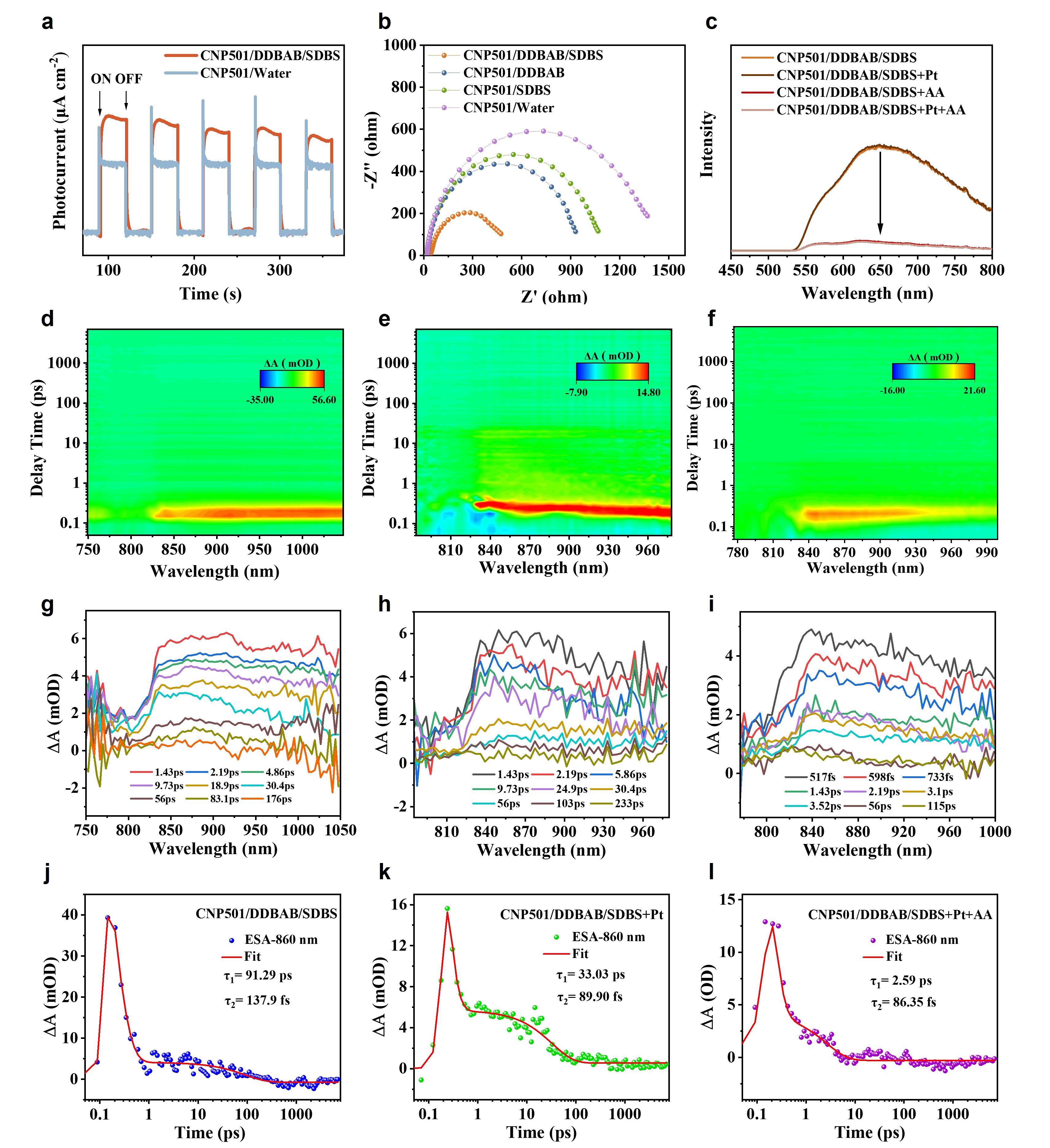
Fig. 4. Charge transfer dynamics of CNP501 nanophotocatalysts modulated by surfactant assembly. (a) Transient photocurrent responses of CNP501/Water versus CNP501/DDBAB/SDBS nanophotocatalysts. (b) EIS of CNP501-based nanophotocatalysts synthesized in different media. Measurement conditions: Three-electrode system with Ag/AgCl reference electrode and Pt counter electrode. (c) PL spectra of CNP501/DDBAB/SDBS under four conditions: no additives, with Pt only, with AA only, with both Pt and AA; λexc = 295 nm. Pseudocolor 2D fs-TAS maps for CNP501/DDBAB/SDBS (d), CNP501/DDBAB/SDBS+Pt (e), and CNP501/DDBAB/SDBS+Pt+AA (f) samples. (g-i) Corresponding transient absorption spectra of the samples. (j-l) Transient absorption decay kinetics at 860 nm and biexponential fitting, from which the lifetimes of the slow (τ1) and fast (τ2) components are extracted. The Pt loading is 6 wt% relative to the catalyst mass, and the concentration of AA is 0.1 mol L?1; the group without additives only contains the catalyst solution with the same concentration.
|
| [1] | Mingyu Ma, Zongyang Liu, Kuo Yuan, Zheyuan Liu, Jiaxin Wang, Qingqing Lin, Di-Chang Zhong, Tong-Bu Lu. Self-photosensitizing metal complexes for photocatalytic hydrogen evolution [J]. Chinese Journal of Catalysis, 2026, 86(7): 375-383. |
| [2] | Hanxi Li, Zhendong Luo, Qiang Xue, Yunfei Zhi, Jun Du, Xukai Zhou. Engineering channel microenvironment and charge dynamics in covalent organic frameworks through linkage-specific povarov cyclization for enhanced photocatalytic hydrogen evolution [J]. Chinese Journal of Catalysis, 2026, 86(7): 363-374. |
| [3] | Hongwen Zhang, Yinghui Cai, Bingyue Li, Wei Shan, Hua Tang. Isolated Cu atoms and CuO nanoclusters synergistically boost hydrogen evolution over TiO2 [J]. Chinese Journal of Catalysis, 2026, 83(4): 162-171. |
| [4] | Bolin Yang, Fei Jin, Zhiliang Jin. Efficient photocatalytic hydrogen production by a heterojunction strategy with covalent organic frameworks loaded with non-precious-metal semiconductors [J]. Chinese Journal of Catalysis, 2026, 81(2): 172-184. |
| [5] | Ruiqi Zhang, Xintong Yao, Junchang Liu, Zhi Chen, Dafeng Zhang, Xipeng Pu. Interfacial Cu‒S bond and localized surface plasmon resonance modulated Cu3P@Cu/Mn0.3Cd0.7S S-scheme heterojunction for efficient photocatalytic hydrogen evolution [J]. Chinese Journal of Catalysis, 2026, 89(10): 258-268. |
| [6] | Yunchao Zhang, Jinkang Pan, Xiang Ni, Feiqi Mo, Yuanguo Xu, Pengyu Dong. Revealing the dynamics of charge carriers in organic/inorganic hybrid FS-COF/WO3 S-scheme heterojunction for boosted photocatalytic hydrogen evolution [J]. Chinese Journal of Catalysis, 2025, 74(7): 250-263. |
| [7] | Zhengyu Zhou, Zhiliang Jin. Custom exposed crystal facets: Synergistic effect of optimum crystal facet anisotropy and Ohmic heterojunction boosting photocatalytic hydrogen evolution [J]. Chinese Journal of Catalysis, 2025, 74(7): 294-307. |
| [8] | Xinlong Zheng, Yiming Song, Chongtai Wang, Qizhi Gao, Zhongyun Shao, Jiaxin Lin, Jiadi Zhai, Jing Li, Xiaodong Shi, Daoxiong Wu, Weifeng Liu, Wei Huang, Qi Chen, Xinlong Tian, Yuhao Liu. Properties, applications, and challenges of copper- and zinc-based multinary metal sulfide photocatalysts for photocatalytic hydrogen evolution [J]. Chinese Journal of Catalysis, 2025, 74(7): 22-70. |
| [9] | YuQing Yan, YongHui Wu, Jun Wang, JinRong Huo, Kai Yang, KangQiang Lu. S-scheme Cd0.8Zn0.2S nanowires/CeO2 nanocubes heterojunction for efficient photocatalytic hydrogen evolution [J]. Chinese Journal of Catalysis, 2025, 79(12): 231-239. |
| [10] | Xianglin Xiang, Bei Cheng, Bicheng Zhu, Chuanjia Jiang, Guijie Liang. High-entropy alloy nanocrystals boosting photocatalytic hydrogen evolution coupled with selective oxidation of cinnamyl alcohol [J]. Chinese Journal of Catalysis, 2025, 68(1): 326-335. |
| [11] | Junxian Bai, Rongchen Shen, Guijie Liang, Chaochao Qin, Difa Xu, Haobin Hu, Xin Li. Topology-induced local electric polarization in 2D thiophene-based covalent organic frameworks for boosting photocatalytic H2 evolution [J]. Chinese Journal of Catalysis, 2024, 59(4): 225-236. |
| [12] | Jinkang Pan, Aicaijun Zhang, Lihua Zhang, Pengyu Dong. Construction of S-scheme heterojunction from protonated D-A typed polymer and MoS2 for efficient photocatalytic H2 production [J]. Chinese Journal of Catalysis, 2024, 58(3): 180-193. |
| [13] | Tingting Yang, Jing Wang, Zhongliao Wang, Jinfeng Zhang, Kai Dai. Ipolymer Cd3(C3N3S3)2/Zn3(C3N3S3)2 S-scheme heterojunction enhances photocatalytic H2 production [J]. Chinese Journal of Catalysis, 2024, 58(3): 157-167. |
| [14] | Ming Wang, Yaling Li, Dengxin Yan, Hui Hu, Yujie Song, Xiaofang Su, Jiamin Sun, Songtao Xiao, Yanan Gao. Dipole polarization modulating of vinylene-linked covalent organic frameworks for efficient photocatalytic hydrogen evolution [J]. Chinese Journal of Catalysis, 2024, 65(10): 103-112. |
| [15] | Zhihan Yu, Chen Guan, Xiaoyang Yue, Quanjun Xiang. Infiltration of C-ring into crystalline carbon nitride S-scheme homojunction for photocatalytic hydrogen evolution [J]. Chinese Journal of Catalysis, 2023, 50(7): 361-371. |
| Viewed | ||||||
|
Full text |
|
|||||
|
Abstract |
|
|||||


