
Chinese Journal of Catalysis ›› 2026, Vol. 89: 40-75.DOI: 10.1016/S1872-2067(26)65163-7
• Review • Previous Articles Next Articles
Yueyang Yaoa,b, Nan Zhangb, Ruiqian Jiaob, Panpan Liub, Xiangbo Fenga,*( ), Dandan Mab, Jun Lib, Yu Chenb, Jian-Wen Shib,*()
Received:2026-01-13
Accepted:2026-03-16
Online:2026-10-18
Published:2026-09-01
Contact:
*E-mail: fengxiangbo@xjtu.edu.cn (X. Feng),jianwen.shi@mail.xjtu.edu.cn (J.-W. Shi).
About author:Xiangbo Feng (Technological Institute of Materials & Energy Science, Xijing University) received his Ph.D. degree and conducted postdoctoral research at Xi'an Jiaotong University. He currently serves as a Professor, Associate Dean at Xijing University, and holds several concurrent positions including specially-appointed researcher at Xi'an Jiaotong University. He is a (youth) editorial board member for Journal of Rare Earths and Frontiers in Thermal Engineering. His research focuses on green energy and low-carbon conversion, efficient control of atmospheric pollution, and the development of novel nanoporous catalytic materials. He has presided over multiple research projects, including grants from the National Natural Science Foundation of China. He has published over 60 SCI papers as the first or corresponding author, with 17 papers recognized as ESI Highly Cited Papers and 15 as ESI Hot Papers. He is a recipient of several awards, including the Shaanxi and Chongqing Natural Science Awards. He has been selected as a Wiley China High-Contribution Author and listed among the World's Top 2% Scientists, and was honored as a "Young Science and Technology Star" in the Shaanxi Innovation Talent Climbing Project, among multiple other talent honors.Supported by:Yueyang Yao, Nan Zhang, Ruiqian Jiao, Panpan Liu, Xiangbo Feng, Dandan Ma, Jun Li, Yu Chen, Jian-Wen Shi. Rational design of rare earth-modified Mn-based catalysts for low-temperature NH3-SCR: Mechanisms, strategies, and prospects[J]. Chinese Journal of Catalysis, 2026, 89: 40-75.
Add to citation manager EndNote|Ris|BibTeX
URL: https://www.cjcatal.com/EN/10.1016/S1872-2067(26)65163-7
| Catalyst | Synthesis | Reaction conditions: [NOx]; [NH3]; [O2]; GHSV (ppm, ppm, vol%, h-1); balance gas | NOx conversion | N2 selectivity | Year/Ref. |
|---|---|---|---|---|---|
| MnO2 | All MnOx (analytical grade, Aladdin) were used as received | 500; 500; 3.0; 27,000; N2 | > 90% (100-250 °C) | — | 2018/[ |
| Mn2O3 | ∼90% (150-200 °C) | — | |||
| Mn3O4 | > 80% (225-250 °C) | — | |||
| MnO | ∼60% (300 °C) | — | |||
| MnO2@CeO2 | thermal decomposition | 500; 500; 5.0; 60,000; N2 | > 90% (100-275 °C) | — | 2023/[ |
| Mn2O3@CeO2 | > 80% (100-250 °C) | — | |||
| Mn3O4@CeO2 | > 80% (175-250 °C) | — | |||
| MnO/CeO2-NR | hydrothermal | 1000; 1000; 6.0; 13000; Ar | ∼50% (350 °C) | ∼80% (150-450 °C) | 2023/[ |
| Mn2O3/CeO2-NR | ∼60% (350 °C) | ∼85% (150-450 °C) | |||
| MnO2/CeO2-NR | ∼70% (350 °C) | ∼90% (150-450 °C) | |||
| α-MnO2 | hydrothermal + wet impregnation | 500; 500; 11.0; 36,000; N2 | > 80% (90-120 °C) | — | 2022/[ |
| β-MnO2 | > 70% (90-120 °C) | — | |||
| γ-MnO2 | ∼20% (90-110 °C) | — | |||
| CeO2 @α-MnO2 | > 95% (75-250 °C) | — | |||
| CeO2 @ β-MnO2 | > 95% (75-250 °C) | — | |||
| CeO2 @ γ-MnO2 | > 95% (75-250 °C) | — | |||
| α-MnO2 | redox hydrothermal | 500; 500; 19.0; 36,000; N2 | > 70% (90-120 °C) | > 70% (50-120 °C) | 2021/[ |
| β-MnO2 | ∼30% (50-120 °C) | ∼40% (50-120 °C) | |||
| γ-MnO2 | > 80% (90-120 °C) | ∼60% (50-120 °C) | |||
| δ-MnO2 | ∼50% (50-120 °C) | > 70% (50-100 °C) |
Table 1 Comparison of low-temperature NH3-SCR de-NOx performance of MnOx with different crystal phases and Mn valence states.
| Catalyst | Synthesis | Reaction conditions: [NOx]; [NH3]; [O2]; GHSV (ppm, ppm, vol%, h-1); balance gas | NOx conversion | N2 selectivity | Year/Ref. |
|---|---|---|---|---|---|
| MnO2 | All MnOx (analytical grade, Aladdin) were used as received | 500; 500; 3.0; 27,000; N2 | > 90% (100-250 °C) | — | 2018/[ |
| Mn2O3 | ∼90% (150-200 °C) | — | |||
| Mn3O4 | > 80% (225-250 °C) | — | |||
| MnO | ∼60% (300 °C) | — | |||
| MnO2@CeO2 | thermal decomposition | 500; 500; 5.0; 60,000; N2 | > 90% (100-275 °C) | — | 2023/[ |
| Mn2O3@CeO2 | > 80% (100-250 °C) | — | |||
| Mn3O4@CeO2 | > 80% (175-250 °C) | — | |||
| MnO/CeO2-NR | hydrothermal | 1000; 1000; 6.0; 13000; Ar | ∼50% (350 °C) | ∼80% (150-450 °C) | 2023/[ |
| Mn2O3/CeO2-NR | ∼60% (350 °C) | ∼85% (150-450 °C) | |||
| MnO2/CeO2-NR | ∼70% (350 °C) | ∼90% (150-450 °C) | |||
| α-MnO2 | hydrothermal + wet impregnation | 500; 500; 11.0; 36,000; N2 | > 80% (90-120 °C) | — | 2022/[ |
| β-MnO2 | > 70% (90-120 °C) | — | |||
| γ-MnO2 | ∼20% (90-110 °C) | — | |||
| CeO2 @α-MnO2 | > 95% (75-250 °C) | — | |||
| CeO2 @ β-MnO2 | > 95% (75-250 °C) | — | |||
| CeO2 @ γ-MnO2 | > 95% (75-250 °C) | — | |||
| α-MnO2 | redox hydrothermal | 500; 500; 19.0; 36,000; N2 | > 70% (90-120 °C) | > 70% (50-120 °C) | 2021/[ |
| β-MnO2 | ∼30% (50-120 °C) | ∼40% (50-120 °C) | |||
| γ-MnO2 | > 80% (90-120 °C) | ∼60% (50-120 °C) | |||
| δ-MnO2 | ∼50% (50-120 °C) | > 70% (50-100 °C) |
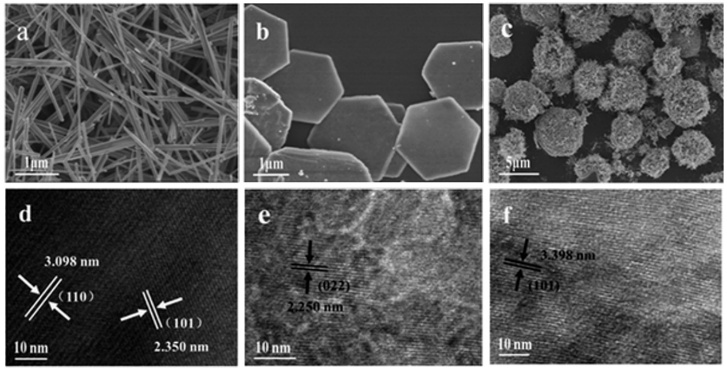
Fig. 1. SEM and HRTEM images of MnO2 nanorods (a,d), MnO2 nanosheets (b,e), and MnO2 nanospheres (c,f). Reprinted with permission from Ref. [63]. Copyright 2016, Royal Society of Chemistry.
| Catalyst | Preparation method | Reaction conditions: [NOx]; [NH3]; [O2]; GHSV; balance gas | NOx conversion | N2 selectivity | Year/[Ref.] |
|---|---|---|---|---|---|
| MnOx | thermal decomposition | 500 ppm; 500 ppm; 5.0 vol%; 60000 h-1; N2 | < 60% (50-350 °C) | > 50% (50-200 °C) | 2017/[ |
| CeO2 | thermal decompositions | < 30% (50-350 °C) | > 90% (50-350 °C) | ||
| MnCe-MMM | mechanical mixing | < 30% (50-350 °C) | > 50% (50-350 °C) | ||
| MnCe-IM | impregnation | < 80% (50-350 °C) | > 70% (50-175 °C) | ||
| MnCe-HTM | hydrothermal treatment | ∼100% (100-325 °C) | > 70% (50-200 °C) | ||
| MnCe-CPM | Co-precipitation | > 80% (125-350 °C) | > 70% (50-200 °C) | ||
| MnCe-SGM | sol-gel | > 80% (125-350 °C) | > 70% (50-200 °C) |
Table 2 Comparison of NH3-SCR performance of Mn-based catalysts obtained via different preparation methods.
| Catalyst | Preparation method | Reaction conditions: [NOx]; [NH3]; [O2]; GHSV; balance gas | NOx conversion | N2 selectivity | Year/[Ref.] |
|---|---|---|---|---|---|
| MnOx | thermal decomposition | 500 ppm; 500 ppm; 5.0 vol%; 60000 h-1; N2 | < 60% (50-350 °C) | > 50% (50-200 °C) | 2017/[ |
| CeO2 | thermal decompositions | < 30% (50-350 °C) | > 90% (50-350 °C) | ||
| MnCe-MMM | mechanical mixing | < 30% (50-350 °C) | > 50% (50-350 °C) | ||
| MnCe-IM | impregnation | < 80% (50-350 °C) | > 70% (50-175 °C) | ||
| MnCe-HTM | hydrothermal treatment | ∼100% (100-325 °C) | > 70% (50-200 °C) | ||
| MnCe-CPM | Co-precipitation | > 80% (125-350 °C) | > 70% (50-200 °C) | ||
| MnCe-SGM | sol-gel | > 80% (125-350 °C) | > 70% (50-200 °C) |
| Catalyst | Preparation method | Reaction conditions: [NOx]; [NH3]; [O2]; GHSV (ppm, ppm, vol%, h-1); balance gas | NOx conversion | N2 selectivity | Year/Ref. |
|---|---|---|---|---|---|
| MnOx | Co-precipitation | 500; 500; 3.0; 60,000; N2 | ∼90% (150-225 °C) | — | 2024/[ |
| Mn-Ce (Ce:Mn=0.05) | ∼100% (100-225 °C) | > 80% (50-350 °C) | |||
| MnOx | methanol reduction | 500; 500; 3.0; 60,000; N2 | ∼50% (100-150 °C) | > 70% (0-125 °C) | 2024/[ |
| Mn-Sm (Sm:Mn=0.05) | 100% (25-200 °C) | > 80% (0-150 °C) | |||
| MnOx | Co-precipitation | 700; 700; 5.0; 30,000; N2 | > 80% (100-180 °C) | — | 2024/[ |
| Mn-Ce (Ce:Mn=1) | > 80% (100-200 °C) | — | |||
| Mn-Ce (Ce:Mn=1.5) | Co-precipitation | 500; 500; 5.0; 60,000; Ar | 100% (100-200 °C) | > 60% (50-200 °C) | 2023/[ |
| MnOx | Co-precipitation | 500; 500; 5.0; 48,600; Ar | ∼80% (∼200 °C) | > 90% (50-300 °C) | 2023/[ |
| Mn-Er (Er:Mn=0.1) | > 80% (52-250 °C) | > 90% (50-300 °C) | |||
| Mn-Ce (Ce:Mn=0.25) | hydrothermal + impregnation | 500; 500; 11.0; 36,000; N2 | > 90% (150-250 °C) | > 70% (75-150 °C) | 2022/[ |
| Mn-La (La:Mn=0.022) | Co-impregnation | 600; 600; 3.0; 54,000; Ar | > 80% (200-300 °C) | — | 2021/[ |
| MnOx | polymer-assisted deposition | 500; 500; 5.0; 38, 000; N2 | > 50% (200-255 °C) | — | 2021/[ |
| Mn-Ce (Ce:Mn=1) | > 90% (150-250 °C) | > 80% (60-220 °C) | |||
| MnO2 | hydrothermal | 500; 500; 5.0; 30,000; N2 | ∼100% (90-150 °C) | > 90% (50-110 °C) | 2021/[ |
| Mn-Ce (Ce:Mn=0.25) | ∼100% (105-150 °C) | > 90% (50-130 °C) | |||
| Mn-Ce | solvothermal | 500; 500; 3.0; 52,500; N2 | > 90% (150-310 °C) | — | 2021/[ |
| Mn-Ce | hydrothermal | 500; 500; 5.0; 30,000; N2 | > 80% (160-240 °C) | > 90% (80-140 °C) | 2020/[ |
| Mn-Ce (Ce:Mn=1) | Co-precipitation | 500; 500; 10.0; 60,000; N2 | > 90% (200-300 °C) | — | 2020/[ |
| Mn-Ce nanorods | hydrothermal | 500; 500; 6.0; 200,000; N2 | > 70% (200-300 °C) | > 80% (0-300 °C) | 2020/[ |
| α-MnO2 | hydrothermal | 500; 500; 3.0; 100,000; N2 | > 60% (175-300 °C) | — | 2020/[ |
| Mn-Ce | > 80% (125-275 °C) | — | |||
| Mn-Ce | hydrothermal | 500; 500; 5.0; 50,000; Ar | > 90% (200-320 °C) | — | 2019/[ |
| Mn-Ce | sacrificial template | 1000; 1000; 5.0; 30,000; N2 | > 90% (100-180 °C) | > 70% (60-180 °C) | 2019/[ |
| MnOx | Co-precipitation | 500; 500; 5.0; 36,000; N2 | ∼100% (150-300 °C) | ∼100% (90-300 °C) | 2018/[ |
| Mn-Gd (Gd:Mn = 0.1) | ∼100% (120-330 °C) | ∼100% (150-300 °C) | |||
| Mn-Ce | impregnation | 500; 500; 5.0; 60,000; N2 | > 80% (100-250 °C) | — | 2017/[ |
| Mn-Eu (Eu:Mn = 0.1) | Co-precipitation | 600; 600; 5.0; 108,000; Ar | 100% (150-400 °C) | > 95% (100-400 °C) | 2017/[ |
| Mn-Ce (Ce:Mn = 0.2) | 100% (150-250 °C) | — | |||
| Mn-Sm (Sm:Mn = 0.1) | 100% (150-300 °C) | — | |||
| Mn-Ce (Ce:Mn = 1) | surfactant-template | 500; 500; 5.0; 64000; He | 100% (100-200 °C) | > 70% (150-200 °C) | 2013/[ |
Table 3 RE modification effects on MnOx catalysts: De-NOx activity and N2 selectivity (Parentheses: temperature window for the listed metric.)
| Catalyst | Preparation method | Reaction conditions: [NOx]; [NH3]; [O2]; GHSV (ppm, ppm, vol%, h-1); balance gas | NOx conversion | N2 selectivity | Year/Ref. |
|---|---|---|---|---|---|
| MnOx | Co-precipitation | 500; 500; 3.0; 60,000; N2 | ∼90% (150-225 °C) | — | 2024/[ |
| Mn-Ce (Ce:Mn=0.05) | ∼100% (100-225 °C) | > 80% (50-350 °C) | |||
| MnOx | methanol reduction | 500; 500; 3.0; 60,000; N2 | ∼50% (100-150 °C) | > 70% (0-125 °C) | 2024/[ |
| Mn-Sm (Sm:Mn=0.05) | 100% (25-200 °C) | > 80% (0-150 °C) | |||
| MnOx | Co-precipitation | 700; 700; 5.0; 30,000; N2 | > 80% (100-180 °C) | — | 2024/[ |
| Mn-Ce (Ce:Mn=1) | > 80% (100-200 °C) | — | |||
| Mn-Ce (Ce:Mn=1.5) | Co-precipitation | 500; 500; 5.0; 60,000; Ar | 100% (100-200 °C) | > 60% (50-200 °C) | 2023/[ |
| MnOx | Co-precipitation | 500; 500; 5.0; 48,600; Ar | ∼80% (∼200 °C) | > 90% (50-300 °C) | 2023/[ |
| Mn-Er (Er:Mn=0.1) | > 80% (52-250 °C) | > 90% (50-300 °C) | |||
| Mn-Ce (Ce:Mn=0.25) | hydrothermal + impregnation | 500; 500; 11.0; 36,000; N2 | > 90% (150-250 °C) | > 70% (75-150 °C) | 2022/[ |
| Mn-La (La:Mn=0.022) | Co-impregnation | 600; 600; 3.0; 54,000; Ar | > 80% (200-300 °C) | — | 2021/[ |
| MnOx | polymer-assisted deposition | 500; 500; 5.0; 38, 000; N2 | > 50% (200-255 °C) | — | 2021/[ |
| Mn-Ce (Ce:Mn=1) | > 90% (150-250 °C) | > 80% (60-220 °C) | |||
| MnO2 | hydrothermal | 500; 500; 5.0; 30,000; N2 | ∼100% (90-150 °C) | > 90% (50-110 °C) | 2021/[ |
| Mn-Ce (Ce:Mn=0.25) | ∼100% (105-150 °C) | > 90% (50-130 °C) | |||
| Mn-Ce | solvothermal | 500; 500; 3.0; 52,500; N2 | > 90% (150-310 °C) | — | 2021/[ |
| Mn-Ce | hydrothermal | 500; 500; 5.0; 30,000; N2 | > 80% (160-240 °C) | > 90% (80-140 °C) | 2020/[ |
| Mn-Ce (Ce:Mn=1) | Co-precipitation | 500; 500; 10.0; 60,000; N2 | > 90% (200-300 °C) | — | 2020/[ |
| Mn-Ce nanorods | hydrothermal | 500; 500; 6.0; 200,000; N2 | > 70% (200-300 °C) | > 80% (0-300 °C) | 2020/[ |
| α-MnO2 | hydrothermal | 500; 500; 3.0; 100,000; N2 | > 60% (175-300 °C) | — | 2020/[ |
| Mn-Ce | > 80% (125-275 °C) | — | |||
| Mn-Ce | hydrothermal | 500; 500; 5.0; 50,000; Ar | > 90% (200-320 °C) | — | 2019/[ |
| Mn-Ce | sacrificial template | 1000; 1000; 5.0; 30,000; N2 | > 90% (100-180 °C) | > 70% (60-180 °C) | 2019/[ |
| MnOx | Co-precipitation | 500; 500; 5.0; 36,000; N2 | ∼100% (150-300 °C) | ∼100% (90-300 °C) | 2018/[ |
| Mn-Gd (Gd:Mn = 0.1) | ∼100% (120-330 °C) | ∼100% (150-300 °C) | |||
| Mn-Ce | impregnation | 500; 500; 5.0; 60,000; N2 | > 80% (100-250 °C) | — | 2017/[ |
| Mn-Eu (Eu:Mn = 0.1) | Co-precipitation | 600; 600; 5.0; 108,000; Ar | 100% (150-400 °C) | > 95% (100-400 °C) | 2017/[ |
| Mn-Ce (Ce:Mn = 0.2) | 100% (150-250 °C) | — | |||
| Mn-Sm (Sm:Mn = 0.1) | 100% (150-300 °C) | — | |||
| Mn-Ce (Ce:Mn = 1) | surfactant-template | 500; 500; 5.0; 64000; He | 100% (100-200 °C) | > 70% (150-200 °C) | 2013/[ |
| Catalyst | Preparation method | Reaction conditions: [NOx]; [NH3]; [O2]; GHSV (ppm, ppm, vol%, h-1); balance gas | NOx conversion | SO2 resistance | H2O resistance | Combined H2O + SO2 tolerance | Year/Ref. |
|---|---|---|---|---|---|---|---|
| MnOx | methanol reduction | 500; 500; 3.0; 60000; N2 | ∼ 50% (100-150 °C) | 25 ppm SO2, ∼45% to ∼40% after ∼3 h at 150 °C | 3% H2O, 100% to ~20% after ∼3 h at 150 °C | 25 ppm SO2, 3% H2O, ~40% to ~20% after 3 h at 150 °C | 2024/[ |
| Mn-Sm | 100% (25-200 °C) | 25 ppm SO2, ∼90% to ~40% after ∼3 h at 150 °C | 3% H2O, 100% to ∼60% after ∼3 h at 150 °C | 25 ppm SO2, 3% H2O, ~90% to ~40% after 3 h at 150 °C | |||
| Mn-Ce | Co-precipitation | 500; 500; 5.0; 60000; Ar | 100% (100-200 °C) | 100 ppm SO2, 100% to ∼75% after ∼9 h at 200 °C | 10% H2O, 100% to ~90% after 2 h at 200 °C | 100 ppm SO2, 10% H2O, 100% to ~35% after 4 h at 200 °C | 2023/[ |
| Mn-Er | Co-precipitation | 500; 500; 5.0; 48600; Ar | > 80% (52-250 °C) | — | 5% H2O, 100% to ~95% after 10 h at 150 °C | 50 ppm SO2, 5% H2O, ∼ 95% to ∼ 90% after 10 h at 150 °C | 2023/[ |
| MnOx | Co-precipitation | 500; 500; 5.0; 30000; N2 | > 90% (160-260 °C) | 100 ppm SO2, 100% to ∼20% after 2 h (dropping to ∼0% after 4 h) at 200 °C | 5% H2O, ~100% to ~60% after 4 h at 200 °C | 100 ppm SO2, 5% H2O, 100% to ~0% after 2 h at 200 °C | 2022/[ |
| Mn-Pr | ∼100% (120-220 °C) | 100 ppm SO2, 100% to ∼ 90% after 2 h (and to ~20% after 4 h) at 200 °C | 5% H2O, ~100%, no deactivation after 4 h at 200 °C | 100 ppm SO2, 5% H2O, 100% to ~90% after 4 h at 200 °C | |||
| Mn-Ce | hydrothermal | 500; 500; 5.0; 30000; N2 | ∼ 100% (90-150 °C) | 250 ppm SO2, 100% to ∼70% after 6 h at 150 °C | — | — | 2021/[ |
| Mn-Ce | solvothermal | 500; 500; 3.0; 52500; N2 | > 90% (150-310 °C) | 200 ppm SO2, 100% to ∼ 0% after 4 h at 150 °C | 5% H2O, ~90% to ~75% after 4 h at 150 °C | — | 2021/[ |
| Mn-Ce | sacrificial template | 1000; 1000; 5.0; 30000; N2 | > 90% (100-180 °C) | 100 ppm SO2, ~100% to ~80% after 12 h at 180 °C | 10% H2O, ~100%, no deactivation after 8 h at 180 °C | — | 2018/[ |
| MnOx | Co-precipitation | 500; 500; 5.0; 36000; N2 | ∼100% (150-300 °C) | 100 ppm SO2, ~100% to ~10% after 4 h at 200 °C | 5% H2O, ~100% to ~70% after 6 h 200 °C | 100 ppm SO2, 5% H2O, ~100% to ~30% after 8 h at 200 °C | 2018/[ |
| Mn-Gd | ∼100% (120-330 °C) | 100 ppm SO2, ~100% to ~90% after 4 h at 200 °C | 5% H2O, no deactivation after 6 h 200 °C | 100 ppm SO2, 5% H2O, ~100% to ~60% after 8 h at 200 °C | |||
| Mn-Ce | impregnation | 500; 500; 5.0; 60000; N2 | > 80% (100-250 °C) | — | — | 100 ppm SO2, 5% H2O, ~90% to ~70% after 10 h at 200 °C | 2017/[ |
| Mn-Eu | Co-precipitation | 600; 600; 5.0; 108,000; Ar | 100% (150-400 °C) | — | — | 100 ppm SO2, 5% H2O, 100% to ~90% after 4h at 350 °C | 2017/[ |
| Mn-Sm | Co-precipitation | 500; 500; 5.0; 49000; Ar | ∼90% (250 °C) | 100 ppm SO2, 100% to 96% after 14 h at 100 °C | 2% H2O, no deactivation after 14 h 100 °C | 100 ppm SO2, 2% H2O, 96% to ~90% after 16 h at 100 °C | 2015/[ |
Table 4 RE modification effects on MnOx catalysts: H2O/SO2 tolerance (Reported as NOx conversion change during exposure at the stated temperature/time.)
| Catalyst | Preparation method | Reaction conditions: [NOx]; [NH3]; [O2]; GHSV (ppm, ppm, vol%, h-1); balance gas | NOx conversion | SO2 resistance | H2O resistance | Combined H2O + SO2 tolerance | Year/Ref. |
|---|---|---|---|---|---|---|---|
| MnOx | methanol reduction | 500; 500; 3.0; 60000; N2 | ∼ 50% (100-150 °C) | 25 ppm SO2, ∼45% to ∼40% after ∼3 h at 150 °C | 3% H2O, 100% to ~20% after ∼3 h at 150 °C | 25 ppm SO2, 3% H2O, ~40% to ~20% after 3 h at 150 °C | 2024/[ |
| Mn-Sm | 100% (25-200 °C) | 25 ppm SO2, ∼90% to ~40% after ∼3 h at 150 °C | 3% H2O, 100% to ∼60% after ∼3 h at 150 °C | 25 ppm SO2, 3% H2O, ~90% to ~40% after 3 h at 150 °C | |||
| Mn-Ce | Co-precipitation | 500; 500; 5.0; 60000; Ar | 100% (100-200 °C) | 100 ppm SO2, 100% to ∼75% after ∼9 h at 200 °C | 10% H2O, 100% to ~90% after 2 h at 200 °C | 100 ppm SO2, 10% H2O, 100% to ~35% after 4 h at 200 °C | 2023/[ |
| Mn-Er | Co-precipitation | 500; 500; 5.0; 48600; Ar | > 80% (52-250 °C) | — | 5% H2O, 100% to ~95% after 10 h at 150 °C | 50 ppm SO2, 5% H2O, ∼ 95% to ∼ 90% after 10 h at 150 °C | 2023/[ |
| MnOx | Co-precipitation | 500; 500; 5.0; 30000; N2 | > 90% (160-260 °C) | 100 ppm SO2, 100% to ∼20% after 2 h (dropping to ∼0% after 4 h) at 200 °C | 5% H2O, ~100% to ~60% after 4 h at 200 °C | 100 ppm SO2, 5% H2O, 100% to ~0% after 2 h at 200 °C | 2022/[ |
| Mn-Pr | ∼100% (120-220 °C) | 100 ppm SO2, 100% to ∼ 90% after 2 h (and to ~20% after 4 h) at 200 °C | 5% H2O, ~100%, no deactivation after 4 h at 200 °C | 100 ppm SO2, 5% H2O, 100% to ~90% after 4 h at 200 °C | |||
| Mn-Ce | hydrothermal | 500; 500; 5.0; 30000; N2 | ∼ 100% (90-150 °C) | 250 ppm SO2, 100% to ∼70% after 6 h at 150 °C | — | — | 2021/[ |
| Mn-Ce | solvothermal | 500; 500; 3.0; 52500; N2 | > 90% (150-310 °C) | 200 ppm SO2, 100% to ∼ 0% after 4 h at 150 °C | 5% H2O, ~90% to ~75% after 4 h at 150 °C | — | 2021/[ |
| Mn-Ce | sacrificial template | 1000; 1000; 5.0; 30000; N2 | > 90% (100-180 °C) | 100 ppm SO2, ~100% to ~80% after 12 h at 180 °C | 10% H2O, ~100%, no deactivation after 8 h at 180 °C | — | 2018/[ |
| MnOx | Co-precipitation | 500; 500; 5.0; 36000; N2 | ∼100% (150-300 °C) | 100 ppm SO2, ~100% to ~10% after 4 h at 200 °C | 5% H2O, ~100% to ~70% after 6 h 200 °C | 100 ppm SO2, 5% H2O, ~100% to ~30% after 8 h at 200 °C | 2018/[ |
| Mn-Gd | ∼100% (120-330 °C) | 100 ppm SO2, ~100% to ~90% after 4 h at 200 °C | 5% H2O, no deactivation after 6 h 200 °C | 100 ppm SO2, 5% H2O, ~100% to ~60% after 8 h at 200 °C | |||
| Mn-Ce | impregnation | 500; 500; 5.0; 60000; N2 | > 80% (100-250 °C) | — | — | 100 ppm SO2, 5% H2O, ~90% to ~70% after 10 h at 200 °C | 2017/[ |
| Mn-Eu | Co-precipitation | 600; 600; 5.0; 108,000; Ar | 100% (150-400 °C) | — | — | 100 ppm SO2, 5% H2O, 100% to ~90% after 4h at 350 °C | 2017/[ |
| Mn-Sm | Co-precipitation | 500; 500; 5.0; 49000; Ar | ∼90% (250 °C) | 100 ppm SO2, 100% to 96% after 14 h at 100 °C | 2% H2O, no deactivation after 14 h 100 °C | 100 ppm SO2, 2% H2O, 96% to ~90% after 16 h at 100 °C | 2015/[ |
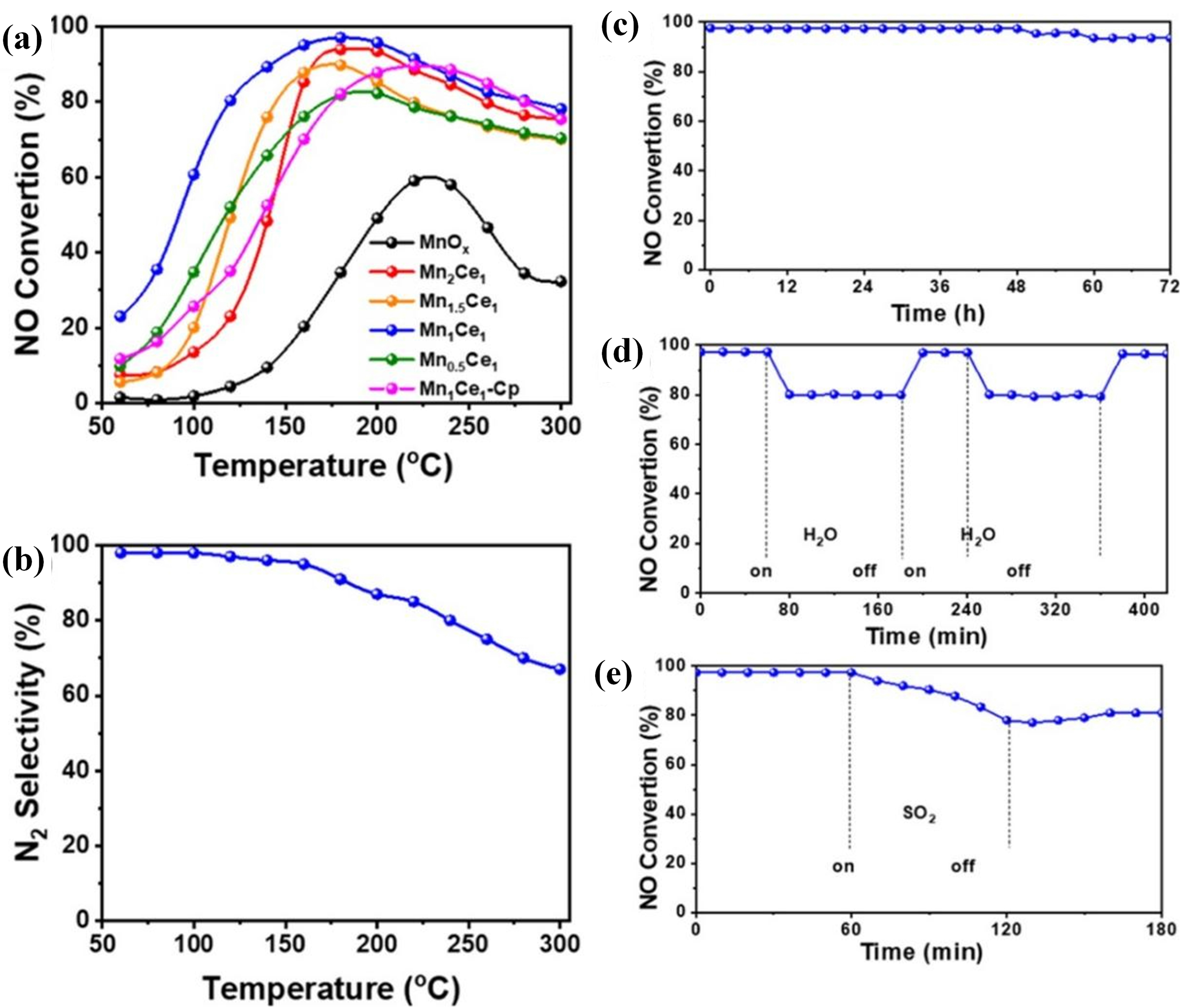
Fig. 2. 3D mesoporous Mn-Ce oxide maintains high NOx conversion and resistance to H2O/SO2. (a) De-NOx activity; (b) N2 selectivity; (c) Stability test; (d) H2O resistance; (e) SO2 resistance. Reprinted with permission from Ref. [72]. Copyright 2021, American Chemical Society.
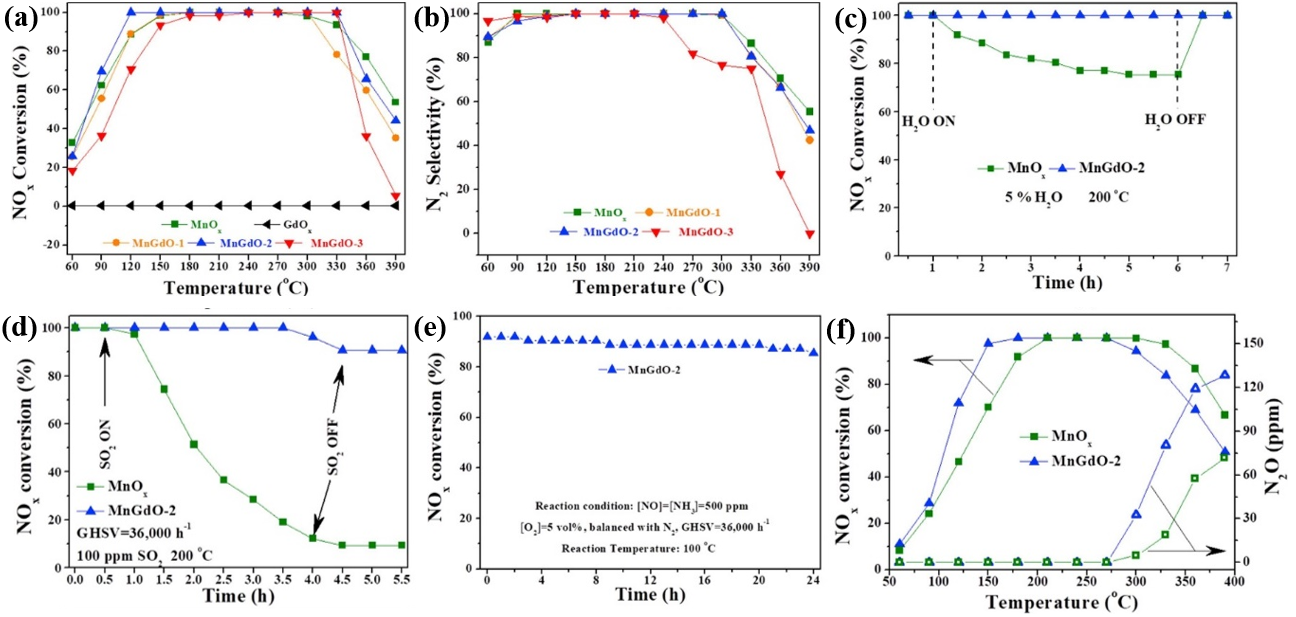
Fig. 3. Gd acts as an electronic promoter, sustaining high conversion/selectivity even under high space velocity and suppressing N2O formation. (a) De-NOx performance; (b) N2 selectivity; (c) H2O resistance test; (d) SO2 resistance test; (e) Stability test; (f) De-NOx performance and N2O production at high GHSV. Reprinted with permission from Ref. [28]. Copyright 2018, Elsevier.
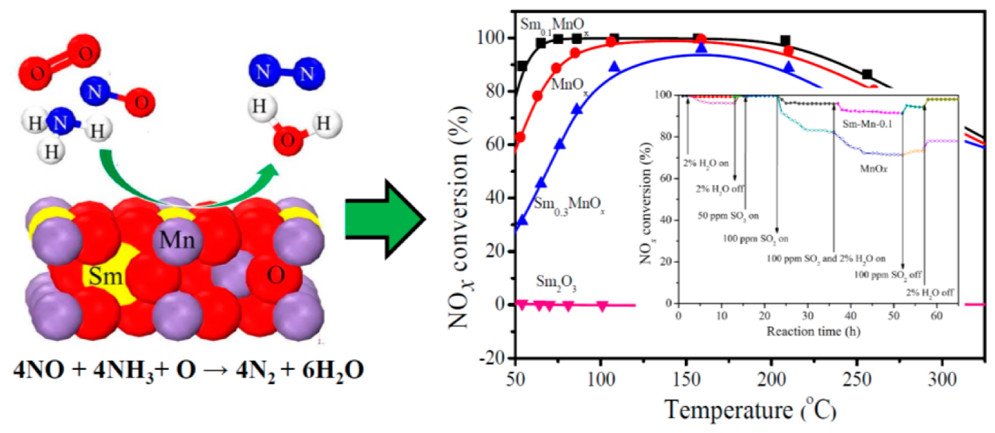
Fig. 4. High NOx removal activity and H2O/SO2 resistance of the Sm-MnOx catalyst: (a) Schematic illustration of the NOx reduction reaction and proposed reaction mechanism, and (b) NOx conversion as a function of reaction temperature and stability under H2O/SO2 atmospheres. Reprinted with permission from Ref. [25].Copyright 2015, American Chemical Society.
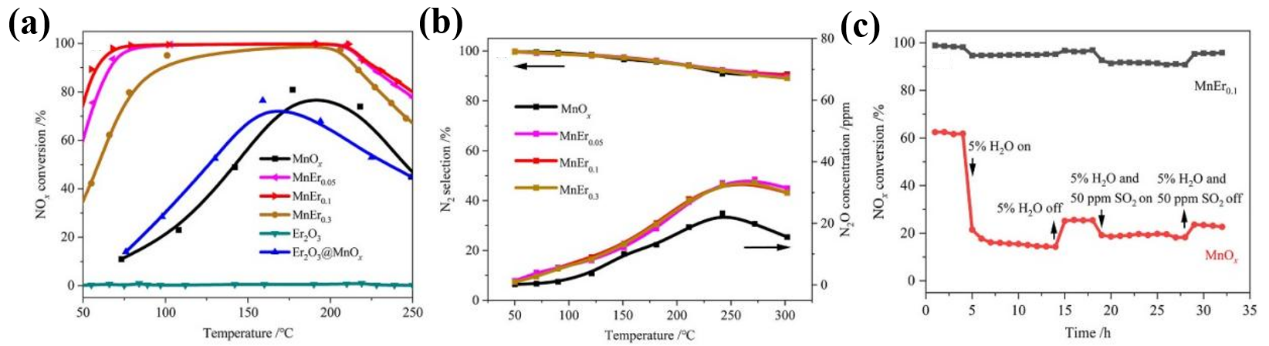
Fig. 5. Er modification improves the balance between activity and selectivity and enhances tolerance to H2O and SO2. (a) NH3-SCR activity; (b) N2 selectivity over various catalysts; (c) SO2 and H2O resistance of MnEr0.1 and MnOx at 150 °C. Reprinted with permission from Ref. [30]. Copyright 2023, Elsevier.
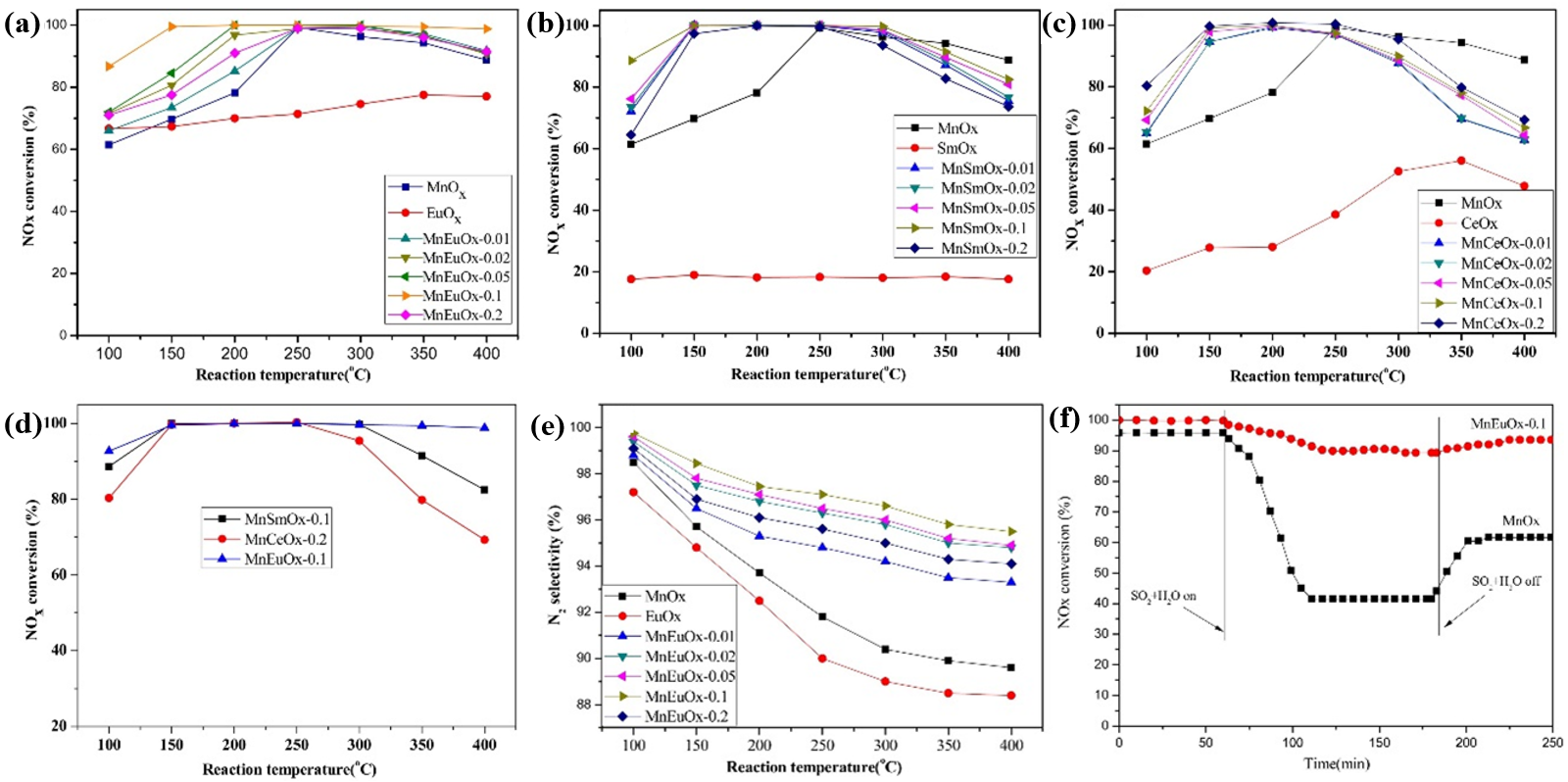
Fig. 6. Eu modification broadens the active temperature window while keeping high N2 selectivity and poisoning resistance. (a-d) NOx conversion; (e) N2 selectivity; (f) H2O and SO2 resistance test of MnEuOx-0.1. Reprinted with permission from Ref. [74]. Copyright 2017, Elsevier.
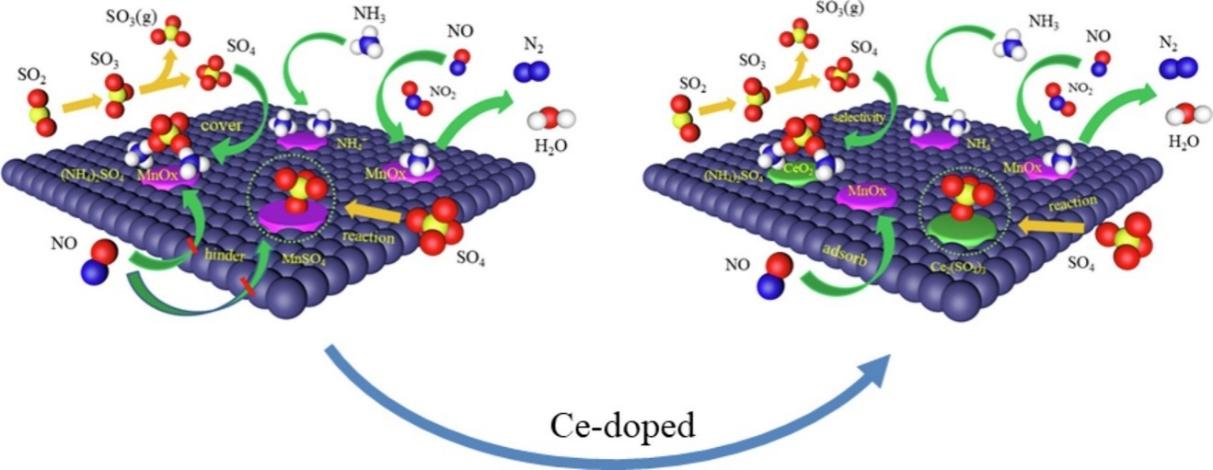
Fig. 7. Erosion process of the catalyst by SO2. Reprinted with permission from Ref. [44]. Copyright 2022, Elsevier.
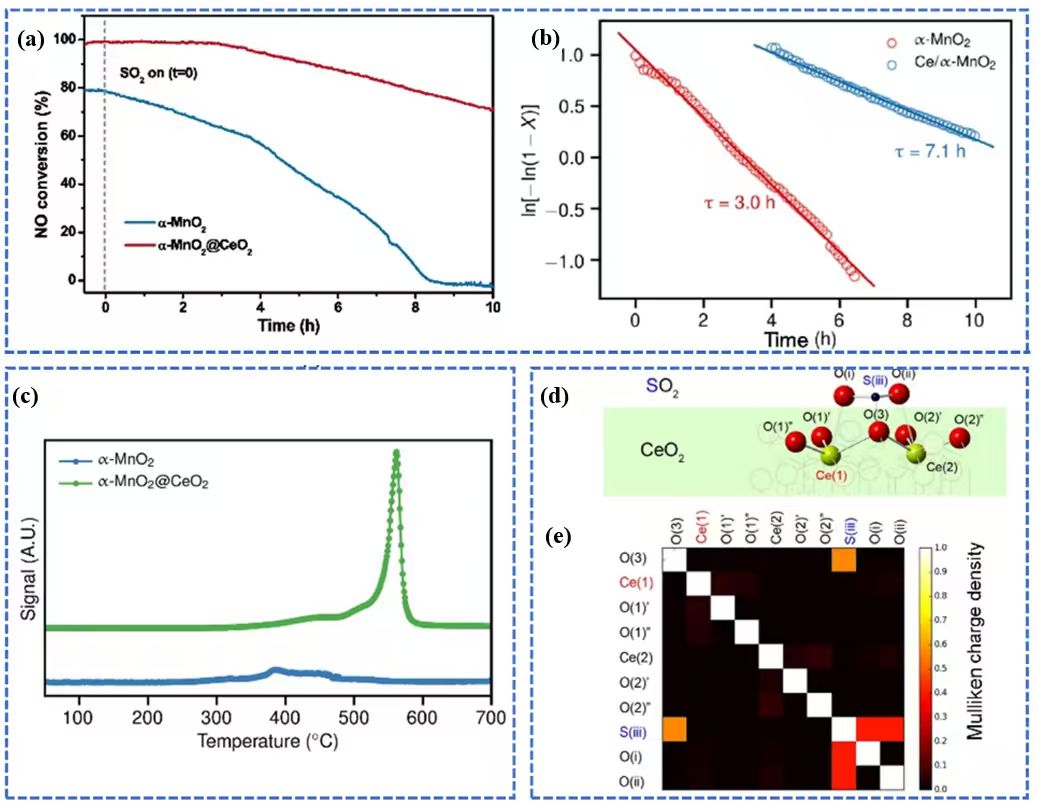
Fig. 8. Ce can buffer SO2 poisoning via reversible sulfate chemistry, enabling prolonged stability under SO2. (a) Long-term stability at 220 °C. (b) Fitting curve of poisoning characteristic time of α-MnO2 and α-MnO2@CeO2 catalysts in the presence of SO2. (c) H₂-TPR profiles of α-MnO2 and α-MnO2@CeO2 catalysts after SO2 pretreatment. (d,e) Mulliken population calculation of SO2 adsorbed on the surface of CeO2 and SO2-CeO2 models. Reprinted with permission from Ref. [88]. Copyright 2020, Elsevier.
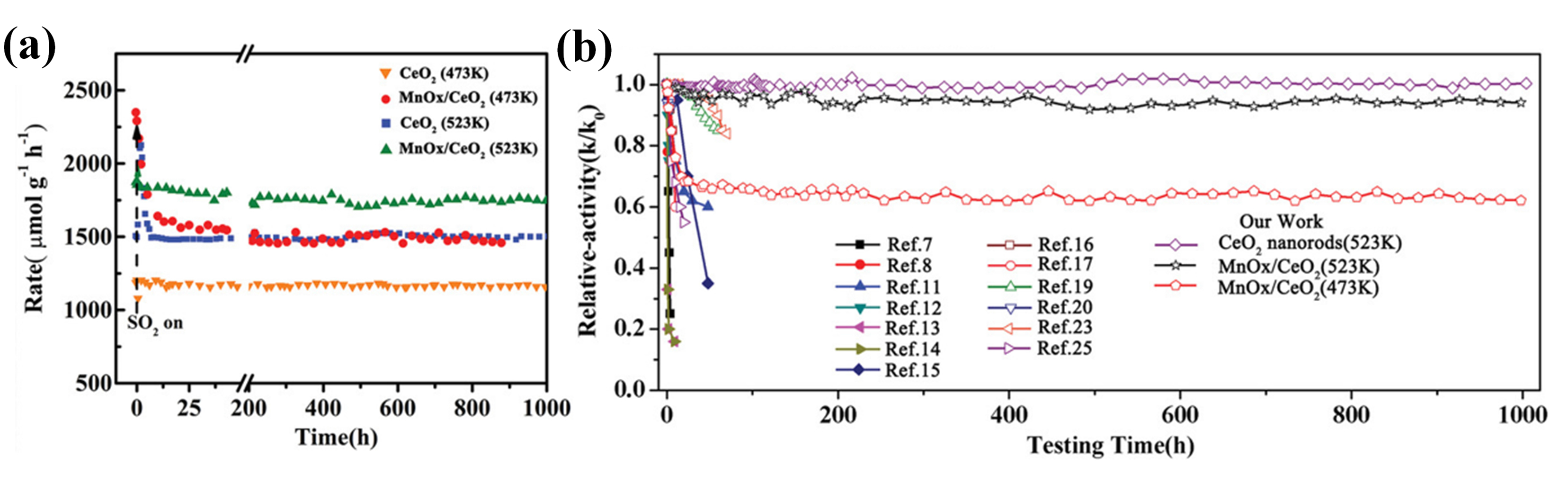
Fig. 9. Catalytic activity and SO2 tolerance of catalysts. (a) Apparent NOx conversion rates over CeO2(NR) and MnOx/CeO2(NR) at 200 and 250 °C. (b) Comparison of activity after SO2 deactivation. Reprinted with permission from Ref. [93]. Copyright 2019, Wiley-VCH.
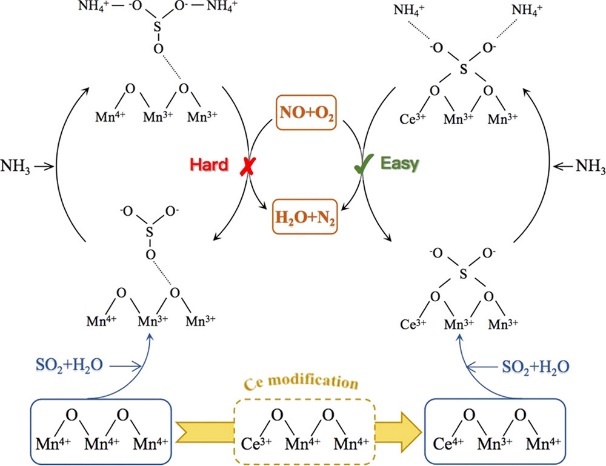
Fig. 10. Mechanism of Ce in promoting the SO2 poisoning resistance of the birnessite-MnO2 catalyst. Reprinted with permission from Ref. [68]. Copyright 2021, American Chemical Society.
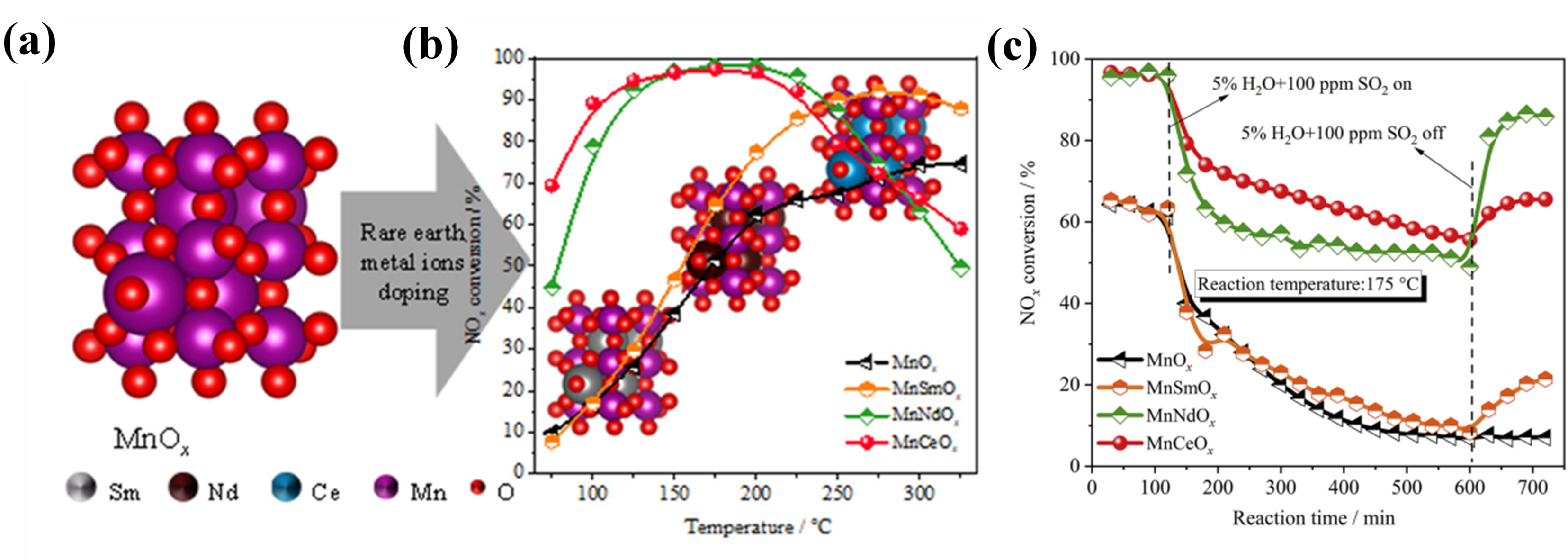
Fig. 11. Different RE modifiers (e.g., Sm/Nd/Ce) lead to distinct trade-offs in activity and H2O/SO2 tolerance in MnOx systems. (a) Structure model of MnOx. (b) Comparison of low-temperature SCR activity over Mn-based catalysts modified with different RE. (c) H2O and SO2 resistance of the prepared catalysts at 175 °C. Reprinted with permission from Ref. [101]. Copyright 2023, Elsevier.
| RE element | Primary focus | Key mechanistic highlight | Main advantage | Ref. |
|---|---|---|---|---|
| Ce | redox hub and SO2 trap | Ce3+/Ce4+-Mn3+/Mn4+ shuttle; higher surface Mn4+ and chemisorbed oxygen; preferential sulfation and core-shell protection; promotes (NH4)2SO4 decomposition; sulfate-derived B-sites | high activity and strong H2O/SO2 tolerance | [ |
| Sm | electronic/kinetic promoter | lowers apparent activation energy; strengthens the nitrate route; less N2O | improved low-temperature activity and N2 selectivity | [ |
| Gd | phase and structure stabilizer | stabilizes texture and inhibits crystallization; maintains Mn4+ and chemisorbed oxygen at high GHSV and long time-on-stream | structural durability | [ |
| Eu | electronic protection + sacrificial sulfation | preferential Eu sulfation protects Mn sites | SO2 resistance | [ |
| Pr | SO2-affinity modifier | preferential sulfation (sacrificial layer); supports redox cycling | SO2 tolerance with activity retention | [ |
| Er | defect/oxygen-vacancy promoter | More oxygen vacancies; maintains higher Mn4+; broadens the activity window | wide operation window | [ |
| Tm | acidity tuning | induces B-sites via Tm-OH groups; enhances NH3 adsorption/activation and NH3 migration | acidity-driven low-temperature activity | [ |
| Ho | mechanism/pathway tuning | promotes dual L-H and E-R routes; | mechanistic flexibility | [ |
Table 5 Systematic comparison of the roles and representative trade-offs of different RE elements in Mn-based SCR catalysts.
| RE element | Primary focus | Key mechanistic highlight | Main advantage | Ref. |
|---|---|---|---|---|
| Ce | redox hub and SO2 trap | Ce3+/Ce4+-Mn3+/Mn4+ shuttle; higher surface Mn4+ and chemisorbed oxygen; preferential sulfation and core-shell protection; promotes (NH4)2SO4 decomposition; sulfate-derived B-sites | high activity and strong H2O/SO2 tolerance | [ |
| Sm | electronic/kinetic promoter | lowers apparent activation energy; strengthens the nitrate route; less N2O | improved low-temperature activity and N2 selectivity | [ |
| Gd | phase and structure stabilizer | stabilizes texture and inhibits crystallization; maintains Mn4+ and chemisorbed oxygen at high GHSV and long time-on-stream | structural durability | [ |
| Eu | electronic protection + sacrificial sulfation | preferential Eu sulfation protects Mn sites | SO2 resistance | [ |
| Pr | SO2-affinity modifier | preferential sulfation (sacrificial layer); supports redox cycling | SO2 tolerance with activity retention | [ |
| Er | defect/oxygen-vacancy promoter | More oxygen vacancies; maintains higher Mn4+; broadens the activity window | wide operation window | [ |
| Tm | acidity tuning | induces B-sites via Tm-OH groups; enhances NH3 adsorption/activation and NH3 migration | acidity-driven low-temperature activity | [ |
| Ho | mechanism/pathway tuning | promotes dual L-H and E-R routes; | mechanistic flexibility | [ |
| Catalyst | Preparation method | Reaction conditions: [NOx]; [NH3]; [O2]; GHSV (ppm, ppm, vol%, h-1); balance gas | NOx conversion | N2 selectivity | Year/Ref. |
|---|---|---|---|---|---|
| Mn-Ce-Co | two-step hydrothermal | 500; 500; 5.0; 24000; N2 | ∼100% (90-270 °C) | ∼100% (60-240 °C) | 2020/[ |
| Mn-V-Ce | hydrothermal | 500; 500; 6.0; 160000; N2 | > 90% (200-350 °C) | > 90% (75-300 °C) | 2020/[ |
| Mn-Ce-Co | one-step redox precipitation | 300; 300; 5.0; 30,000; N2 | > 80% (87-277 °C) | > 90% (50-175 °C) | 2023/[ |
| Mn-Ce-Fe | impregnation | 500; 500; 5.0, 50000; N2 | > 90% (125-225 °C) | > 80% (0-150 °C) | 2024/[ |
| Mn-Ce-Sm-Fe | > 90% (100-275 °C) | > 80% (0-200 °C) | |||
| Mn-Ce | hydrothermal | 600; 600; 5.0; 108000; Ar | > 70% (200-350 °C) | > 95% (100-400 °C) | 2024/[ |
| Mn-Ce-Pr | one-step impregnation | > 90% (180-345 °C) | > 95% (100-400 °C) | ||
| Mn-Nb-Fe | electrospinning | 500; 500; 5.0; 36000; N2 | ∼100% (180-300 °C) | > 90% (60-300 °C) | 2023/[ |
| Mn-Nd-Nb-Fe | ∼100% (160-300 °C) | > 90% (60-360 °C) | |||
| Mn-Ce | wetness Impregnation | 600; 600; 6.5; 84000; Ar | > 90% (150-350 °C) | > 80% (50-250 °C) | 2021/[ |
| Mn-V-Ce | > 90% (150-400 °C) | > 85% (50-400 °C) | |||
| Mn-Gd-Co | one-step synthesis | 500; 500; 5.0; 100000; N2 | ∼100% (100-250 °C) | > 90% (50-300 °C) | 2024/[ |
| Mn-Ce | Co-precipitation | 500; 500; 5.0; 30000; N2 | > 80% (100-300 °C) | > 80% (100-150 °C) | 2020/[ |
| Mn-Fe | > 80% (100-300 °C) | > 80% (100-150 °C) | |||
| Mn-Ce-Fe | > 95% (150-200 °C) | > 90% (100-150 °C) |
Table 6 RE modification effects on Mn-M composite catalysts: De-NOx activity and N2 selectivity.
| Catalyst | Preparation method | Reaction conditions: [NOx]; [NH3]; [O2]; GHSV (ppm, ppm, vol%, h-1); balance gas | NOx conversion | N2 selectivity | Year/Ref. |
|---|---|---|---|---|---|
| Mn-Ce-Co | two-step hydrothermal | 500; 500; 5.0; 24000; N2 | ∼100% (90-270 °C) | ∼100% (60-240 °C) | 2020/[ |
| Mn-V-Ce | hydrothermal | 500; 500; 6.0; 160000; N2 | > 90% (200-350 °C) | > 90% (75-300 °C) | 2020/[ |
| Mn-Ce-Co | one-step redox precipitation | 300; 300; 5.0; 30,000; N2 | > 80% (87-277 °C) | > 90% (50-175 °C) | 2023/[ |
| Mn-Ce-Fe | impregnation | 500; 500; 5.0, 50000; N2 | > 90% (125-225 °C) | > 80% (0-150 °C) | 2024/[ |
| Mn-Ce-Sm-Fe | > 90% (100-275 °C) | > 80% (0-200 °C) | |||
| Mn-Ce | hydrothermal | 600; 600; 5.0; 108000; Ar | > 70% (200-350 °C) | > 95% (100-400 °C) | 2024/[ |
| Mn-Ce-Pr | one-step impregnation | > 90% (180-345 °C) | > 95% (100-400 °C) | ||
| Mn-Nb-Fe | electrospinning | 500; 500; 5.0; 36000; N2 | ∼100% (180-300 °C) | > 90% (60-300 °C) | 2023/[ |
| Mn-Nd-Nb-Fe | ∼100% (160-300 °C) | > 90% (60-360 °C) | |||
| Mn-Ce | wetness Impregnation | 600; 600; 6.5; 84000; Ar | > 90% (150-350 °C) | > 80% (50-250 °C) | 2021/[ |
| Mn-V-Ce | > 90% (150-400 °C) | > 85% (50-400 °C) | |||
| Mn-Gd-Co | one-step synthesis | 500; 500; 5.0; 100000; N2 | ∼100% (100-250 °C) | > 90% (50-300 °C) | 2024/[ |
| Mn-Ce | Co-precipitation | 500; 500; 5.0; 30000; N2 | > 80% (100-300 °C) | > 80% (100-150 °C) | 2020/[ |
| Mn-Fe | > 80% (100-300 °C) | > 80% (100-150 °C) | |||
| Mn-Ce-Fe | > 95% (150-200 °C) | > 90% (100-150 °C) |
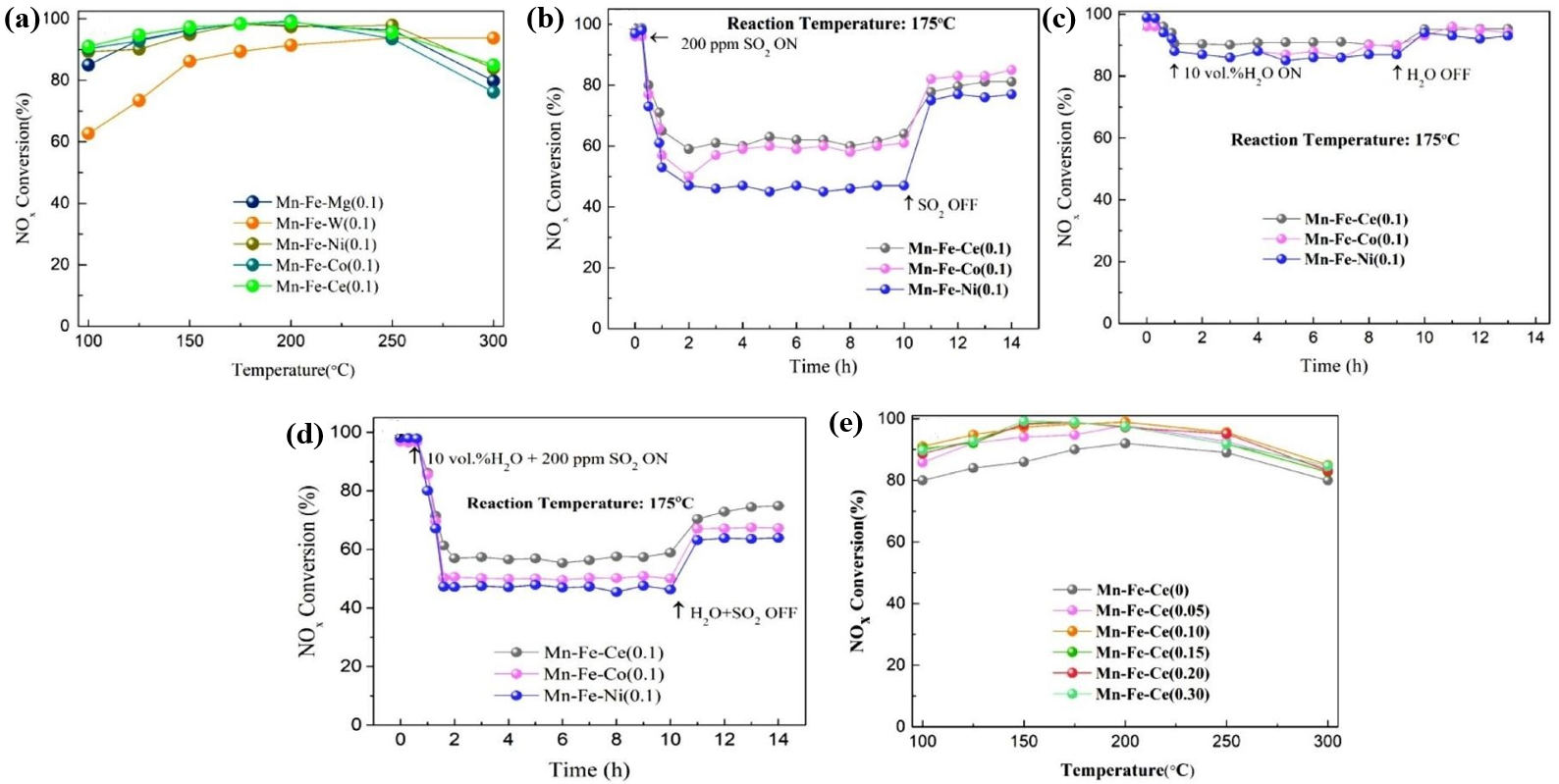
Fig. 12. In Mn-Fe-Ce systems, Ce-enabled redox coupling delivers high activity and retains performance under severe H2O/SO2 conditions. (a) NOx conversion of catalysts doped with different elements. (b) SO2 resistance study. (c) H2O tolerance test. (d) H2O and SO2 tolerance test. (e) NOx conversion over Mn-Fe-Ce catalysts. Reprinted with permission from Ref. [33]. Copyright 2020, Elsevier.

Fig. 13. Sm introduction improves morphology/dispersion and mitigates sulfation in MnFe-based catalysts, as evidenced by SEM/EDS. (a) MnFe; (b) SmMnFe-0.1; (c) SmMnFe-0.3; (d) MnFe-S; (e) SmMnFe-0.1-S catalysts. Reprinted with permission from Ref. [121]. Copyright 2022, Elsevier.
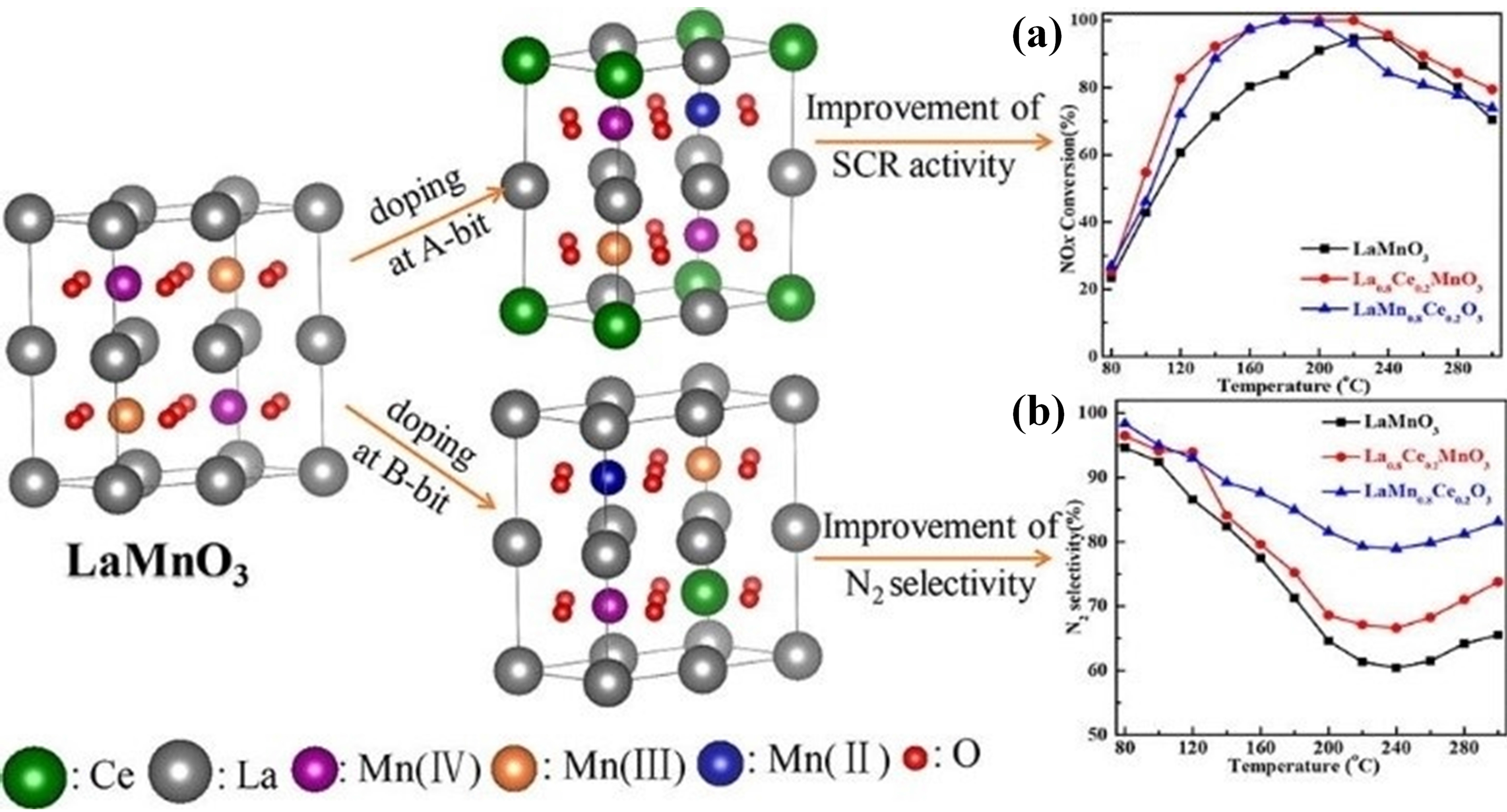
Fig. 14. Regulation of de-NOx performance of LaMnO3 catalysts by Ce doping at A/B sites: (a) NOx conversion, (b) N2 selectivity. Reprinted with permission from Ref. [124], Copyright 2021, Elsevier.
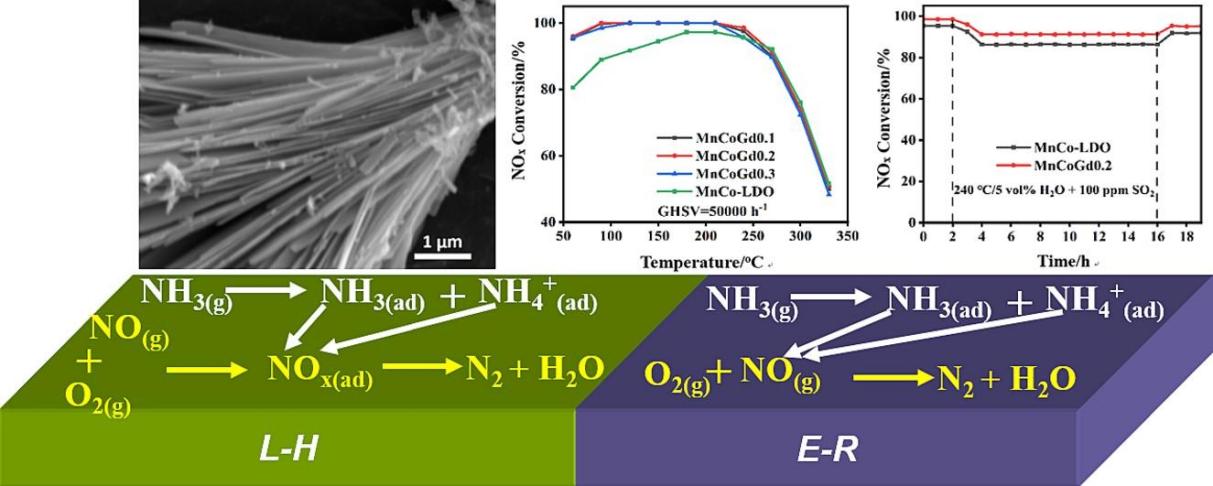
Fig. 15. Gd-modified Mn-Co LDH-derived oxides arises from coupled redox enhancement and acid-site optimization, improving H2O/SO2 resistance. Reprinted with permission from Ref. [111]. Copyright 2024, Elsevier.
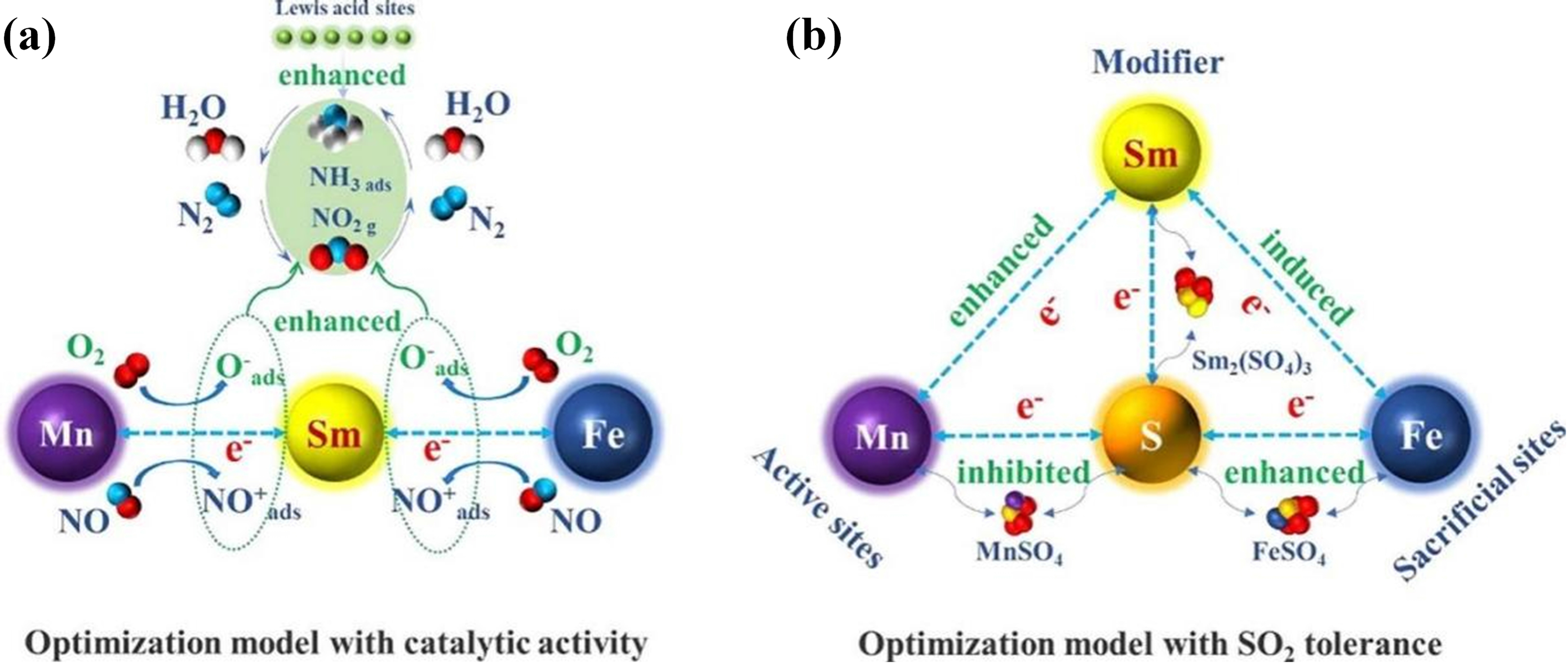
Fig. 16. Schematic illustration of the optimization mechanism of Sm doping on the catalytic activity (a) and SO2 tolerance (b) of MnFeOx catalysts. Reprinted with permission from Ref. [121]. Copyright 2022, Elsevier.
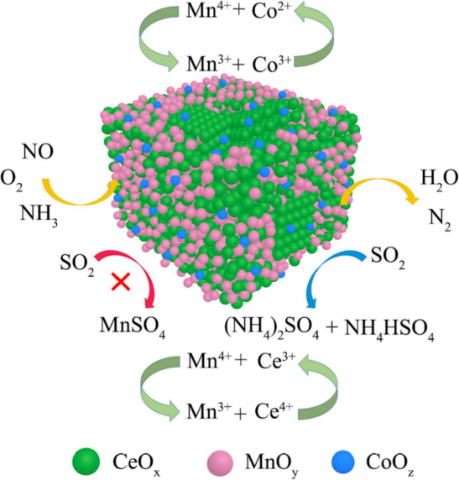
Fig. 17. Ce-Mn-Co synergy builds multi-step redox cycles that accelerate SCR while limiting sulfate accumulation. Reprinted with permission from Ref. [107]. Copyright 2023, Elsevier.
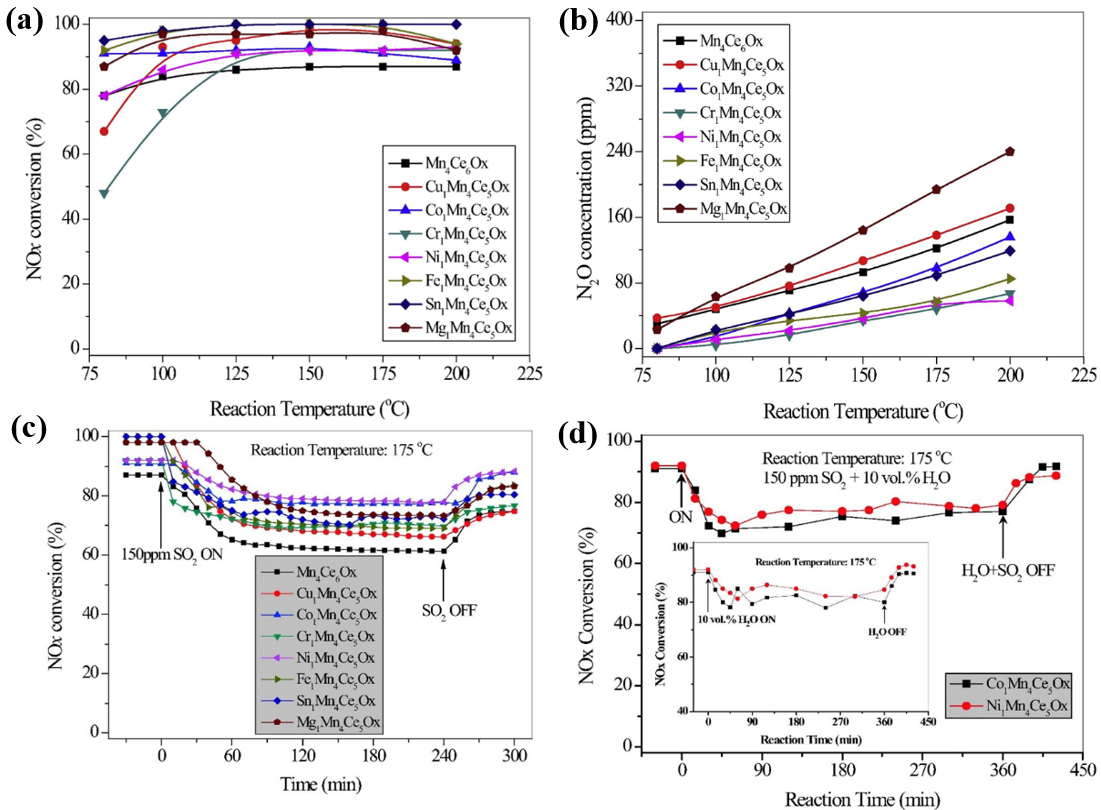
Fig. 18. Co/Ni dopants in MnOx-CeO2 enhance redox kinetics and expand robustness against H2O/SO2 poisoning. (a) Catalytic performance of the series of catalysts. (b) N2O yield. (c) NOx conversion in the presence of SO2 at 175 °C. (d) H2O and/or SO2 resistance of Co1Mn4Ce5Ox and Ni1Mn4Ce5Ox. Reprinted with permission from Ref. [126]. Copyright 2017, Elsevier.
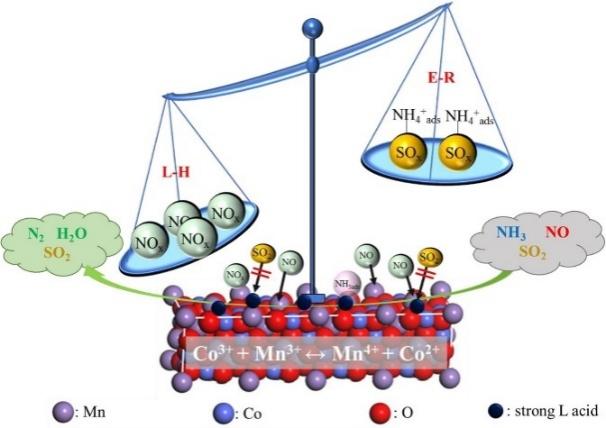
Fig. 19. Mechanistic switching from SO2-sensitive E-R to robust L-H pathway underpins the stability of Mn5Co5Ox catalyst. Reprinted with permission from Ref. [127]. Copyright 2023, Elsevier.
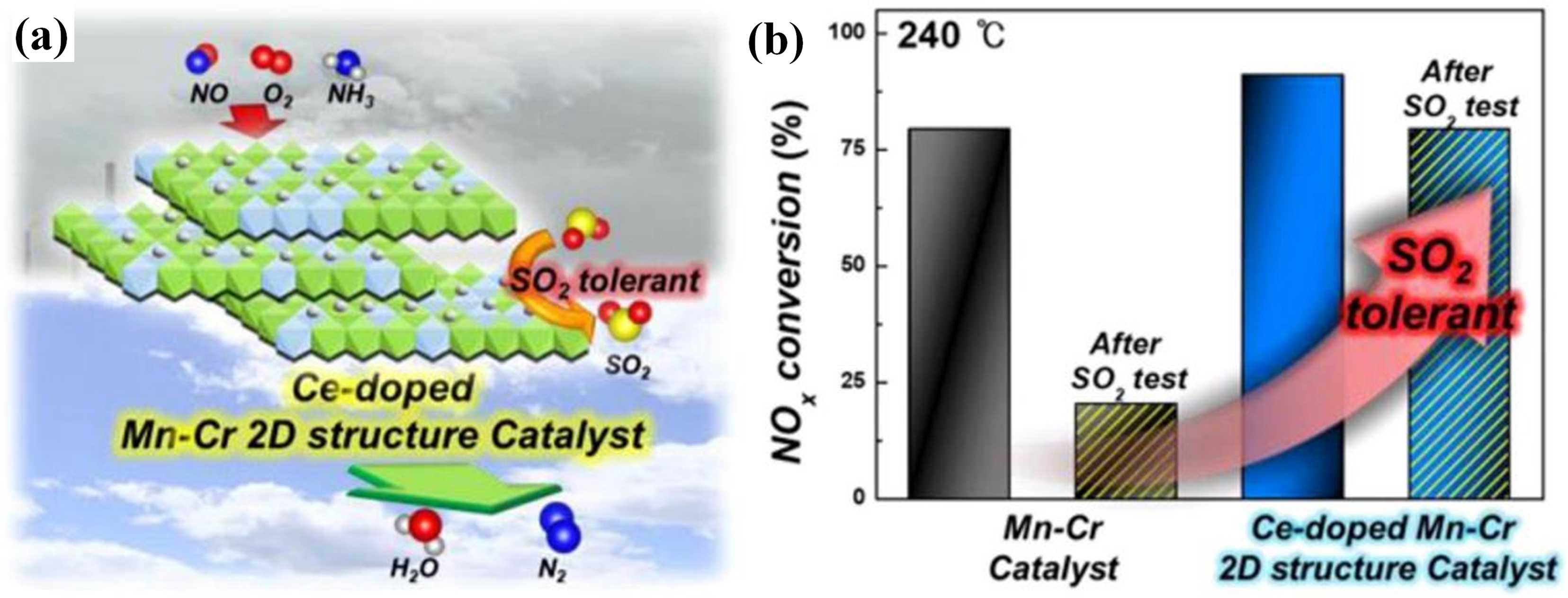
Fig. 20. High activity and H2O/SO2 resistance of the Ce0.2-Mn2Cr1Ox-LDO catalyst: (a) Schematic diagram of 2D structure, de-NOx and SO2 tolerance mechanism, (b) Regeneration effect at 300 oC after deactivation. Reprinted with permission from Ref. [128]. Copyright 2022, Elsevier.
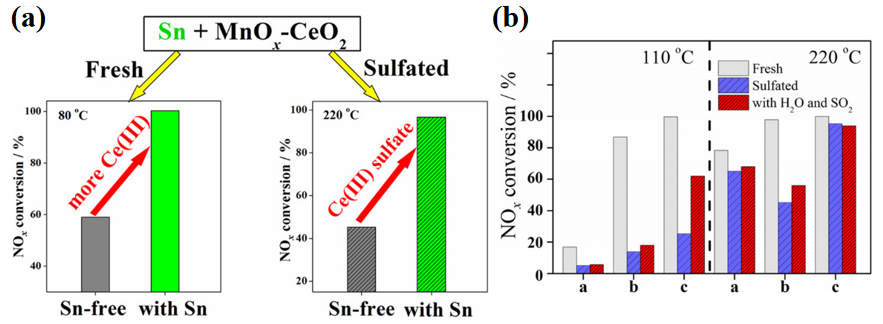
Fig. 21. Sn doping provides acidity/structure reinforcement that markedly boosts low-temperature activity in Mn-Ce oxides. (a) Significant improvement of low-temperature activity by Sn introduction. (b) Effects of SO2 + H2O and sulfation on NOx conversion over Sn(0.5)-Ce(0.5)-O, Mn(0.4)-Ce(0.6)-O, and Sn(0.1)-Mn(0.4)-Ce(0.5)-O catalysts. Reprinted with permission from Ref. [129]. Copyright 2013, American Chemical Society.
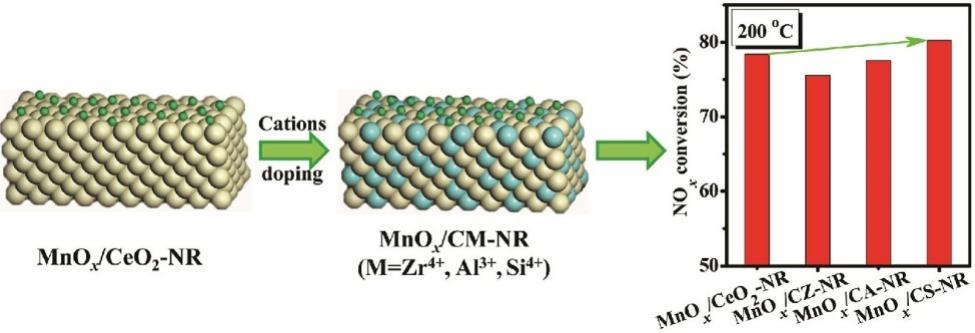
Fig. 22. Schematic illustration of doping (M = Zr⁴⁺, Al³⁺, Si⁴⁺) into MnOx/CeO2-NR and its effect on NOx conversion. Reprinted with permission from Ref. [34], Copyright 2019, Elsevier.
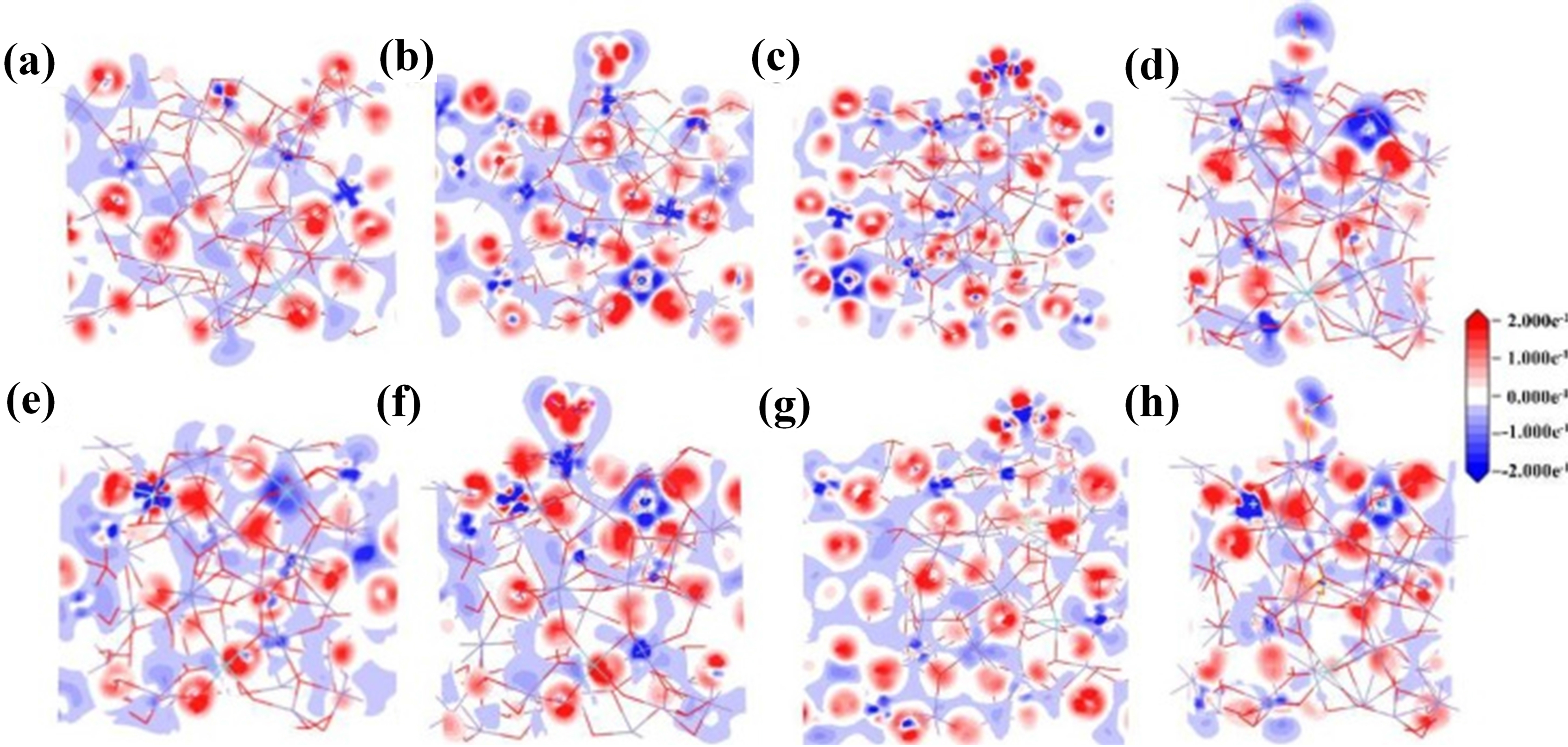
Fig. 23. Nb/Nd co-doping induces an electron-deficient surface that weakens SO2 bond strength: Electron density difference analysis. MnFeNbOx surface (a) with adsorbed NH3 (b), NO (c), and SO2 (d); (e) MnFeNb₀.₂Nd₀.₁Ox surface with adsorbed NH3 (f), NO (g), and SO2 (h). Blue and red colors indicate a decrease and increase in electron density, respectively. Reprinted with permission from Ref. [110]. Copyright 2023, Elsevier.
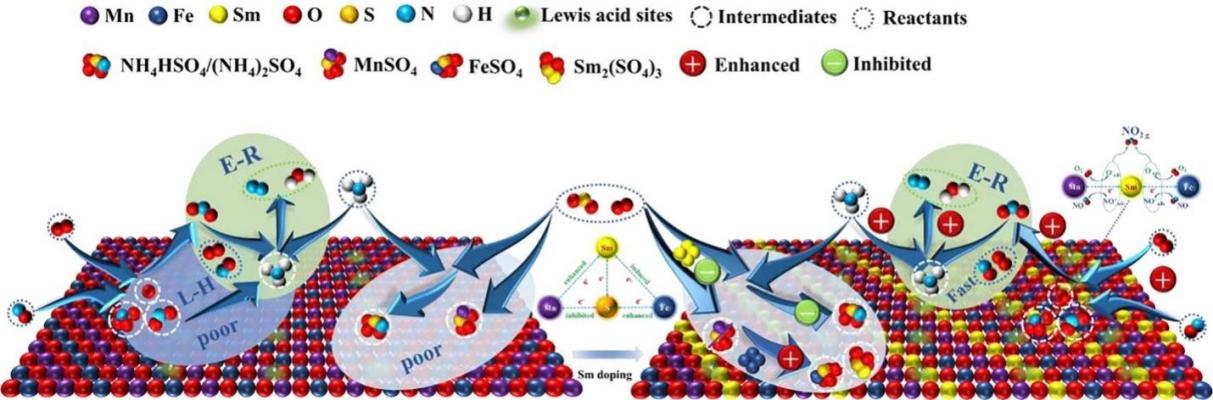
Fig. 24. Sm promotes both SCR activity and SO2 resistance in MnFeOx catalysts through combined electronic and adsorption regulation. Reprinted with permission from Ref. [121]. Copyright 2022, Elsevier.
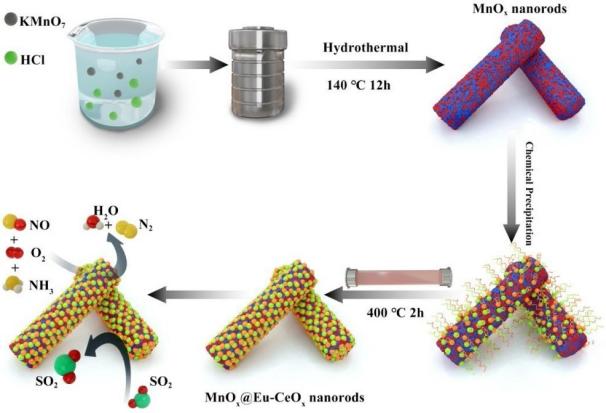
Fig. 25. Schematic illustration of the preparation process of MnOx@Eu-CeOx core-shell materials. Reprinted with permission from Ref. [130]. Copyright 2020, Elsevier.
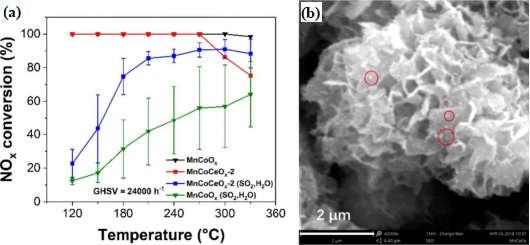
Fig. 26. Improve durability under H2O/SO2 (a) and In-situ grown CeO2 nanoparticles on Mn-Co microflowers stabilize the surface (b). Reprinted with permission from Ref. [105]. Copyright 2020, Elsevier.
| Catalyst system | Synergistic effects and performance enhancement | Ref. |
|---|---|---|
| Mn-Ce-W | W moderately weakens the redox strength of the Mn-Ce system. It slightly reduces NO oxidation at low temperatures but strongly suppresses over oxidation of NH3 at higher temperature, which decreases N2O formation and improves resistance to water | [ |
| Mn-Ce-Fe | Ce and Fe build an electron transfer cycle involving Mn3+ and Fe3+ that markedly enhances low-temperature activity. CeO2 reacts preferentially with SO2, protects Mn active sites and improves sulfur resistance. | [ |
| Mn-Ce-Sn | Sn doping strengthens the Ce3+/Ce4+ redox cycle and increases the concentration of oxygen vacancies, which promotes oxidation of NO to NO2 and activates the fast SCR route. It also greatly increases the amount of surface acid sites, so low-temperature de-NOx activity is significantly enhanced. | [ |
| Mn-Ce-Sm | Ce captures SO2 through chemisorption and preferential sulfation. Sm increases the number of L-sites, stabilizes the structure and enhances hydrophobicity, and its electronic effects suppress over oxidation of NH3. These contributions together improve N2 selectivity and sulfur resistance. | [ |
| Mn-Ce-La | In LaMnO3 perovskite, the lattice position of Ce doping precisely controls performance. Substitution at the A site enhances SO2 tolerance, whereas substitution at the B site effectively improves N2 selectivity. La forms the perovskite framework and influences the surface area and thermal stability of the catalyst. | [ |
| Mn-Ce-Pr | Pr induces a broom like morphology and increases the specific surface area. It also acts as an SO2 trap that reacts preferentially and forms sulfates with a relatively high decomposition temperature, which effectively protects Mn active centers. | [ |
| Mn-Ce-Si | Among Si4+, Zr4+ and Al3+ dopants, Si4+ gives the best overall effect. It provides the richest oxygen vacancies and acid sites, the highest Mn4+ content and an appropriate redox strength, and these features combine to enhance activity, selectivity and resistance to poisoning. | [ |
| Mn-Ce-Cr | Cr establishes Mn-Cr redox cycles and effectively suppresses formation of MnSO₄, so catalysts poisoned by H2O and SO2 can fully recover their activity through simple thermal regeneration. | [ |
| Mn-Ce-Co | Co introduction creates a new Mn3+/Co3+ redox cycle that works together with the Mn4+/Ce3+ cycle. This cooperation promotes oxygen migration and oxygen vacancy formation and suppresses MnSO4 formation. | [ [ |
| Mn-Sm-Fe | Sm increases the number of L-sites and builds Sm2+/Mn4+ and Sm2+/Fe3+ electron transfer cycles, which enhance NO activation and N2 selectivity. Fe acts as a sacrificial site that reacts preferentially with SO2, and this sacrificial behavior works together with Sm to improve sulfur resistance. | [ |
| Mn-Ce-Ni | Ni enhances the overall oxidation ability, promotes oxidation of NO to NO2 and activates the fast SCR route. It also effectively suppresses N2O formation and improves selectivity. | [ |
| Mn-Ce-Eu MnOx@Eu-CeOx | The Eu-CeOx shell physically isolates the MnOx core and minimizes SO2 poisoning while enhancing surface acidity, which builds a core-shell cooperative protection mechanism. | [ |
| Gd-Mn-Co | Gd stabilizes the layered structure and significantly increases the specific surface area. Together with Co, it raises the contents of Mn4+ and Co3+, strengthens redox ability and acidity and results in high activity over a wide temperature window. | [ |
| Mn-Ce-Nb-Fe | Nb5+ and Fe3+ strengthen electronic interactions and surface acidity. Nb reacts preferentially with SO2 and promotes decomposition of surface NH4HSO4, which protects Mn and Ce active sites in a cooperative way. | [ |
| Mn-Nb-Fe-Nd | Nb and Nd form Nb-O-Nd bridges. Their electronic effects enhance adsorption of NH3 and NO while suppressing adsorption of SO2 and thus provide precise and simultaneous promotion of reactants and inhibition of poisons. | [ |
Table 7 Summary of synergistic mechanisms in Mn-RE-M catalyst systems.
| Catalyst system | Synergistic effects and performance enhancement | Ref. |
|---|---|---|
| Mn-Ce-W | W moderately weakens the redox strength of the Mn-Ce system. It slightly reduces NO oxidation at low temperatures but strongly suppresses over oxidation of NH3 at higher temperature, which decreases N2O formation and improves resistance to water | [ |
| Mn-Ce-Fe | Ce and Fe build an electron transfer cycle involving Mn3+ and Fe3+ that markedly enhances low-temperature activity. CeO2 reacts preferentially with SO2, protects Mn active sites and improves sulfur resistance. | [ |
| Mn-Ce-Sn | Sn doping strengthens the Ce3+/Ce4+ redox cycle and increases the concentration of oxygen vacancies, which promotes oxidation of NO to NO2 and activates the fast SCR route. It also greatly increases the amount of surface acid sites, so low-temperature de-NOx activity is significantly enhanced. | [ |
| Mn-Ce-Sm | Ce captures SO2 through chemisorption and preferential sulfation. Sm increases the number of L-sites, stabilizes the structure and enhances hydrophobicity, and its electronic effects suppress over oxidation of NH3. These contributions together improve N2 selectivity and sulfur resistance. | [ |
| Mn-Ce-La | In LaMnO3 perovskite, the lattice position of Ce doping precisely controls performance. Substitution at the A site enhances SO2 tolerance, whereas substitution at the B site effectively improves N2 selectivity. La forms the perovskite framework and influences the surface area and thermal stability of the catalyst. | [ |
| Mn-Ce-Pr | Pr induces a broom like morphology and increases the specific surface area. It also acts as an SO2 trap that reacts preferentially and forms sulfates with a relatively high decomposition temperature, which effectively protects Mn active centers. | [ |
| Mn-Ce-Si | Among Si4+, Zr4+ and Al3+ dopants, Si4+ gives the best overall effect. It provides the richest oxygen vacancies and acid sites, the highest Mn4+ content and an appropriate redox strength, and these features combine to enhance activity, selectivity and resistance to poisoning. | [ |
| Mn-Ce-Cr | Cr establishes Mn-Cr redox cycles and effectively suppresses formation of MnSO₄, so catalysts poisoned by H2O and SO2 can fully recover their activity through simple thermal regeneration. | [ |
| Mn-Ce-Co | Co introduction creates a new Mn3+/Co3+ redox cycle that works together with the Mn4+/Ce3+ cycle. This cooperation promotes oxygen migration and oxygen vacancy formation and suppresses MnSO4 formation. | [ [ |
| Mn-Sm-Fe | Sm increases the number of L-sites and builds Sm2+/Mn4+ and Sm2+/Fe3+ electron transfer cycles, which enhance NO activation and N2 selectivity. Fe acts as a sacrificial site that reacts preferentially with SO2, and this sacrificial behavior works together with Sm to improve sulfur resistance. | [ |
| Mn-Ce-Ni | Ni enhances the overall oxidation ability, promotes oxidation of NO to NO2 and activates the fast SCR route. It also effectively suppresses N2O formation and improves selectivity. | [ |
| Mn-Ce-Eu MnOx@Eu-CeOx | The Eu-CeOx shell physically isolates the MnOx core and minimizes SO2 poisoning while enhancing surface acidity, which builds a core-shell cooperative protection mechanism. | [ |
| Gd-Mn-Co | Gd stabilizes the layered structure and significantly increases the specific surface area. Together with Co, it raises the contents of Mn4+ and Co3+, strengthens redox ability and acidity and results in high activity over a wide temperature window. | [ |
| Mn-Ce-Nb-Fe | Nb5+ and Fe3+ strengthen electronic interactions and surface acidity. Nb reacts preferentially with SO2 and promotes decomposition of surface NH4HSO4, which protects Mn and Ce active sites in a cooperative way. | [ |
| Mn-Nb-Fe-Nd | Nb and Nd form Nb-O-Nd bridges. Their electronic effects enhance adsorption of NH3 and NO while suppressing adsorption of SO2 and thus provide precise and simultaneous promotion of reactants and inhibition of poisons. | [ |
| Catalyst | Preparation method | Reaction conditions: [NOx]; [NH3]; [O2]; GHSV (ppm, ppm, vol%, h-1); balance gas | NOx conversion | SO2 resistance | H2O resistance | Combined H2O + SO2 tolerance | Year/ [Ref.] |
|---|---|---|---|---|---|---|---|
| Mn-V- Ce | hydrothermal | 500; 500; 6.0; 160000; N2 | > 90% (200-350 °C) | 100 ppm SO2, ~100% to ~80% after 12 h at 220 °C | 5.5% H2O, ~100% to ~80% after 12 h at 220 °C | 100 ppm SO2, 5.5% H2O, ~100% to ~60% after 12 h at 220 °C | 2020/[ |
| Mn-Ce-Fe | Co- precipitation | 500; 500; 5.0; 30000; N2 | > 95% (150-200 °C) | 200 ppm SO2, ~100% to ~60% after 8 h at 175 °C | 10% H2O, ~100% to ~90% after 8 h at 175 °C | 200 ppm SO2, 5.5% H2O, ~100% to ~60% after 8 h at 175 °C | 2020/[ |
| Mn-Ce-Fe | impregnation | 500; 500; 5.0; 50000; N2 | > 90% (125-225 °C) | 100 ppm SO2, ~100% to ~30% after 10 h at 180 °C | — | — | 2024/[ |
| Mn-Ce-Sm-Fe | > 90% (100-275 °C) | 100 ppm SO2, ~100% to ~95% after 10 h at 180 °C | — | — | |||
| Mn-Ce | hydrothermal | 600; 600; 5.0; 108000; Ar | > 70% (200-350 °C) | 100 ppm SO2, ~80% to ~60% after 10 h at 250 °C | — | 100 ppm SO2, 5% H2O, ~80% to ~50% after 24 h at 250 °C | 2024/[ |
| Mn-Ce-Pr | one-step impregnation | > 90% (180-345 °C) | 100 ppm SO2, ~100% to ~90% after 10 h at 250 °C | — | 100 ppm SO2, 5% H2O, ~100% to ~80% after 24 h at 250 °C | ||
| Mn-Gd-Co | one-step synthesis | 500; 500; 5.0; 100000; N2 | ∼100% (100-250 °C) | — | — | 100 ppm SO2, 5% H2O, ~100% to ~90% after 14 h at 240 °C | 2024/[ |
| Mn-Nb-Fe | electrospinning | 500; 500; 5.0; 36000; N2 | ∼100% (180-300 °C) | 100 ppm SO2, ~90% to ~30% after 8 h at 120 °C | 10% H2O, ~90% to ~70% after 7 h at 120 °C | 100 ppm SO2, 10% H2O, ~50% to ~20% after 3 h at 120 °C | 2023/[ |
| Mn-Nd-Nb-Fe | ∼ 100% (160-300 °C) | 100 ppm SO2, ~95% to ~50% after 8 h at 120 °C | 10% H2O, ~95% to ~90% after 7 h at 120 °C | 100 ppm SO2, 10% H2O, ~70% to ~30% after 3 h at 120 °C | |||
| Mn-Ce | Co- precipitation | 500; 500; 5.0; 60000; N2 | > 70% (150-250 °C) | — | — | 100 ppm SO2, 5% H2O, ~60% to ~30% after 10 h at 250 °C | 2023/[ |
| Mn-Ce-Nb | > 90% (175-275 °C) | — | — | 100 ppm SO2, 5% H2O, ~60% to ~30% after 10 h at 250 °C | |||
| Mn-Ce-Fe | > 70% (150-275 °C) | — | — | 100 ppm SO2, 5% H2O, ~90% to ~60% after 10 h at 250 °C | |||
| Mn-Ce-Nb-Fe | > 90% (150-250 °C) | — | — | 100 ppm SO2, 5% H2O, ~90% to ~60% after 10 h at 250 °C | |||
| Mn-V- Ce | Wetness impregnation | 600; 600; 6.5; 84,000; Ar | > 90% (150-400 °C) | 100 ppm SO2, 100% to ∼70% after 12 h at 200 °C | 5% H2O, ~100% to ~80% after 12 h at 200 °C | 100 ppm SO2, 5% H2O, 100% to ~60% after 12 h at 200 °C | 2021/[ |
| Mn-Ce-Co | one-step redox precipitation | 300; 300; 5.0; 30000; N2 | > 80% (87-277 °C) | 100 ppm SO2, ~95% to ~60% after 10 h at 210 °C | 10% H2O, ~95% to ~90% after 15 h at 210 °C | 100 ppm SO2, 10% H2O, ~90% to ~60% after 10 h at 250 °C | 2023/[ |
| Mn-Ce-Sn | ultrasonication-assisted coprecipitation | 1000; 1000; 2.0; 35000; N2 | ∼100% (110-230 °C) | 100 ppm SO2, ~100% to ~95% at 220 °C | — | 100 ppm SO2, 10% H2O, ~100% to ~90% at 220 °C | 2013/[ |
| Mn-V- Ce | hydrothermal | 500; 500; 6.0; 160000; N2 | > 90% (200-350 °C) | 100 ppm SO2, ~100% to ~80% after 12 h at 220 °C | 5.5% H2O, ~100% to ~80% after 12 h at 220 °C | 100 ppm SO2, 5.5% H2O, ~100% to ~60% after 12 h at 220 °C | 2020/[ |
| Mn-Sm-Fe | PEG-assisted co-precipitation | 500; 500; 5.0; 60000; N2 | ∼100% (75-200 °C) | 100 ppm SO2, ~100% to ~55% after 3 h at 200 °C | 5% H2O, 100%, no deactivation after 1 h at 200 °C | 100 ppm SO2, 5% H2O, ~55% to ~40% after 3 h at 200 °C | 2022/[ |
| Mn-Fe-Ce-Al | Co- precipitation | 200; 200; 5.0; 1667; N2 | > 80% (100-130 °C) | 100 ppm SO2, ~80% to ~75% after 8 h at 100 °C | 4% H2O, ~80% to ~75% after 8 h at 100 °C | 100 ppm SO2, 4% H2O, 83% to ~60% after 120 h at 100 °C | 2020/[ |
| Mn-Ce-Co | Co- precipitation | 500; 500; 5.0; 48000; N2 | ~90% (75-200 °C) | 150 ppm SO2, 90% to ~70% after 4 h at 175 °C | — | 150 ppm SO2, 10% H2O, 85% to >70% after 6 h at 175 °C | 2017/[ |
| Mn-Ce-Ni | ~90% (125-200 °C) | 150 ppm SO2, 90% to ~70% after 4 h at 175 °C | — | 150 ppm SO2, 10% H2O, 85% to ~70% after 6 h at 175 °C | |||
| Mn-Ce-Cr | Co- precipitation | 500; 500; 5.0; 90000; N2 | > 90% (150-220 °C) | — | — | 100 ppm SO2, 5% H2O, 91% to ~60% after 4 h at 240 °C | 2022/[ |
| Mn-Ce-Eu | chemical precipitation | 600; 600; 2.5; 90000; Ar | > 90% (100-200 °C) | 100 ppm SO2, ~95% to ~90% after 33 h at 200 °C | — | — | 2020/[ |
| Mn-Ce-Zr | hydrothermal | 500; 500; 5.0; 60000; N2 | < 80% (200 °C) | — | — | 100 ppm SO2, 5% H2O, 80% to ~60% after 8 h at 200 °C | 2019/[ |
| Mn-Ce-Al | > 80% (200 °C) | — | — | 100 ppm SO2, 5% H2O, 80% to <60% after 8 h at 200 °C | |||
| Mn-Ce-Si | ~80% (200 °C) | — | — | 100 ppm SO2, 5% H2O, 80% to <60% after 8 h at 200 °C |
Table 8 RE modification effects on Mn-M Composite catalysts: H2O/SO2 tolerance.
| Catalyst | Preparation method | Reaction conditions: [NOx]; [NH3]; [O2]; GHSV (ppm, ppm, vol%, h-1); balance gas | NOx conversion | SO2 resistance | H2O resistance | Combined H2O + SO2 tolerance | Year/ [Ref.] |
|---|---|---|---|---|---|---|---|
| Mn-V- Ce | hydrothermal | 500; 500; 6.0; 160000; N2 | > 90% (200-350 °C) | 100 ppm SO2, ~100% to ~80% after 12 h at 220 °C | 5.5% H2O, ~100% to ~80% after 12 h at 220 °C | 100 ppm SO2, 5.5% H2O, ~100% to ~60% after 12 h at 220 °C | 2020/[ |
| Mn-Ce-Fe | Co- precipitation | 500; 500; 5.0; 30000; N2 | > 95% (150-200 °C) | 200 ppm SO2, ~100% to ~60% after 8 h at 175 °C | 10% H2O, ~100% to ~90% after 8 h at 175 °C | 200 ppm SO2, 5.5% H2O, ~100% to ~60% after 8 h at 175 °C | 2020/[ |
| Mn-Ce-Fe | impregnation | 500; 500; 5.0; 50000; N2 | > 90% (125-225 °C) | 100 ppm SO2, ~100% to ~30% after 10 h at 180 °C | — | — | 2024/[ |
| Mn-Ce-Sm-Fe | > 90% (100-275 °C) | 100 ppm SO2, ~100% to ~95% after 10 h at 180 °C | — | — | |||
| Mn-Ce | hydrothermal | 600; 600; 5.0; 108000; Ar | > 70% (200-350 °C) | 100 ppm SO2, ~80% to ~60% after 10 h at 250 °C | — | 100 ppm SO2, 5% H2O, ~80% to ~50% after 24 h at 250 °C | 2024/[ |
| Mn-Ce-Pr | one-step impregnation | > 90% (180-345 °C) | 100 ppm SO2, ~100% to ~90% after 10 h at 250 °C | — | 100 ppm SO2, 5% H2O, ~100% to ~80% after 24 h at 250 °C | ||
| Mn-Gd-Co | one-step synthesis | 500; 500; 5.0; 100000; N2 | ∼100% (100-250 °C) | — | — | 100 ppm SO2, 5% H2O, ~100% to ~90% after 14 h at 240 °C | 2024/[ |
| Mn-Nb-Fe | electrospinning | 500; 500; 5.0; 36000; N2 | ∼100% (180-300 °C) | 100 ppm SO2, ~90% to ~30% after 8 h at 120 °C | 10% H2O, ~90% to ~70% after 7 h at 120 °C | 100 ppm SO2, 10% H2O, ~50% to ~20% after 3 h at 120 °C | 2023/[ |
| Mn-Nd-Nb-Fe | ∼ 100% (160-300 °C) | 100 ppm SO2, ~95% to ~50% after 8 h at 120 °C | 10% H2O, ~95% to ~90% after 7 h at 120 °C | 100 ppm SO2, 10% H2O, ~70% to ~30% after 3 h at 120 °C | |||
| Mn-Ce | Co- precipitation | 500; 500; 5.0; 60000; N2 | > 70% (150-250 °C) | — | — | 100 ppm SO2, 5% H2O, ~60% to ~30% after 10 h at 250 °C | 2023/[ |
| Mn-Ce-Nb | > 90% (175-275 °C) | — | — | 100 ppm SO2, 5% H2O, ~60% to ~30% after 10 h at 250 °C | |||
| Mn-Ce-Fe | > 70% (150-275 °C) | — | — | 100 ppm SO2, 5% H2O, ~90% to ~60% after 10 h at 250 °C | |||
| Mn-Ce-Nb-Fe | > 90% (150-250 °C) | — | — | 100 ppm SO2, 5% H2O, ~90% to ~60% after 10 h at 250 °C | |||
| Mn-V- Ce | Wetness impregnation | 600; 600; 6.5; 84,000; Ar | > 90% (150-400 °C) | 100 ppm SO2, 100% to ∼70% after 12 h at 200 °C | 5% H2O, ~100% to ~80% after 12 h at 200 °C | 100 ppm SO2, 5% H2O, 100% to ~60% after 12 h at 200 °C | 2021/[ |
| Mn-Ce-Co | one-step redox precipitation | 300; 300; 5.0; 30000; N2 | > 80% (87-277 °C) | 100 ppm SO2, ~95% to ~60% after 10 h at 210 °C | 10% H2O, ~95% to ~90% after 15 h at 210 °C | 100 ppm SO2, 10% H2O, ~90% to ~60% after 10 h at 250 °C | 2023/[ |
| Mn-Ce-Sn | ultrasonication-assisted coprecipitation | 1000; 1000; 2.0; 35000; N2 | ∼100% (110-230 °C) | 100 ppm SO2, ~100% to ~95% at 220 °C | — | 100 ppm SO2, 10% H2O, ~100% to ~90% at 220 °C | 2013/[ |
| Mn-V- Ce | hydrothermal | 500; 500; 6.0; 160000; N2 | > 90% (200-350 °C) | 100 ppm SO2, ~100% to ~80% after 12 h at 220 °C | 5.5% H2O, ~100% to ~80% after 12 h at 220 °C | 100 ppm SO2, 5.5% H2O, ~100% to ~60% after 12 h at 220 °C | 2020/[ |
| Mn-Sm-Fe | PEG-assisted co-precipitation | 500; 500; 5.0; 60000; N2 | ∼100% (75-200 °C) | 100 ppm SO2, ~100% to ~55% after 3 h at 200 °C | 5% H2O, 100%, no deactivation after 1 h at 200 °C | 100 ppm SO2, 5% H2O, ~55% to ~40% after 3 h at 200 °C | 2022/[ |
| Mn-Fe-Ce-Al | Co- precipitation | 200; 200; 5.0; 1667; N2 | > 80% (100-130 °C) | 100 ppm SO2, ~80% to ~75% after 8 h at 100 °C | 4% H2O, ~80% to ~75% after 8 h at 100 °C | 100 ppm SO2, 4% H2O, 83% to ~60% after 120 h at 100 °C | 2020/[ |
| Mn-Ce-Co | Co- precipitation | 500; 500; 5.0; 48000; N2 | ~90% (75-200 °C) | 150 ppm SO2, 90% to ~70% after 4 h at 175 °C | — | 150 ppm SO2, 10% H2O, 85% to >70% after 6 h at 175 °C | 2017/[ |
| Mn-Ce-Ni | ~90% (125-200 °C) | 150 ppm SO2, 90% to ~70% after 4 h at 175 °C | — | 150 ppm SO2, 10% H2O, 85% to ~70% after 6 h at 175 °C | |||
| Mn-Ce-Cr | Co- precipitation | 500; 500; 5.0; 90000; N2 | > 90% (150-220 °C) | — | — | 100 ppm SO2, 5% H2O, 91% to ~60% after 4 h at 240 °C | 2022/[ |
| Mn-Ce-Eu | chemical precipitation | 600; 600; 2.5; 90000; Ar | > 90% (100-200 °C) | 100 ppm SO2, ~95% to ~90% after 33 h at 200 °C | — | — | 2020/[ |
| Mn-Ce-Zr | hydrothermal | 500; 500; 5.0; 60000; N2 | < 80% (200 °C) | — | — | 100 ppm SO2, 5% H2O, 80% to ~60% after 8 h at 200 °C | 2019/[ |
| Mn-Ce-Al | > 80% (200 °C) | — | — | 100 ppm SO2, 5% H2O, 80% to <60% after 8 h at 200 °C | |||
| Mn-Ce-Si | ~80% (200 °C) | — | — | 100 ppm SO2, 5% H2O, 80% to <60% after 8 h at 200 °C |
| Catalyst | Preparation method | Reaction conditions: [NOx]; [NH3]; [O2]; GHSV (ppm, ppm, vol%, h-1); balance gas | NOx conversion | N2 selectivity | Year/Ref. |
|---|---|---|---|---|---|
| Mn/TiO2(Ac) | wet impregnation | 500; 500; 3.0; 27000; N2 | > 90% (175-300 °C) | — | 2018/[ |
| Mn/TiO2(N) | > 90% (125-275 °C) | — | |||
| Mn-Ce-Sn | inverse co-precipitation | 500; 500; 5.0; 60000; N2 | ~70% (225 °C) | — | 2019/[ |
| Mn-Ce-Sn/TiO2 | ~80% (225 °C) | — | |||
| Mn/Al2O3 | impregnation | 500; 500; 5.0; 80000; N2 | > 80% (200-250 °C) | > 70% (100-350 °C) | 2024/[ |
| Mn-Ce/Al2O3 | > 80% (125-300 °C) | > 70% (100-350 °C) | |||
| Mn-Nd/Al2O3 | > 80% (150-275 °C) | > 70% (100-350 °C) | |||
| Mn-La/Al2O3 | > 80% (150-275 °C) | > 70% (100-350 °C) | |||
| Mn-Y/Al2O3 | > 80% (175-275 °C) | > 70% (100-350 °C) | |||
| Mn-Ce/CC | incipient-wetness impregnation | 500; 500; 5.0; 20000; N2 | > 90% (90-240 °C) | > 60% (90-240 °C) | 2023/[ |
| Mn-Ce/TiO2 | impregnation | 600; 600; 5.0; 20000; N2 | > 90% (120-220 °C) | > 80% (90-150 °C) | 2023/[ |
| Mn-Ce-Sb/TiO2 | > 90% (120-220 °C) | > 80% (90-200 °C) | |||
| Mn-Ce-Co/TiO2 | Sol-gel | 500; 500; 8.0; 32000; N2 | > 90% (125-250 °C) | > 80% (75-225 °C) | 2024/[ |
| Mn-Ce/TiO2 | Co-precipitation | 500; 500; 3.0; 75000; N2 | > 90% (120-220 °C) | > 80% (90-240 °C) | 2023/[ |
| Mn-Ce-Sm/TiO2 | > 90% (130-220 °C) | > 80% (90-240 °C) | |||
| Mn-Ce/TiO2 with 001 facets | hydrothermal | 800; 800; 8.0; 10000; N2 | 91.2% (180 °C) | > 85% (80-220 °C) | 2022/[ |
| Mn-Ce/TiO2 with 001facets | 68.1% (180 °C) | > 75% (80-220 °C) | |||
| Mn-Ce/C3N4 | ultrasonic-assisted deposition-precipitation | 1000; 1000; 3.0; 24000; N2 | > 90% (125-300 °C) | > 90% (100-275 °C) | 2023/[ |
| Mn-Ce/γ-Al2O3 | > 90% (175-275 °C) | > 90% (100-300 °C) | |||
| Mn-Ce/ MNT | > 90% (175-275 °C) | > 90% (100-275 °C) | |||
| Mn-Ce/TiO2 | > 90% (150-275 °C) | > 90% (100-300 °C) | |||
| Mn-Ce | coprecipitation | 500; 500; 5.0; 100000; Ar | > 90% (150-200 °C) | > 90% (50-325 °C) | 2022/[ |
| Mn-Ce/TiO2 | > 90% (125-225 °C) | > 90% (50-325 °C) | |||
| Mn-Ce-Ti/CFA | physical separations + chemical activation + calcination | 500; 500; 5.0; 54000; N2 | > 90% (120-360 °C) | > 90% (60-330 °C) | 2022/[ |
| Mn-Sm/TiO2 | coprecipitation + wet impregnation | 500; 500; 8.0; 60000; N2 | > 90% (150-250 °C) | > 80% (100-225 °C) | 2022/[ |
| Mn-Gd/TiO2 | Co-precipitation | 500; 500; 5.0; 100000; N2 | 100% (120-350 °C) | 100% (90-300 °C) | 2018/[ |
| Mn-Nd/TiO2 | impregnation | 500; 500; 5.0; 20000; N2 | 100% (140-220 °C) | > 90% (60-200 °C) | 2020/[ |
| Mn-Tm/TiO2 | impregnation | 500; 500; 5.0; 36000; N2 | > 90% (120-300 °C) | > 90% (60-270 °C) | 2021/[ |
| Mn-Ho/TiO2 | impregnation + drying + calcination | 800; 800; 5.0; 20000; N2 | > 90% (100-200 °C) | > 90% (60-180 °C) | 2020/[ |
| Mn-La/TiO2 | sol-gel | 1000; 1000; 7.0; 30000; N2 | > 90% (130-260 °C) | > 90% (120-260 °C) | 2020/[ |
| Mn-Eu/TiO2 | inverse co-precipitation | 500; 500; 5.0; 36000; N2 | 100% (180-390 °C) | > 90% (100-460 °C) | 2017/[ |
Table 9 RE and support modification effects on MnOx catalysts: De-NOx activity and N2 selectivity.
| Catalyst | Preparation method | Reaction conditions: [NOx]; [NH3]; [O2]; GHSV (ppm, ppm, vol%, h-1); balance gas | NOx conversion | N2 selectivity | Year/Ref. |
|---|---|---|---|---|---|
| Mn/TiO2(Ac) | wet impregnation | 500; 500; 3.0; 27000; N2 | > 90% (175-300 °C) | — | 2018/[ |
| Mn/TiO2(N) | > 90% (125-275 °C) | — | |||
| Mn-Ce-Sn | inverse co-precipitation | 500; 500; 5.0; 60000; N2 | ~70% (225 °C) | — | 2019/[ |
| Mn-Ce-Sn/TiO2 | ~80% (225 °C) | — | |||
| Mn/Al2O3 | impregnation | 500; 500; 5.0; 80000; N2 | > 80% (200-250 °C) | > 70% (100-350 °C) | 2024/[ |
| Mn-Ce/Al2O3 | > 80% (125-300 °C) | > 70% (100-350 °C) | |||
| Mn-Nd/Al2O3 | > 80% (150-275 °C) | > 70% (100-350 °C) | |||
| Mn-La/Al2O3 | > 80% (150-275 °C) | > 70% (100-350 °C) | |||
| Mn-Y/Al2O3 | > 80% (175-275 °C) | > 70% (100-350 °C) | |||
| Mn-Ce/CC | incipient-wetness impregnation | 500; 500; 5.0; 20000; N2 | > 90% (90-240 °C) | > 60% (90-240 °C) | 2023/[ |
| Mn-Ce/TiO2 | impregnation | 600; 600; 5.0; 20000; N2 | > 90% (120-220 °C) | > 80% (90-150 °C) | 2023/[ |
| Mn-Ce-Sb/TiO2 | > 90% (120-220 °C) | > 80% (90-200 °C) | |||
| Mn-Ce-Co/TiO2 | Sol-gel | 500; 500; 8.0; 32000; N2 | > 90% (125-250 °C) | > 80% (75-225 °C) | 2024/[ |
| Mn-Ce/TiO2 | Co-precipitation | 500; 500; 3.0; 75000; N2 | > 90% (120-220 °C) | > 80% (90-240 °C) | 2023/[ |
| Mn-Ce-Sm/TiO2 | > 90% (130-220 °C) | > 80% (90-240 °C) | |||
| Mn-Ce/TiO2 with 001 facets | hydrothermal | 800; 800; 8.0; 10000; N2 | 91.2% (180 °C) | > 85% (80-220 °C) | 2022/[ |
| Mn-Ce/TiO2 with 001facets | 68.1% (180 °C) | > 75% (80-220 °C) | |||
| Mn-Ce/C3N4 | ultrasonic-assisted deposition-precipitation | 1000; 1000; 3.0; 24000; N2 | > 90% (125-300 °C) | > 90% (100-275 °C) | 2023/[ |
| Mn-Ce/γ-Al2O3 | > 90% (175-275 °C) | > 90% (100-300 °C) | |||
| Mn-Ce/ MNT | > 90% (175-275 °C) | > 90% (100-275 °C) | |||
| Mn-Ce/TiO2 | > 90% (150-275 °C) | > 90% (100-300 °C) | |||
| Mn-Ce | coprecipitation | 500; 500; 5.0; 100000; Ar | > 90% (150-200 °C) | > 90% (50-325 °C) | 2022/[ |
| Mn-Ce/TiO2 | > 90% (125-225 °C) | > 90% (50-325 °C) | |||
| Mn-Ce-Ti/CFA | physical separations + chemical activation + calcination | 500; 500; 5.0; 54000; N2 | > 90% (120-360 °C) | > 90% (60-330 °C) | 2022/[ |
| Mn-Sm/TiO2 | coprecipitation + wet impregnation | 500; 500; 8.0; 60000; N2 | > 90% (150-250 °C) | > 80% (100-225 °C) | 2022/[ |
| Mn-Gd/TiO2 | Co-precipitation | 500; 500; 5.0; 100000; N2 | 100% (120-350 °C) | 100% (90-300 °C) | 2018/[ |
| Mn-Nd/TiO2 | impregnation | 500; 500; 5.0; 20000; N2 | 100% (140-220 °C) | > 90% (60-200 °C) | 2020/[ |
| Mn-Tm/TiO2 | impregnation | 500; 500; 5.0; 36000; N2 | > 90% (120-300 °C) | > 90% (60-270 °C) | 2021/[ |
| Mn-Ho/TiO2 | impregnation + drying + calcination | 800; 800; 5.0; 20000; N2 | > 90% (100-200 °C) | > 90% (60-180 °C) | 2020/[ |
| Mn-La/TiO2 | sol-gel | 1000; 1000; 7.0; 30000; N2 | > 90% (130-260 °C) | > 90% (120-260 °C) | 2020/[ |
| Mn-Eu/TiO2 | inverse co-precipitation | 500; 500; 5.0; 36000; N2 | 100% (180-390 °C) | > 90% (100-460 °C) | 2017/[ |
| Catalyst | Preparation method | Reaction conditions: [NOx]; [NH3]; [O2]; GHSV (ppm, ppm, vol%, h-1); balance gas | NOx conversion | SO2 resistance | H2O resistance | Combined H2O + SO2 tolerance | Year/Ref. |
|---|---|---|---|---|---|---|---|
| Mn-Ce-Sm/TiO2 | coprecipitation + wet impregnation | 500; 500; 8.0; 60000; N2 | > 90% (150-250 °C) | 100 ppm SO2, ~100% to ~80% after 11.5 h at 200 °C | — | — | 2022/[ |
| Mn-Sm/ TiO2 | > 90% (150-250 °C) | 100 ppm SO2, ~100% to ~80% after 12 h at 200 °C | — | — | |||
| Mn-Ce/ Al2O3 | impregnation | 500; 500; 5.0; 80000; N2 | > 80% (200-250 °C) | 50 ppm SO2, ~95% to ~40% after 6 h at 200 °C | 10% H2O, ~95% to ~60% after 6 h at 200 °C | — | 2024/[ |
| Mn-Ce-Co/TiO2 | sol-gel | 500; 500; 8.0; 32000; N2 | > 90% (125-250 °C) | 50 ppm SO2, ~100% to ~60% after 24 h at 250 °C | 10% H2O, ~100% to ~80% after 24 h at 250 °C | 50 ppm SO2, 10% H2O, ~100% to ~90% after 24 h at 250 °C | 2024/[ |
| Mn-Ce/TiO2 with 001 facets | hydrothermal | 800; 800; 8.0; 10000; N2 | 91.2% (180 °C) | 200 ppm SO2, ~90% to ~80% after 7.5 h at 180 °C | — | — | 2022/[ |
| Mn-Ce/TiO2 with 101 facets | 68.1% (180 °C) | 200 ppm SO2, ~70% to ~50% after 7.5 h at 180 °C | — | — | |||
| Mn-Ce/ CC | incipient- wetness impregnation | 500; 500; 5.0; 20000; N2 | > 90% (90-240 °C) | 100 ppm SO2, ~100% to ~80% after 15 h at 150 °C | H2O, ~100%,no deactivation after 6 h at 150 °C | 100 ppm SO2, H2O, ~80% to ~70% after 2 h at 150 °C | 2023/[ |
| Mn-Ce/ C3N4 | ultrasonic- assisted deposition- precipitation | 1000; 1000; 3.0; 24000; N2 | > 90% (125-300 °C) | 200 ppm SO2, ~85% to ~15% after 6 h at 200 °C | 5% H2O, ~100%, no deactivation after 6 h at 200 °C | 200 ppm SO2, 5% H2O, ~100% to ~75% after 6 h at 200 °C | 2023/[ |
| Mn-Ce/ γ-Al2O3 | > 90% (175-275 °C) | 200 ppm SO2, ~90% to ~35% after 6 h at 200 °C | 5% H2O, ~90%, no deactivation after 6 h at 200 °C | 200 ppm SO2, 5% H2O, ~85% to ~50% after 6 h at 200 °C | |||
| Mn-Ce/ MNT | > 90% (175-275 °C) | 200 ppm SO2, ~100% to ~90% after 6 h at 200 °C | 5% H2O, ~90% to ~60% after 6 h at 200 °C | 200 ppm SO2, 5% H2O, ~80% to ~10% after 6 h at 200 °C | |||
| Mn-Ce/ TiO2 | > 90% (150-275 °C) | 200 ppm SO2, ~90% to ~50% after 6 h at 200 °C | 5% H2O, ~95% to ~90% after 6 h at 200 °C | 200 ppm SO2, 5% H2O, ~85% to ~40% after 6 h at 200 °C | |||
| Mn-Ce/ TiO2 | impregnation | 600; 600; 5.0; 20000; N2 | > 90% (120-220 °C) | 800 ppm SO2, 98% to 63% after 8 h at 150 °C | 5% H2O, 100% to ~70% after 5 h at 150 °C | 800 ppm SO2, 5% H2O, ~95% to ~40% after 6 h at 150 °C | 2023/[ |
| Mn-Ce-Sb/TiO2 | > 90% (120-220 °C) | 800 ppm SO2, 98% to 81% after 8 h at 150 °C | 5% H2O, 100% to ~80% after 5 h at 150 °C | 800 ppm SO2, 5% H2O, ~95% to ~40% after 6 h at 150 °C | |||
| Mn-Ce/ TiO2 | Co-precipitation | 500; 500; 3.0; 44000; N2 | > 90% (120-220 °C) | 100 ppm SO2, 100% to ~35% after 6 h at 200 °C | 5% H2O, ~100%, no deactivation after 3 h at 200 °C | 100 ppm SO2, 5% H2O, 99.4% to 73.4% after 6 h at 200 °C | 2023/[ |
| Mn-Ce-Sm/TiO2 | > 90% (130-220 °C) | 100 ppm SO2, 100% to ~61% after 6 h at 200 °C | 5% H2O, ~100%, no deactivation after 3 h at 200 °C | 100 ppm SO2, 5% H2O, 99.2% to 73.4% after 6 h at 200 °C | |||
| Mn-Ce | Co-precipitation | 500; 500; 5.0; 100000; Ar | > 90% (150-200 °C) | — | 2% H2O, 100% to 85% after 8 h at 180 °C | 50 ppm SO2, 2% H2O, 96% to 67% after 10 h at 180 °C | 2022/[ |
| Mn-Ce/ TiO2 | > 90% (125-225 °C) | — | 2% H2O, 100% to 93% after 8 h at 180 °C | 50 ppm SO2, 2% H2O, 96% to 75% after 10 h at 180 °C | |||
| Mn-Ce-Ti/CFA | sol-gel | 500; 500; 5.0; 54000; N2 | > 90% (120-360 °C) | — | 10% H2O, 100% to 90% after 6 h at 120 °C | 100 ppm SO2, 10% H2O, 100% to 40% after 5 h at 120 °C | 2022/[ |
| Mn-Nd/ TiO2 | impregnation | 500; 500; 5.0; 20000; N2 | 100% (140-220 °C) | 100 ppm SO2, 100% to ~40% after 24 h at 180 °C | 10% H2O, 100% to 80% after 2 h at 180 °C | — | 2022/[ |
| Mn-Ce-Co/TiO2/ SiO2 | sol-gel + incipient-wetness impregnation | 500; 500; 5.0; 40000; Ar | > 80% (175-275 °C) | 50 ppm SO2, ~100%, no deactivation after 3 h at 160 °C | 10% H2O, 100% to 92% after 7 h at 160 °C | 50 ppm SO2, 10% H2O, 100% to 92% after 7 h at 160 °C | 2022/[ |
| Mn-Fe/ TiO2 | impregnation | 800; 800; 5.0; 20000; N2 | > 85% (90-200 °C) | — | — | 200 ppm SO2, 15% H2O, 90% to 55% after 4 h at 120 °C | 2017/[ |
| Mn-Fe-Ho/TiO2 | > 85% (60-200 °C) | — | — | 200 ppm SO2, 15% H2O, 90% to 80% after 4 h at 120 °C |
Table 10 RE and support modification effects on MnOx catalysts: H2O/SO2 tolerance.
| Catalyst | Preparation method | Reaction conditions: [NOx]; [NH3]; [O2]; GHSV (ppm, ppm, vol%, h-1); balance gas | NOx conversion | SO2 resistance | H2O resistance | Combined H2O + SO2 tolerance | Year/Ref. |
|---|---|---|---|---|---|---|---|
| Mn-Ce-Sm/TiO2 | coprecipitation + wet impregnation | 500; 500; 8.0; 60000; N2 | > 90% (150-250 °C) | 100 ppm SO2, ~100% to ~80% after 11.5 h at 200 °C | — | — | 2022/[ |
| Mn-Sm/ TiO2 | > 90% (150-250 °C) | 100 ppm SO2, ~100% to ~80% after 12 h at 200 °C | — | — | |||
| Mn-Ce/ Al2O3 | impregnation | 500; 500; 5.0; 80000; N2 | > 80% (200-250 °C) | 50 ppm SO2, ~95% to ~40% after 6 h at 200 °C | 10% H2O, ~95% to ~60% after 6 h at 200 °C | — | 2024/[ |
| Mn-Ce-Co/TiO2 | sol-gel | 500; 500; 8.0; 32000; N2 | > 90% (125-250 °C) | 50 ppm SO2, ~100% to ~60% after 24 h at 250 °C | 10% H2O, ~100% to ~80% after 24 h at 250 °C | 50 ppm SO2, 10% H2O, ~100% to ~90% after 24 h at 250 °C | 2024/[ |
| Mn-Ce/TiO2 with 001 facets | hydrothermal | 800; 800; 8.0; 10000; N2 | 91.2% (180 °C) | 200 ppm SO2, ~90% to ~80% after 7.5 h at 180 °C | — | — | 2022/[ |
| Mn-Ce/TiO2 with 101 facets | 68.1% (180 °C) | 200 ppm SO2, ~70% to ~50% after 7.5 h at 180 °C | — | — | |||
| Mn-Ce/ CC | incipient- wetness impregnation | 500; 500; 5.0; 20000; N2 | > 90% (90-240 °C) | 100 ppm SO2, ~100% to ~80% after 15 h at 150 °C | H2O, ~100%,no deactivation after 6 h at 150 °C | 100 ppm SO2, H2O, ~80% to ~70% after 2 h at 150 °C | 2023/[ |
| Mn-Ce/ C3N4 | ultrasonic- assisted deposition- precipitation | 1000; 1000; 3.0; 24000; N2 | > 90% (125-300 °C) | 200 ppm SO2, ~85% to ~15% after 6 h at 200 °C | 5% H2O, ~100%, no deactivation after 6 h at 200 °C | 200 ppm SO2, 5% H2O, ~100% to ~75% after 6 h at 200 °C | 2023/[ |
| Mn-Ce/ γ-Al2O3 | > 90% (175-275 °C) | 200 ppm SO2, ~90% to ~35% after 6 h at 200 °C | 5% H2O, ~90%, no deactivation after 6 h at 200 °C | 200 ppm SO2, 5% H2O, ~85% to ~50% after 6 h at 200 °C | |||
| Mn-Ce/ MNT | > 90% (175-275 °C) | 200 ppm SO2, ~100% to ~90% after 6 h at 200 °C | 5% H2O, ~90% to ~60% after 6 h at 200 °C | 200 ppm SO2, 5% H2O, ~80% to ~10% after 6 h at 200 °C | |||
| Mn-Ce/ TiO2 | > 90% (150-275 °C) | 200 ppm SO2, ~90% to ~50% after 6 h at 200 °C | 5% H2O, ~95% to ~90% after 6 h at 200 °C | 200 ppm SO2, 5% H2O, ~85% to ~40% after 6 h at 200 °C | |||
| Mn-Ce/ TiO2 | impregnation | 600; 600; 5.0; 20000; N2 | > 90% (120-220 °C) | 800 ppm SO2, 98% to 63% after 8 h at 150 °C | 5% H2O, 100% to ~70% after 5 h at 150 °C | 800 ppm SO2, 5% H2O, ~95% to ~40% after 6 h at 150 °C | 2023/[ |
| Mn-Ce-Sb/TiO2 | > 90% (120-220 °C) | 800 ppm SO2, 98% to 81% after 8 h at 150 °C | 5% H2O, 100% to ~80% after 5 h at 150 °C | 800 ppm SO2, 5% H2O, ~95% to ~40% after 6 h at 150 °C | |||
| Mn-Ce/ TiO2 | Co-precipitation | 500; 500; 3.0; 44000; N2 | > 90% (120-220 °C) | 100 ppm SO2, 100% to ~35% after 6 h at 200 °C | 5% H2O, ~100%, no deactivation after 3 h at 200 °C | 100 ppm SO2, 5% H2O, 99.4% to 73.4% after 6 h at 200 °C | 2023/[ |
| Mn-Ce-Sm/TiO2 | > 90% (130-220 °C) | 100 ppm SO2, 100% to ~61% after 6 h at 200 °C | 5% H2O, ~100%, no deactivation after 3 h at 200 °C | 100 ppm SO2, 5% H2O, 99.2% to 73.4% after 6 h at 200 °C | |||
| Mn-Ce | Co-precipitation | 500; 500; 5.0; 100000; Ar | > 90% (150-200 °C) | — | 2% H2O, 100% to 85% after 8 h at 180 °C | 50 ppm SO2, 2% H2O, 96% to 67% after 10 h at 180 °C | 2022/[ |
| Mn-Ce/ TiO2 | > 90% (125-225 °C) | — | 2% H2O, 100% to 93% after 8 h at 180 °C | 50 ppm SO2, 2% H2O, 96% to 75% after 10 h at 180 °C | |||
| Mn-Ce-Ti/CFA | sol-gel | 500; 500; 5.0; 54000; N2 | > 90% (120-360 °C) | — | 10% H2O, 100% to 90% after 6 h at 120 °C | 100 ppm SO2, 10% H2O, 100% to 40% after 5 h at 120 °C | 2022/[ |
| Mn-Nd/ TiO2 | impregnation | 500; 500; 5.0; 20000; N2 | 100% (140-220 °C) | 100 ppm SO2, 100% to ~40% after 24 h at 180 °C | 10% H2O, 100% to 80% after 2 h at 180 °C | — | 2022/[ |
| Mn-Ce-Co/TiO2/ SiO2 | sol-gel + incipient-wetness impregnation | 500; 500; 5.0; 40000; Ar | > 80% (175-275 °C) | 50 ppm SO2, ~100%, no deactivation after 3 h at 160 °C | 10% H2O, 100% to 92% after 7 h at 160 °C | 50 ppm SO2, 10% H2O, 100% to 92% after 7 h at 160 °C | 2022/[ |
| Mn-Fe/ TiO2 | impregnation | 800; 800; 5.0; 20000; N2 | > 85% (90-200 °C) | — | — | 200 ppm SO2, 15% H2O, 90% to 55% after 4 h at 120 °C | 2017/[ |
| Mn-Fe-Ho/TiO2 | > 85% (60-200 °C) | — | — | 200 ppm SO2, 15% H2O, 90% to 80% after 4 h at 120 °C |

Fig. 27. Ceria nanostructures with rod, plate and cube morphologies tune exposed facets and interfacial oxygen exchange in Mn/CeO2 catalysts. TEM images, HRTEM images, and schematic illustrations of CeO2-R (a1-a3), CeO2-P (b1-b3), and CeO2-C (c1-c3). Reprinted with permission from Ref. [106]. Copyright 2020, Elsevier.
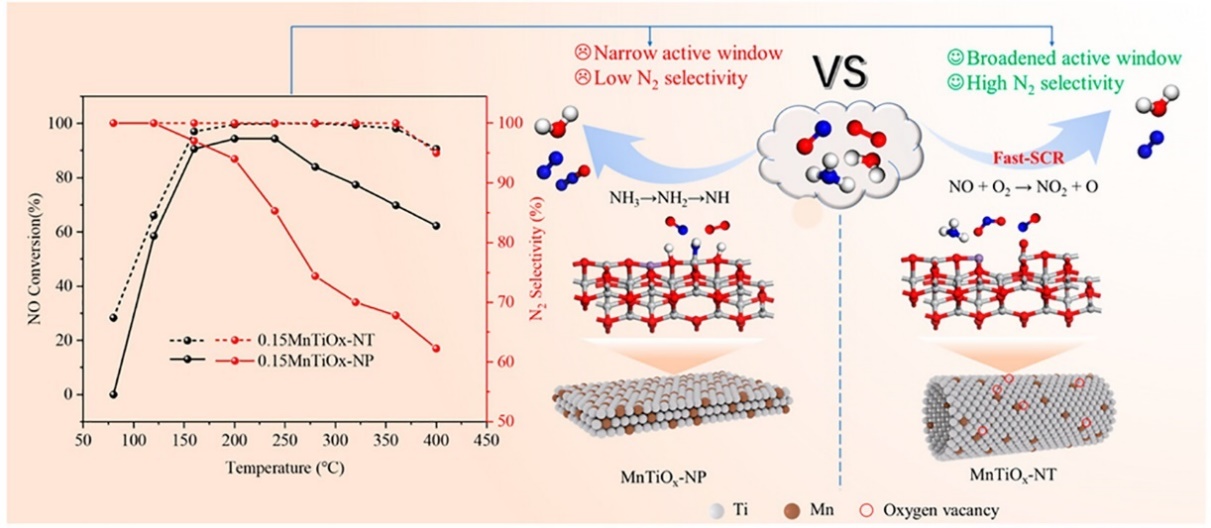
Fig. 28. NO conversion and schematic illustration of the possible NH3-SCR reaction mechanism over 0.15MnTiOx-NT and 0.15MnTiOx-NP catalysts. Reprinted with permission from Ref. [151]. Copyright 2024, American Chemical Society.
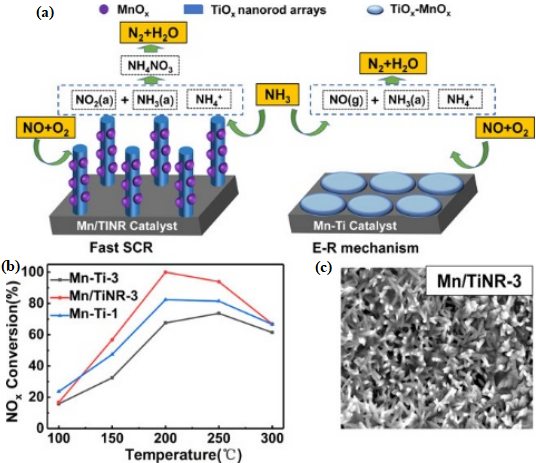
Fig. 29. TiO2 nanorod arrays favor the fast-SCR route by enriching chemisorbed oxygen and shaping the dominant mechanism: (a) de-NOx mechanism, (b) de-NOx performance, (c) Morphology. Reprinted with permission from Ref. [152], Copyright 2022, American Chemical Society.
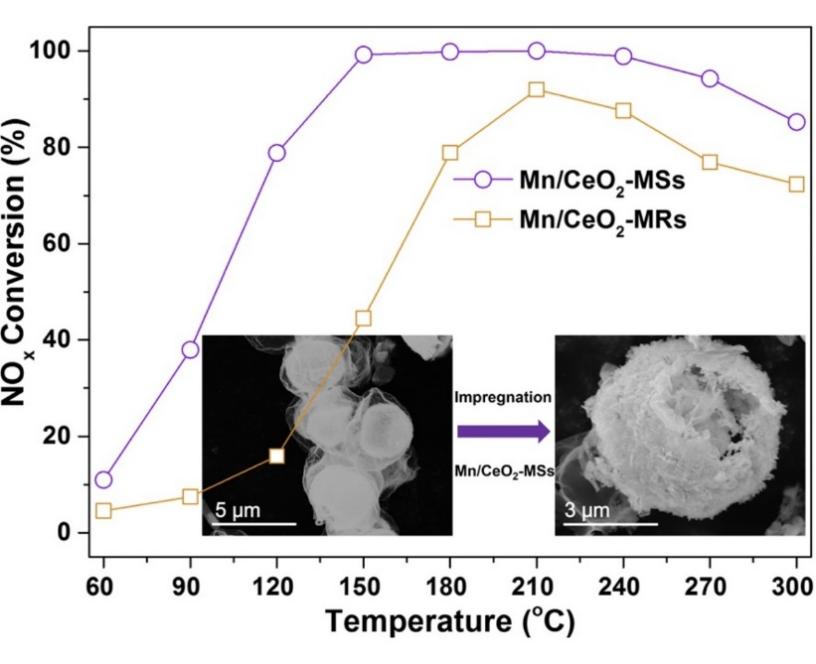
Fig. 30. NOx conversion profiles and SEM morphology of Mn/CeO2-MSs versus Mn/CeO2-MRs catalysts for low-temperature NH3-SCR. Reprinted with permission from Ref. [29]. Copyright 2017, Elsevier.
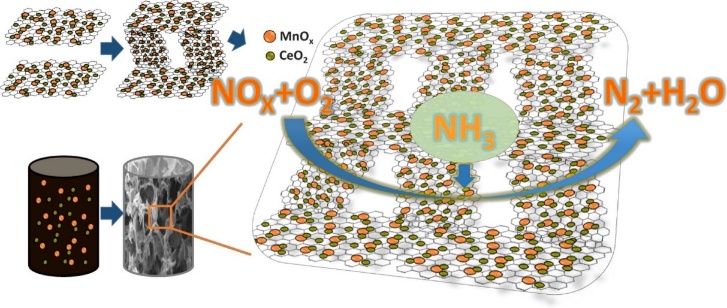
Fig. 31. Schematic illustration of the architecture of the MnOx-CeO2/RGA composite catalyst. Reprinted with permission from Ref. [85]. Copyright 2020, Elsevier.
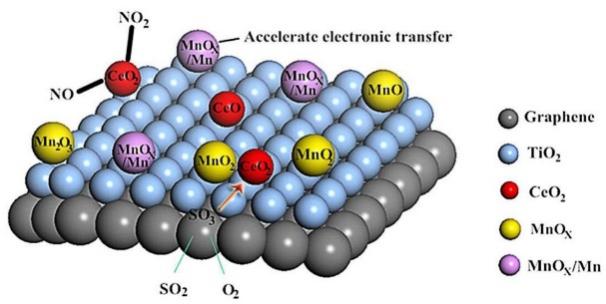
Fig. 32. Schematic diagram of the denitration reaction mechanism over CeOx-MnOx/TiO2-GE catalysts. Reprinted with permission from Ref. [158]. Copyright 2015, Elsevier.
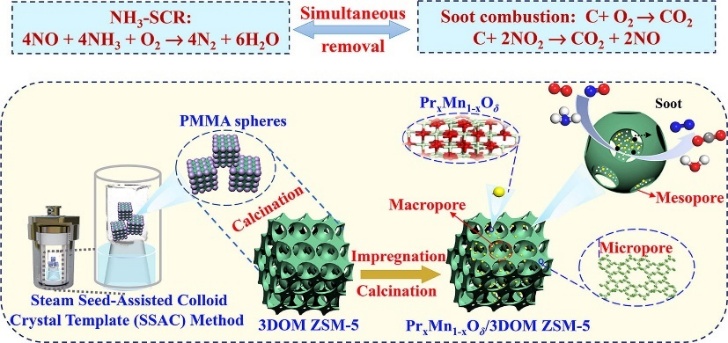
Fig. 33. 3DOM ZSM-5 support provide confinement plus dual-function active sites for coupled soot/NOx removal. Reprinted with permission from Ref. [159]. Copyright 2023, Elsevier.
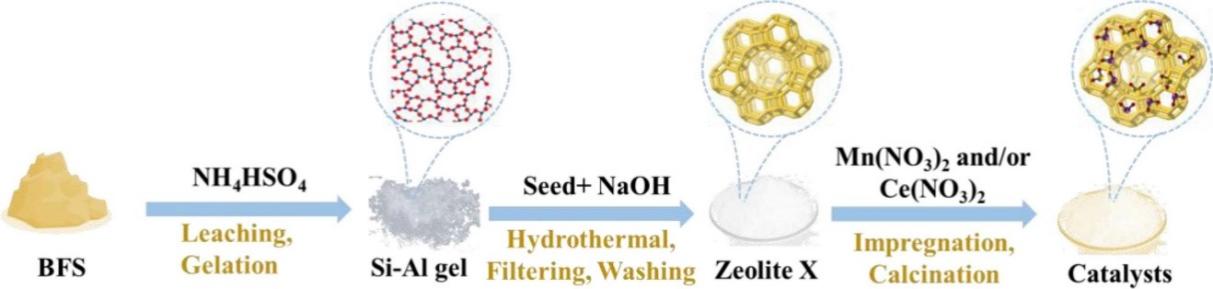
Fig. 34. Zeolite-X-derived supports help maintain high dispersion of Mn/RE species via confinement-driven synthesis routes. Reprinted with permission from Ref. [160]. Copyright 2022, Elsevier.
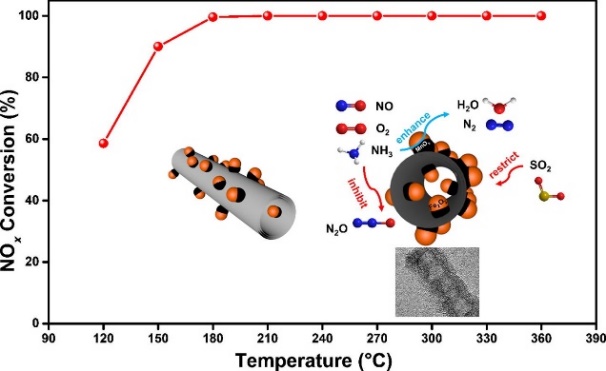
Fig. 35. Structural model of the MnOx@Fe₂O₃ core-shell catalyst, NOx conversion profile, and TEM image illustrating the structure and activity correlation Reprinted with permission from Ref. [161]. Copyright 2022, Elsevier.
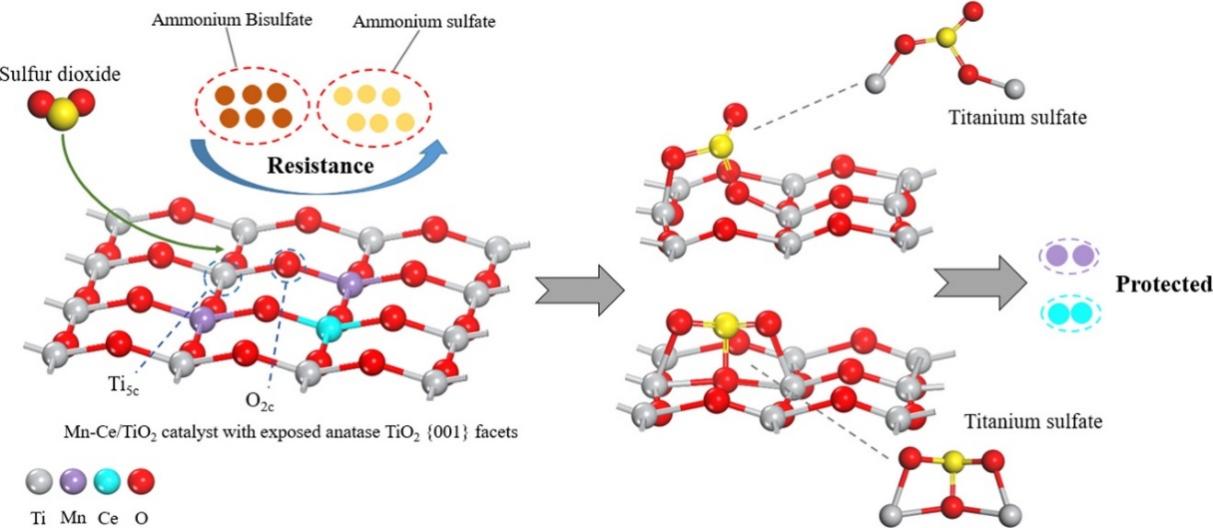
Fig. 36. Exposed anatase TiO2{001} facets promote SO2 resistance by altering sulfate adsorption and regeneration pathways. Reprinted with permission from Ref. [138]. Copyright 2022, Elsevier.
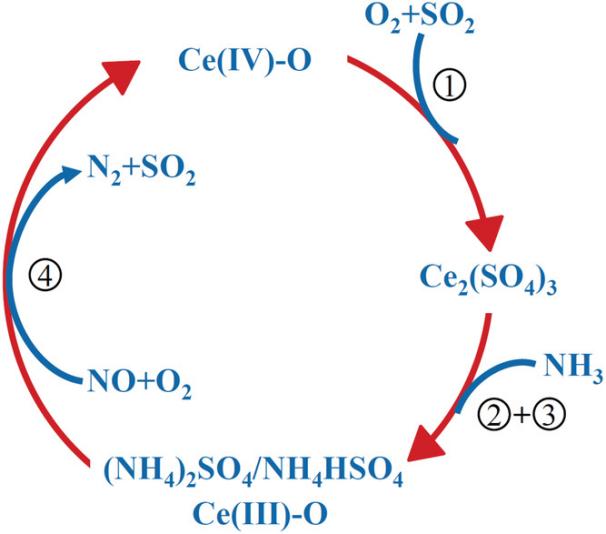
Fig. 37. Schematic of the proposed mechanism over CeO2(NR) and MnOx/CeO2(NR) showing the dynamic deposition-decomposition equilibrium of surface sulfate. Reprinted with permission from Ref. [93]. Copyright 2019, Wiley-VCH.
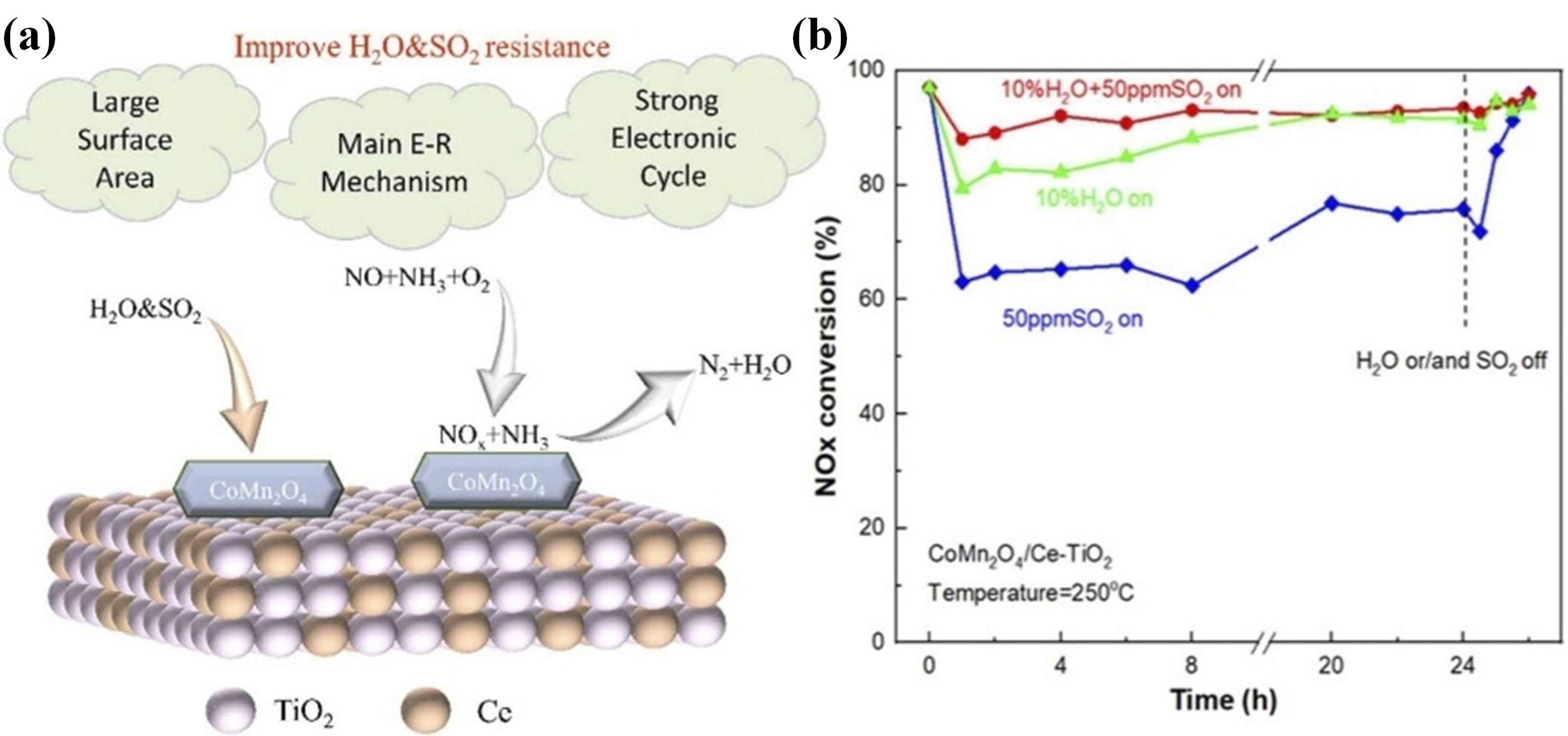
Fig. 38. Ce-doped CoMn2O4/TiO2 catalysts leverage multi-component synergy to resist combined H2O/SO2 poisoning while retaining activity: (a) de-NOx reaction mechanism, (b) de-NOx performance under H2O and SO2 conditions. Reprinted with permission from Ref. [137], Copyright 2024, Elsevier.
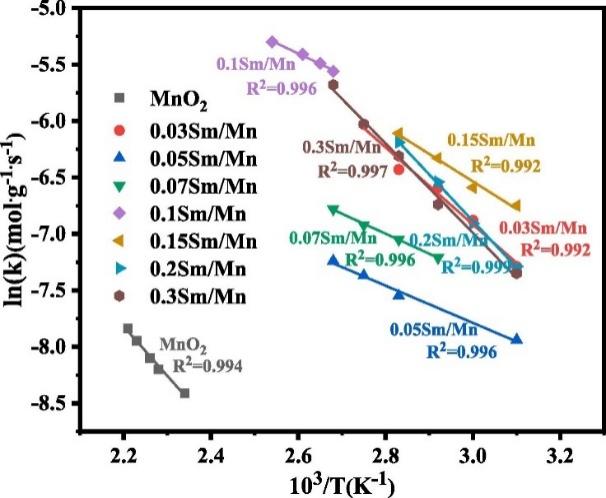
Fig. 39. Sm lowers the apparent activation energy of SCR on δ-MnO2. Reprinted with permission from Ref. [73]. Copyright 2024, Elsevier.
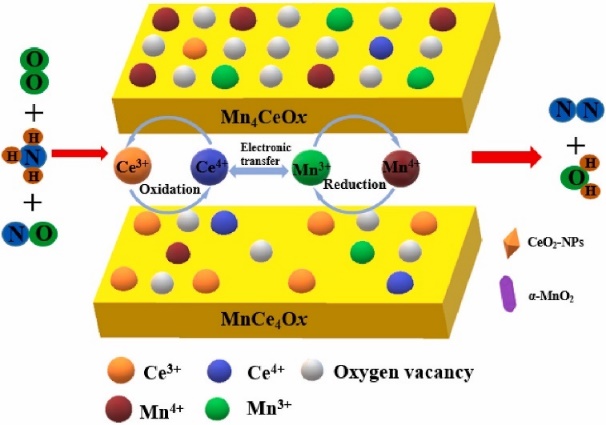
Fig. 40. RE-Mn electron shuttling strengthens redox cycling and drives fast SCR. Reprinted with permission from Ref. [45]. Copyright 2022, Elsevier.
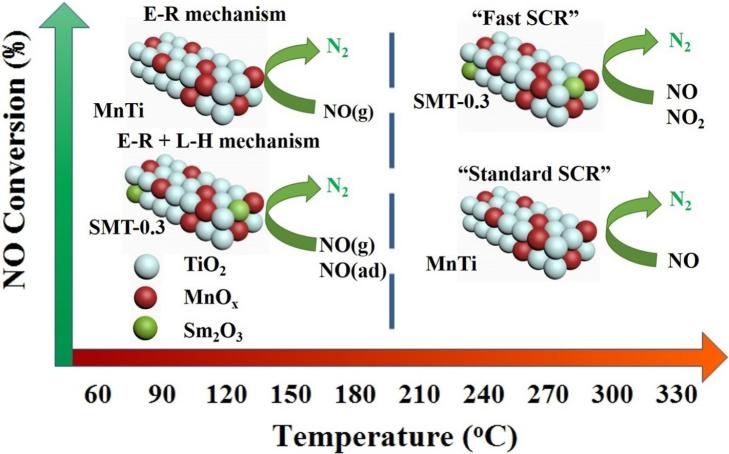
Fig. 41. Sm modification promotes the fast-SCR pathway in MnOx-TiO2. Reprinted with permission from Ref. [76]. Copyright 2017, Elsevier.
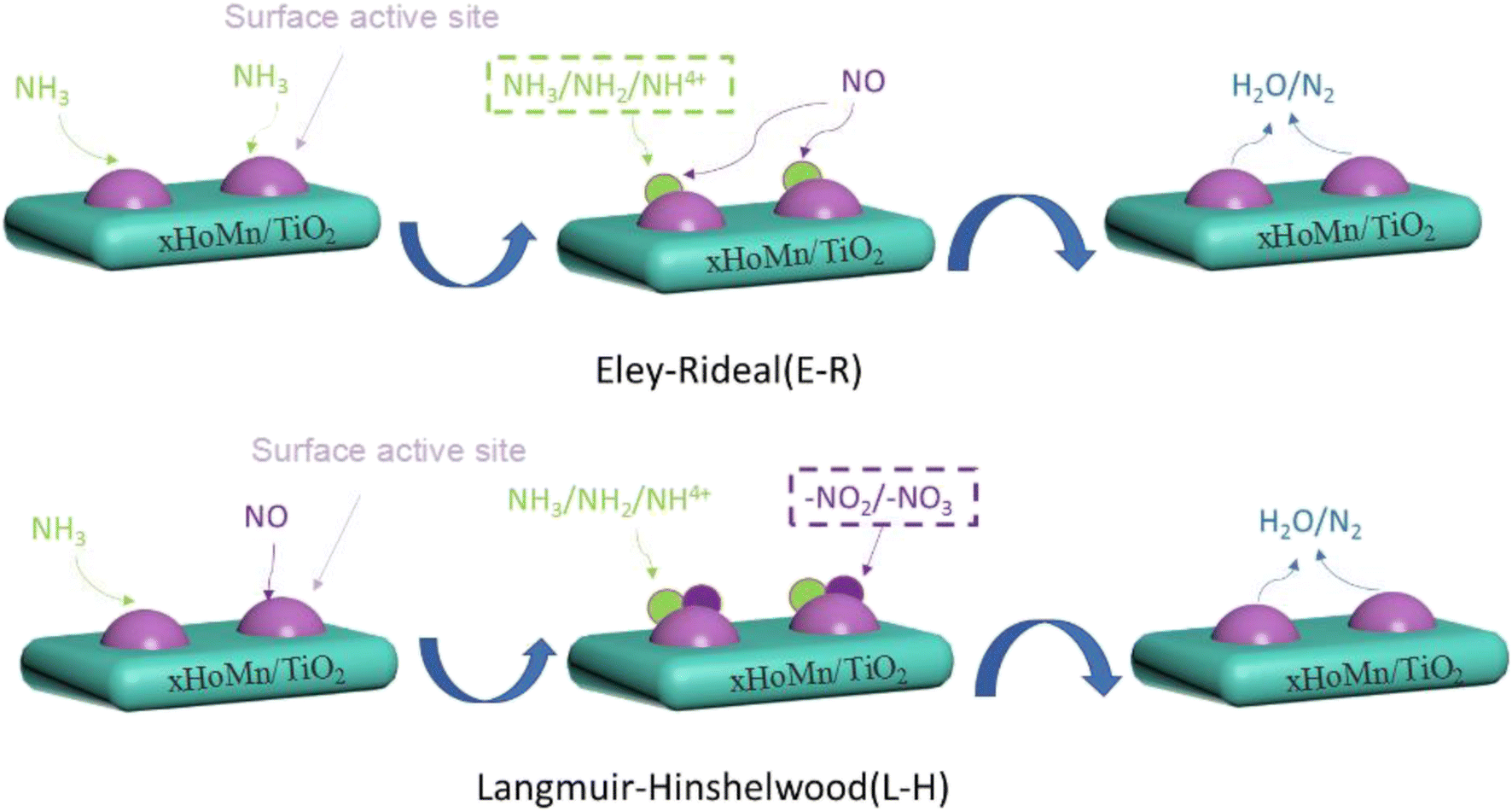
Fig. 42. Ho creates dual active sites that couple L-H and E-R SCR pathways on xHoMn/TiO2 catalysts. Reprinted with permission from Ref. [75], Copyright 2020, Springer Nature.
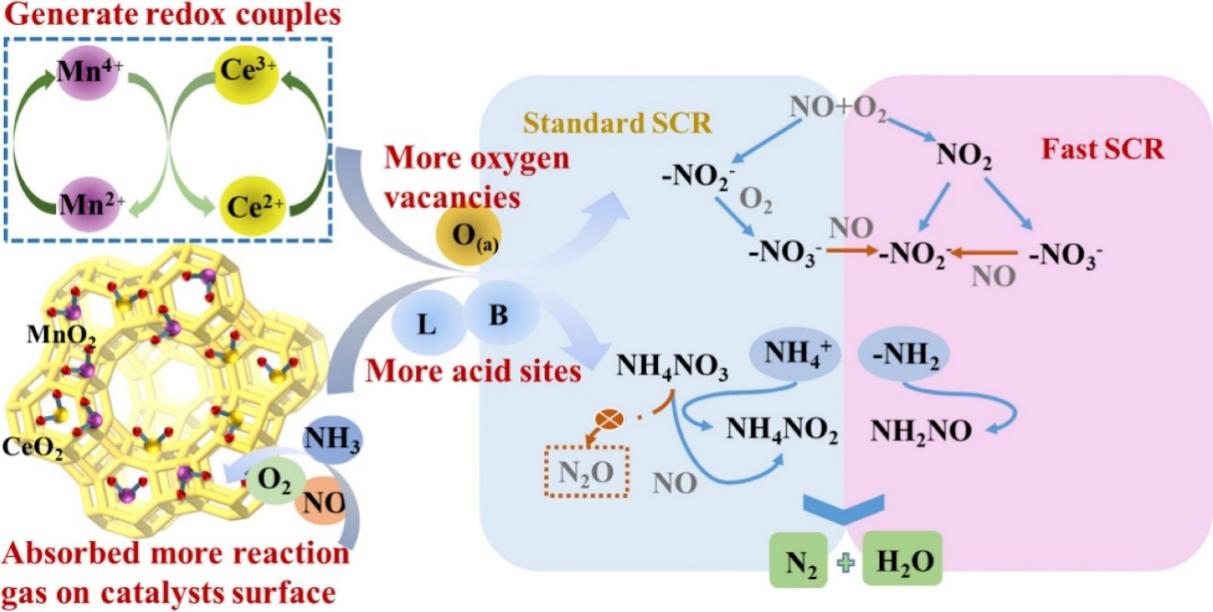
Fig. 43. Mn-Ce/Zeolite X dual sites boost both E-R and L-H pathways. Reprinted with permission from Ref. [160]. Copyright 2022, Elsevier.
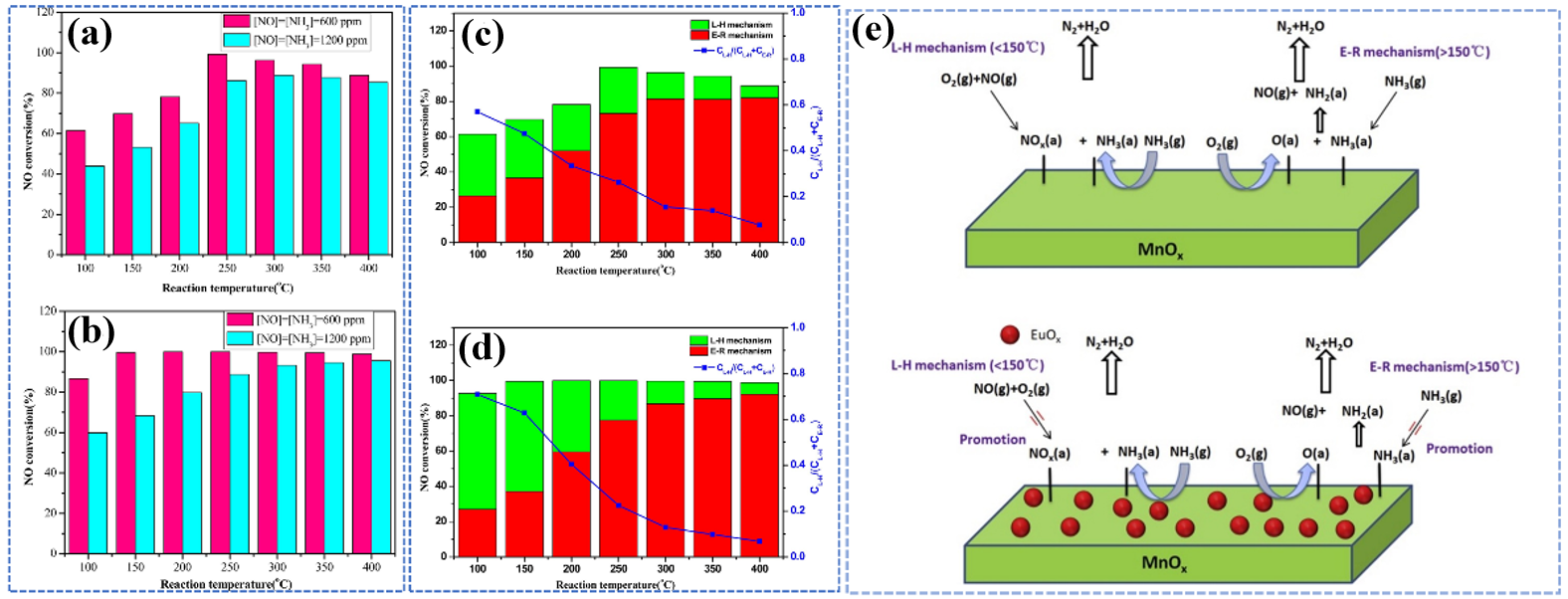
Fig. 44. Eu triggers a temperature-dependent shift from L-H-dominated to E-R-dominated SCR. (a,b) Effect of NO concentration on activity. (c,d) Contribution of E-R and L-H mechanisms. (e) Schematic diagram of the temperature-dependent mechanism of MnOx and MnEuOx-0.1 catalysts. Reprinted with permission from Ref. [74]. Copyright 2017, Elsevier.
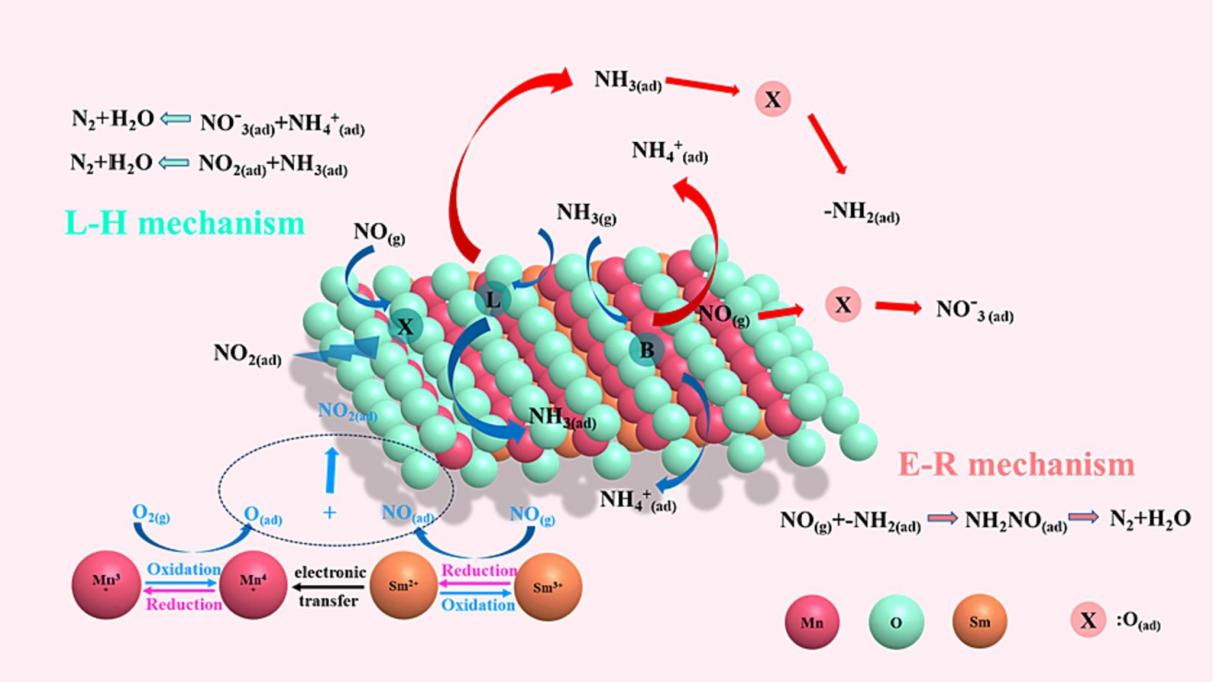
Fig. 45. Sm regulates the nitrate and amide routes to suppress N2O formation and maintain high N2 selectivity. Reprinted with permission from Ref. [73]. Copyright 2024, Elsevier.
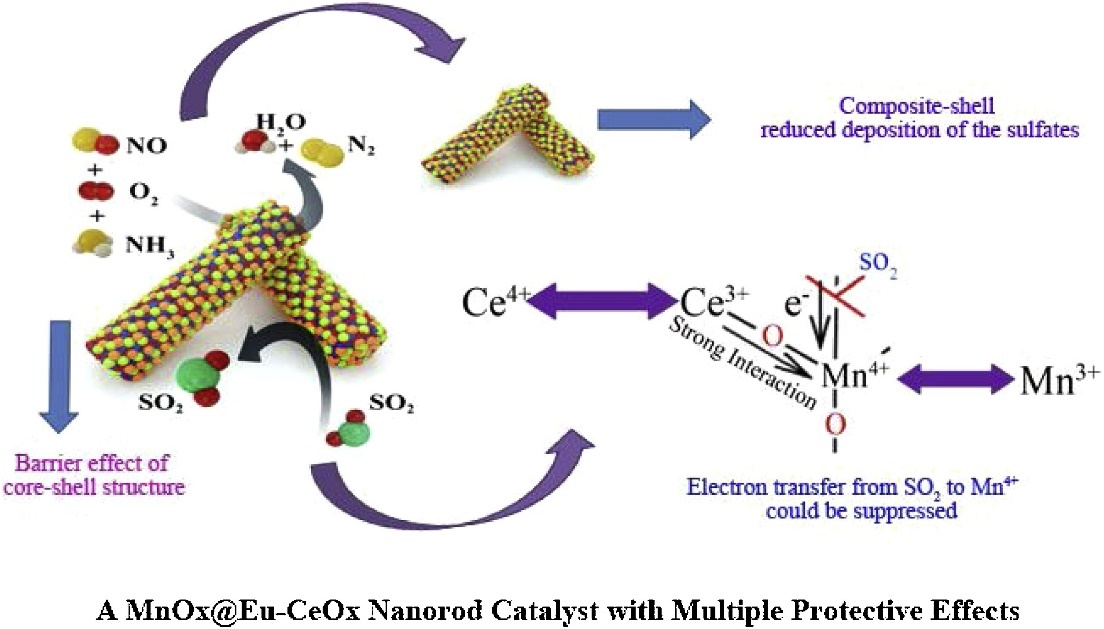
Fig. 46. MnOx@Eu-CeOx core-shell structures suppress Mn sulfation via electronic protection and sacrificial sulfate formation. Reprinted with permission from Ref. [130]. Copyright 2020, Elsevier.
|
| [1] | Sen Wang, Shiying Li, Rui Geng, Bo Zhou, Pengfei Wang, Zhangfeng Qin, Mei Dong, Jianguo Wang, Unni Olsbye, Weibin Fan. The smallest Ni species triggering selective hydrogenation of CO2 to methane: Ni dimer embedded in MFI and enhancement of MnOx [J]. Chinese Journal of Catalysis, 2026, 87(8): 113-125. |
| [2] | Yang Ding, Yizhen Lu, Tianrong Yu, Mingrui Zhang, Rui Zhao, Ruijie Yang, Qixin Li, Shiqun Wu, Jinlong Zhang. Dual pathways in photo-driven Fischer-Tropsch synthesis for high selective hydrocarbon production [J]. Chinese Journal of Catalysis, 2026, 87(8): 22-46. |
| [3] | Shahla Karimi, Mehran Rezaei, Jiguang Deng, Hongxing Dai, Ali Rastegarpanah. Recent advances in noble metal-based catalysts for methane decomposition: Performance, mechanism, and optimization [J]. Chinese Journal of Catalysis, 2026, 86(7): 9-48. |
| [4] | Zheguan Lin, Shuyi He, Tiesen Li, Qingyan Cui, Wenfu Yan, Yuanyuan Yue. Design of interface structure to enhance the operational temperature range of CuO/Cu-SSZ-13 for concurrent NOx selective catalytic reduction and CO oxidation [J]. Chinese Journal of Catalysis, 2026, 85(6): 286-297. |
| [5] | Jiaying Liu, Yu Fang. Unraveling structure-activity relationships in 2-D covalent organic frameworks for photocatalysis: From molecular engineering to high-performance optimization [J]. Chinese Journal of Catalysis, 2026, 85(6): 47-87. |
| [6] | Jingyao Wu, Yujing Lv, Qiang Zhao, Shuo Wang, Ying Wang, Na Wen, Zhengxin Ding, Zizhong Zhang, Jinlin Long. Electron-proton duet in covalent organic frameworks for efficient direct oxygen reduction to hydrogen peroxide [J]. Chinese Journal of Catalysis, 2026, 84(5): 288-300. |
| [7] | Zhiyao Liu, Tangkang Liu, Chuan Qin, Guoliang Liu, Anmin Zheng. Zirconia-mediated interfacial catalysis for CO2 hydrogenation [J]. Chinese Journal of Catalysis, 2026, 84(5): 1-24. |
| [8] | Yu Gu, Shujia Zhang, Minglu Xu, Hao Yan, Minghao Zhou, Lei Wang, Hui Shi. Dehydroaromatization of methane and methane co-aromatization process with propane: Reaction mechanism, catalyst design, carbon deposition and process optimization [J]. Chinese Journal of Catalysis, 2026, 84(5): 25-60. |
| [9] | Haifeng Fan, Di Xu, Ting Zeng, Guoqiang Hou, Yangyang Li, Siyi Huang, Yanfei Xu, Zheng Wang, Xinhua Gao, Xiang-Kui Gu, Mingyue Ding. Highly efficient electron-enriched Y2O3‒x-Ni interfaces boosting low-temperature CO2 methanation [J]. Chinese Journal of Catalysis, 2026, 84(5): 200-213. |
| [10] | Jiaxing Li, Yue Peng, Yifan Li, Yunpeng Long, William Orbell, Chuan Gao, Xiao Zhu, Xing Yuan, Lin Chen, Junhua Li. Modulation of Pt-Cu interaction in Pt/Cu-SSZ-13 for selective catalytic oxidation of ammonia [J]. Chinese Journal of Catalysis, 2026, 83(4): 376-387. |
| [11] | Fan Dang, Chunli Ai, Chi Ma, Zeyu Jiang, Jicheng Liu, Mingjiao Tian, Mingzhuo Zhang, Chi He. Advances in metal oxide catalysts for efficient VOCs oxidation: Synthesis strategy and catalytic mechanism [J]. Chinese Journal of Catalysis, 2026, 81(2): 97-123. |
| [12] | Bingzhi Li, Ganggang Li, Zeyu Zhao, Fenglian Zhang, Zhongshen Zhang, Jie Cheng, Zhengping Hao. Oxygen vacancy-mediated asymmetric Ni-Ov-Co sites for efficient low-temperature N2O decomposition [J]. Chinese Journal of Catalysis, 2026, 90(11): 276-286. |
| [13] | Ruiyuan Liu, Chengyang Yin, Chengming Zhong, Jia Hou, Xiaofei Song, Jian Liu, Zhen Zhao. Fundamental insight into copper-based zeolite catalysts for NH3-SCR: Two decades’ progress and future perspectives [J]. Chinese Journal of Catalysis, 2026, 89(10): 76-101. |
| [14] | Ai Yating, A. C. Carabineiro Sónia, Xiong Xianqiang, Zhu Huayue, Wang Qi, Weng Bo, Yang Min-Quan. Systematic assessment of emerging contaminants elimination using an S-scheme Mn0.5Cd0.5S/In2S3 photocatalyst: Degradation pathways, toxicity evaluation and mechanistic analysis [J]. Chinese Journal of Catalysis, 2025, 75(8): 147-163. |
| [15] | Tingkai Xiong, Fengyu Gao, Jiajun Wen, Honghong Yi, Shunzheng Zhao, Xiaolong Tang. Efficient synthesis of flexible SCR catalysts utilizing graphene oxide as a bridging agent without calcination: Catalytic performance, mechanism and kinetics studies [J]. Chinese Journal of Catalysis, 2025, 74(7): 377-393. |
| Viewed | ||||||
|
Full text |
|
|||||
|
Abstract |
|
|||||


