
Chinese Journal of Catalysis ›› 2026, Vol. 89: 1-39.DOI: 10.1016/S1872-2067(26)65122-4
• Review • Next Articles
Chunjie Yanga,b, Na Weia,*( ), Shu Wanga, Qi Zhanga, Xiyang Liua, Wenchao Xua, Keke Houb, Ningqiang Zhangc, Lingcong Lia,*(), Zhen Zhaoa,b,*()
Received:2025-12-31
Accepted:2026-02-22
Online:2026-10-18
Published:2026-09-01
Contact:
*E-mail:wwweina@126.com(N. Wei),lilingcong@synu.edu.cn(L. Li),zhenzhao@cup.edu.cn(Z. Zhao).
About author:Na Wei (College of Chemistry and Chemical Engineering, Shenyang Normal University) received her Ph.D. degree from Liaoning University in 2017. In the same year, she joined the Institute of Catalysis for Energy and Environment, College of Chemistry and Chemical Engineering, Shenyang Normal University as a faculty member. Her current research interests focus on novel materials, heterogeneous catalysis and thermocatalysis with emphasis on design of new MOFs and their derivative catalysts, and the control of their morphology and microstructure, together with the study of reaction mechanisms for the efficient capture and catalytic conversion of CO2.Supported by:Chunjie Yang, Na Wei, Shu Wang, Qi Zhang, Xiyang Liu, Wenchao Xu, Keke Hou, Ningqiang Zhang, Lingcong Li, Zhen Zhao. Progress in unraveling the mechanisms of dual functional materials for CO2 capture and reduction[J]. Chinese Journal of Catalysis, 2026, 89: 1-39.
Add to citation manager EndNote|Ris|BibTeX
URL: https://www.cjcatal.com/EN/10.1016/S1872-2067(26)65122-4
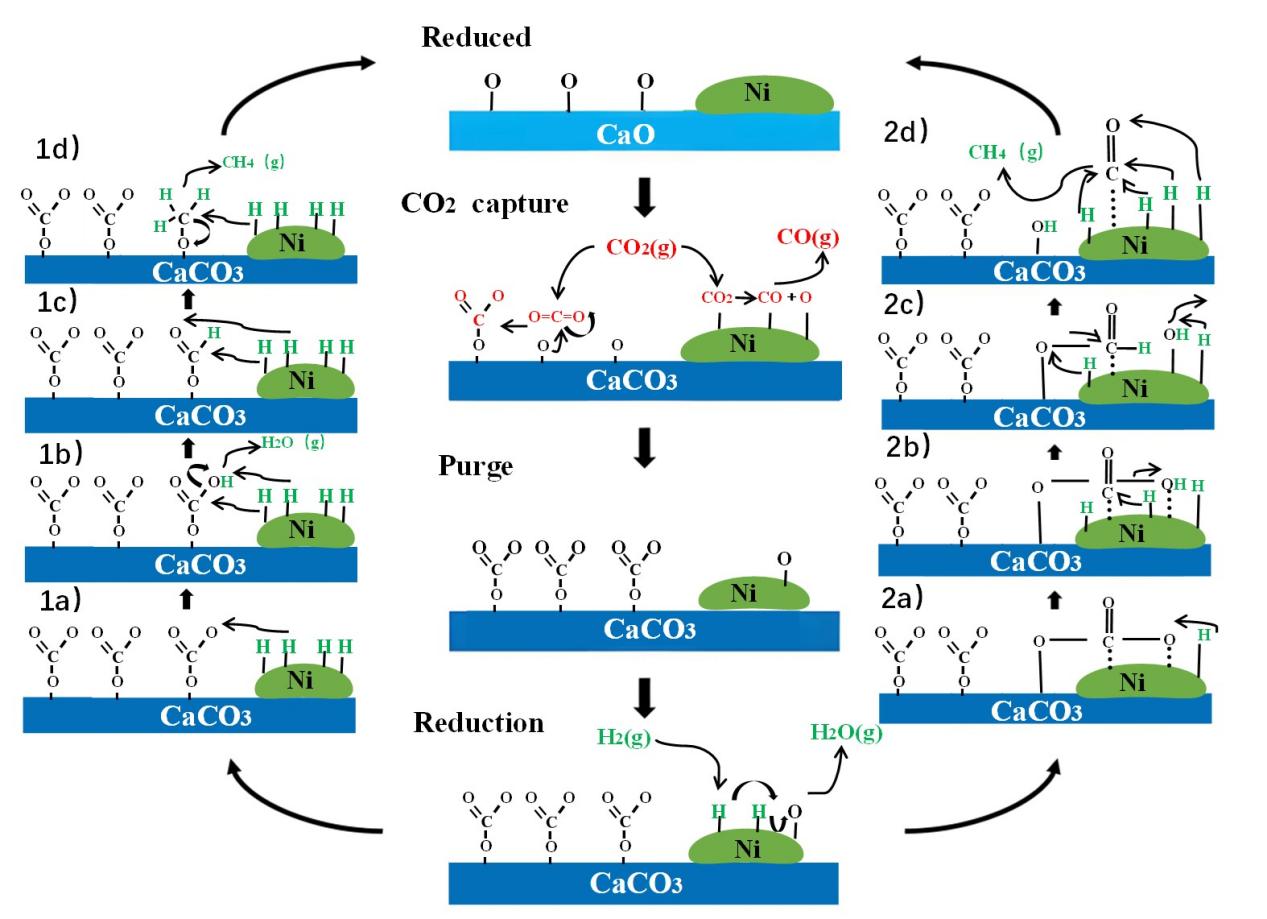
Fig. 1. Proposed integrated CO2 capture and direct methanation over Ni/CaO DFM. Reproduced with permission from Ref. [35]. Copyright 2023, American Chemical Society.
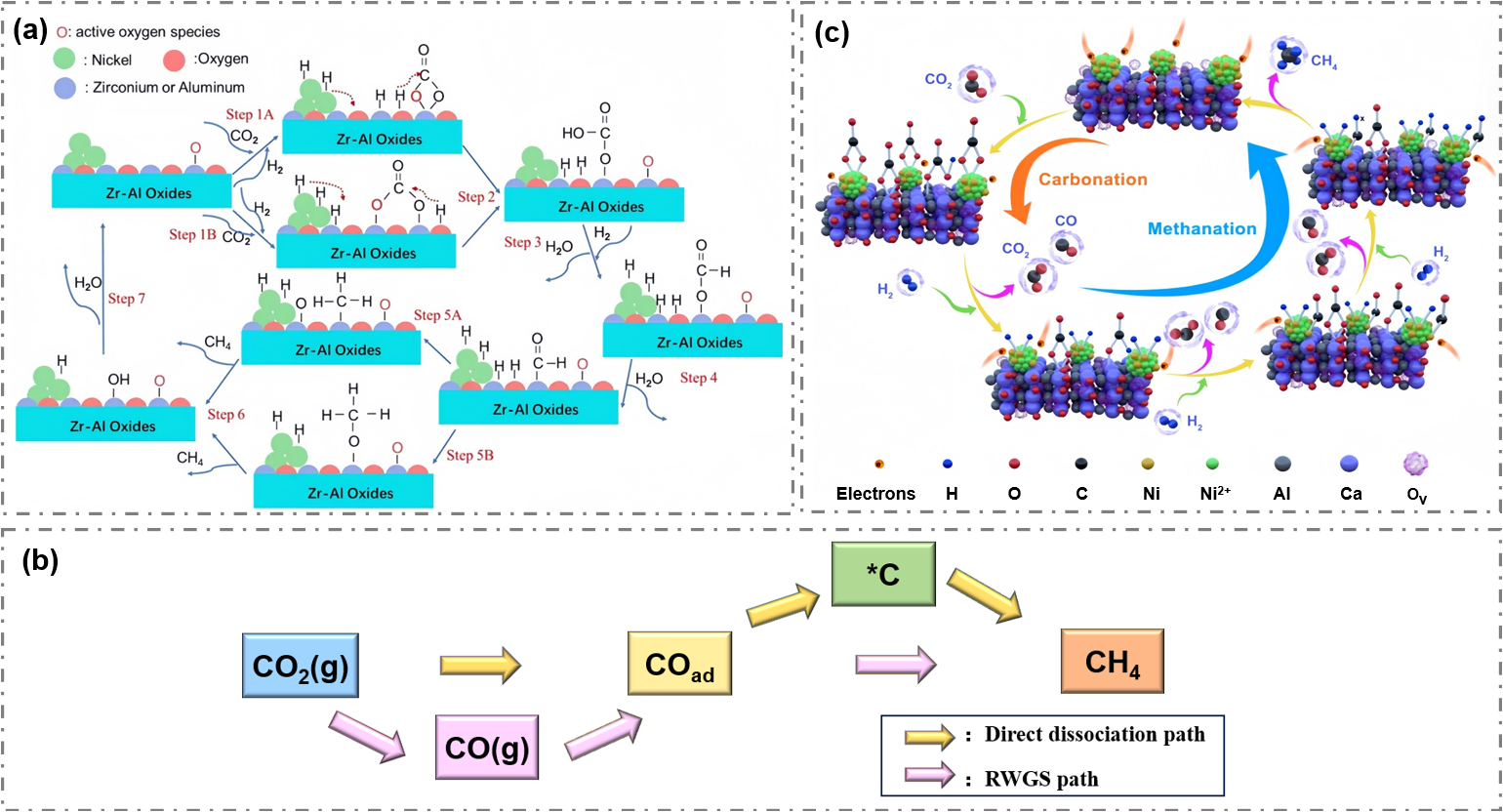
Fig. 2. CO2 capture and methanation reaction pathway: (a) *HCOO mechanism of Ni-Zr-Al ternary hydrotalcite DFM. Reproduced with permission from Ref. [46]. Copyright 2021, Elsevier. (b) Schematic of two competing pathways for the formation of *CO intermediate from CO2 on DFMs. (c) Schematic diagram of the carbonation and hydrogenation reaction mechanism for Ni/AlCaOx DFMs. Reproduced with permission from Ref. [47]. Copyright 2024, American Chemical Society.
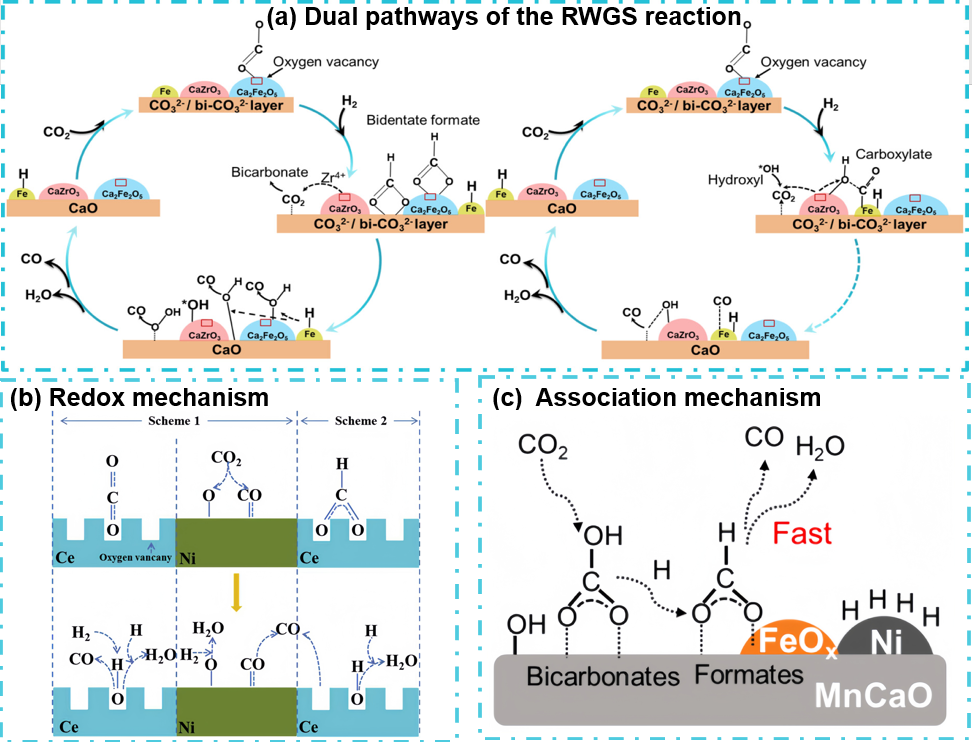
Fig. 3. Reaction mechanism of RWGS: (a) Proposed mechanism of CaZrO3 promoted Fe-CaO dual functional material for CO2 hydrogenation reduction pathway: *b-HCOO mechanism and *COOH and hydroxyl synergistic promotions during CaL-RWGS reaction. Reproduced with permission from Ref. [59]. Copyright 2024, American Chemical Society. (b) Reaction mechanism of the RWGS reaction over Ca1Ni0.1Ce0.033 DFM. Reproduced with permission from Ref. [32]. Copyright 2019, Elsevier. (c) Mechanistic diagram of associative *HCOO on Fe2.5Ni2.5MnCaO DFM for the RWGS reaction. Reproduced with permission from Ref. [57]. Copyright 2024, Elsevier.
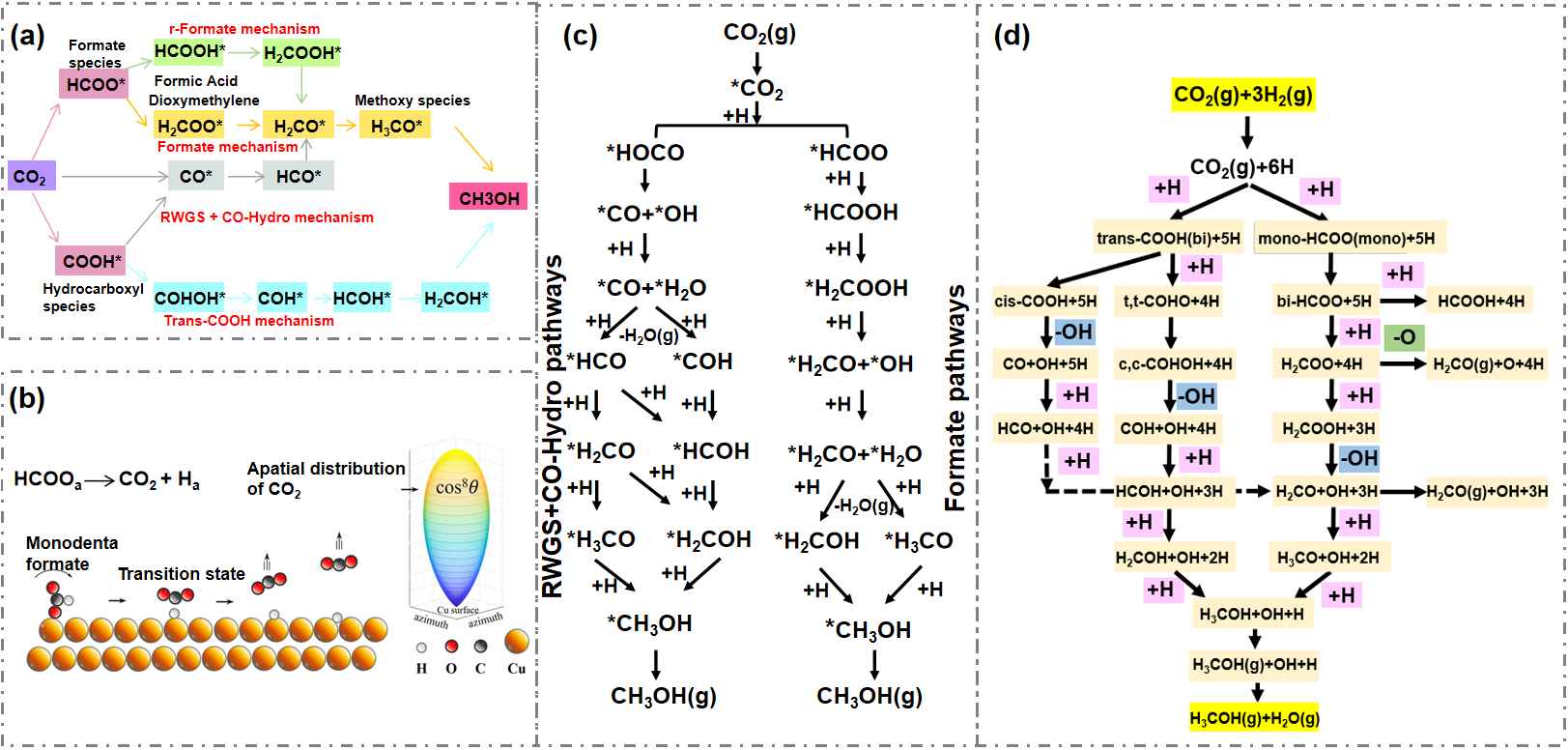
Fig. 4. Pathways of CO2 hydrogenation to CH3OH reaction: (a) Classification of CH3OH reaction pathways. Reproduced with permission from Ref. [64]. Copyright 2020, Royal Society of Chemistry. (b) Reaction pathway of *HCOO intermediates. Reproduced with permission from Ref. [69]. Copyright 2024, American Chemical Society. (c) Reaction scheme for CO2 hydrogenation to CH3OH via the RWGS + CO-Hydro and formate pathways. Reproduced with permission from Ref. [72]. Copyright 2025, American Chemical Society. (d) Reaction mechanism network of CH3OH synthesis on Cu (111).
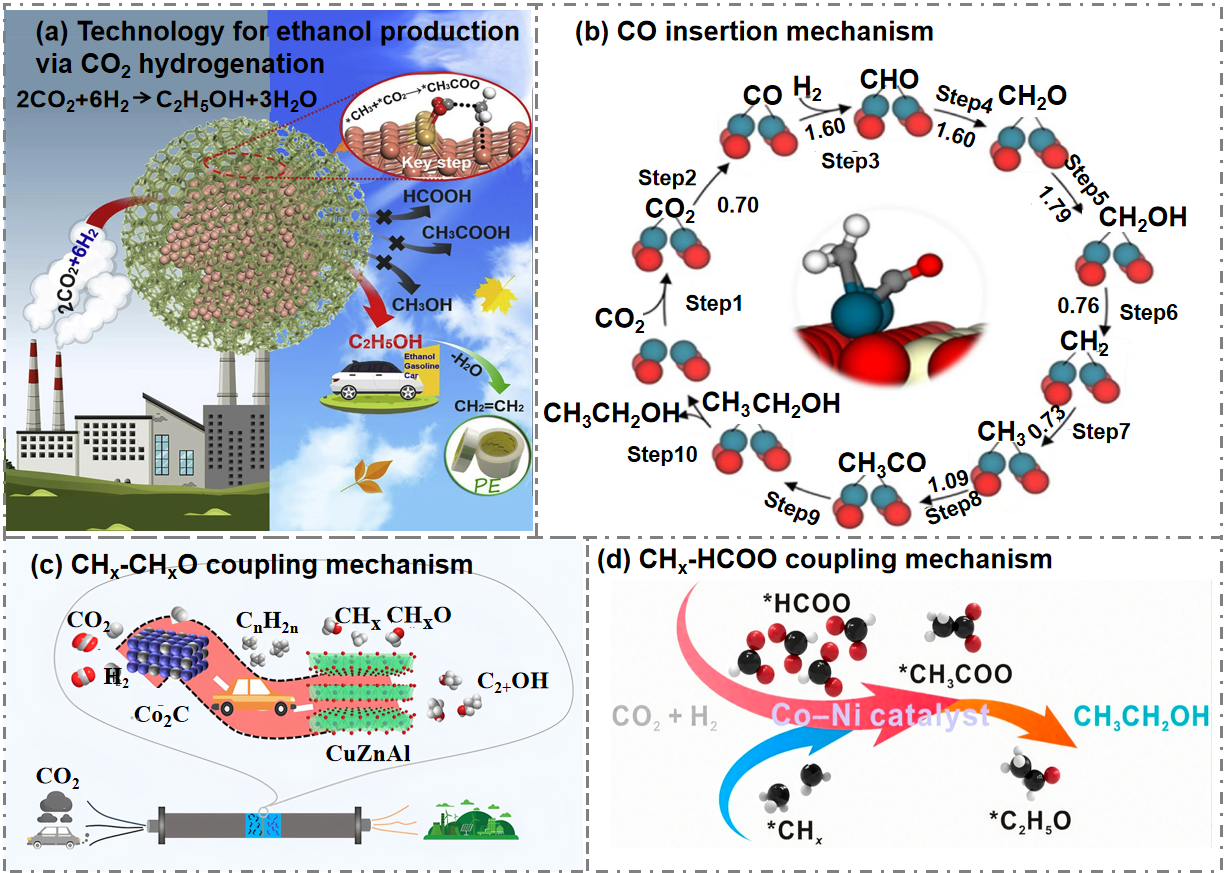
Fig. 5. Pathways and mechanism of C2H5OH synthesis via CO2 hydrogenation: (a) Technology for C2H5OH production via CO2 hydrogenation. Reproduced with permission from Ref. [84]. Copyright 2020, Elsevier. (b) Activation barriers (in eV) of elementary steps involved in the catalytic cycle for the formation of C2H5OH over Pd2/CeO2 (110), with red spheres denoting the O atoms and blue spheres indicating Pd atoms. The inserted figure shows the transition state structure of *CH3 and *CO coupling. Reproduced with permission from Ref. [86]. Copyright 2021, Elsevier. (c) CHx-CHxO coupling mechanism in CO2 hydrogenation via Co2C-CuZnAl DFM. Reproduced with permission from Ref. [79]. Copyright 2023, American Chemical Society. (d) Schematic diagram of the intermediate conversion mechanism for CO2 hydrogenation to C2H5OH over Co-Ni catalysts. Reproduced with permission from Ref. [92]. Copyright 2019, American Chemical Society.
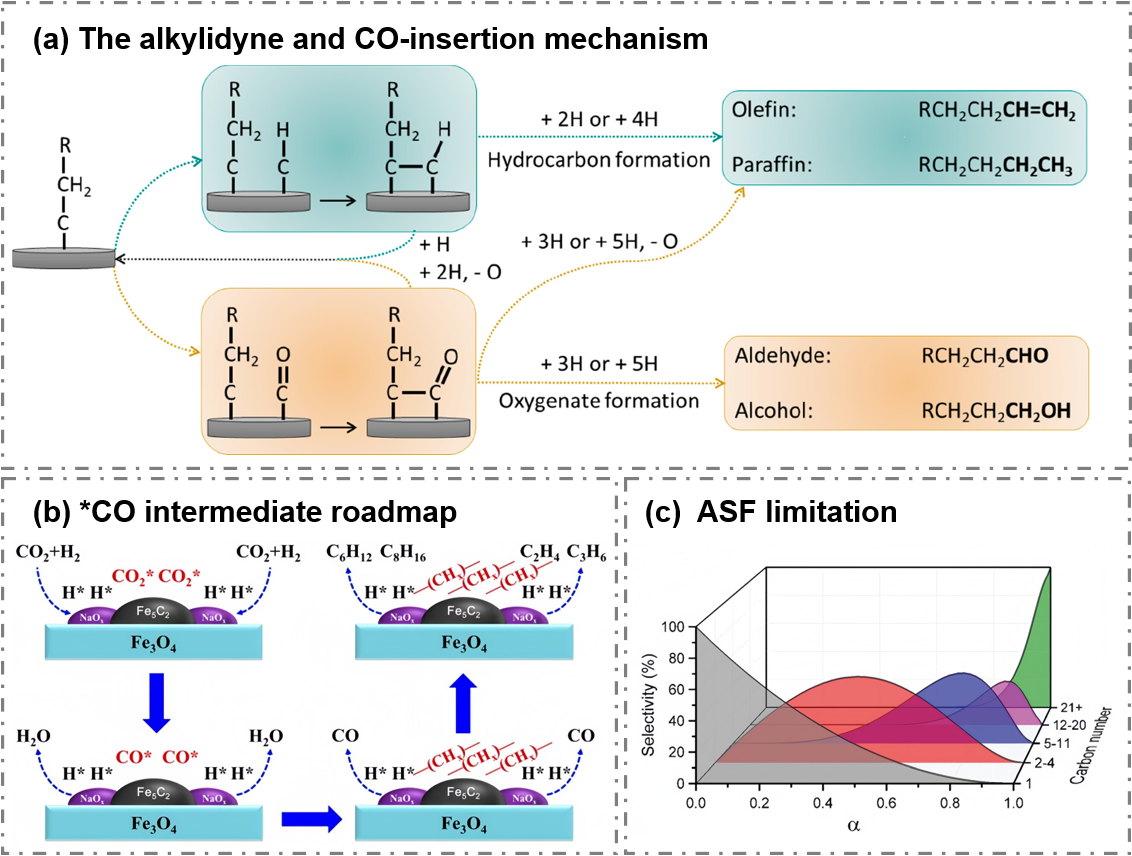
Fig. 6. CO2-FTS reaction mechanisms and product distribution limitation: (a) The alkylidyne and *CO-insertion mechanism. Reproduced with permission from Ref. [95]. Copyright 2023, American Chemical Society. (b) *CO intermediate roadmap for CO2 hydrogenation to C2-C4 olefins. Reproduced with permission from Ref. [100]. Copyright 2019, American Chemical Society. (c) Change of selectivity of hydrocarbon products in different ranges with chain growth probability (α). Reproduced with permission from Ref. [94]. Copyright 2019, Royal Society of Chemistry.
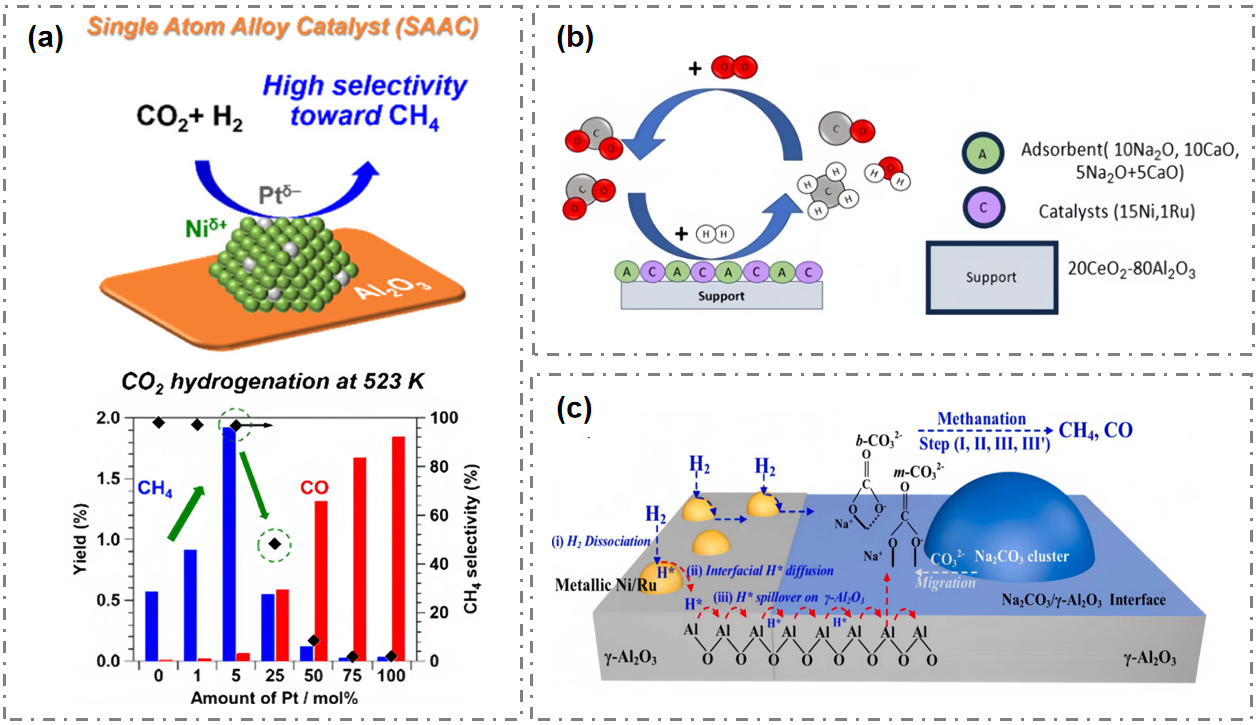
Fig. 7. CO2-to-C2-C4 olefins FTS/MTO mechanisms and DFT: (a) A possible mechanism for the synthesis of C2-C4 olefins via CO2 hydrogenation on Na0.02Co0.4ZnFe2O4. Reproduced with permission from Ref. [102]. Copyright 2025, Wiley-VCH. (b) Possible hydrogenation mechanism of the 0.05Na/CaFe2O4 catalyst. Reproduced with permission from Ref. [107]. Copyright 2025, Elsevier. (c) Schematic illustration of structure-performance correlation for CO2 hydrogenation over the Fe-Co catalysts. Reproduced with permission from Ref. [108]. Copyright 2024, American Chemical Society. (d) DFT calculations. Reaction diagram [energy (E) at a typical reaction temperature of 593 K] of the hydrogenation of CO2 on the (101) surface of the tetragonal ZnZrOx model. Reproduced with permission from Ref. [109]. Copyright 2024, Wiley-VCH.
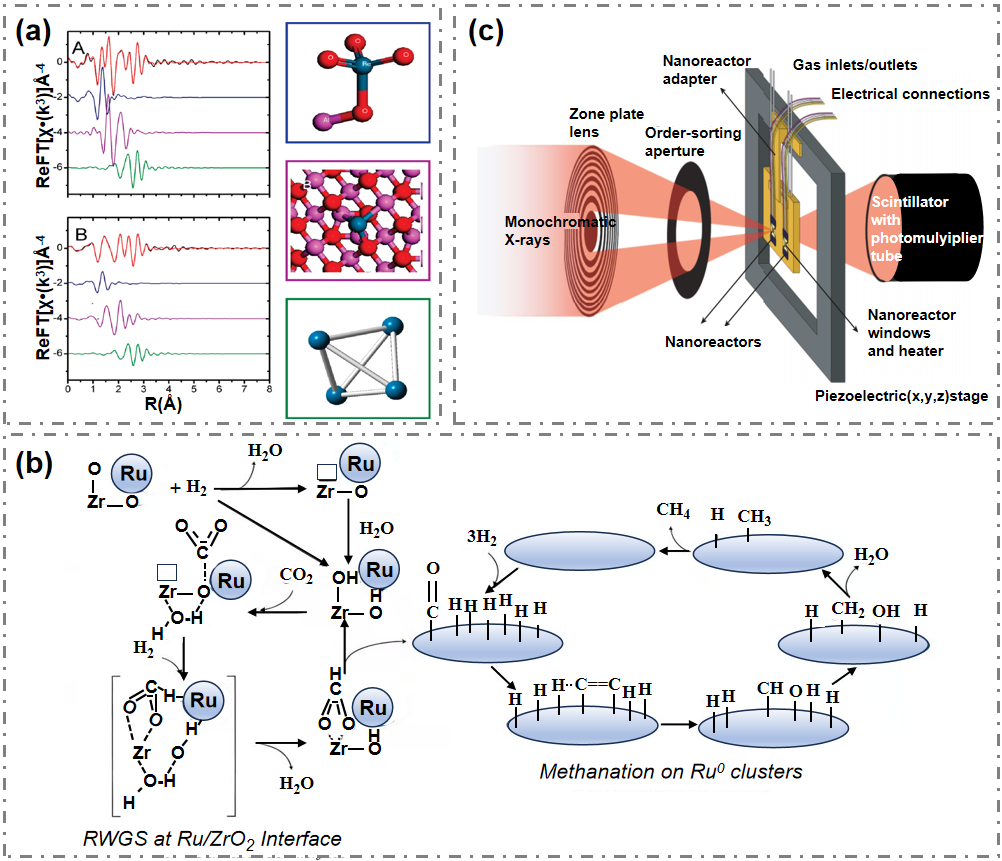
Fig. 8. Application of in-situ synchrotron radiation techniques can be summarized as follows: (a) Real part of the Fourier transform of 500 °C (A) and 700 °C (B) EXAFS data (black) and model (red). The components in the model for the oxidic Re (blue), Re atoms on the alumina surface at min2 (purple), and Re clusters (green) are shown offset beneath the data and model. The insets show a representation of these different Re species. From top to bottom, they are: oxidic Re, min2, and Re clusters. The blue, red, and purple spheres represent Re, O, and Al atoms. Reproduced with permission from Ref. [142]. Copyright 2025, American Chemical Society. (b) Proposed CO2 hydrogenation mechanism over Ru/ZrO2 DFM. (c) In-situ STXM uses a Fresnel zone plate to focus soft X-rays on the sample in a nanoreactor; an order-sorting aperture removes higher diffraction orders, and the adaptor with piezo-controlled translation enables high-precision raster scans. Reproduced with permission from Ref. [145]. Copyright 2008, Springer Nature.
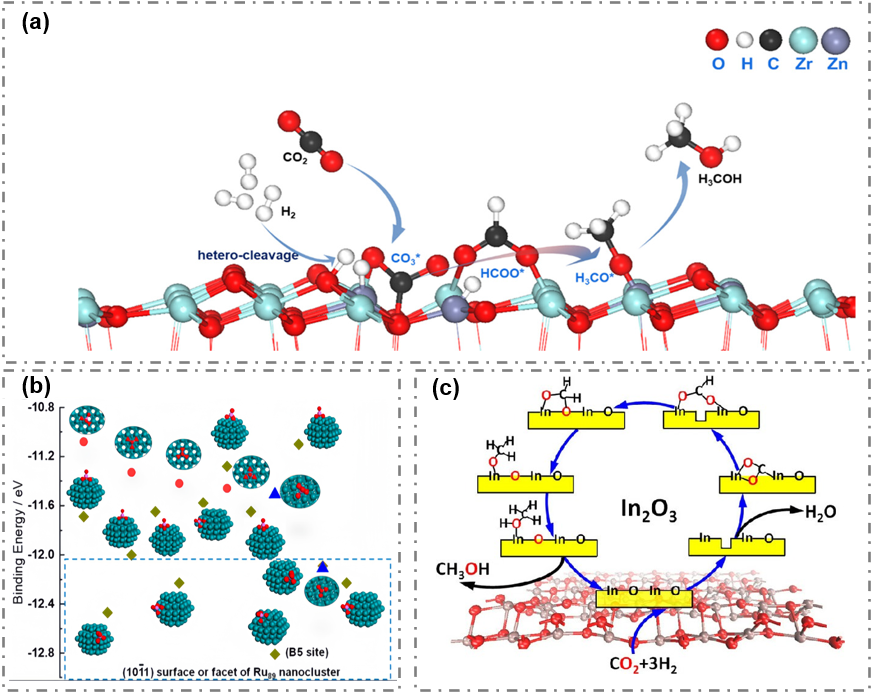
Fig. 9. Application of DFT: (a) The schematic diagram of the atomic-level reaction pathway of CO2 hydrogenation to CH3OH on the surface of a metal oxide catalyst. Reproduced with permission from Ref. [172]. Copyright 2023, American Chemical Society. (b) DFT calculations of the binding energy of AlO4 molecular cluster on Ru(0001) and Ru(101-1) surfaces, as well as on the Ru89 nanocluster. Reproduced with permission from Ref. [130]. Copyright 2023, American Chemical Society. (c) The reaction pathway for CO2 hydrogenation to CH3OH on oxygen vacancies of the In2O3(110) surface. Reproduced with permission from Ref. [67]. Copyright 2013, American Chemical Society.
| Adsorbents/promoter components | Catalyticlly active components | Support materials | key intermediates | Reaction mechanisms | Target reactions | Representative literatures |
|---|---|---|---|---|---|---|
| K | Cu | Al2O3 | *CO3, *HCOO | associative | RWGS | [ |
| Li | Ru | Al2O3 | *HCOO, *CO | associative | Met | [ |
| Na | Ru | γ-Al2O3 | *HCOO, *CO | associative | Met | [ |
| Li + Na | Ru | γ-Al2O3 | *HCOO, *CO | associative | Met | [ |
| SrO | Ni | SiO2 | *HCOO, *CO | associative | Met | [ |
| BaO | Ni | SiO2 | *HCOO, *CO | associative | Met | [ |
| CaO | Ni | γ-Al2O3 | *CO, *HCOO | redox and associative | RWGS | [ |
| CaO + CeO2 | Ni | CeO2 | *CO, *HCOO | redox and associative | RWGS | [ |
| Na2O/Na2CO3 | Ru | γ-Al2O3 | *CO | associative | Met | [ |
| Na2O + Yb2O3 | Ni | γ-Al2O3 | *HCOO, *CO | associative | Met | [ |
| MgO + LiNO3/NaNO3/KNO3 | Ni | CeO2 + MgO | *HCOO, *CO | associative | Met | [ |
| Na2CO3 | Ni | γ-Al2O3 | *HCOO, *CO | associative | Met | [ |
| Na2CO3 | Ru | γ-Al2O3 | *HCOO, *CO | associative | Met | [ |
| Al | Cu | γ-Al2O3 | *CO, *HCOO | redox and associative | RWGS | [ |
| Na2CO3 | Ni-Ru | γ-Al2O3 | *HCOO, *CO | associative | Met | [ |
| Li-Na | Ru | γ-Al2O3 | *HCOO, *CO | associative | Met | [ |
| Li/Na/K | Ru | ZrO2 | *CO | associative | Met | [ |
| CaO + Na2CO3 | Ru | γ-Al2O3 | *HCOO, *CO | associative | Met | [ |
| Li/Na/K/Cs | Ru | TiO2 | *HCOO, *CO | associative | Met | [ |
| BaO | Ru | γ-Al2O3 | *HCOO, *CO | associative | Met | [ |
| K2CO3 | Ru | γ-Al2O3 | *CO | associative | Met | [ |
| MgO | Ru | CeO2 | *HCOO, *CO | associative | Met | [ |
| Na2O | Ru | γ-Al2O3 | *HCOO, *CO | associative | Met | [ |
| CeO2 + ZrO2 | Cu | γ-Al2O3 | *HCOO, *COOH | associative | MS | [ |
| ZnO, ZrO2, MgO | Cu | γ-Al2O3 | *HCOO | associative | MS | [ |
| ZnO-Al2O3 | Cu | Al2O3 | *HCOO | associative | MS | [ |
| α-ZrO2/γ-ZrO2/m-ZrO2 | Cu | ZrO2 | *HCOO | associative | MS | [ |
| Na2CO3-CaO | Cu | γ-Al2O3 | *CO | redox | RWGS | [ |
| CeO2-Al2O3 | Fe-Cu | CeO2-Al2O3 | *CO | redox | RWGS | [ |
| ZnO-ZnSiO4 | Cu-Zn-Zr | ZnSiO4 | *CO | RWGS + CO-Hydro | MS | [ |
| ZrO2 | Cu | ZrO2 | *CO | redox | RWGS | [ |
| ZrO2 | Fe-Co | ZrO2 | *CO | CO2-FTS | OS | [ |
| K | Fe | CaO | *CO | CO2-FTS | OS | [ |
| Na2CO3 | Ni | γ-Al2O3 | *HCOO | associative | Met | [ |
| Na | Pt | Al2O3 | *CO3, *HCOO | associative | RWGS | [ |
| ZrO2 | Rh-Pt | ZrO2 | *HCOO, *CO | associative | Met | [ |
| CaO | Ru | CeO2 | *HCOO | associative | Met | [ |
| CeO2-CaO | CeO2 | CaO | *CO3, *HCOO | associative | RWGS | [ |
| CaO | Ni-Fe | (Mg,Al)Ox | *HCOO | associative | Met | [ |
| ZrO2 | ZnO-ZrO2 | ZrO2 | *HCOO | associative | MS | [ |
| Mn | Co-Mn | Co3O4 | *CO | RWGS + CO-Hydro | MS | [ |
| Ga | Cu | ZnO-ZrO2 | *HCOO | associative | MS | [ |
| K2CO3 | Cu | γ-Al2O3 | *HCOO | associative | RWGS | [ |
| ZnGa2O4 | ZnGa2O4 | SAPO-34 | *CH3OH | CO2-MTO | OS | [ |
| ZrO2 | In2O3 | ZrO2 | *COOH | associative | MS | [ |
| BaO | Ni | SiO2-Al2O3 | *HCOO | associative | Met | [ |
| CaO-MgO | Ni | CaO | *CO, *HCOO | associative and redox | Met/RWGS | [ |
| CeO2 | Ni | Al2O3 | *HCOO | associative | Met | [ |
Table 1 Key components, target reactions, and representative literature of different types of DFMs.
| Adsorbents/promoter components | Catalyticlly active components | Support materials | key intermediates | Reaction mechanisms | Target reactions | Representative literatures |
|---|---|---|---|---|---|---|
| K | Cu | Al2O3 | *CO3, *HCOO | associative | RWGS | [ |
| Li | Ru | Al2O3 | *HCOO, *CO | associative | Met | [ |
| Na | Ru | γ-Al2O3 | *HCOO, *CO | associative | Met | [ |
| Li + Na | Ru | γ-Al2O3 | *HCOO, *CO | associative | Met | [ |
| SrO | Ni | SiO2 | *HCOO, *CO | associative | Met | [ |
| BaO | Ni | SiO2 | *HCOO, *CO | associative | Met | [ |
| CaO | Ni | γ-Al2O3 | *CO, *HCOO | redox and associative | RWGS | [ |
| CaO + CeO2 | Ni | CeO2 | *CO, *HCOO | redox and associative | RWGS | [ |
| Na2O/Na2CO3 | Ru | γ-Al2O3 | *CO | associative | Met | [ |
| Na2O + Yb2O3 | Ni | γ-Al2O3 | *HCOO, *CO | associative | Met | [ |
| MgO + LiNO3/NaNO3/KNO3 | Ni | CeO2 + MgO | *HCOO, *CO | associative | Met | [ |
| Na2CO3 | Ni | γ-Al2O3 | *HCOO, *CO | associative | Met | [ |
| Na2CO3 | Ru | γ-Al2O3 | *HCOO, *CO | associative | Met | [ |
| Al | Cu | γ-Al2O3 | *CO, *HCOO | redox and associative | RWGS | [ |
| Na2CO3 | Ni-Ru | γ-Al2O3 | *HCOO, *CO | associative | Met | [ |
| Li-Na | Ru | γ-Al2O3 | *HCOO, *CO | associative | Met | [ |
| Li/Na/K | Ru | ZrO2 | *CO | associative | Met | [ |
| CaO + Na2CO3 | Ru | γ-Al2O3 | *HCOO, *CO | associative | Met | [ |
| Li/Na/K/Cs | Ru | TiO2 | *HCOO, *CO | associative | Met | [ |
| BaO | Ru | γ-Al2O3 | *HCOO, *CO | associative | Met | [ |
| K2CO3 | Ru | γ-Al2O3 | *CO | associative | Met | [ |
| MgO | Ru | CeO2 | *HCOO, *CO | associative | Met | [ |
| Na2O | Ru | γ-Al2O3 | *HCOO, *CO | associative | Met | [ |
| CeO2 + ZrO2 | Cu | γ-Al2O3 | *HCOO, *COOH | associative | MS | [ |
| ZnO, ZrO2, MgO | Cu | γ-Al2O3 | *HCOO | associative | MS | [ |
| ZnO-Al2O3 | Cu | Al2O3 | *HCOO | associative | MS | [ |
| α-ZrO2/γ-ZrO2/m-ZrO2 | Cu | ZrO2 | *HCOO | associative | MS | [ |
| Na2CO3-CaO | Cu | γ-Al2O3 | *CO | redox | RWGS | [ |
| CeO2-Al2O3 | Fe-Cu | CeO2-Al2O3 | *CO | redox | RWGS | [ |
| ZnO-ZnSiO4 | Cu-Zn-Zr | ZnSiO4 | *CO | RWGS + CO-Hydro | MS | [ |
| ZrO2 | Cu | ZrO2 | *CO | redox | RWGS | [ |
| ZrO2 | Fe-Co | ZrO2 | *CO | CO2-FTS | OS | [ |
| K | Fe | CaO | *CO | CO2-FTS | OS | [ |
| Na2CO3 | Ni | γ-Al2O3 | *HCOO | associative | Met | [ |
| Na | Pt | Al2O3 | *CO3, *HCOO | associative | RWGS | [ |
| ZrO2 | Rh-Pt | ZrO2 | *HCOO, *CO | associative | Met | [ |
| CaO | Ru | CeO2 | *HCOO | associative | Met | [ |
| CeO2-CaO | CeO2 | CaO | *CO3, *HCOO | associative | RWGS | [ |
| CaO | Ni-Fe | (Mg,Al)Ox | *HCOO | associative | Met | [ |
| ZrO2 | ZnO-ZrO2 | ZrO2 | *HCOO | associative | MS | [ |
| Mn | Co-Mn | Co3O4 | *CO | RWGS + CO-Hydro | MS | [ |
| Ga | Cu | ZnO-ZrO2 | *HCOO | associative | MS | [ |
| K2CO3 | Cu | γ-Al2O3 | *HCOO | associative | RWGS | [ |
| ZnGa2O4 | ZnGa2O4 | SAPO-34 | *CH3OH | CO2-MTO | OS | [ |
| ZrO2 | In2O3 | ZrO2 | *COOH | associative | MS | [ |
| BaO | Ni | SiO2-Al2O3 | *HCOO | associative | Met | [ |
| CaO-MgO | Ni | CaO | *CO, *HCOO | associative and redox | Met/RWGS | [ |
| CeO2 | Ni | Al2O3 | *HCOO | associative | Met | [ |
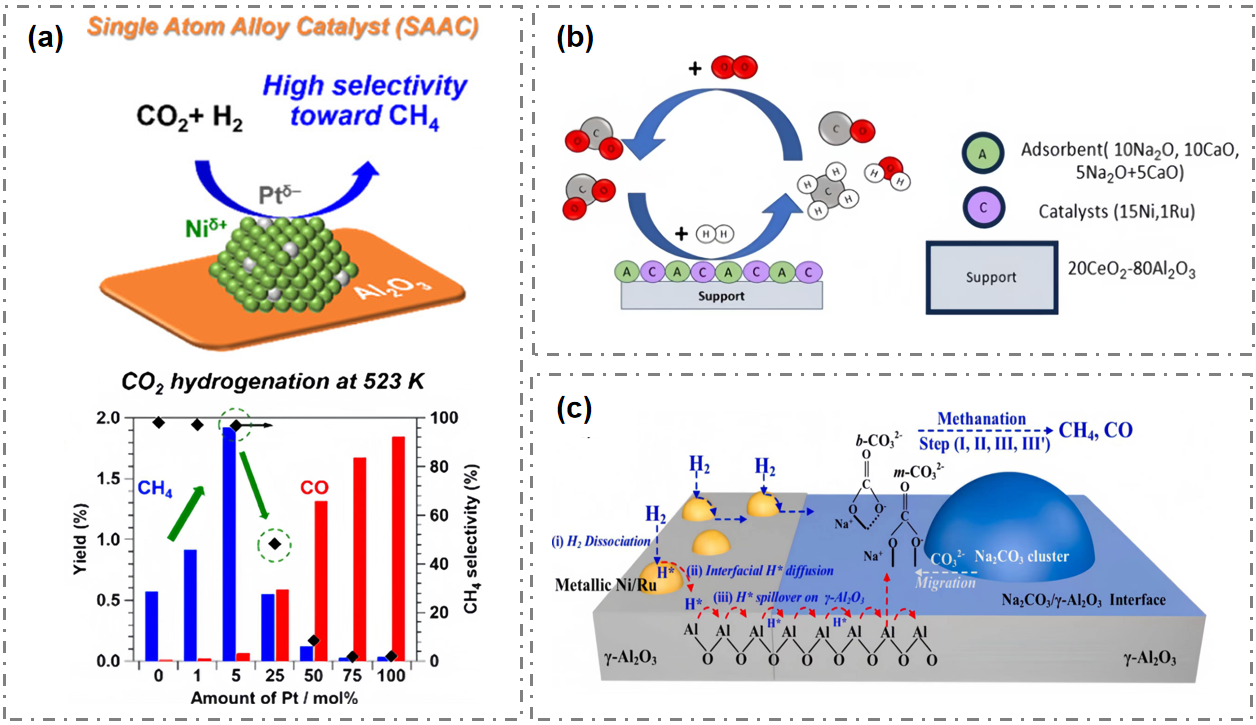
Fig. 10. Ni-based DFMs CO2 hydrogenation catalytic structures reactions and pathways: (a) Structure-property relationship of Ni95Pt5/Al2O3 single-atom alloy catalyst. Reproduced with permission from Ref. [224]. Copyright 2019, American Chemical Society. (b) Alternating Na2O-CaO adsorbent and Ni-Ru catalyst loading on DFMs and its reaction cycle. Reproduced with permission from Ref. [55]. Copyright 2024, American Chemical Society. (c) Proposed pathways and stepwise hydrogenation of b-CO3 and m-CO3 in co-extruded DFMs. Reproduced with permission from Ref. [195]. Copyright 2025, Elsevier.
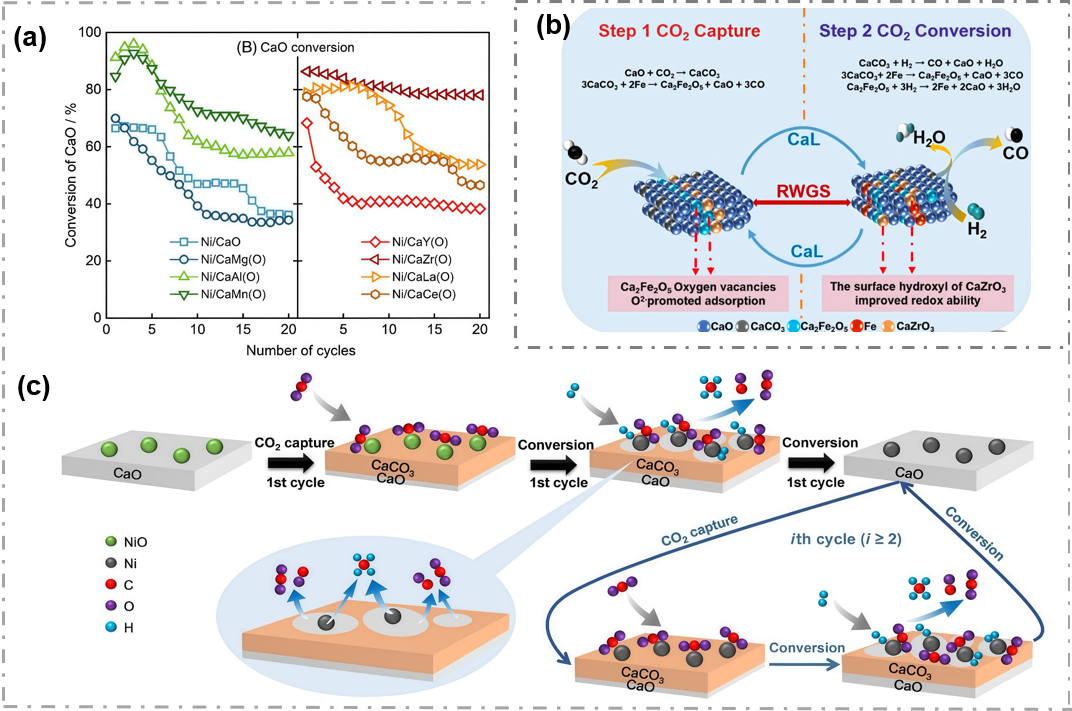
Fig. 11. Key performances and mechanisms of Ni-based DFMs in RWGS: (a) CaO conversion of different DFMs in 20 cycles (CO2 capture at 600 °C in 15% CO2/N2 for 25 min; conversion at 600 °C in 66.7% H2 /N2). Reproduced with permission from Ref. [62]. Copyright 2021, Wiley-Blackwell. (b) Schematic illustration of the CO2 capture and integrated conversion mechanism over Zr/Fe-modified Ni-based DFMs. Reproduced with permission from Ref. [59]. Copyright 2024, American Chemical Society. (c) Illustration of the CO2 capture and conversion process over Ni/CaO DFMs. Reproduced with permission from Ref. [62]. Copyright 2021, Wiley-Blackwell.
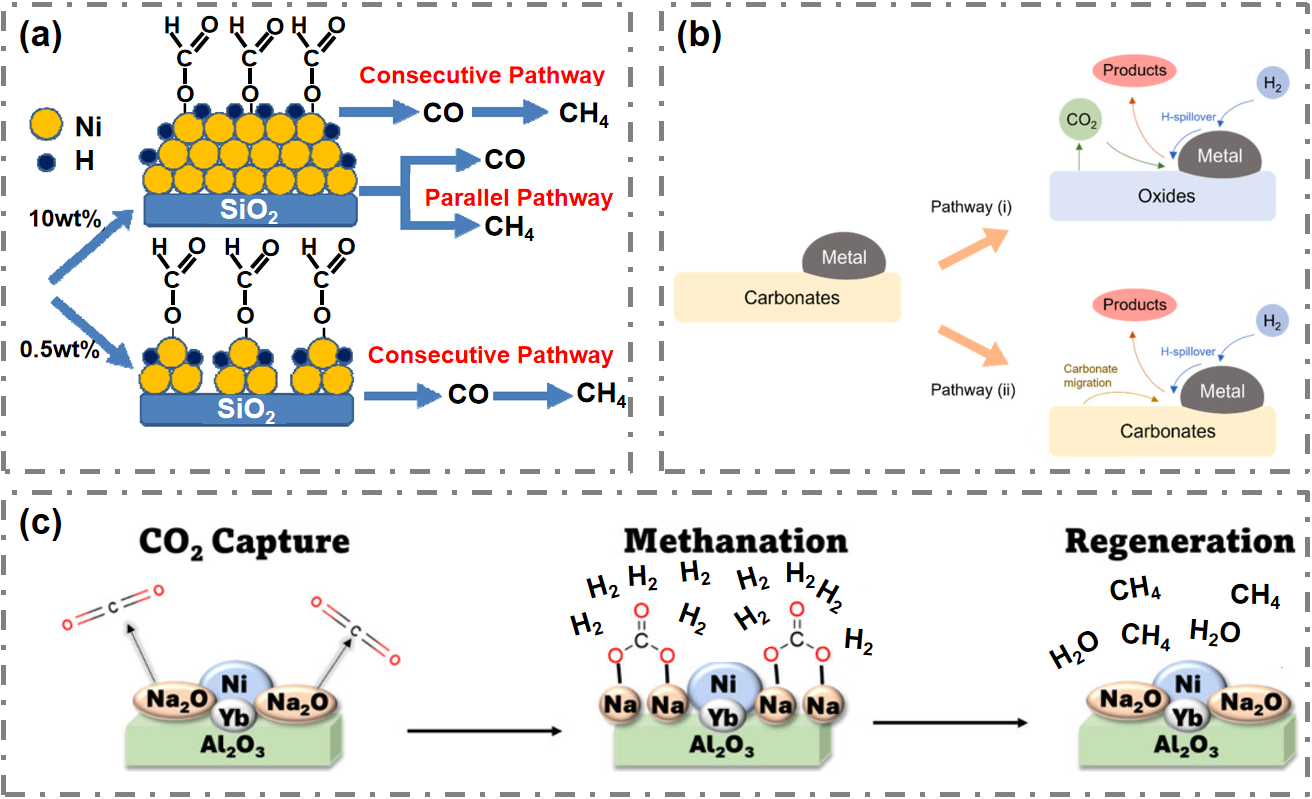
Fig. 12. Regulation of CO2 hydrogenation pathways over Ni-based DFMs. (a) Proposed mechanism on Ni/SiO2. Reproduced with permission from Ref. [231]. Copyright 2015, Royal Society of Chemistry. (b) Two possible pathways for immobilized CO2 during CCR cycles. Reproduced with permission from Ref. [232]. Copyright 2023, Elsevier. (c) CO2 capture and conversion to CH4 over a Yb-promoted Ni-based DFM. Reproduced with permission from Ref. [37]. Copyright 2025, Elsevier.
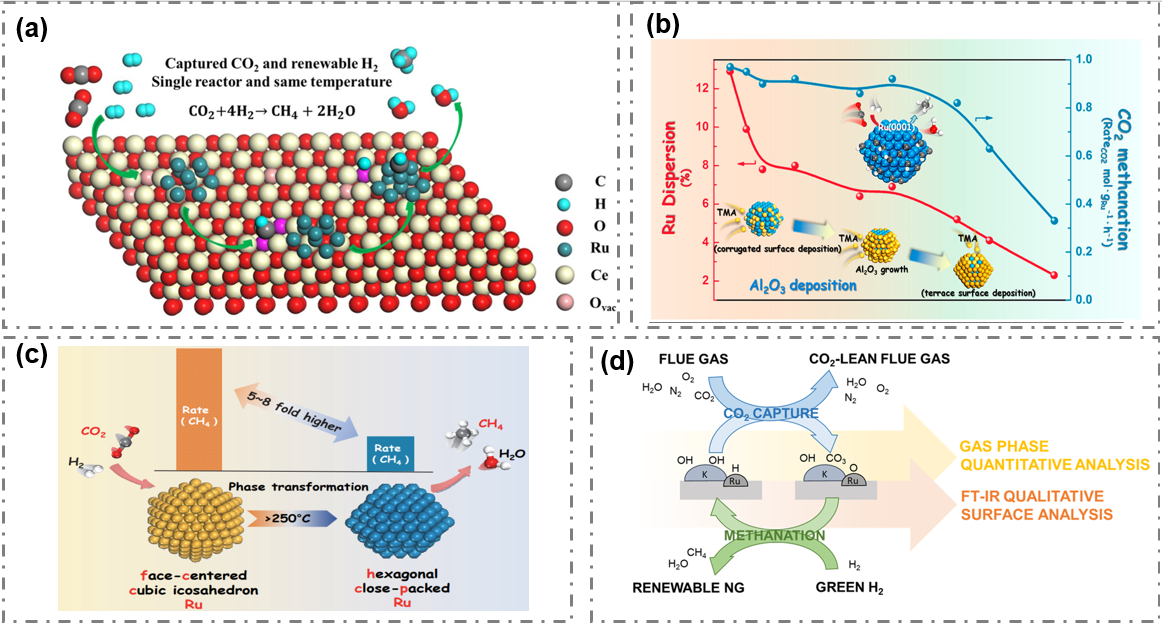
Fig. 13. Schematic representation of key mechanisms, structure-activity relationships, and integrated CO2 methanation in Ru-based DFMs. (a) Conversion of captured CO2 via the formate route over Ru/CeO2. Reproduced with permission from Ref. [26] Copyright 2020, Elsevier. (b) Influence of Al2O3 deposition on Ru dispersion and CO2 methanation activity. Reproduced with permission from Ref. [130]. Copyright 2023, American Chemical Society. (c) Effect of Ru crystal phase transformation on methanation performance. Reproduced with permission from Ref. [240]. Copyright 2024, Elsevier. (d) Integrated CO2 capture-methanation system and analysis of Ru-K/Ba DFMs. Reproduced with permission from Ref. [202]. Copyright 2023, American Chemical Society.
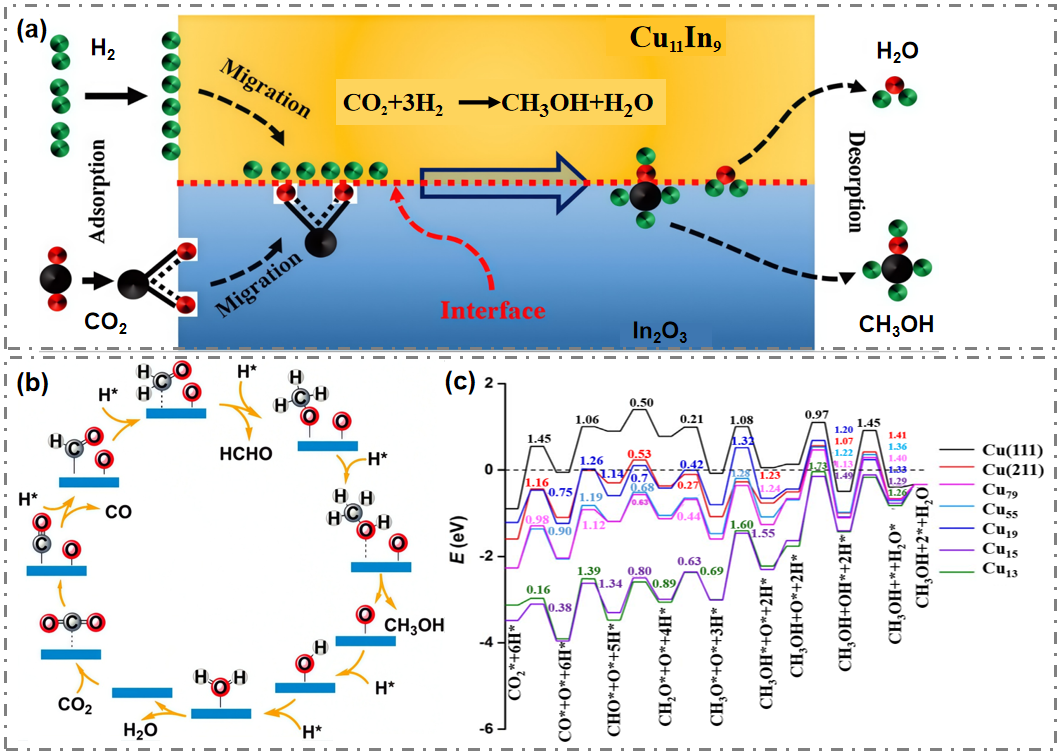
Fig. 14. Charts of reaction mechanisms and energy profiles for CO2 hydrogenation to CH3OH over Cu-based catalysts. (a) CH3OH synthesis mechanism on intermetallic Cu-In catalysts. Reproduced with permission from Ref. [244]. Copyright 2019, Elsevier. (b) Reaction pathways on Cu clusters and extended surfaces. Reproduced with permission from Ref. [245]. Copyright 2018, Elsevier. (c) Potential energy surface with elementary reaction barriers (eV) for CO2 reduction on Cu clusters and extended surfaces. Reproduced with permission from Ref. [245]. Copyright 2018, Elsevier.
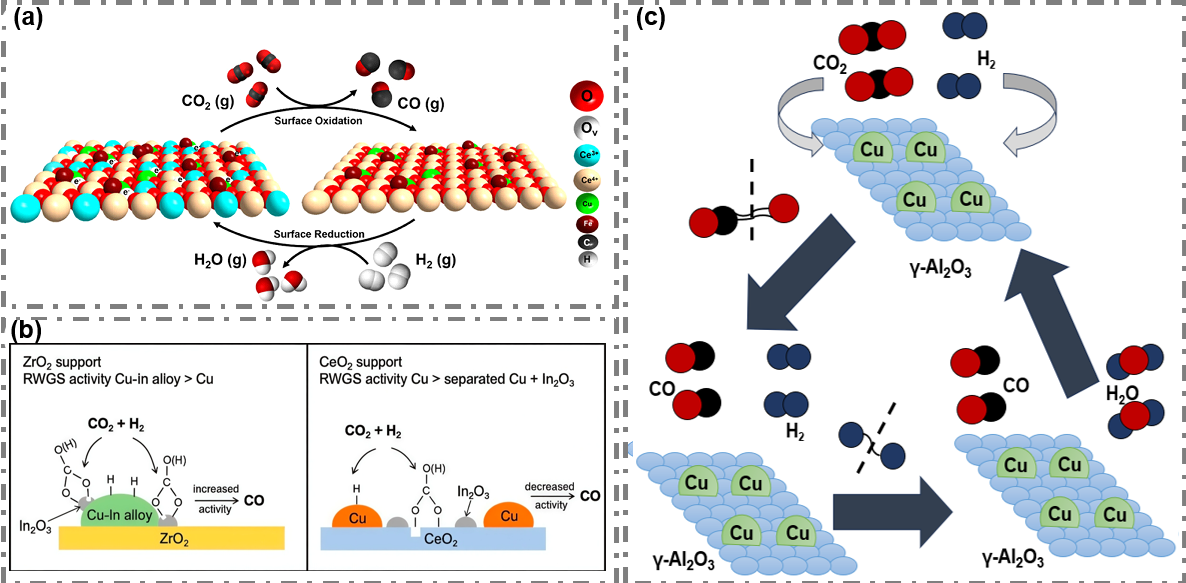
Fig. 15. Mechanisms and performance characteristics of Cu-based catalysts for the RWGS reaction are illustrated as follows: (a) Redox mechanism and surface structure evolution of Fe/CuCeO2 during RWGS. Reproduced with permission from Ref. [210]. Copyright 2024, American Chemical Society. (b) Dependence of active phases, surface properties, intermediates, and RWGS activity on different supports for Cu10/ZrO2, Cu5In5/ZrO2, Cu10/CeO2, and Cu5In5/CeO2. Reproduced with permission from Ref. [248]. Copyright 2022, American Chemical Society. (c) Redox process of CO2 hydrogenation on xCuAl catalyst.
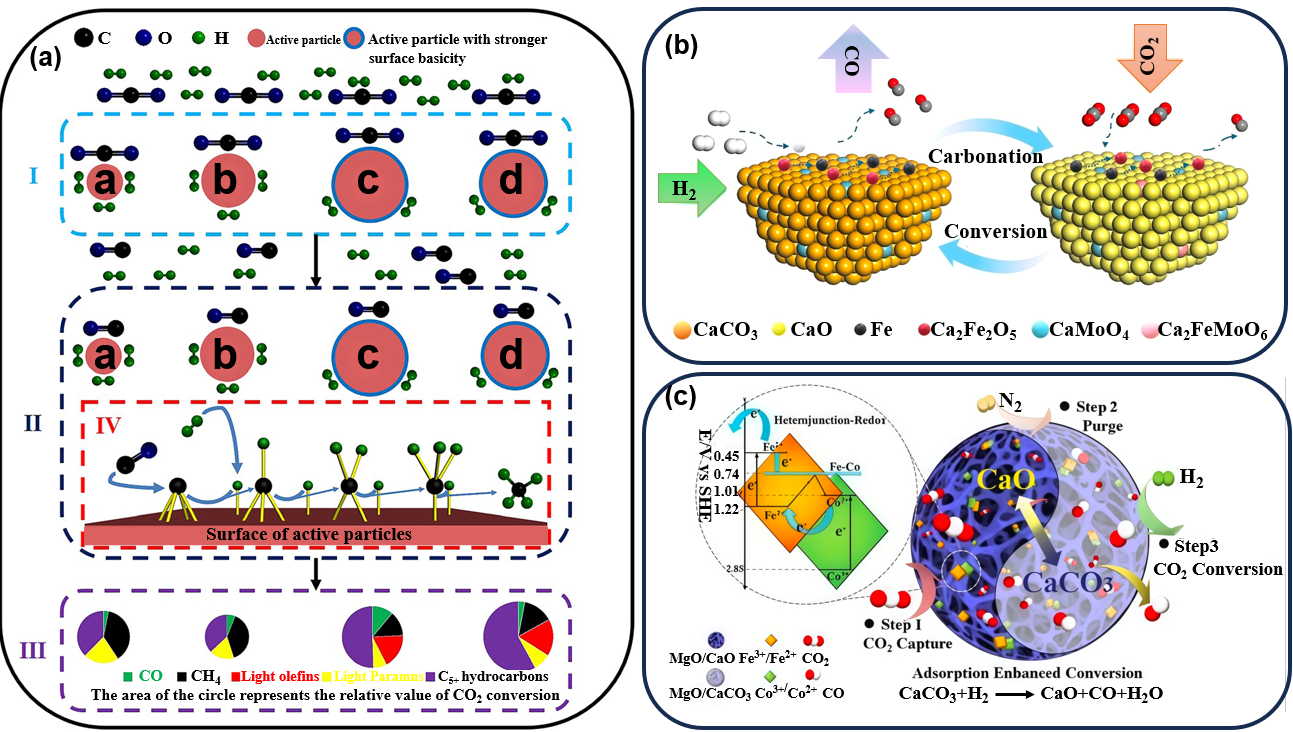
Fig. 16. Mechanism of CO2 capture and conversion over Fe-based DFMs in RWGS: (a) Scheme of the CO2 hydrogenation process. (I) RWGS reaction, (II) FTS reaction, (III) product distribution, and (IV) process to produce CH4 via FTS reaction. Catalysts: a: 5Zn-Fe/Al, b: Fe/Al, c: 10K-Fe/Al, and d: 2Zn-10K-Fe/Al. Reproduced with permission from Ref. [105]. Copyright 2024, Royal Society of Chemistry. (b) Core mechanism diagram of Mo/Fe-CaO DFM for CO2 capture and conversion in RWGS. Reproduced with permission from Ref. [249]. Copyright 2025, American Chemical Society. (c) Heterojunction-redox mechanism of bimetallic catalyst Fe5Co5Mg10CaO for the adsorption-enhanced in-situ conversion. Reproduced with permission from Ref. [257]. Copyright 2012, Royal Society of Chemistry.
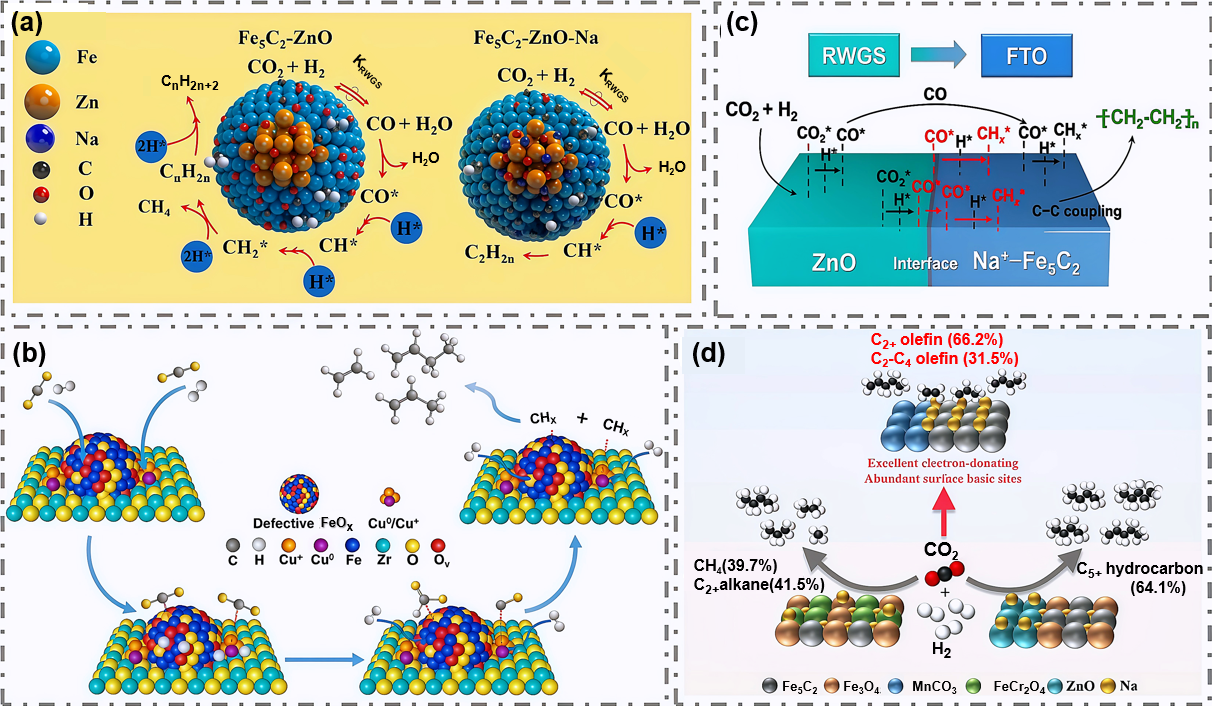
Fig. 17. Schematic diagram of the CO2 hydrogenation reaction over Fe-based DFMs and the regulatory mechanism of promoters: (a) Plausible mechanism of Na effects on Fe5C2 for CO2 hydrogenation. Reproduced with permission from Ref. [259]. Copyright 2021, Elsevier. (b) Schematic diagram of CO2 hydrogenation on supported Cu-decorated Fe catalysts. Reproduced with permission from Ref. [110]. Copyright 2024, American Chemical Society. (c) Reaction mechanism for CO2 hydrogenation to olefins over the Na-Zn-Fe catalyst. Reproduced with permission from Ref. [263]. Copyright 2024, Elsevier. (d) Schematic of CO2 hydrogenation reaction over Fe-based catalysts. Reproduced with permission from Ref. [264]. Copyright 2025, Elsevier.
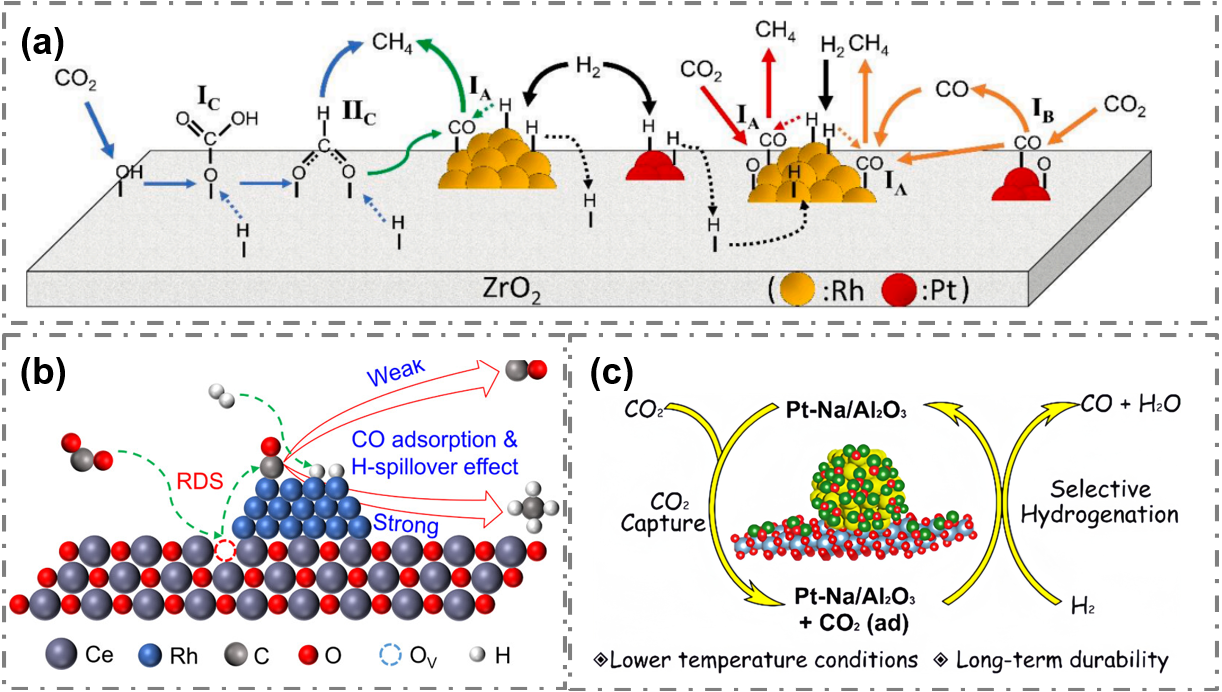
Fig. 18. CCR reaction mechanisms of noble metal-based DFMs: (a) Proposed reaction route for CO2 methanation on the ZrO2-supported bimetallic sample (75Rh25Pt). Where IA: Rh0-CO species, IB: Pt0-CO species, IC: *HCO3 species on ZrO2, IIC: *HCOO species on ZrO2. Reproduced with permission from Ref. [214]. Copyright 2022, Elsevier. (b) Mechanism of Rh-CeO2 DFM. Reproduced with permission from Ref. [280]. Copyright 2023, American Chemical Society. (c) CCR reaction mechanisms and low-temperature long-term durability of Pt-Na/Al2O3 DFM. Reproduced with permission from Ref. [213]. Copyright 2022, American Chemical Society.
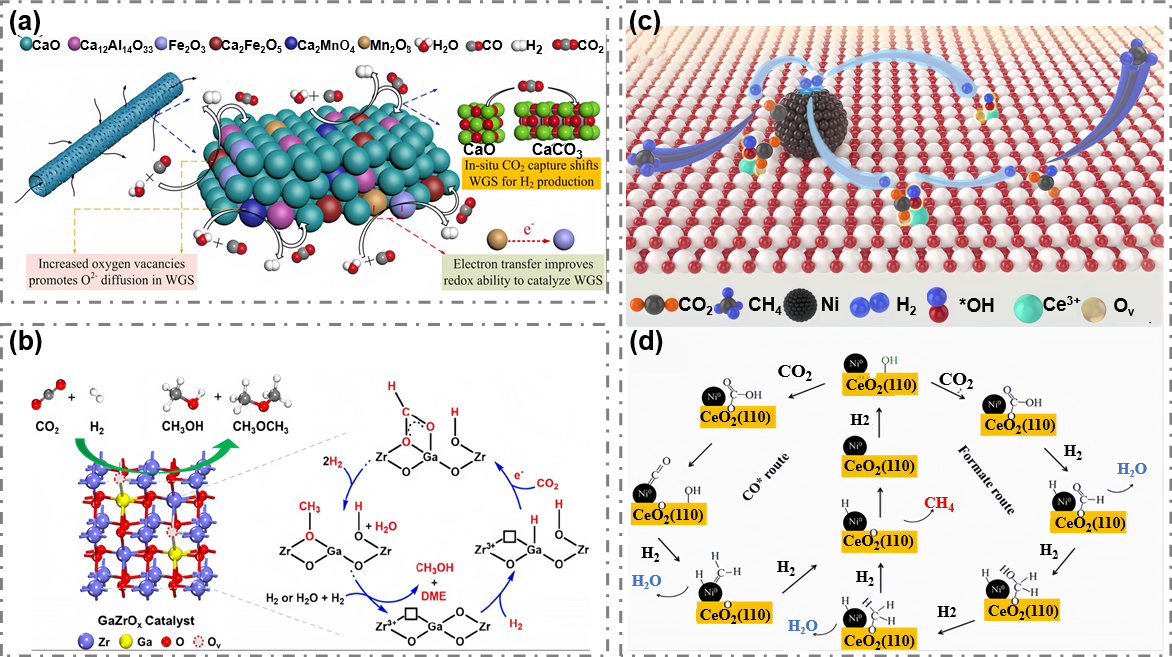
Fig. 19. Key mechanisms and performances of non-noble metal-based DFMs (excluding Ni, Cu, Fe) in CO2 conversion. (a) Mechanism diagram of microtubular Fe/Mn-promoted CaO-Ca12Al14O33 in RWGS process. Reproduced with permission from Ref. [31] Copyright 2022, Elsevier. (b) Crystal structure of metal oxide catalysts and the reaction cycle mechanism of CO2 conversion to CH3OH/dimethyl ether. Reproduced with permission from Ref. [292]. Copyright 2021, American Chemical Society. (c) Schematic diagram of the formation of FLPs (with yellow light); formate route and carbonyl route for low-temperature CO2 methanation over Ni/CeO2-R. Reproduced with permission from Ref. [285]. Copyright 2022, American Chemical Society. (d) Possible reaction pathway. Reproduced with permission from Ref. [285]. Copyright 2022, American Chemical Society.
|
| [1] | Zihao Gao, Kai Huang, Qingling Xu, Xin Wang, Zhicheng Liu, Bin Shao, Jun Hu. Engineering catalytic microenvironments for enhancing ethylene production in CO2 capture and in-situ oxidative dehydrogenation of ethane [J]. Chinese Journal of Catalysis, 2026, 88(9): 322-334. |
| [2] | Fleur A. E. Bruekers, Tess I. van Benthem, Rajamohanan Sobhana Anju, N. Raveendran Shiju. Phase to performance: The advancing role of molybdenum carbides in reverse water-gas shift reaction [J]. Chinese Journal of Catalysis, 2026, 85(6): 1-12. |
| [3] | Zhiyao Liu, Tangkang Liu, Chuan Qin, Guoliang Liu, Anmin Zheng. Zirconia-mediated interfacial catalysis for CO2 hydrogenation [J]. Chinese Journal of Catalysis, 2026, 84(5): 1-24. |
| [4] | Haifeng Fan, Di Xu, Ting Zeng, Guoqiang Hou, Yangyang Li, Siyi Huang, Yanfei Xu, Zheng Wang, Xinhua Gao, Xiang-Kui Gu, Mingyue Ding. Highly efficient electron-enriched Y2O3‒x-Ni interfaces boosting low-temperature CO2 methanation [J]. Chinese Journal of Catalysis, 2026, 84(5): 200-213. |
| [5] | Mang Zheng, Qi Li, Qianxi Liu, Huiquan Gu, Mingyang Liu, Qi Liu, Baojiang Jiang. Asymmetric oxygen-bridged Bi-In dual sites for efficient photothermal CO2 methanation [J]. Chinese Journal of Catalysis, 2026, 83(4): 351-362. |
| [6] | Xianxuan Ren, Rozemarijn D. E. Krösschell, Zhuowu Men, Peng Wang, Ivo A. W. Filot, Emiel J. M. Hensen. A theoretical study of the role of K on the reverse water-gas shift reaction on Hägg carbide [J]. Chinese Journal of Catalysis, 2025, 72(5): 289-300. |
| [7] | Tao Ban, Jian-Wei Wang, Xi-Yang Yu, Hai-Kuo Tian, Xin Gao, Zheng-Qing Huang, Chun-Ran Chang. Machine learning-assisted screening of SA-FLP dual-active-site catalysts for the production of methanol from methane and water [J]. Chinese Journal of Catalysis, 2025, 70(3): 311-321. |
| [8] | Chongya Yang, Weijue Wang, Hongying Zhuo, Zheng Shen, Tianyu Zhang, Xiaofeng Yang, Yanqiang Huang. Phase engineering of Ru-based nanocatalysts for enhanced activity toward CO2 methanation [J]. Chinese Journal of Catalysis, 2024, 61(6): 226-236. |
| [9] | Feng Sha, Shan Tang, Chizhou Tang, Zhendong Feng, Jijie Wang, Can Li. The role of surface hydroxyls on ZnZrOx solid solution catalyst in CO2 hydrogenation to methanol [J]. Chinese Journal of Catalysis, 2023, 45(2): 162-173. |
| [10] | Longtai Li, Bin Yang, Biao Gao, Yifu Wang, Lingxia Zhang, Tatsumi Ishihara, Wei Qi, Limin Guo. CO2 hydrogenation selectivity shift over In-Co binary oxides catalysts: Catalytic mechanism and structure-property relationship [J]. Chinese Journal of Catalysis, 2022, 43(3): 862-876. |
| [11] | Chenxi Zhang, Peiyuan Zhao, Shuangxi Liu, Kai Yu. Three-dimensionally ordered macroporous perovskite materials for environmental applications [J]. Chinese Journal of Catalysis, 2019, 40(9): 1324-1338. |
| [12] | J. H. Flores, M. E. H. Maia da Costa, M. I. Pais da Silva. Effect of Cu-ZnO-Al2O3 supported on H-ferrierite on hydrocarbons formation from CO hydrogenation [J]. Chinese Journal of Catalysis, 2016, 37(3): 378-388. |
| [13] | WANG Dan-Jun, TAO Fu-Rong, ZHAO Hua-Hua, SONG Huan-Ling, CHOU Ling-Jun. Preparation of Cu/ZnO/Al2O3 Catalyst for CO2 Hydrogenation to Methanol by CO2 Assisted Aging [J]. Chinese Journal of Catalysis, 2011, 32(9): 1452-1456. |
| [14] | LI Zhong*;FAN Hui;ZHENG Huayan;LIU Yan. Influence of Microwave Irradiation on Precursor Microstructure and Catalytic Performance of Cu/ZnO/Al2O3 for Slurry Methanol Synthesis [J]. Chinese Journal of Catalysis, 2010, 31(4): 471-478. |
| [15] | LIN Shengda, TANG Haodong, Lü Zhaobo, LIU Cailai, CEN Yaqing, LIU Huazhang*. Influence of Precipitation Methods on Precursors and Properties of Cu-Based Catalyst for Methanol Synthesis [J]. Chinese Journal of Catalysis, 2010, 31(10): 1257-1262. |
| Viewed | ||||||
|
Full text |
|
|||||
|
Abstract |
|
|||||


