
Chinese Journal of Catalysis ›› 2026, Vol. 89: 477-490.DOI: 10.1016/S1872-2067(26)65177-7
• Article • Previous Articles
Jin Yanga, Jiajin Lina, Changchun Yeb, Yifei Lia, Shumin Liua, Gaige Zhanga, Shengjie Liuc, Guangxu Chena,*( )
)
Received:2026-02-27
Accepted:2026-04-28
Online:2026-10-18
Published:2026-09-01
Contact:
*E-mail:cgx08@scut.edu.cn(G. Chen).
Supported by:Jin Yang, Jiajin Lin, Changchun Ye, Yifei Li, Shumin Liu, Gaige Zhang, Shengjie Liu, Guangxu Chen. Tunnel-confined and quenching-anchored atomic Cu in transition metal oxides for efficient catalytic oxidation[J]. Chinese Journal of Catalysis, 2026, 89: 477-490.
Add to citation manager EndNote|Ris|BibTeX
URL: https://www.cjcatal.com/EN/10.1016/S1872-2067(26)65177-7
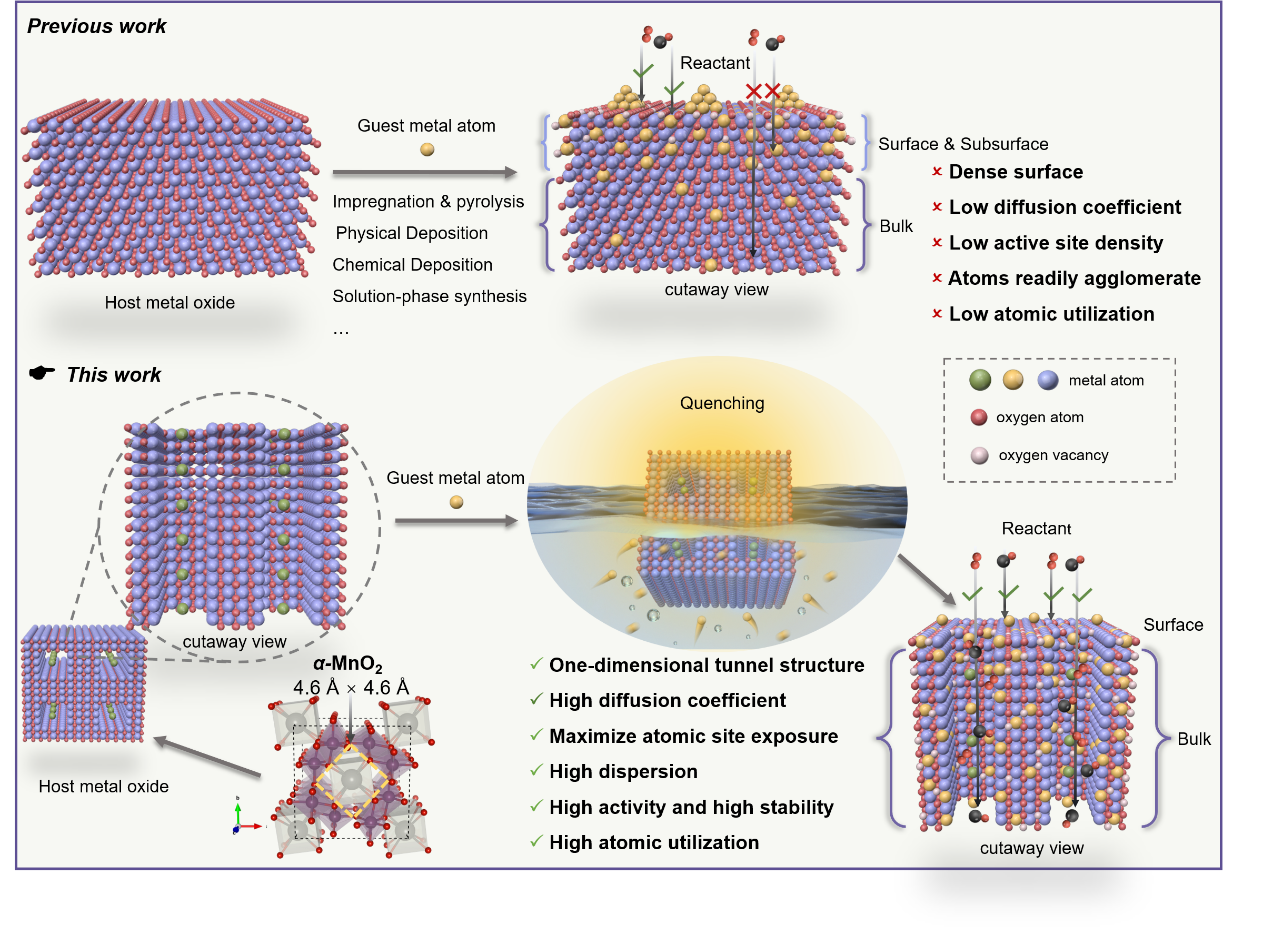
Fig. 1. Schematic illustration depicting variations in the anchoring sites of guest metal atoms during quenching, associated with different atomic packing configurations.

Fig. 2. (a) Schematic illustration of the synthesis process of MnO2-QCu via the quenching process. (b,c) TEM images of MnO2-QCu. (d) XRD patterns of pristine MnO2, MnO2-Qwater, and MnO2-QCu. (e) HAADF-STEM image of MnO2-QCu, along with IFFT images corresponding to the (211) I and (202) II lattice planes. (f) Aberration-corrected HAADF-STEM image of MnO2-QCu. (g) Intensity profiles extracted from the green and yellow dashed regions in (f). (h) HAADF-STEM image and corresponding EDX elemental mapping of Mn, O, Cu, and K in MnO2-QCu.
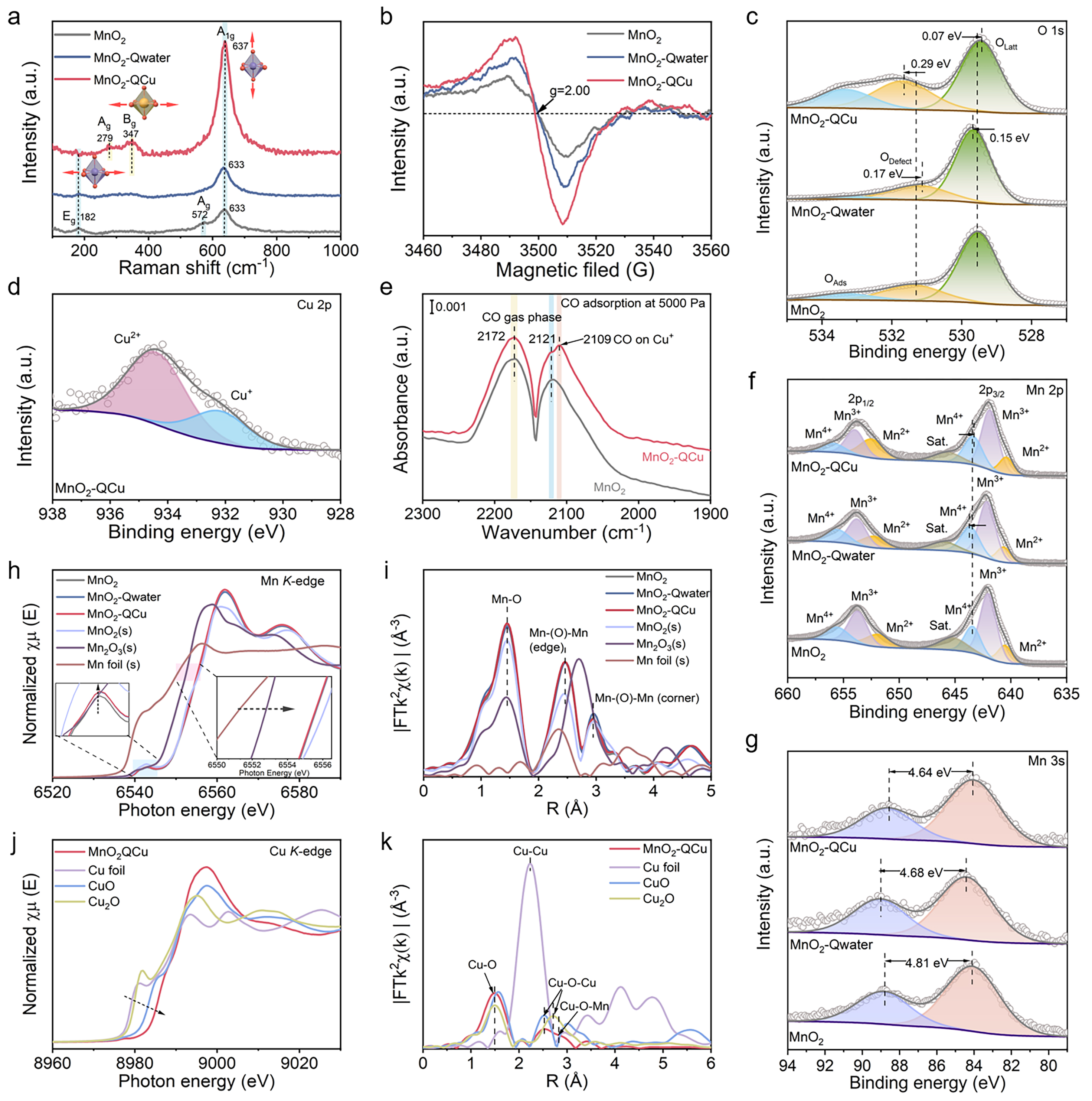
Fig. 3. (a) Raman spectra of MnO2, MnO2-Qwater, and MnO2-QCu. (b) EPR spectra of the corresponding catalysts. (c) High-resolution XPS spectra of the O 1s region of various catalysts. (d) Cu 2p XPS spectra of the MnO2-QCu. (e) The infrared Fourier transform spectroscopy of CO adsorption on MnO2 and MnO2-QCu catalysts at 5000 Pa, respectively. XPS spectra of Mn 2p (f) and Mn 3s (g) for MnO2, MnO2-Qwater, and MnO2-QCu. (h) Normalized Mn K-edge XANES spectra, with reference fingerprints indicating different Mn oxidation states. (i) EXAFS spectra of Mn K-edge, highlighting local coordination environments around Mn. (j) Normalized Cu K-edge XANES spectra of MnO2-QCu compared with reference compounds (Cu foil, Cu2O, and CuO). (k) EXAFS spectra at the Cu K-edge, revealing the local structure of Cu species in MnO2-QCu.
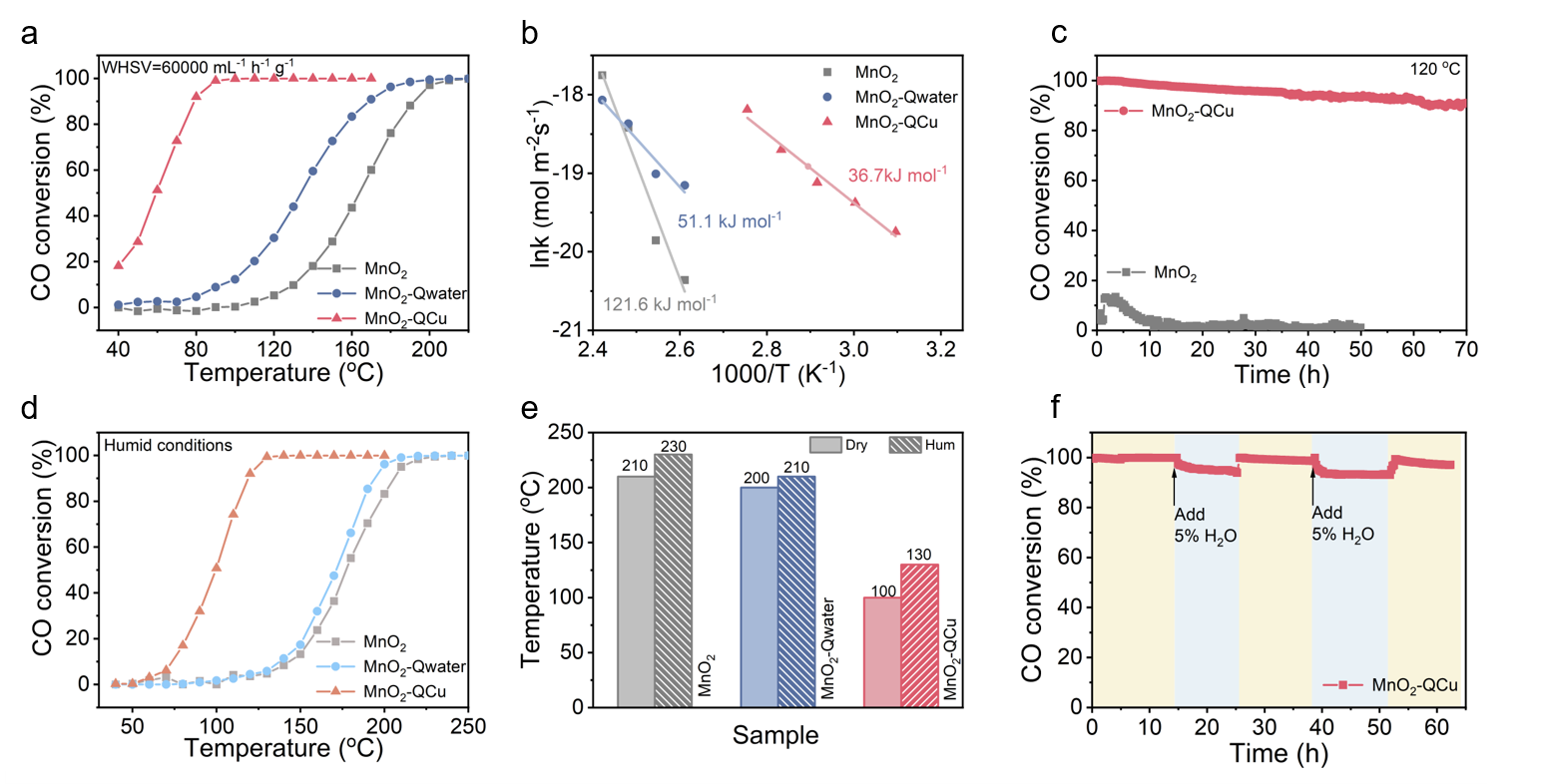
Fig. 4. (a) Light-off curves for the CO oxidation reaction over MnO2, MnO2-Qwater, and MnO2-QCu. (Reaction condition: 1 vol% CO, 16 vol% O2 balanced with N2, total flow rate = 50 mL min-1, WHSV = 60000 mL gcat-1 h-1). (b) Apparent activation energies of various catalysts (WHSV = 300000 mL gcat-1 h-1). (c) Long-term stability test of CO oxidation at 120 °C for 70 h. (d) Light-off curves for the CO oxidation reaction under humid conditions (Reaction conditions: 5 vol% H2O, 1 vol% CO, 16 vol% O2 balanced with N2, total flow rate = 50 mL min-1, WHSV = 60000 mL gcat-1 h-1). (e) Comparison of T100 values across various catalysts under dry versus humid conditions. (f) Water tolerance assessment of MnO2-QCu during CO oxidation with periodic addition of 5 vol% H2O.
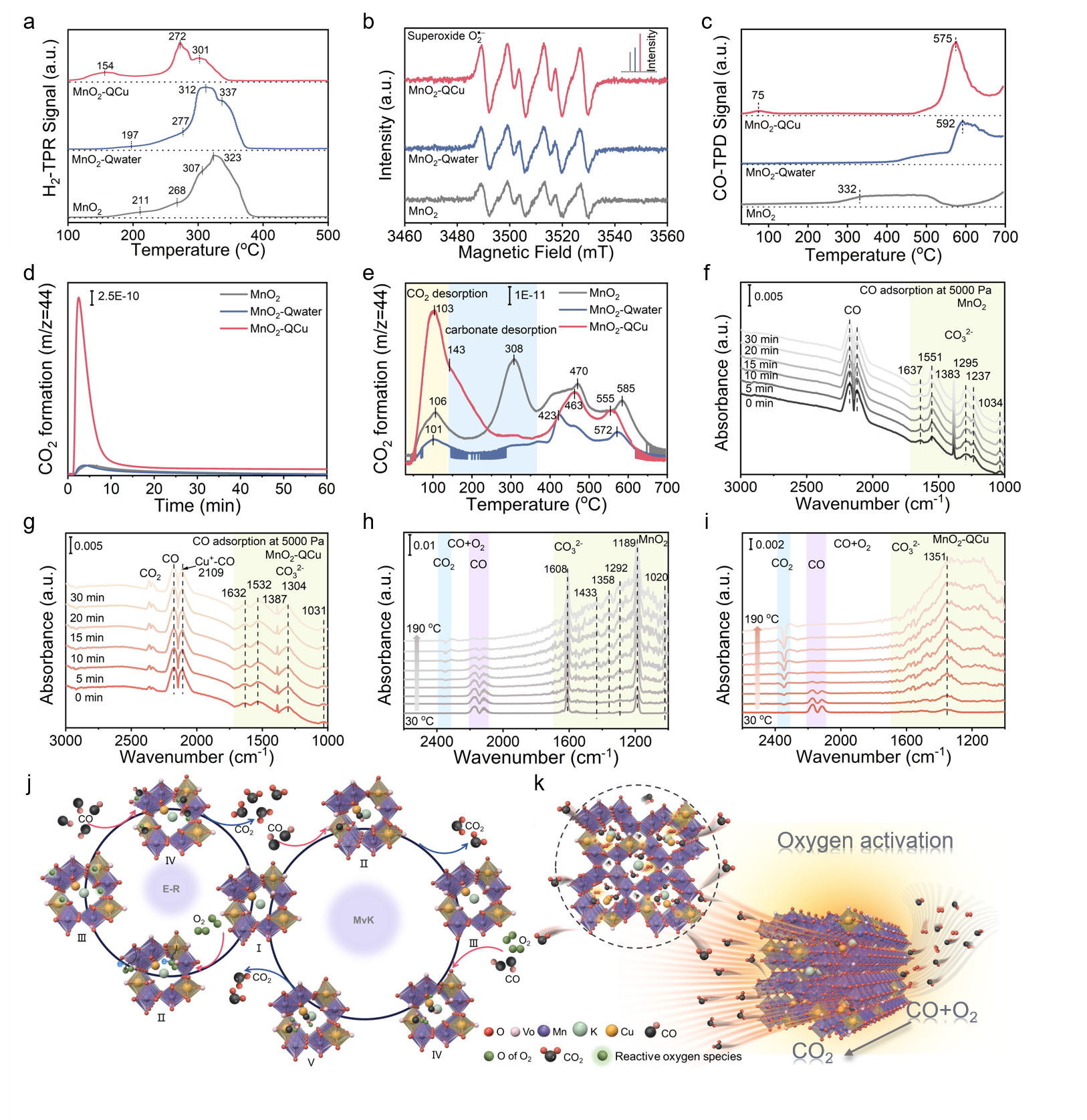
Fig. 5. (a) H2-TPR profiles of MnO2, MnO2-Qwater, and MnO2-QCu. (b) EPR spectra of superoxide O2-• species captured by DMPO as a spin-trapping agent. (c) CO-TPD profiles of MnO2, MnO2-Qwater and MnO2-QCu catalysts. (d) CO-TPSR curves showing CO2 formation over time. (e) CO-TPSR curves showing CO2 release and carbonate decomposition over temperature. In-situ time-resolved infrared spectra of CO adsorption on MnO2 (f) and MnO2-QCu (g) measured under 5 vol% CO at 5000 Pa. In-situ DRIFTS spectra collected during CO oxidation on MnO2 (h) and MnO2-QCu (i) under a flow of 1 vol% CO and 16 vol% O2 in N2 at different temperatures. (j) The proposed mechanisms for CO oxidation on the MnO2-QCu catalyst. (k) Schematic of CO oxidation over Cu-loaded MnO2 frameworks.
|
| [1] | Zheguan Lin, Shuyi He, Tiesen Li, Qingyan Cui, Wenfu Yan, Yuanyuan Yue. Design of interface structure to enhance the operational temperature range of CuO/Cu-SSZ-13 for concurrent NOx selective catalytic reduction and CO oxidation [J]. Chinese Journal of Catalysis, 2026, 85(6): 286-297. |
| [2] | Junbo Tian, Peng Zheng, Shuang Deng, Yongjun Ji, Tengfei Zhang, Zhiyi Sun, Wenxing Chen, Yi-Chi Wang, Lin Gu, Dong Su, Guangwen Xu, Ziyi Zhong, Fabing Su. Hydrogen-induced Ptσ+-O-Ti4+-(H-oxygen vacancy) interfacial sites in Pt/TiO2 for enhanced low-temperature CO oxidation [J]. Chinese Journal of Catalysis, 2026, 90(11): 117-129. |
| [3] | Yongqi Zhao, Junjie Jiang, Yang Zou, Pu Wang, Xue Li, Xiaolong Liu, Tingyu Zhu. Ultra-low doping 0.1(PtMnFeCoNi)/TiO2 catalysts: Modulating the electronic states of active metal sites to enhance CO oxidation through high entropy strategy [J]. Chinese Journal of Catalysis, 2025, 76(9): 173-184. |
| [4] | Xiaorui Du, Yike Huang, Xiaoli Pan, Xunzhu Jiang, Yang Su, Jingyi Yang, Yalin Guo, Bing Han, Chengyan Wen, Chenguang Wang, Botao Qiao. Top-down fabrication of active interface between TiO2 and Pt nanoclusters. Part 1: Redispersion process and mechanism [J]. Chinese Journal of Catalysis, 2024, 58(3): 237-246. |
| [5] | Xiaorui Du, Yike Huang, Xiaoli Pan, Xunzhu Jiang, Yang Su, Jingyi Yang, Yalin Guo, Bing Han, Chengyan Wen, Chenguang Wang, Botao Qiao. Top-down fabrication of active interface between TiO2 and Pt nanoclusters. Part 2: Catalytic performance and reaction mechanism in CO oxidation [J]. Chinese Journal of Catalysis, 2024, 58(3): 247-254. |
| [6] | Xuefei Weng, Shuangli Yang, Ding Ding, Mingshu Chen, Huilin Wan. Applications of in-situ wide spectral range infrared absorption spectroscopy for CO oxidation over Pd/SiO2 and Cu/SiO2 catalysts [J]. Chinese Journal of Catalysis, 2022, 43(8): 2001-2009. |
| [7] | Yang Ou, Songda Li, Fei Wang, Xinyi Duan, Wentao Yuan, Hangsheng Yang, Ze Zhang, Yong Wang. Reversible transformation between terrace and step sites of Pt nanoparticles on titanium under CO and O2 environments [J]. Chinese Journal of Catalysis, 2022, 43(8): 2026-2033. |
| [8] | Chun Zhu, Jin-Xia Liang, Yang-Gang Wang, Jun Li. Non-noble metal single-atom catalyst with MXene support: Fe1/Ti2CO2 for CO oxidation [J]. Chinese Journal of Catalysis, 2022, 43(7): 1830-1841. |
| [9] | Yanan Gao, Fu-Kuo Chiang, Shaojie Li, Long Zhang, Peng Wang, Emiel J. M. Hensen. Influence of hematite morphology on the CO oxidation performance of Au/α-Fe2O3 [J]. Chinese Journal of Catalysis, 2021, 42(4): 658-665. |
| [10] | Fan Wu, Lei He, Wen-Cui Li, Rao Lu, Yang Wang, An-Hui Lu. Highly dispersed boron-nitride/CuOx-supported Au nanoparticles for catalytic CO oxidation at low temperatures [J]. Chinese Journal of Catalysis, 2021, 42(3): 388-395. |
| [11] | Chunyan Dong, Yan Zhou, Na Ta, Wenlu Liu, Mingrun Li, Wenjie Shen. Shape impact of nanostructured ceria on the dispersion of Pd species [J]. Chinese Journal of Catalysis, 2021, 42(12): 2234-2241. |
| [12] | Zhu-Yuan Zheng, Dong Wang, Yi Zhang, Fan Yang, Xue-Qing Gong. Structures and reactivities of the CeO2/Pt(111) reverse catalyst: A DFT+U study [J]. Chinese Journal of Catalysis, 2020, 41(9): 1360-1368. |
| [13] | Panpan Wang, Jiahao Duan, Jie Wang, Fuming Mei, Peng Liu. Elucidating structure-performance correlations in gas-phase selective ethanol oxidation and CO oxidation over metal-doped γ-MnO2 [J]. Chinese Journal of Catalysis, 2020, 41(8): 1298-1310. |
| [14] | Linxi Wang, Shyam Deo, Kerry Dooley, Michael J. Janik, Robert M. Rioux. Influence of metal nuclearity and physicochemical properties of ceria on the oxidation of carbon monoxide [J]. Chinese Journal of Catalysis, 2020, 41(6): 951-962. |
| [15] | Ya-Qiong Su, Long Zhang, Valery Muravev, Emiel J. M. Hensen. Lattice oxygen activation in transition metal doped ceria [J]. Chinese Journal of Catalysis, 2020, 41(6): 977-984. |
| Viewed | ||||||
|
Full text |
|
|||||
|
Abstract |
|
|||||


