
Chinese Journal of Catalysis ›› 2026, Vol. 91: 103-121.DOI: 10.1016/S1872-2067(26)65182-0
• Articles • Previous Articles Next Articles
Jian Yiing Loha,b, Feng Ming Yapa,b, Elton Song-Zhe Maha,b, Xianhai Zengc, Wee-Jun Onga,b,d,e,f,g,*( )
)
Received:2026-04-16
Accepted:2026-05-08
Online:2026-12-18
Published:2026-10-13
Jian Yiing Loh, Feng Ming Yap, Elton Song-Zhe Mah, Xianhai Zeng, Wee-Jun Ong. Harnessing electronic structure modulation of Cu2+-mediated layered double hydroxide towards selective C2 pathway in CO2 reduction and plastic upcycling[J]. Chinese Journal of Catalysis, 2026, 91: 103-121.
Add to citation manager EndNote|Ris|BibTeX
URL: https://www.cjcatal.com/EN/10.1016/S1872-2067(26)65182-0
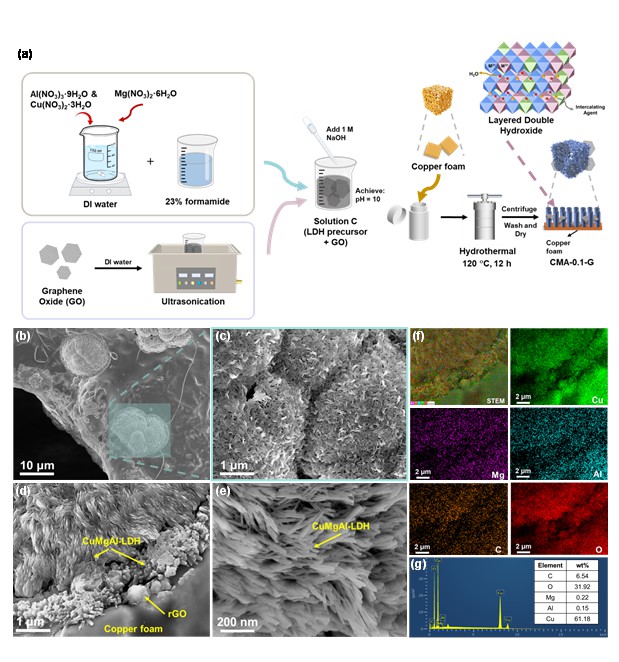
Fig. 1. (a) Schematic illustration of the synthesis of CMA-0.1-G. FESEM images of CMA-0.1-G on copper foam with elevating magnifications of 10 μm (b), 1 μm (c,d), and 200 nm (e). (f) STEM image with the corresponding EDX mapping of Cu, Mg, Al, C and O elements of CMA-0.1-G. (g) EDX spectrum of Cu, Mg, Al, C and O in CMA-0.1-G.

Fig. 2. (a) Low magnification TEM image of CMA-0.1-G, with the inset highlighting the CuMgAl-LDH. (b) HRTEM image of CMA-0.1-G with inset of FFT image. (c) Magnified TEM image of CMA-0.1-G. (d) HRTEM image of nanoneedles LDH. (e) XRD patterns of CMA-0.1 and CMA-0.1-G. (f) Raman spectra of CMA-0.1 and CMA-0.1-G.
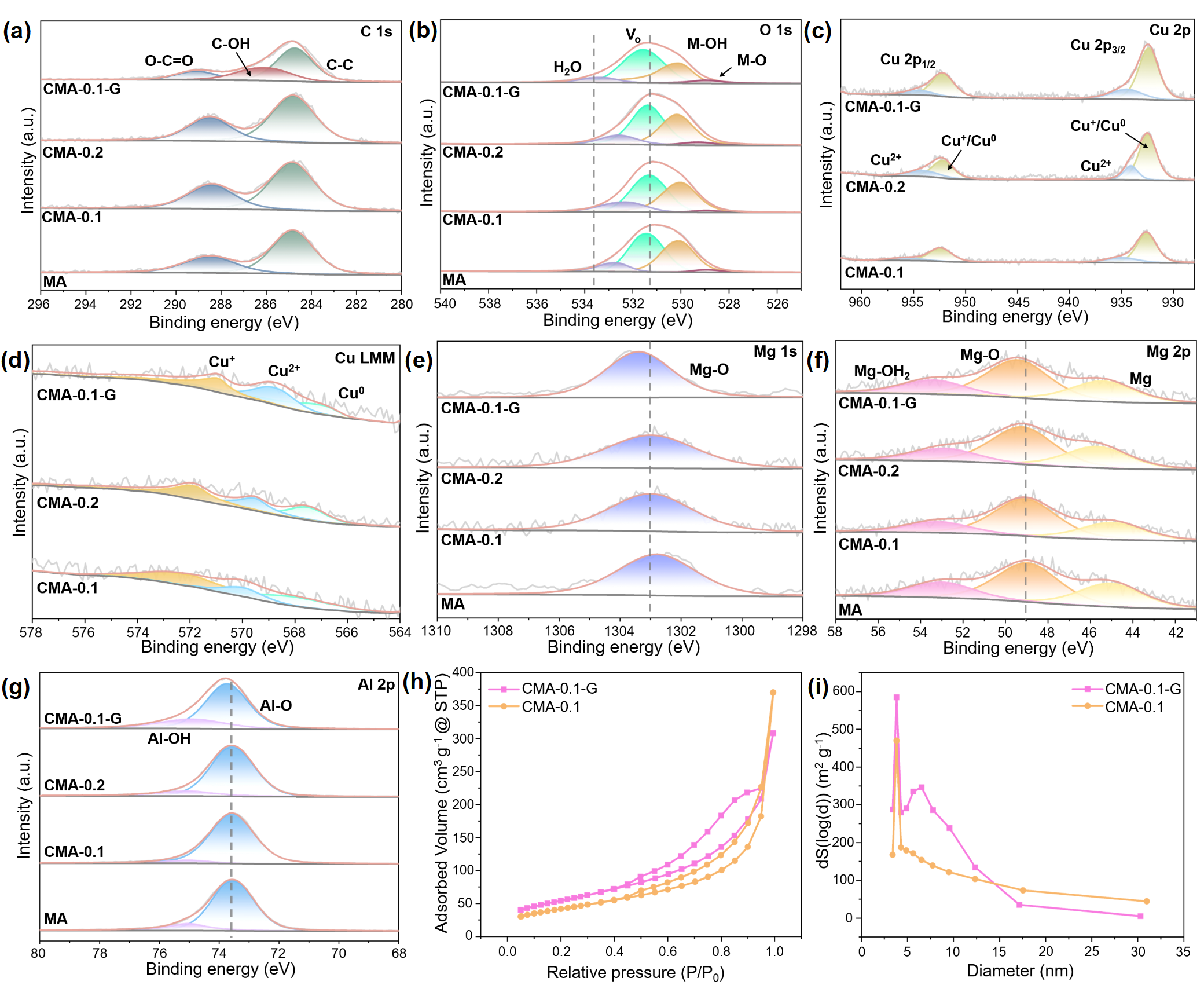
Fig. 3. XPS spectra of C 1s (a), O 1s (b), Cu 2p (c), Cu LMM (d), Mg 1s (e), Mg 2p (f) and Al 2p (g). BET analysis (h) and pore size distribution (i) of CMA-0.1-G and CMA-0.1.
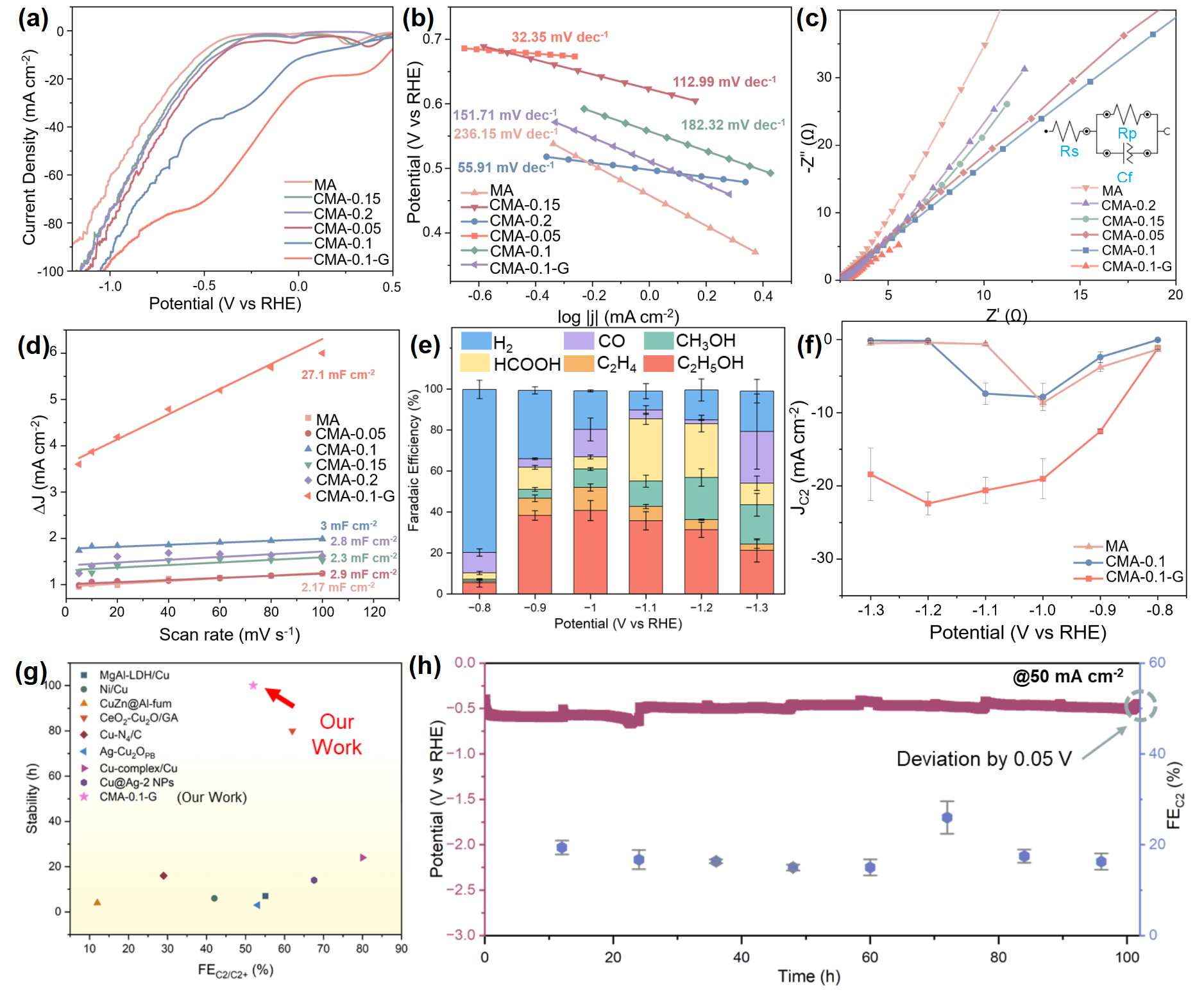
Fig. 4. Electrocatalytic CO2RR Performance. (a) LSV plots for different catalysts. Tafel plots (b), Nyquist plots (c), and Cdl (d) for the as-prepared catalysts. (e) FE values of C1 and C2 products at various applied potentials for CMA-0.1-G. (f) C2 partial current density plot of MA, CMA-0.1 and CMA-0.1-G. (g) Comparison plot of typical CO2RR electrocatalysts (e.g. MgAl-LDH/Cu [6], Ni/Cu [48], CuZn@Al-fum [49], CeO2-Cu2O/GA [50], Cu-N4/C [51], Ag-Cu2OPB [52], Cu-complex/Cu [10] and Cu@Ag-2 NPs [53]). (h) Chronopotentiometry test of CMA-0.1-G at 50 mA cm-2 for 100 h.
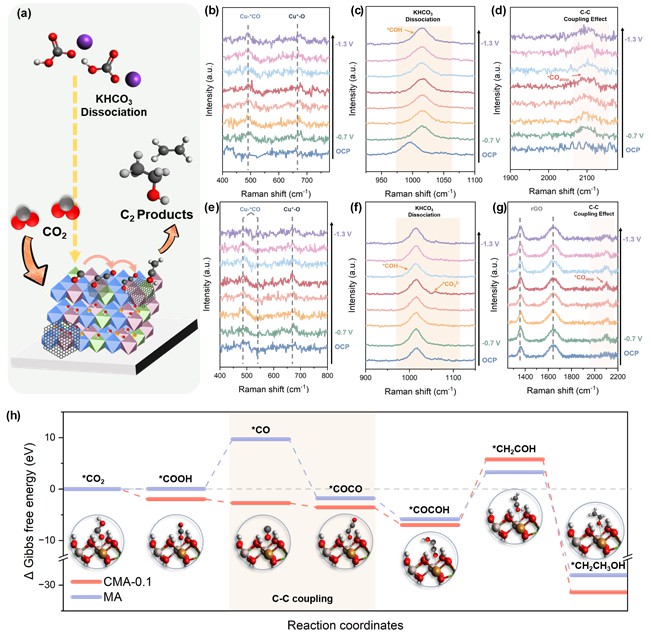
Fig. 5. (a) Graphical illustration of C2 product formation from electrocatalyst. In-situ Raman spectra for CO2RR for CMA-0.1 in the range of 400-780 cm-1 (b), 800-1100 cm-1 (c), 1900-2180 cm-1 (d) and CMA-0.1-G in the range of 400-800 cm-1 (e), 900-1150 cm-1 (f), and 1300-2200 cm-1 (g) at a potential range of -0.7 to -1.3 V vs. RHE. (h) Free energy profiles of CO2RR on MA and CMA-0.1 catalysts.
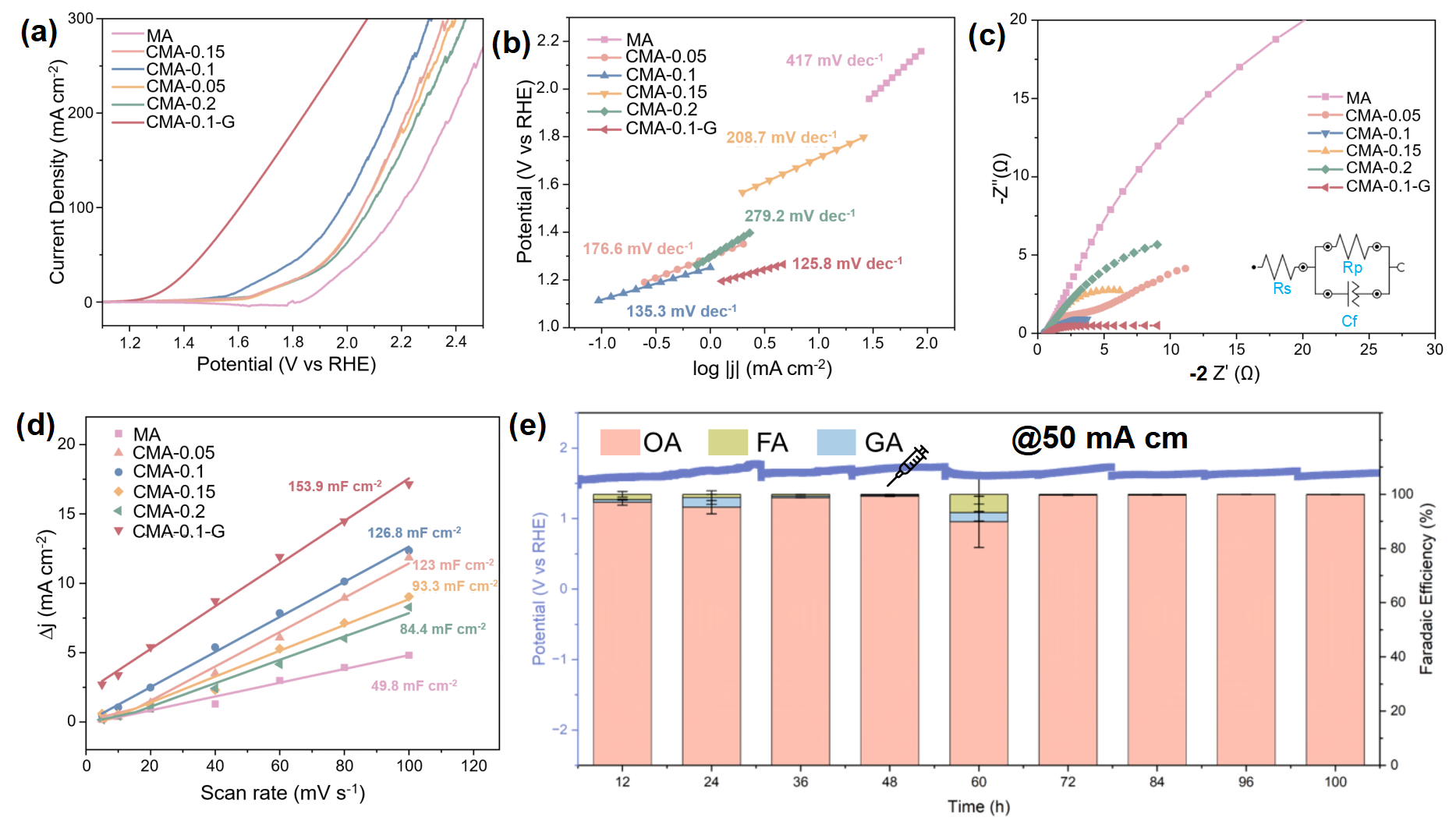
Fig. 6. Electrocatalytic PET oxidation performance. LSV plot (a), Tafel plot (b), Nyquist plot (c) and electrochemical double layer capacitance (Cdl) (d) for the as-prepared catalysts. (e) Chronopotentiometry test and FE of CMA-0.1-G at 50 mA cm-2 for 100 h.
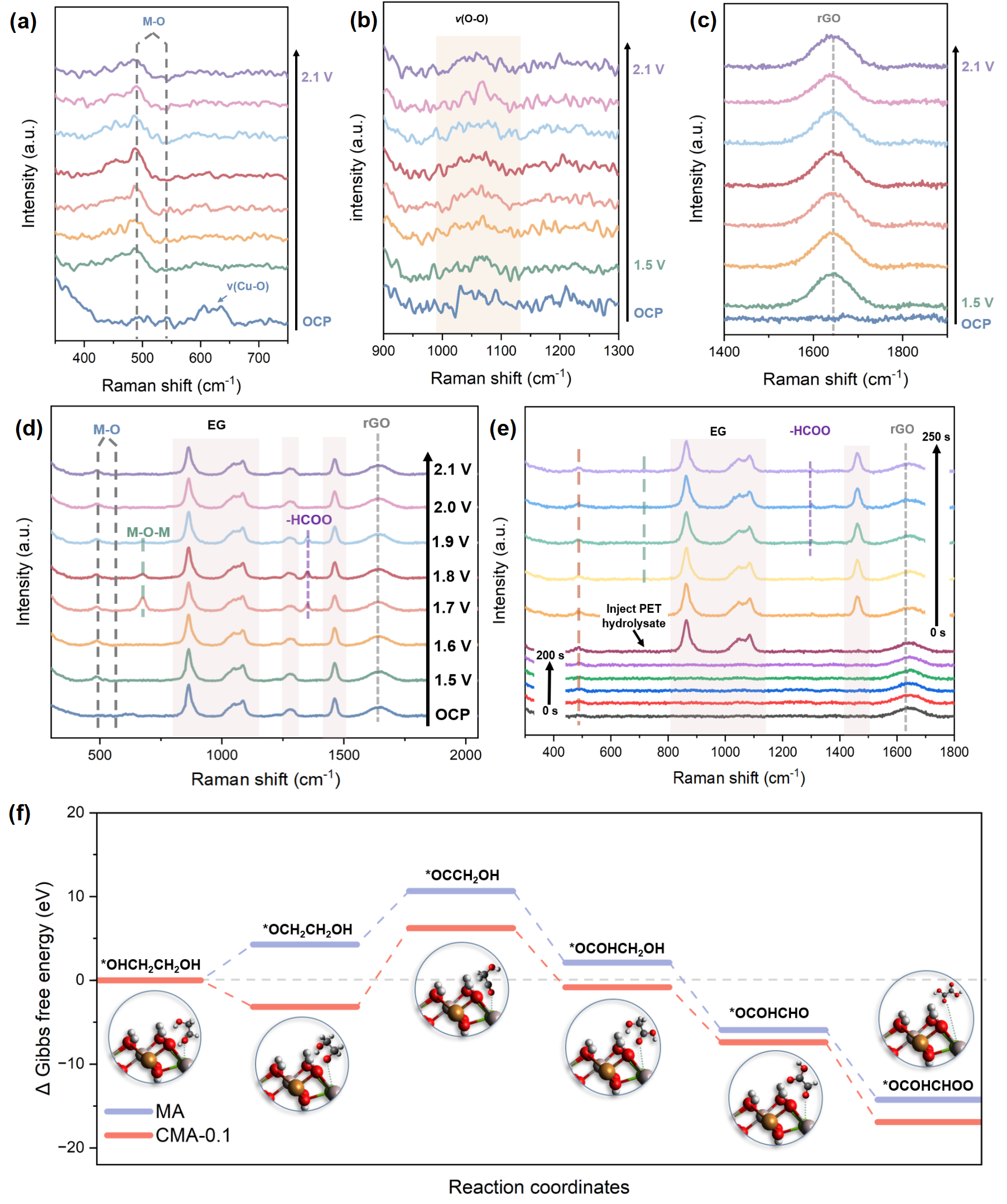
Fig. 7. In-situ Raman spectra for CMA-0.1-G during OER (1 mol L-1 KOH) in the range of 350-750 cm-1 (a), 900-1300 cm-1 (b), 1400-1900 cm-1 (c) and PET oxidation at potential range of -0.7 to -1.3 V vs. RHE (d). (e) OER (1 mol L-1 KOH) and half-way injected PET under 1.7 V. (f) PET oxidation reaction network and free energy diagram for PET oxidation to oxalic acid on the surfaces of CMA-0.1 and MA.
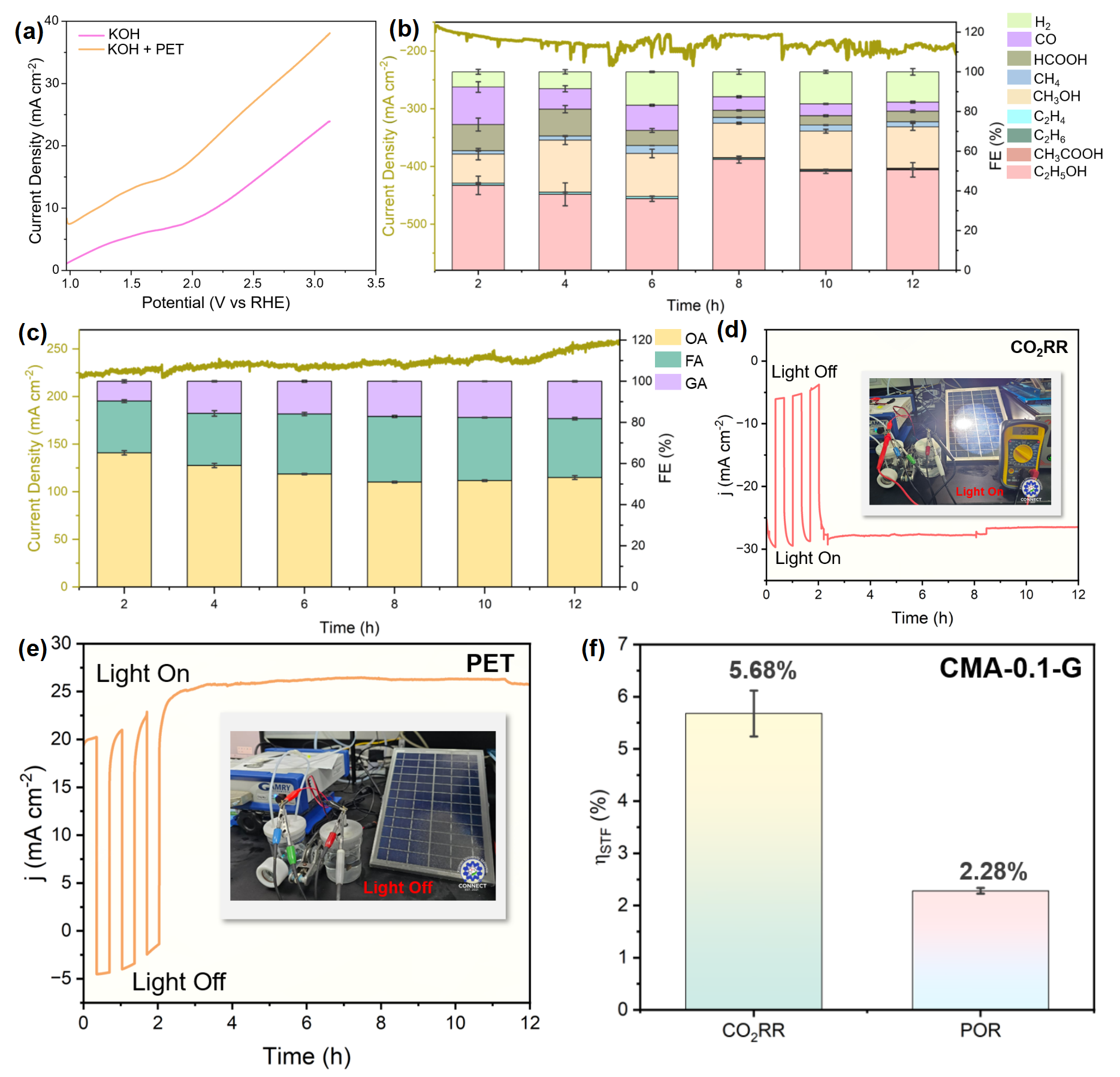
Fig. 8. (a) LSV polarization curves of the integrated cell with and without PET hydrolysate. Flow-cell bifunctional electrolyzer: chronoamperometry stability test for POR-CO2RR. Chronoamperometry for CO2RR with product FE (b) and chronoamperometry for POR with product FE (c). CO2RR (d) and POR (e) stability during continuous illumination for 12 h, along with the inset displaying the solar-cell (light on and light off) bifunctional POR-CO2RR hybrid unit featuring CMA-0.1-G as the anode and cathode electrodes. (f) The ηSTF of the tested electrocatalysts in bifunctional solar-powered electrolysis at the 60th min.
|
| [1] | Hao Wu, Xinyu Zeng, Wang Wang, Bei Cheng, Jingzhao Cheng, Jingsan Xu, Shaowen Cao. The organic-inorganic S-scheme heterojunction with enhanced charge separation simultaneously catalyze the production of hydrogen and imine [J]. Chinese Journal of Catalysis, 2026, 87(8): 185-196. |
| [2] | Jianping Zhang, Kun Zhang, Yinglong Weng, Nannan Li, Tingting Huang, Yitong Lu, Tingyu Sun, Xiaotong Han, Jieshan Qiu. Bioinspired acetate-mediated proton shuttling toward robust oxygen evolution [J]. Chinese Journal of Catalysis, 2026, 87(8): 282-294. |
| [3] | Wei Zuo, Mingyu Liu, Shengjun Sun, Yu Yang, Zixiao Li, Xixi Zhang, Chaoxin Yang, Hefeng Wang, Imran Shakir, Xuefei Liu, Qian Liu, Xuping Sun, Bo Tang. Synergistic chloride resistance via hydrogen‒bond network dynamic optimization and electrostatic repulsion for alkaline seawater oxidation [J]. Chinese Journal of Catalysis, 2026, 87(8): 295-304. |
| [4] | Bowen Li, Changlin Lin, Qi Wang, Yongfeng Lun, Jun Fang, Shuqin Song, Yi Wang. Ligand-shell engineering of a Au25 nanocluster boosting CO2 electroreduction to syngas with tunable range proportion [J]. Chinese Journal of Catalysis, 2026, 87(8): 396-409. |
| [5] | Quan Zhang, Hejin Ma, Ruobing Han, Tonglin Yang, Zhenhui Chen, Miaoyang Zhu, Jiawei Shi, Weiwei Cai, Fangqi Yang, Zehui Yang. Lattice-expanded NiSe catalyst via lanthanum incorporation for accelerating urea electrooxidation in assisting water electrolysis [J]. Chinese Journal of Catalysis, 2026, 86(7): 254-264. |
| [6] | Zheguan Lin, Shuyi He, Tiesen Li, Qingyan Cui, Wenfu Yan, Yuanyuan Yue. Design of interface structure to enhance the operational temperature range of CuO/Cu-SSZ-13 for concurrent NOx selective catalytic reduction and CO oxidation [J]. Chinese Journal of Catalysis, 2026, 85(6): 286-297. |
| [7] | Ben Li, Lihua Wang, De Xia, Yong Wang, Huajie Liu, Shanjun Mao. Zn-induced In-S bond modulation in In2S3 enables selective CO2-to-formate conversion at industrial current densities [J]. Chinese Journal of Catalysis, 2026, 85(6): 106-116. |
| [8] | Bin Yang, Ouardia Akdim, Chengcheng Yuan, Ruina Li, Luo Yu, Hermenegildo García, Jiaguo Yu, Graham J. Hutchings, Panyong Kuang. In-situ reconstructed Cu-In2O3 electron-rich interfaces facilitate high selective CO2-to-CO conversion at low potentials [J]. Chinese Journal of Catalysis, 2026, 85(6): 117-129. |
| [9] | Xiang Wang, Min Zhou, Xiaobin Liao, Xu Han, Congcong Xing, René Bes, Simo Huotari, Jordi Arbiol, Andreu Cabot. Enhanced oxygen evolution and reduction by phosphorus-doped Co9S8 derived from MOFs: Toward high-performance zinc-air batteries [J]. Chinese Journal of Catalysis, 2026, 85(6): 204-215. |
| [10] | Runlin Ma, Xiandi Ma, Hejing Wang, Xu Zhang, Yongzheng Fang, Menggai Jiao, Zhen Zhou. Bifunctional electrocatalysis of hydrazine oxidation and hydrogen evolution reactions on 2D CoX (X = P, S, As, Se): Insights from DFT calculations [J]. Chinese Journal of Catalysis, 2026, 82(3): 115-124. |
| [11] | Peng Huang, Zhijun Xie, Yong Guo, Jun Wang, Ji-Jun Zou, Qiang Deng. Ruthenium-tungsten alloy nanoparticles accelerate the cascade hydrogenation-ring opening of furfurals to linear ketones [J]. Chinese Journal of Catalysis, 2026, 82(3): 337-347. |
| [12] | Zhe Ma, Chenzhao Wang, Peng Xu, Xin Zhou, Xiang Feng, De Chen. Rational design of bifunctional catalysts for hydrocracking of polyethylene waste plastics to narrow-distributed liquid fuels [J]. Chinese Journal of Catalysis, 2026, 82(3): 42-60. |
| [13] | Diankun Song, Yunyun Wu, Jiahui Hua, Chunfeng Shao, Zhaoyang Wei, Jianji Wang, Kai Dai. Insight into the role of imidazolium cations in regulating Ag electrode interface for enhancing electrochemical CO2 reduction [J]. Chinese Journal of Catalysis, 2026, 81(2): 206-215. |
| [14] | Han-Yue Yang, Jia-Jia Wen, Xue Xiao, Yu Chen. Interfacial charge transfer via SMSI in heterostructured Pd/Bi2O3: A paradigm for sustainable electrochemical biomass upcycling [J]. Chinese Journal of Catalysis, 2026, 91(12): 304-314. |
| [15] | Xuanrui Yang, Wenxuan Huang, Jianhua Shen, Chunzhong Li, Yihua Zhu. Electrocatalysts based on oxygen vacancy-induced frustrated Lewis pairs for selective electrooxidation of ethylene glycol to formic acid [J]. Chinese Journal of Catalysis, 2026, 91(12): 315-326. |
| Viewed | ||||||
|
Full text |
|
|||||
|
Abstract |
|
|||||


