
Chinese Journal of Catalysis ›› 2027, Vol. 92: 328-339.DOI: 10.1016/S1872-2067(26)65253-9
• Articles • Previous Articles Next Articles
Zhen Zhanga,b, Xiangya Zhangb, Mai Zhangb, Yifei Yangb, Yitong Wub, Linlin Zhangb,*( ), Jianjun Liaob,*(), Chunfeng Songa,*()
Received:2026-03-26
Accepted:2026-06-26
Online:2027-01-02
Published:2026-10-30
Contact:
*E-mail: chunfeng.song@tju.edu.cn (C. Song),Supported by:Zhen Zhang, Xiangya Zhang, Mai Zhang, Yifei Yang, Yitong Wu, Linlin Zhang, Jianjun Liao, Chunfeng Song. Nano-confinement and hydrophobic ionic-liquid engineering for methanol-selective CO2 electroreduction from dilute streams[J]. Chinese Journal of Catalysis, 2027, 92: 328-339.
Add to citation manager EndNote|Ris|BibTeX
URL: https://www.cjcatal.com/EN/10.1016/S1872-2067(26)65253-9
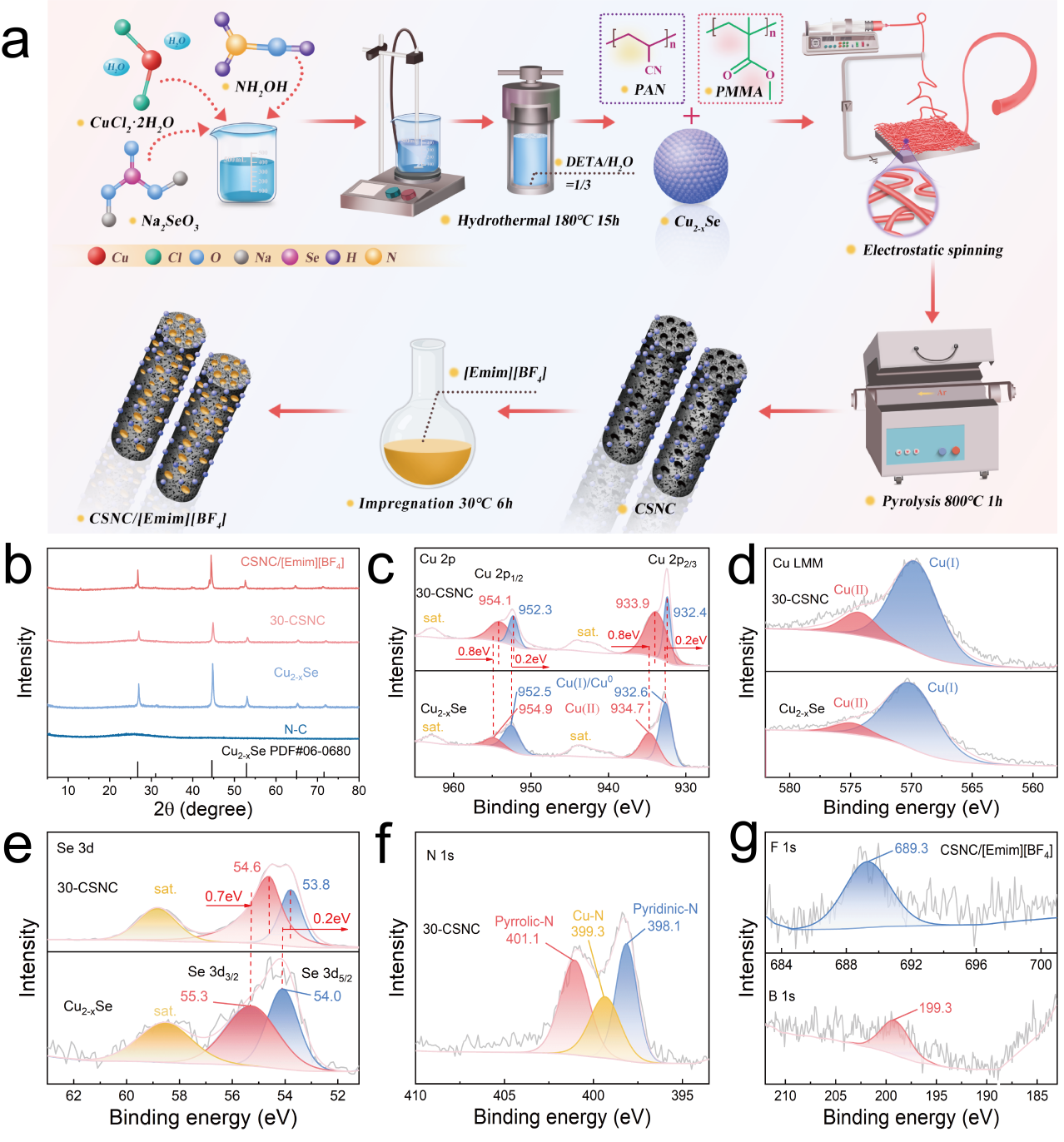
Fig. 1. (a) Preparation of CSNC/[Emim][BF4] composite catalysts. (b) XRD patterns of the samples. High-resolution XPS spectra of Cu2-xSe, 30-CSNC and CSNC/[Emim][BF4]: Cu 2p (c), Cu LMM (d), Se 3d (e), N 1s (f), and F 1s and B 1s (g).
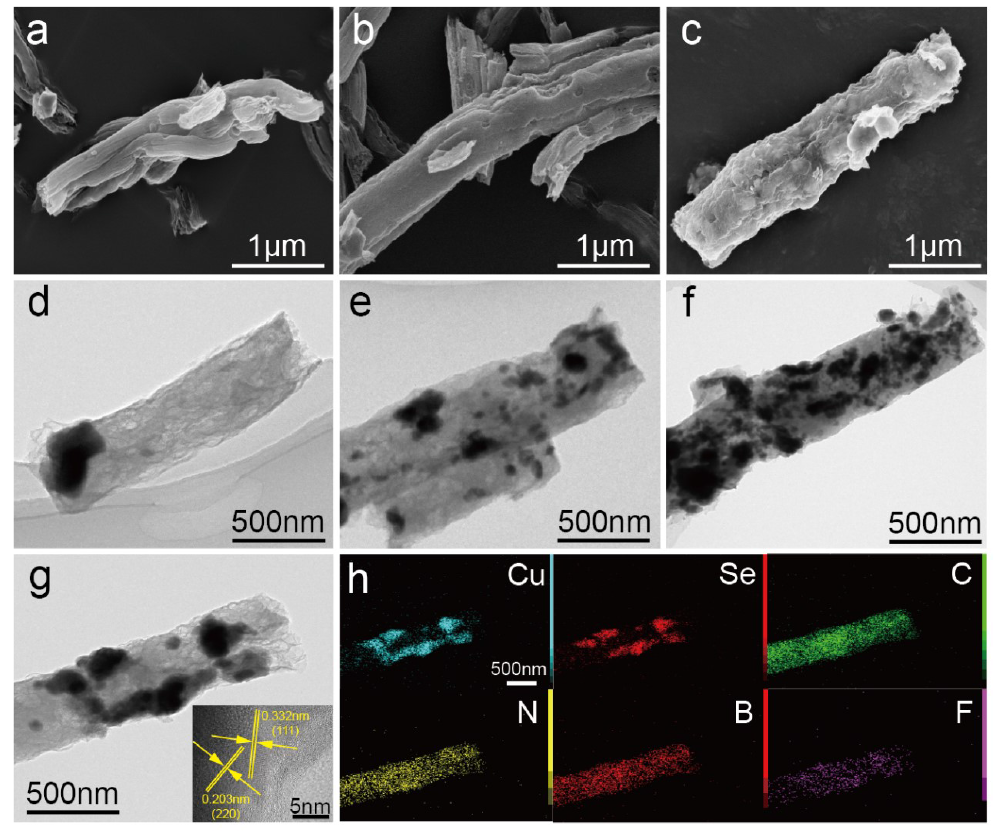
Fig. 2. SEM images of 20-CSNC (a), 30-CSNC (b), and 40-CSNC (c). TEM images of 20-CSNC (d), 30-CSNC (e), and 40-CSNC (f). (g) HRTEM image of CSNC/[Emim][BF4]. (h) EDX elemental mapping images of CSNC/[Emim][BF4].
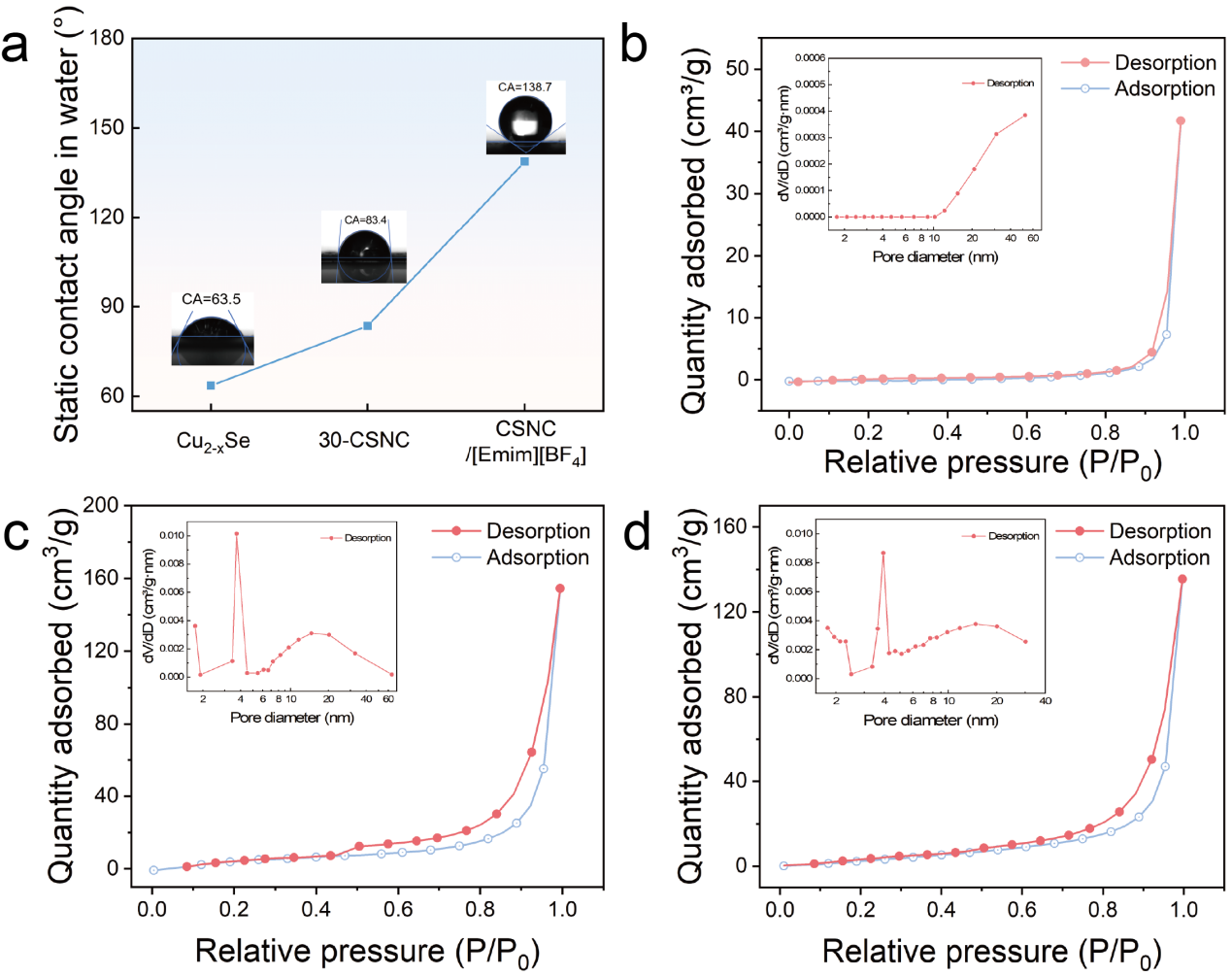
Fig. 3. (a) Static contact angle and nitrogen adsorption-desorption isotherms for Cu2‒xSe (b), 30-CSNC (c), and CSNC/[Emim][BF4] (d).
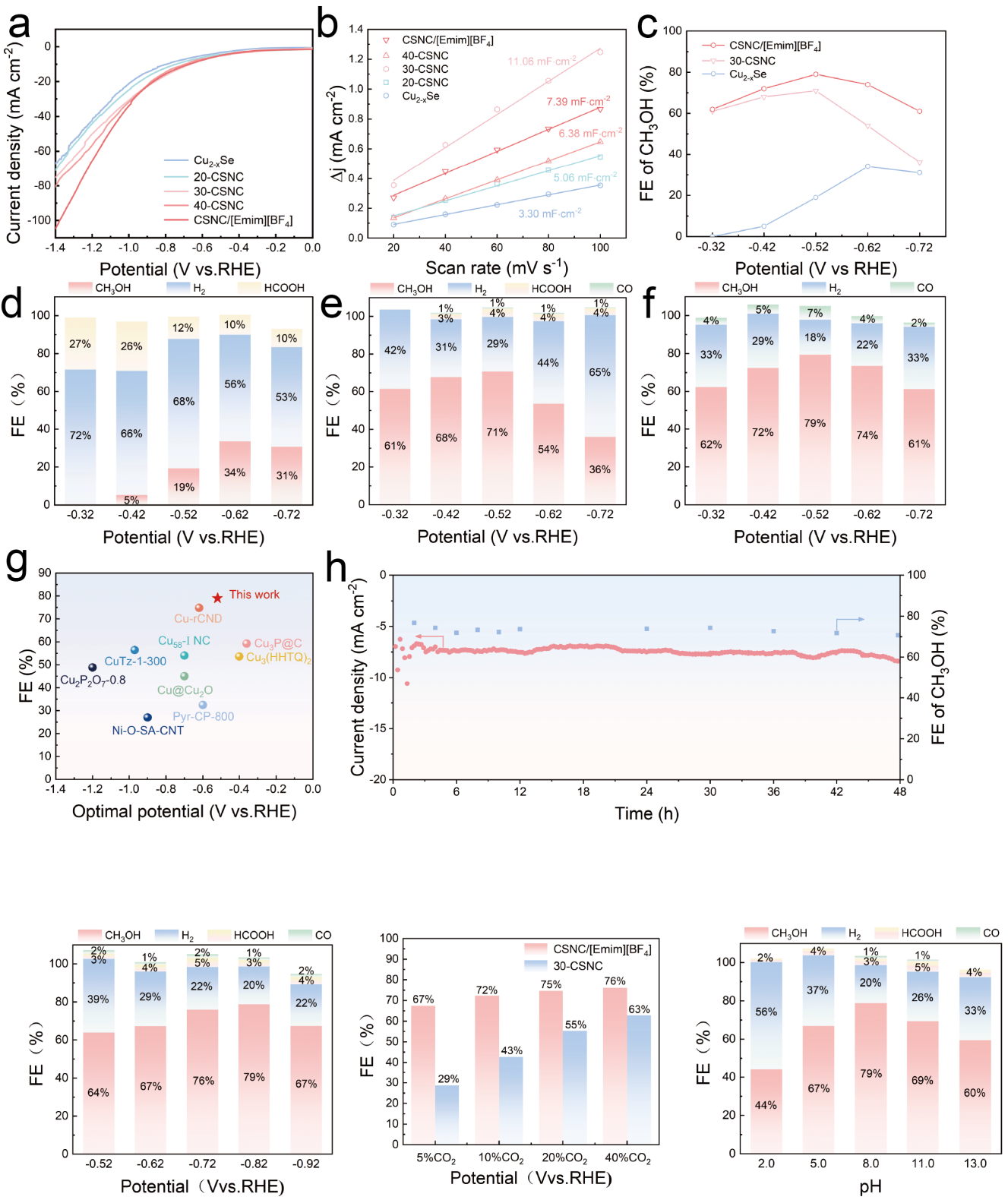
Fig. 4. (a) LSV curves of catalysts in CO2-saturated 0.5 mol/L KHCO3 electrolyte. Cdl of catalysts (b) and Faradaic efficiency (c) of the methanol process using different catalysts. Faradaic efficiency of the CO2RR by Cu2‒xSe (d), 30-CSNC (e), and CSNC/[Emim][BF4] (f). (g) Performance comparison of reported CO2RR-to-methanol electrocatalysts in H-type cells. (h) Stability test of CSNC/[Emim][BF4] at -0.52 V vs. RHE in 0.5 mol/L KHCO3 electrolyte.
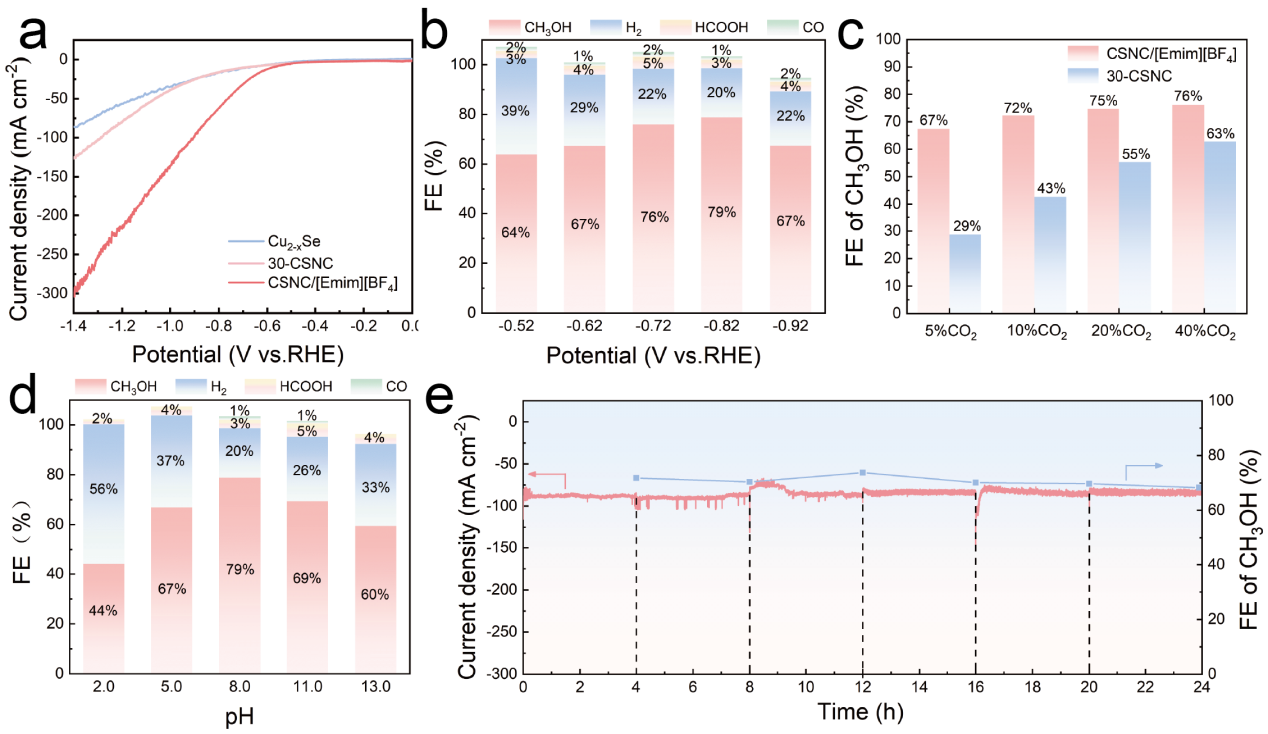
Fig. 5. (a) LSV curves of catalysts. (b) Faradaic efficiency of the CO2RR by CSNC/[Emim][BF4]. (c) Methanol Faradaic efficiency of the catalyst under different carbon dioxide concentrations. (d) Methanol Faradaic efficiency of the catalyst under different pH conditions. (e) Stability test of CSNC/[Emim][BF4] at -0.82 V vs. RHE in 10% CO2 concentration.
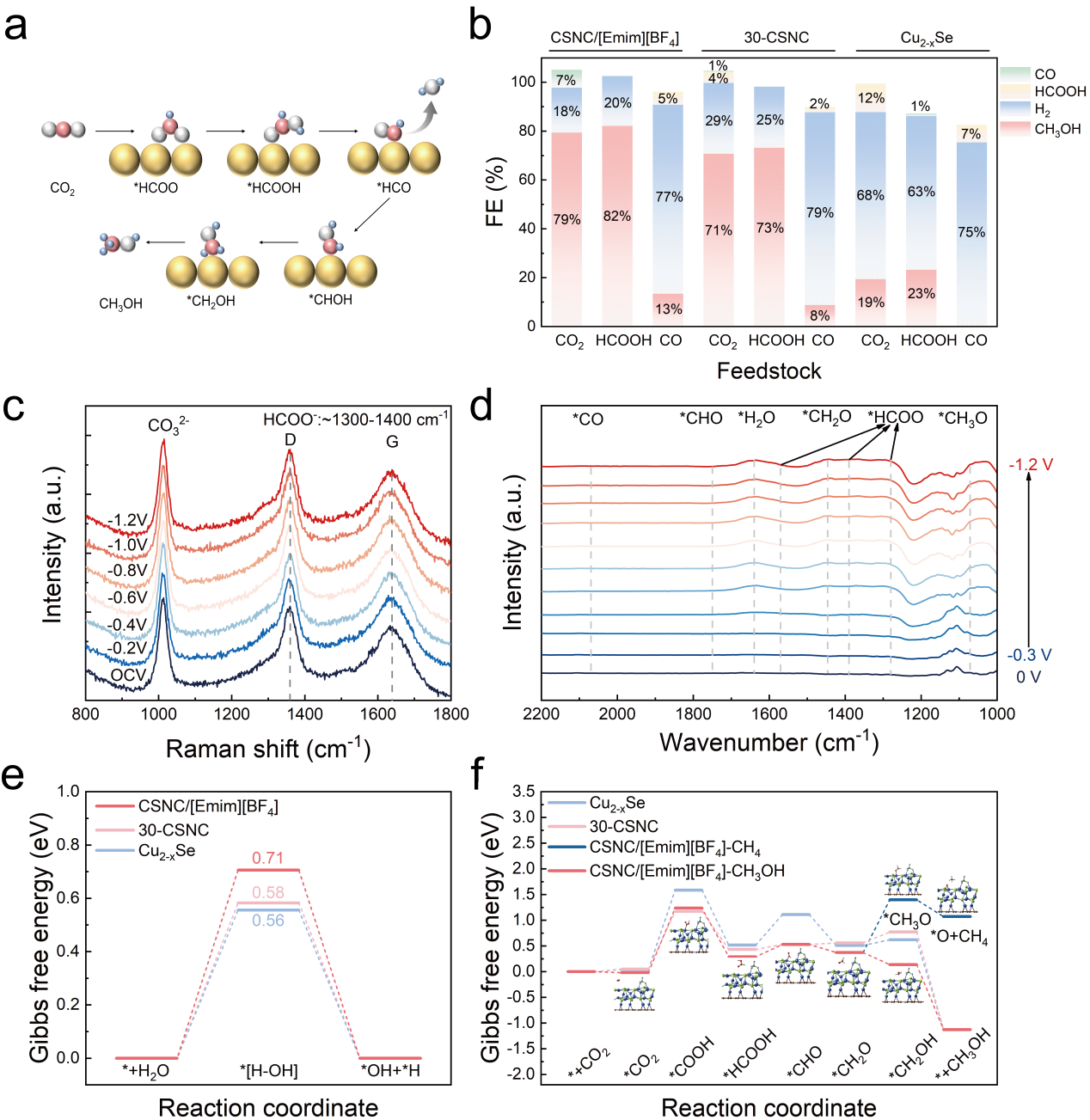
Fig. 6. (a) Schematic diagram of the pathway for forming methanol through CO2RR. (b) Faradaic efficiency of CSNC/[Emim][BF4] at ‒0.52 V vs. RHE in a 0.5 mol/L KHCO3 electrolyte with different feedstocks: CO2, HCOOH, and CO. (c) In situ Raman and (d) In situ IR spectra of the CSNC/[Emim][BF4] catalyst under various applied potentials. The observed absorption bands correspond to adsorbed intermediates: *CO (2070 cm‒1), *CHO (1750 cm‒1), *H2O (1640 cm‒1), *CH2O (1450 cm‒1), *CH3O (1070 cm‒1) and *COOH (1280, 1390, and 1570 cm‒1). Dashed lines and arrows indicate these characteristic bands. Density functional theory (DFT) calculation. (e) reaction free energy profile of H2O dissociation over 30-CSNC and CSNC/[Emim][BF4] catalysts. (f) Gibbs free energy curves of the reaction pathways for the reduction of CO2 to CH3OH and CH4 by different catalysts.
|
| [1] | Jie Zhao, Guangyuan Xu, Si Chen, Huan Yan. Precise tailoring of Cu-ZrO2 interfaces for CO2 hydrogenation to methanol [J]. Chinese Journal of Catalysis, 2027, 92(1): 316-327. |
| [2] | Jiayu Zhang, Kun Wang, Jinglu Yu, Kaiyang Xu, Lu Yang, Jiali Rao, Shuqin Song, Yi Wang. Modulating active sites via Mn-doping in NiCo LDH for energy-saving paired electrosynthesis of H2O2 and formate [J]. Chinese Journal of Catalysis, 2026, 88(9): 307-321. |
| [3] | Xinyi Zhang, Weichen Dong, Yi Cao, Caixia Zhou, Jiaxiu Guo, Hailong Zhang. Efficient continuous synthesis of methanol by direct methane conversion on Cu-KFI zeolite catalysts [J]. Chinese Journal of Catalysis, 2026, 88(9): 369-381. |
| [4] | Songling Wang, Anhua Huang, Fengxing Yin, Ruixiang Lu, Wengang Liu, Yun Zhang, Botao Qiao. In-situ synthesis of hydrogen peroxide for highly selective oxidation of methane to methanol over noble-metal-free catalyst [J]. Chinese Journal of Catalysis, 2026, 88(9): 347-355. |
| [5] | Jiahao Wang, Qiliang Gao, Chao Li, Xiujuan Gao, Jian Gong, Faen Song, Junfeng Zhang, Yizhuo Han, Qingde Zhang. A Cu-incorporated NASICON catalyst executing one-step conversion of methanol and acetic acid to acrylic acid and its esters [J]. Chinese Journal of Catalysis, 2026, 85(6): 356-370. |
| [6] | Lanlan Chen, Li Sheng, Yanan Zhou, Qiquan Luo, Zhenyu Li, Wenhua Zhang, Jinlong Yang. Unraveling the superiority of Ni1-MoS2 single-atom catalyst in CO2 hydrogenation to methanol: A DFT combined microkinetic study [J]. Chinese Journal of Catalysis, 2026, 85(6): 143-152. |
| [7] | Zhiyao Liu, Tangkang Liu, Chuan Qin, Guoliang Liu, Anmin Zheng. Zirconia-mediated interfacial catalysis for CO2 hydrogenation [J]. Chinese Journal of Catalysis, 2026, 84(5): 1-24. |
| [8] | Weiping Xiao, Yue Zhang, Na Wang, Xiaofei Yang. Synergistic electrode-electrolyte coupling enabled highly efficient and durable high entropy intermetallic-based electrocatalyst for oxygen reduction reaction [J]. Chinese Journal of Catalysis, 2026, 82(3): 92-104. |
| [9] | Diankun Song, Yunyun Wu, Jiahui Hua, Chunfeng Shao, Zhaoyang Wei, Jianji Wang, Kai Dai. Insight into the role of imidazolium cations in regulating Ag electrode interface for enhancing electrochemical CO2 reduction [J]. Chinese Journal of Catalysis, 2026, 81(2): 206-215. |
| [10] | Xinyi Wang, Chaoqi Wang, Miao Yang, Xiaoguang Wang, Yuezhong Zuo, Zhuangzhuang Zhang, Yimo Wu, Jingfeng Han, Bing Li, Wei Huang, Limin Ren, Yingxu Wei, Xinmei Liu, Peng Tian, Zhongmin Liu. Machine-learning-aided discovery of methanol-to-olefins zeolite catalysts with ultra-high initial selectivity [J]. Chinese Journal of Catalysis, 2026, 81(2): 124-135. |
| [11] | Chunjie Yang, Na Wei, Shu Wang, Qi Zhang, Xiyang Liu, Wenchao Xu, Keke Hou, Ningqiang Zhang, Lingcong Li, Zhen Zhao. Progress in unraveling the mechanisms of dual functional materials for CO2 capture and reduction [J]. Chinese Journal of Catalysis, 2026, 89(10): 1-39. |
| [12] | Jiaqi Zhao, Peiyu Shen, Zhengxing Qin, Camille Longue, Nourrdine Chaouati, Ruizhe Zhang, Xiao Chen, Shunsuke Asahina, Natsuko Asano, Gabriel Rueff, Eddy Dib, Hongman Sun, Libin Kang, Jiujiang Wang, Hongjuan Zhao, Honghai Liu, Shutao Xu, Ludovic Pinard, Zifeng Yan, Svetlana Mintova. Ultrathin ZSM-5 zeolite nanocrystals synthesized from purely inorganic precursors [J]. Chinese Journal of Catalysis, 2026, 89(10): 464-476. |
| [13] | Chenjia Liang, Jun Yao, Ningze Gao, Xiaoxia Hou, Haoyu Lu, Ruiyao Zhao, Ziheng Zhuang, Jie Yang, Liwen Wang, Xiangke Guo, Nianhua Xue, Tao Wang, Yan Zhu, Weiping Ding. RuOx-PtZn catalyst boosting methanol electro-oxidation by synergic water-activation for high-performance direct methanol fuel cell [J]. Chinese Journal of Catalysis, 2026, 80(1): 304-315. |
| [14] | Jian-Feng Wu, Li-Ye Liang, Zheng Che, Yu-Ting Miao, Lingjun Chou. Bimetallic oxide catalysts for CO2 hydrogenation to methanol: Recent advances and challenges [J]. Chinese Journal of Catalysis, 2025, 73(6): 62-78. |
| [15] | Peipei Xiao, Yong Wang, Xiaomin Tang, Anmin Zheng, Trees De Baerdemaeker, Andrei-Nicolae Parvulescu, Dirk De Vos, Xiangju Meng, Feng-Shou Xiao, Hermann Gies, Toshiyuki Yokoi. Isomers of organic structure directing agent influence the Al distribution of AEI zeolite and catalytic performance in methane oxidation [J]. Chinese Journal of Catalysis, 2025, 73(6): 252-260. |
| Viewed | ||||||
|
Full text |
|
|||||
|
Abstract |
|
|||||


