
Chinese Journal of Catalysis ›› 2026, Vol. 89: 232-245.DOI: 10.1016/S1872-2067(26)65155-8
• Article • Previous Articles Next Articles
Ting Lia, Xiaohui Chena, Xiaolin Lia, Qi Xiaob,*( ), Hongqun Luoa,*(), Nianbing Lia,*()
Received:2026-01-07
Accepted:2026-03-12
Online:2026-10-18
Published:2026-09-01
Contact:
*E-mail:qi.xiao@nnnu.edu.cn(Q. Xiao),luohq@swu.edu.cn (H. Luo),linb@swu.edu.cn(N. Li).
Supported by:Ting Li, Xiaohui Chen, Xiaolin Li, Qi Xiao, Hongqun Luo, Nianbing Li. Autogenous force-mediated assembly: A general strategy for constructing single-atom architectures in hierarchical hybrid electrocatalysts[J]. Chinese Journal of Catalysis, 2026, 89: 232-245.
Add to citation manager EndNote|Ris|BibTeX
URL: https://www.cjcatal.com/EN/10.1016/S1872-2067(26)65155-8
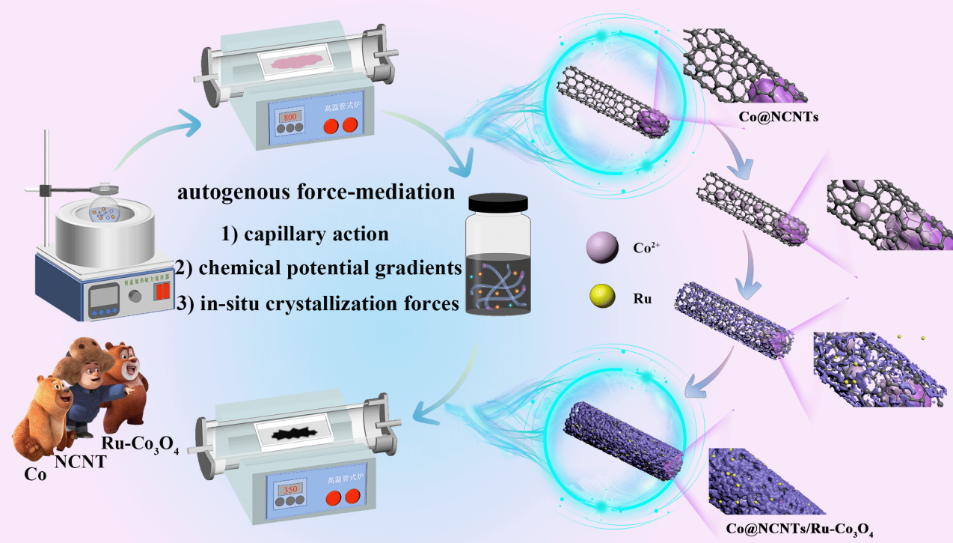
Fig. 1. The synthetic process of Co@NCNTs/Ru-Co3O4.
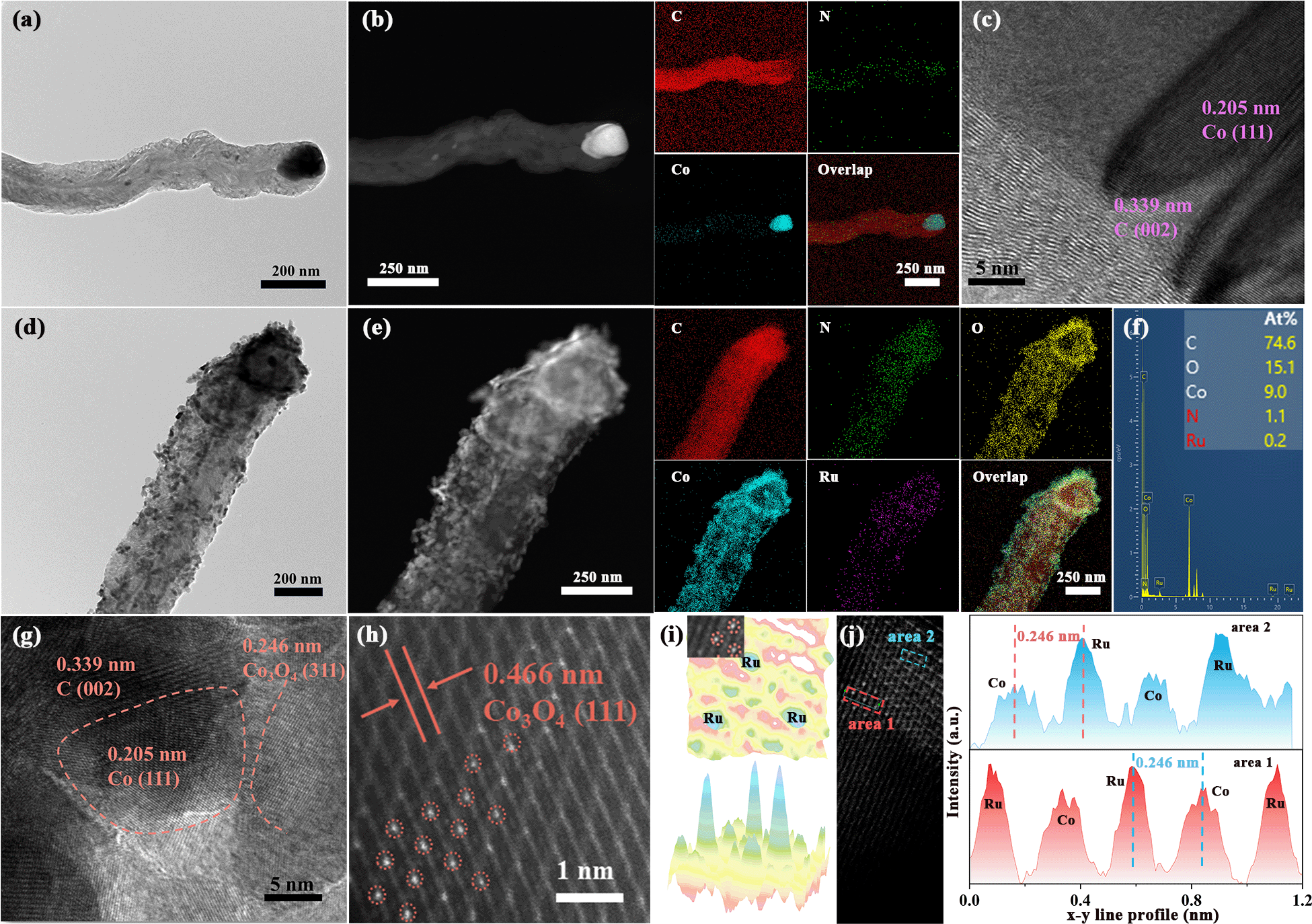
Fig. 2. TEM image (a), elemental mapping images (b), and HRTEM image (c) of Co@NCNTs. TEM image (d), elemental mapping images (e), EDS mapping (f), HRTEM image (g), AC HAADF-STEM image (h), 3D atom-overlapping Gaussian function fitting mapping (i) of the dashed square in (i), and the intensity profiles along the dashed rectangles in AC HAADF-STEM image (j) of Co@NCNTs/Ru-Co3O4.
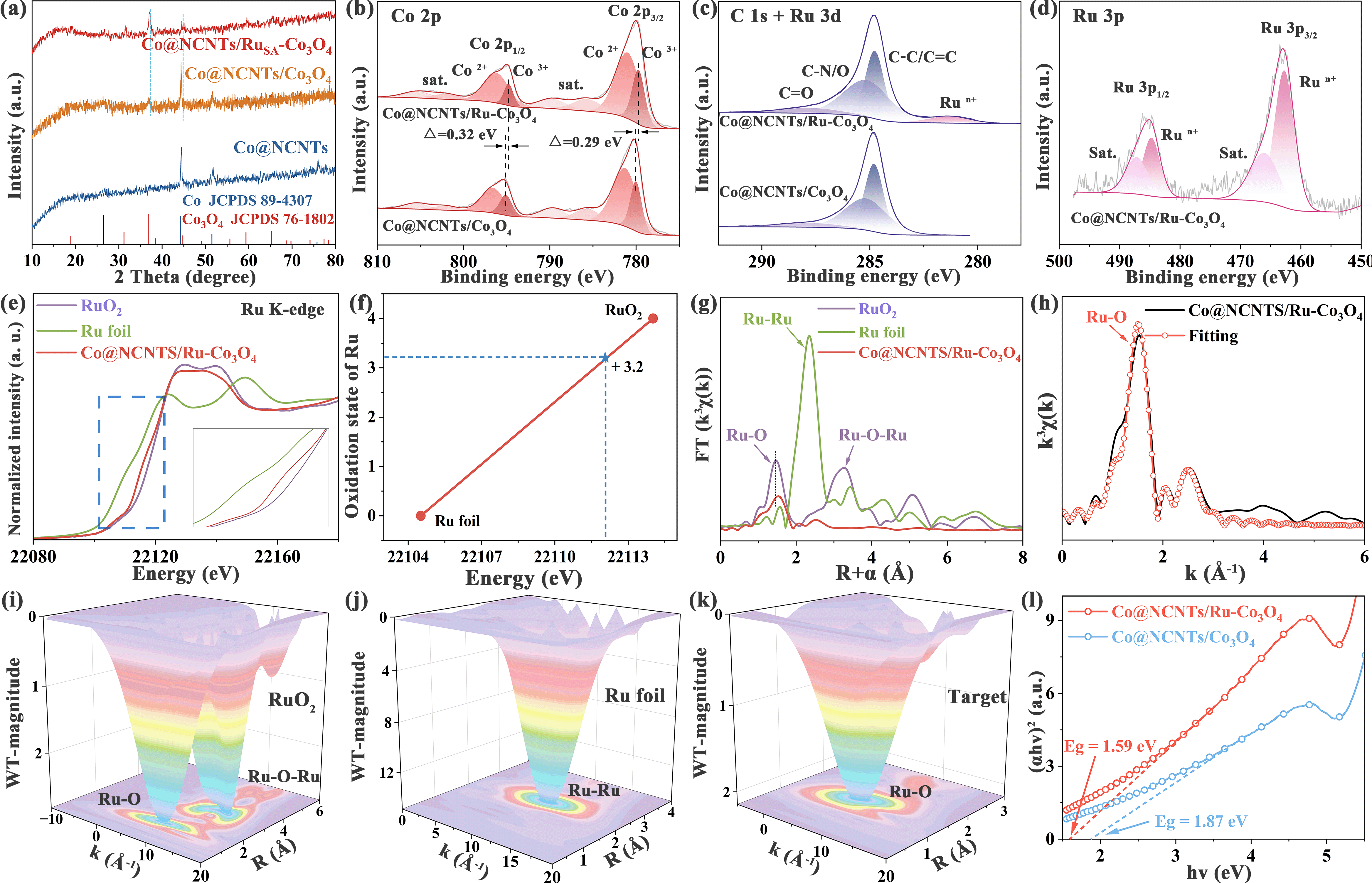
Fig. 3. (a) XRD patterns of Co@NCNTs/Ru-Co3O4, Co@NCNTs/Co3O4, and Co@NCNTs. High resolution XPS spectra of Co 2p (b) and C 1s + Ru 3d (c) for Co@NCNTs/Ru-Co3O4 and Co@NCNTs/Co3O4. (d) High resolution XPS spectra of Ru 3p for Co@NCNTs/Ru-Co3O4. (e) Ru L3-edge XANES spectra of Co@NCNTs/Ru-Co3O4, Ru foil, and RuO2. (f) Calculation of oxidation state of Ru in Co@NCNTs/Ru-Co3O4 from Fig. 3(e). (g) EXAFS spectra of Co@NCNTs/Ru-Co3O4, Ru foil, and RuO2. (h) FT-EXAFS fitting curves of Co@NCNTs/Ru-Co3O4 at the R space. WT-EXAFS of RuO2 (i), Ru foil (j), and Co@NCNTs/Ru-Co3O4 (k). (l) Tauc plots of Co@NCNTs/Ru-Co3O4 and Co@NCNTs/Co3O4 obtained from UV-vis spectroscopy.
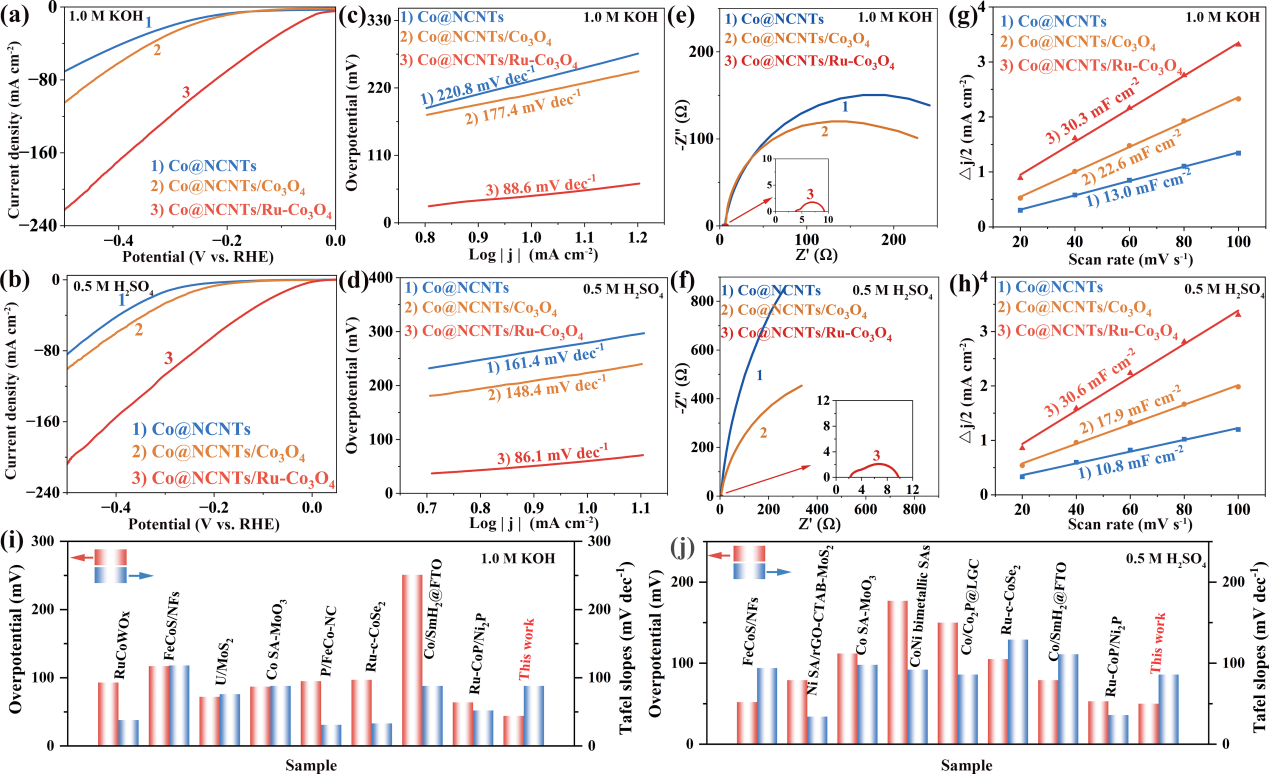
Fig. 4. HER performance evaluation. LSV curves (a,b), Tafel slopes (c,d), Nyquist plots (e,f), and Cdl curves (g,h) of Co@NCNTs/Ru-Co3O4, Co@NCNTs/Co3O4, and Co@NCNTs in 1.0 mol L-1 KOH and in 0.5 mol L-1 H2SO4, respectively. Comparison of overpotentials at 10 mA cm-2 in 1.0 mol L-1 KOH (i) and 0.5 mol L-1 H2SO4 (j) [50,55-68].
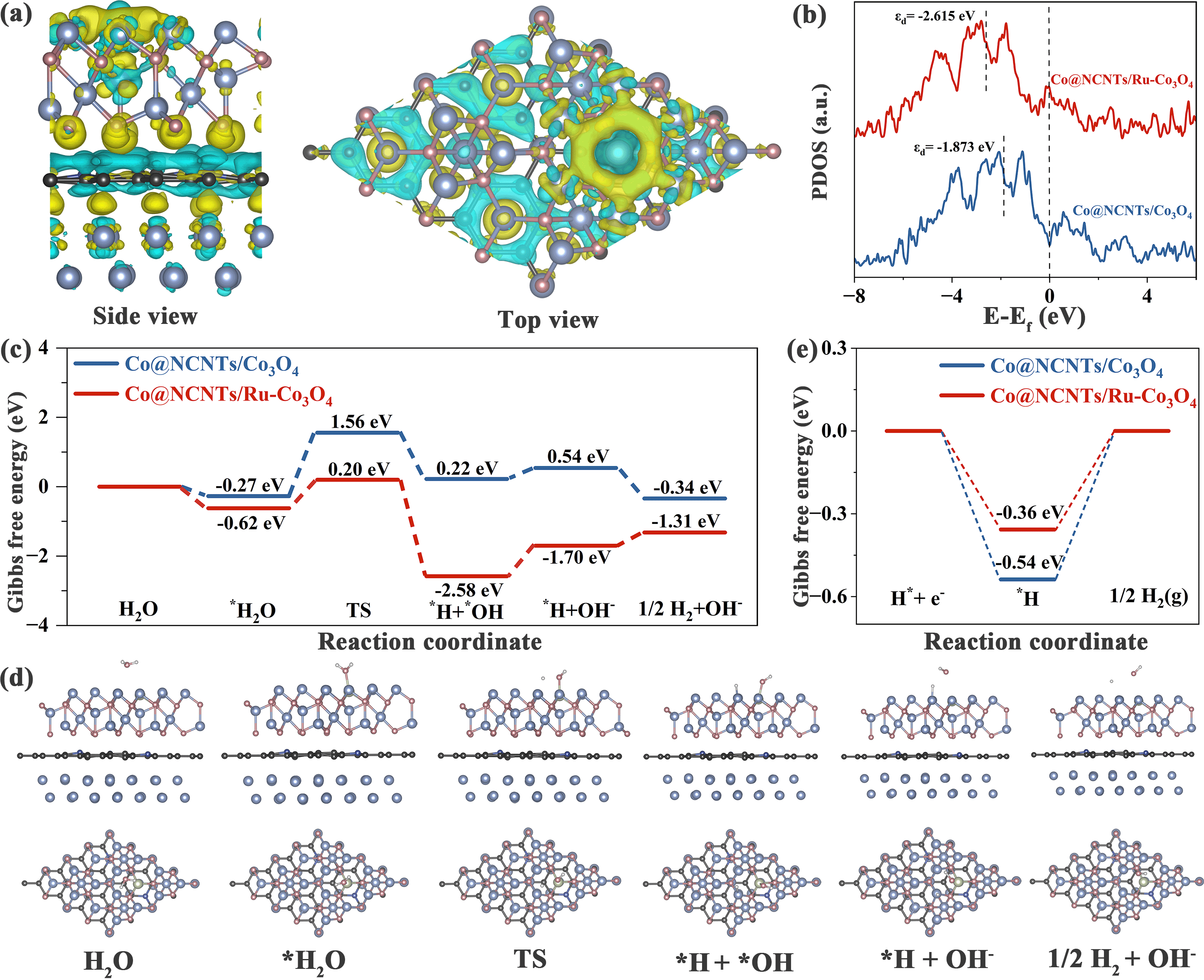
Fig. 5. (a) Charge density difference of Co@NCNTs/Ru-Co3O4 with a side view and a top view. The Co, Ru, O, C, and N atoms are represented by light blue, light green, pink, black, and blue spheres, respectively. Yellow and cyan regions represent electron accumulation and depletion, respectively. (b) PDOS of Co@NCNTs/Ru-Co3O4 and Co@NCNTs/Co3O4 with aligned Fermi level. The vertical lines mark the positions of d-band center. (c) The Gibbs free energy diagrams for complete alkaline HER over Co@NCNTs/Ru-Co3O4 and Co@NCNTs/Co3O4. (d) The schematic illustrations for each step of the alkaline HER process over the Co@NCNTs/Ru-Co3O4. The *H2O, *H + *OH, *H + OH- indicate the adsorbed H2O on the catalyst, the adsorbed H and the adsorbed OH on the catalyst, the adsorbed H is still on the catalyst while the OH is undergoing the process of desorption, respectively. (e) The H adsorption energies on the Co@NCNTs/Ru-Co3O4 and Co@NCNTs/Co3O4, respectively.
|
| [1] | Zihao Gao, Kai Huang, Qingling Xu, Xin Wang, Zhicheng Liu, Bin Shao, Jun Hu. Engineering catalytic microenvironments for enhancing ethylene production in CO2 capture and in-situ oxidative dehydrogenation of ethane [J]. Chinese Journal of Catalysis, 2026, 88(9): 322-334. |
| [2] | Yang Wang, Cun-Feng Fan, Yang Liu, Xiao-Qin Zheng, Xuan-Yi Liu, Kai Zhang, Jiahui Kou, Hengming Huang, Lin-Bing Sun. Iron single-atom catalysts created in constrained space with in-situ-formed carbon layers for efficient Fenton reaction [J]. Chinese Journal of Catalysis, 2026, 88(9): 432-441. |
| [3] | Sathi Chatterjee, Hongmei Li, Kang Liu, Zhang Lin, Liyuan Chai, Min Liu. Single-atom catalysts on two-dimensional (2D) materials for photocatalytic CO2 reduction: Fundamentals, design, and emerging strategies [J]. Chinese Journal of Catalysis, 2026, 88(9): 86-128. |
| [4] | Chunlei Zhang, Hanyu Tan, Chaoyang Sui, Ying Feng, Xinyu Chen, Xiaoqiang Fan, Xuehua Yu, Zhen Zhao. Efficient methane combustion by engineering surface oxygen vacancies on MOF-derived multi-shell Pd@Co3O4 [J]. Chinese Journal of Catalysis, 2026, 88(9): 492-505. |
| [5] | Yueling Chen, Yuling Lin, Ziyan Chen, Xiangyu Kong, Jinhong Bi, Guocheng Huang, Ling Wu. Asymmetric N-Ru-S dipole within covalent organic framework enhances internal electric field for efficient CO2 photoreduction [J]. Chinese Journal of Catalysis, 2026, 87(8): 59-69. |
| [6] | Yang Ding, Zhixue Li, Shuzeng Zhang, Guoxiang Yang, Runtian Zheng, Chunhua Wang. Atomic vacancies accelerating photochemical solar fuel and value-added chemical production: From materials to mechanism [J]. Chinese Journal of Catalysis, 2026, 87(8): 1-21. |
| [7] | Dezhi Wang, Songhua Yang, Yiyi Yangliu, Xufa Peng, Fangyang Liu, Hao Fei, Zhuangzhi Wu. Decoupling competitive reactions by their differential orbital-coupling response to vacancy engineering for efficient electrocatalytic nitrogen reduction [J]. Chinese Journal of Catalysis, 2026, 86(7): 181-190. |
| [8] | Shahla Karimi, Mehran Rezaei, Jiguang Deng, Hongxing Dai, Ali Rastegarpanah. Recent advances in noble metal-based catalysts for methane decomposition: Performance, mechanism, and optimization [J]. Chinese Journal of Catalysis, 2026, 86(7): 9-48. |
| [9] | Jiaying Liu, Yu Fang. Unraveling structure-activity relationships in 2-D covalent organic frameworks for photocatalysis: From molecular engineering to high-performance optimization [J]. Chinese Journal of Catalysis, 2026, 85(6): 47-87. |
| [10] | Yuxi Ren, Baorong Xu, Yu Jin, Hang Xiao, Ranran Niu, Wei Liu, Honghui Ou, Guidong Yang. Homojunction-driven d-band engineering in NiMoO4 for selective electrochemical nitrogen reduction to ammonia [J]. Chinese Journal of Catalysis, 2026, 85(6): 216-225. |
| [11] | Yi-Wen Han, Run-Yu Liu, Yu-Xin Zhang, Lei Ye, Phuc T. T. Nguyen, Tian-Jun Gong, Xue-Bin Lu, Yao Fu, Ning Yan. Establishing built-in electric field within single-atom-anchored hollow architectures for efficient solar-thermal regulation in plastic photoreforming [J]. Chinese Journal of Catalysis, 2026, 84(5): 301-313. |
| [12] | Zijie Wan, Yuqi Yang, Zhenquan Wang, Linrui Wu, Haipeng Zhang, Qingfang Shi, Xiang Liu, Hanlin Yang, Bohan Kang, Quan Xu, Jiaqing Luo, Jian Liu. Spatial confinement and nitrogenous defect anchoring synergistically enhance Ru nanoparticles catalyst performance for industrial current densities hydrogen evolution [J]. Chinese Journal of Catalysis, 2026, 84(5): 130-143. |
| [13] | Mingtao Chu, Huimin Zhang, Bianqing Ren, Jing Cao, Teng Zhang, Ping Song, Zizhun Wang, Ce Han, Weilin Xu. Amorphous-crystalline heterostructured RuMoNiN/Ni-MoO2 for highly efficient and stable alkaline hydrogen evolution reaction [J]. Chinese Journal of Catalysis, 2026, 84(5): 96-105. |
| [14] | Peilin Liu, Xiaqing Zhuang, Tianze Cui, Zisen Wei, Hua Xu, Ruolin Zhang, Yuqi Yang, Jiaqing Luo, Weiyu Song, Yunpeng Liu, Yu Kong, Zhenxing Li, Zhen Zhao, Jian Liu, Yuanqing Sun. Dual-engine active centers of Ru single atoms and nanoclusters synergistically enhancing hydrogen evolution reaction [J]. Chinese Journal of Catalysis, 2026, 84(5): 80-95. |
| [15] | Kaiqiang Xu, Wenjun Zhu, Mahmoud Sayed, Sheng Han. Design and preparation of 1D-based S-scheme photocatalysts [J]. Chinese Journal of Catalysis, 2026, 83(4): 24-53. |
| Viewed | ||||||
|
Full text |
|
|||||
|
Abstract |
|
|||||


