
Chinese Journal of Catalysis ›› 2026, Vol. 89: 246-257.DOI: 10.1016/S1872-2067(26)65180-7
• Article • Previous Articles Next Articles
Peiran Chen,1, Luo Cheng,1, Congbao Guo, Yu He, Yangyang Liu, Yi Wang*( ), Shuqin Song*()
Received:2026-04-01
Accepted:2026-05-07
Online:2026-10-18
Published:2026-09-01
Contact:
*E-mail:wangyi76@mail.sysu.edu.cn(Y. Wang),stsssq@mail.sysu.edu.cn(S. Song).
About author:1 Contributed equally to this work.
Supported by:Peiran Chen, Luo Cheng, Congbao Guo, Yu He, Yangyang Liu, Yi Wang, Shuqin Song. High entropy engineering promoted active sites in layered double hydroxide for seawater oxygen evolution reaction[J]. Chinese Journal of Catalysis, 2026, 89: 246-257.
Add to citation manager EndNote|Ris|BibTeX
URL: https://www.cjcatal.com/EN/10.1016/S1872-2067(26)65180-7
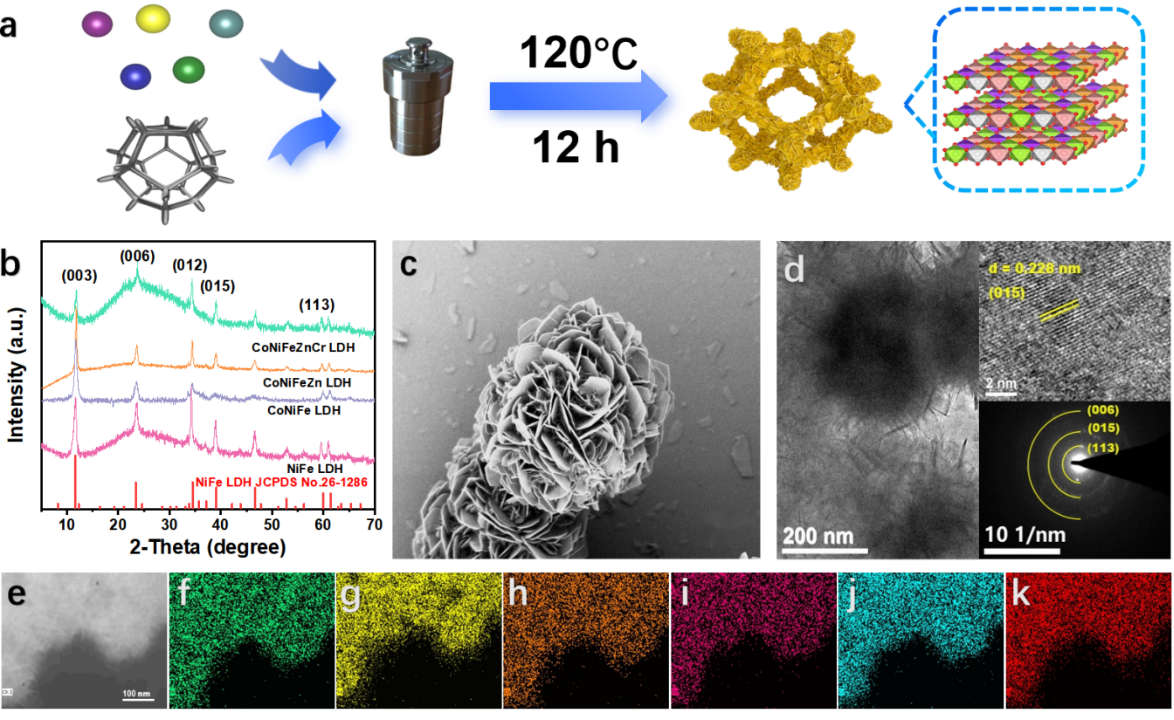
Fig. 1. (a) Schematic illustration for the preparation of CoNiFeZnCr LDH@NF. (b) XRD patterns of LDHs. SEM image (c), TEM image with SAED patterns and HRTEM image (d) (inset: the corresponding lattice fringe pattern) of the CoNiFeZnCr LDH@NF. (e-k) HAADF-STEM image of CoNiFeZnCr LDH@NF and element mappings of CoNiFeZnCr LDH for Ni (green), Fe (yellow), Co (orange), Zn (purple), Cr (indigo), and O (red).
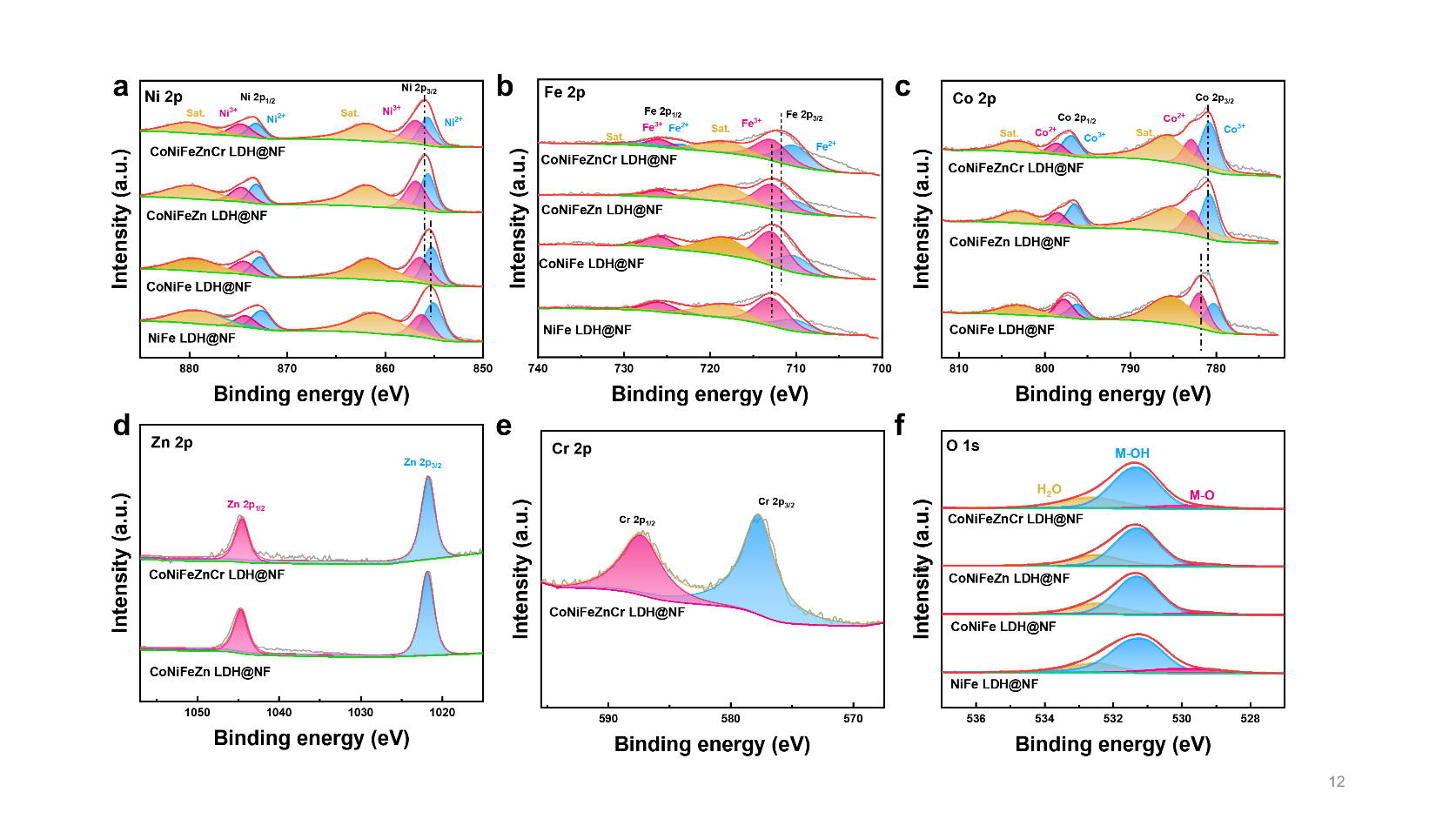
Fig. 2. High-resolution XPS spectra of LDH electrodes. Spectra were collected for CoNiFeZnCr LDH@NF, CoNiFeZn LDH@NF, CoNiFe LDH@NF, and NiFe LDH@NF unless otherwise specified. (a) Ni 2p; (b) Fe 2p; (c) Co 2p (Co-containing samples); (d) Zn 2p (CoNiFeZnCr LDH@NF and CoNiFeZn LDH@NF); (e) Cr 2p (CoNiFeZnCr LDH@NF); (f) O 1s.
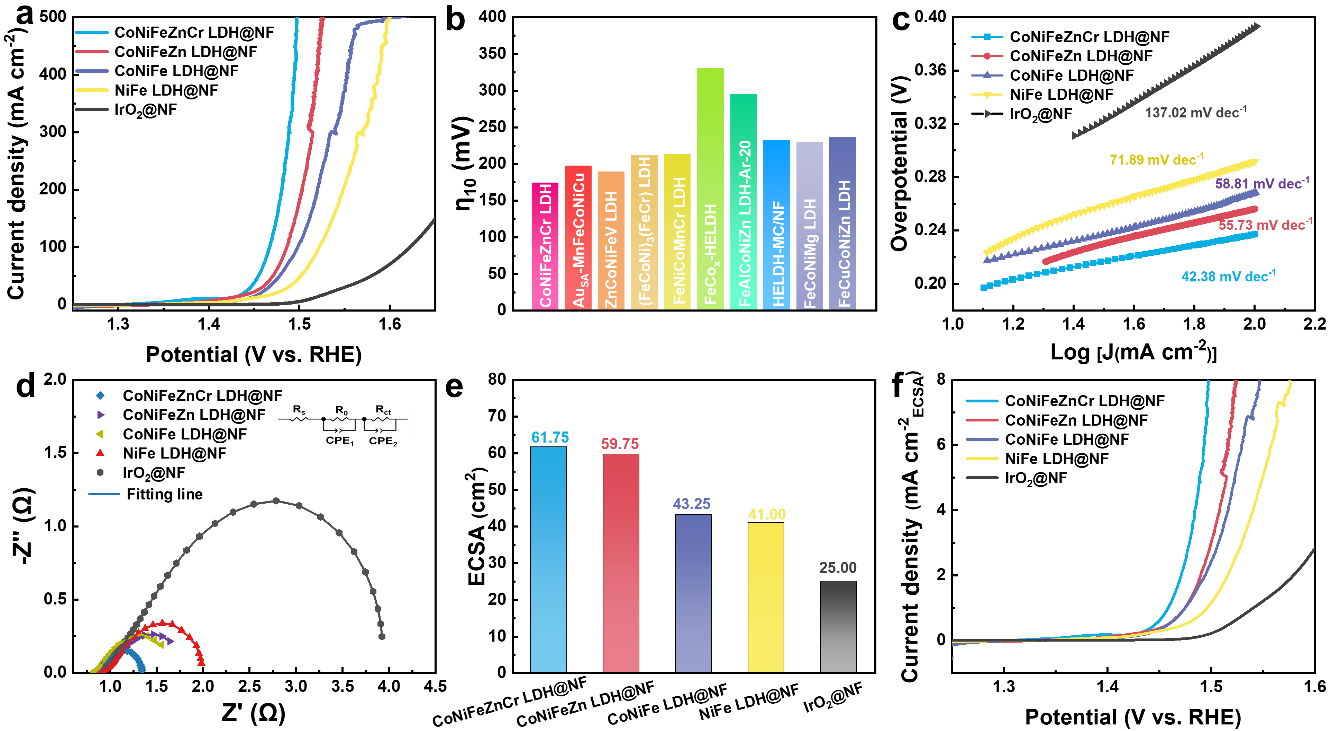
Fig. 3. Electrocatalytic performances of the different catalysts in 1.0 mol L-1 KOH solution. (a) LSV curves. (b) Comparison of overpotential and the corresponding current density with the reported data, which detailed information can be found in Table S4. (c) Tafel plots. (d) EIS at a potential of 1.456 V (vs. RHE). (e) ECSA. (f) LSV curves normalized by ECSA.
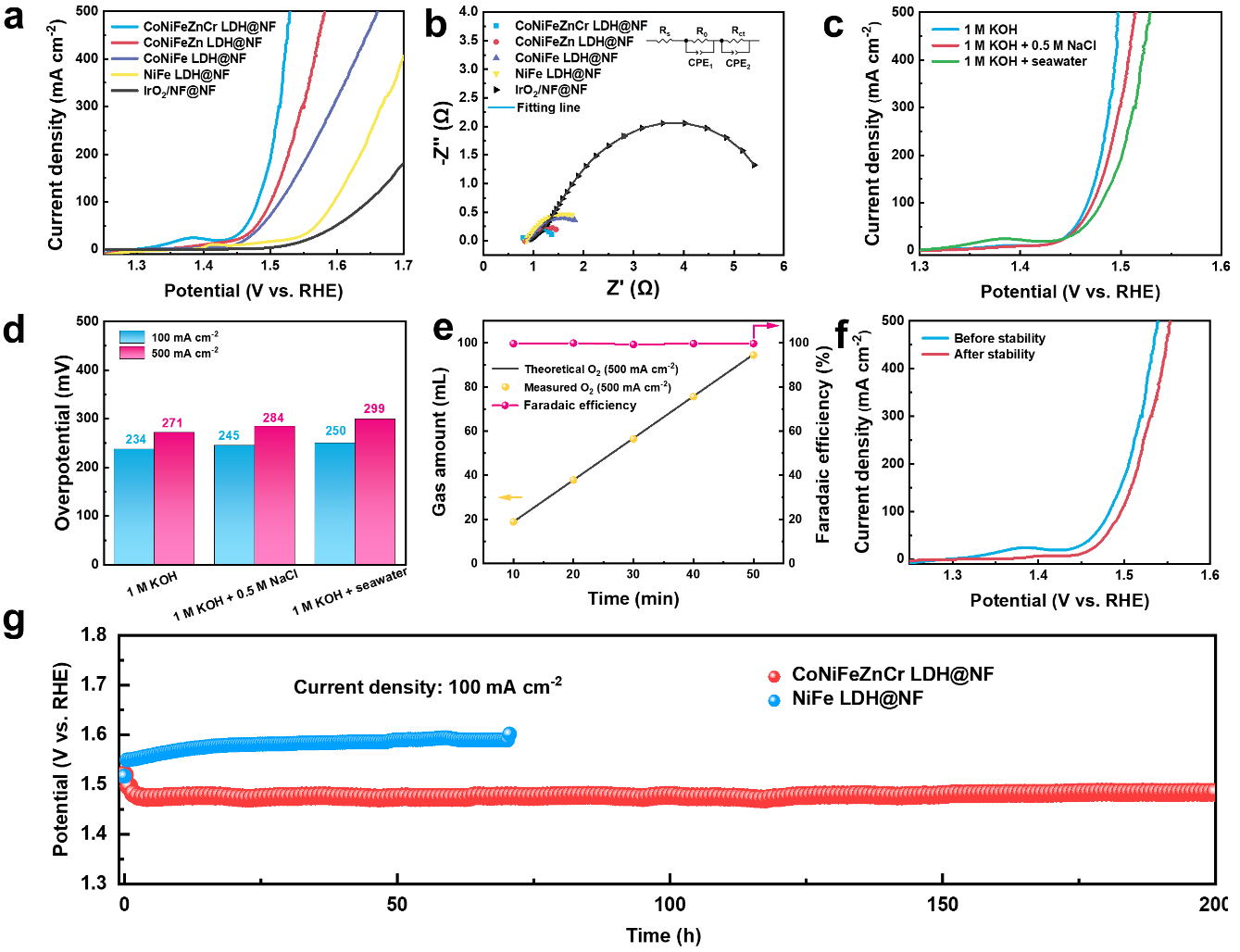
Fig. 4. LSV curves (a) and EIS (b) of the different catalysts in 1.0 mol L-1 KOH + seawater solution. (c) LSV curves of CoNiFeZnCr LDH@NF in different electrolytes. (d) Overpotentials at 100 and 500 mA cm-2 from polarization curves presented in (c). (e) Measured (dots), theoretical (solid lines) gaseous products, and Faradaic efficiency of CoNiFeZnCr LDH@NF at 500 mA cm-2 in alkaline simulated seawater (1.0 mol L-1 KOH + 0.5 mol L-1 NaCl). (f) LSV curves of CoNiFeZnCr LDH@NF before and after 200 h chronopotentiometry stability test in 1.0 mol L-1 KOH + seawater electrolyte. (g) Stability test with chronopotentiometry on CoNiFeZnCr LDH@NF and NiFe LDH@NF at 100 mA cm-2.
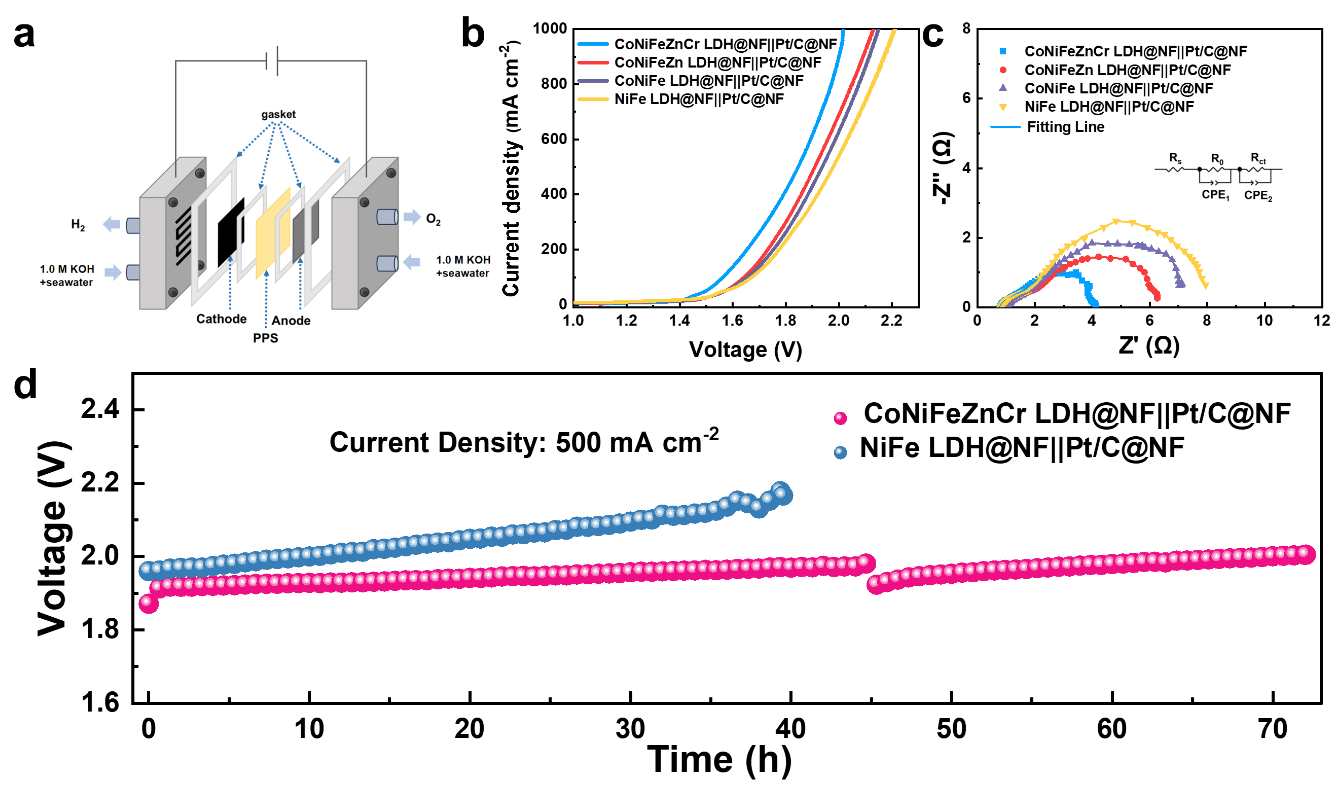
Fig. 5. Overall alkaline simulated seawater electrolysis. (a) Schematic diagram of AWE. (b) LSV curves for the CoNiFeZnCr LDH@NF||Pt/C@NF, CoNiFeZn LDH@NF||Pt/C@NF, and CoNiFe LDH@NF||Pt/C@NF, and NiFe LDH@NF||Pt/C@NF. (c) EIS of CoNiFeZnCr LDH@NF||Pt/C@NF, CoNiFeZn LDH@NF||Pt/C@NF, and CoNiFe LDH@NF||Pt/C@NF, and NiFe LDH@NF||Pt/C@NF. (d) Stability test with chronopotentiometry on CoNiFeZnCr LDH@NF||Pt/C@NF and NiFe LDH@NF||Pt/C@NF at 500 mA cm-2.
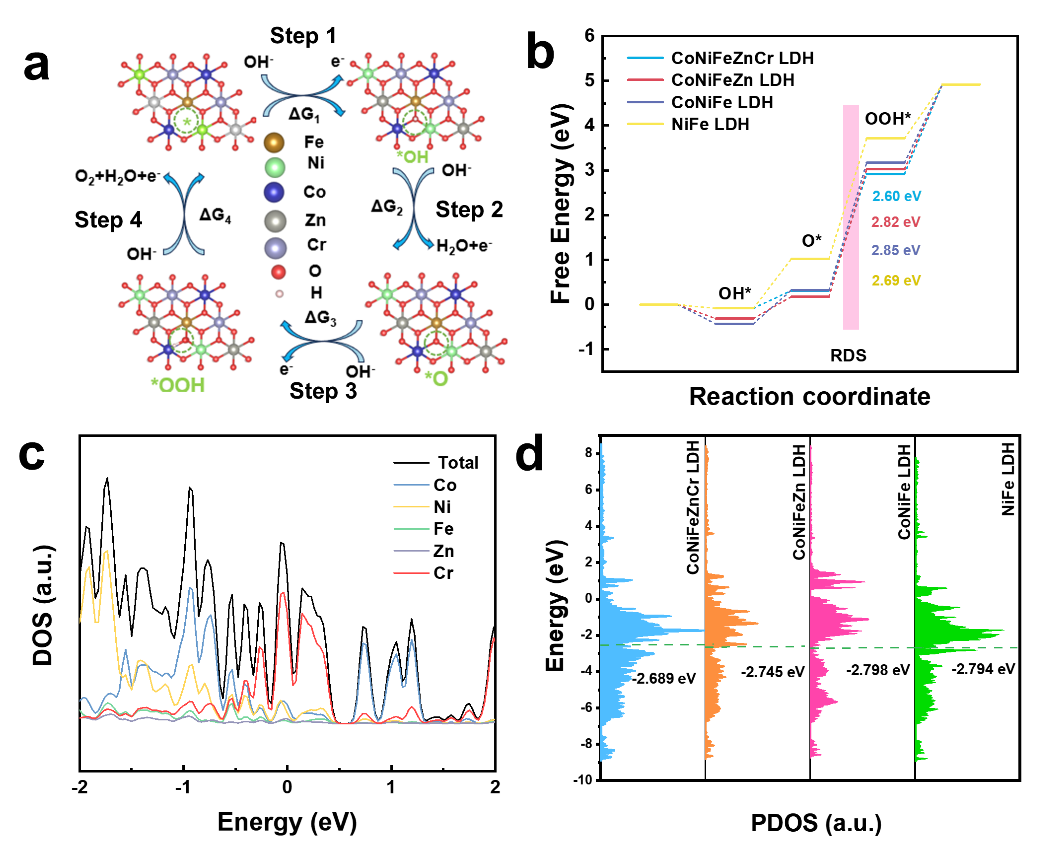
Fig. 6. (a) Schematic illustration of the four-step OER process on the surface of the CoNiFeZnCr LDH catalyst. (b) Gibbs free-energy diagram of O-containing intermediates. (c) Calculated DOS for Co, Ni, Fe, Zn, and Cr in CoNiFeZnCr LDH, with the Fermi level indicated by the black dashed line. (d) d-band centers of CoNiFeZnCr LDH, CoNiFeZn LDH, CoNiFe LDH, and NiFe LDH.
|
| [1] | Jianping Zhang, Kun Zhang, Yinglong Weng, Nannan Li, Tingting Huang, Yitong Lu, Tingyu Sun, Xiaotong Han, Jieshan Qiu. Bioinspired acetate-mediated proton shuttling toward robust oxygen evolution [J]. Chinese Journal of Catalysis, 2026, 87(8): 282-294. |
| [2] | Wei Zuo, Mingyu Liu, Shengjun Sun, Yu Yang, Zixiao Li, Xixi Zhang, Chaoxin Yang, Hefeng Wang, Imran Shakir, Xuefei Liu, Qian Liu, Xuping Sun, Bo Tang. Synergistic chloride resistance via hydrogen‒bond network dynamic optimization and electrostatic repulsion for alkaline seawater oxidation [J]. Chinese Journal of Catalysis, 2026, 87(8): 295-304. |
| [3] | Bo Zhang, Ru Xiao, Liyuan Liu, Xiaobin Liu, Ying Deng, Qingliang Lv, Zexing Wu, Yunmei Du, Yanyan Li, Zhenyu Xiao, Lei Wang. Electrochemistry assisted chlorine corrosion strategy: The minute-level fabrication of lattice Cl- functioned high spin-polarized Ni/Fe-LDH array for enhanced anti-Cl- OER performance [J]. Chinese Journal of Catalysis, 2025, 70(3): 388-398. |
| [4] | Ping Zhang, Hao Chen, Lin Chen, Ying Xiong, Ziqi Sun, Haoyu Yang, Yingke Fu, Yaping Zhang, Ting Liao, Fei Li. Atomically dispersed Ni-N-C catalyst derived from NiZn layered double hydroxides for efficient electrochemical CO2 reduction [J]. Chinese Journal of Catalysis, 2023, 45(2): 152-161. |
| [5] | Junhao Yang, Lulu An, Shuang Wang, Chenhao Zhang, Guanyu Luo, Yingquan Chen, Huiying Yang, Deli Wang. Defects engineering of layered double hydroxide-based electrocatalyst for water splitting [J]. Chinese Journal of Catalysis, 2023, 55(12): 116-136. |
| [6] | Qixian Xie, Dan Ren, Lichen Bai, Rile Ge, Wenhui Zhou, Lu Bai, Wei Xie, Junhu Wang, Michael Grätzel, Jingshan Luo. Investigation of nickel iron layered double hydroxide for water oxidation in different pH electrolytes [J]. Chinese Journal of Catalysis, 2023, 44(1): 127-138. |
| [7] | Xue Bai, Zhiyao Duan, Bing Nan, Liming Wang, Tianmi Tang, Jingqi Guan. Unveiling the active sites of ultrathin Co-Fe layered double hydroxides for the oxygen evolution reaction [J]. Chinese Journal of Catalysis, 2022, 43(8): 2240-2248. |
| [8] | Jinling Cheng, Dingsheng Wang. 2D materials modulating layered double hydroxides for electrocatalytic water splitting [J]. Chinese Journal of Catalysis, 2022, 43(6): 1380-1398. |
| [9] | Gen Huang, Yingying Li, Ru Chen, Zhaohui Xiao, Shiqian Du, Yucheng Huang, Chao Xie, Chungli Dong, Haibo Yi, Shuangyin Wang. Electrochemically formed PtFeNi alloy nanoparticles on defective NiFe LDHs with charge transfer for efficient water splitting [J]. Chinese Journal of Catalysis, 2022, 43(4): 1101-1110. |
| [10] | Kailin Wang, Tianqi Wang, Quazi Arif Islam, Yan Wu. Layered double hydroxide photocatalysts for solar fuel production [J]. Chinese Journal of Catalysis, 2021, 42(11): 1944-1975. |
| [11] | Shenzhou Li, Jianyun Liu, Shuo Duan, Tanyuan Wang, Qing Li. Tuning the oxygen evolution electrocatalysis on NiFe-layered double hydroxides via sulfur doping [J]. Chinese Journal of Catalysis, 2020, 41(5): 847-852. |
| [12] | Shuangde Li, Dongdong Wang, Xiaofeng Wu, Yunfa Chen. Recent advance on VOCs oxidation over layered double hydroxides derived mixed metal oxides [J]. Chinese Journal of Catalysis, 2020, 41(4): 550-560. |
| [13] | Liangliang Huang, Yuqin Zou, Dawei Chen, Shuangyin Wang. Electronic structure regulation on layered double hydroxides for oxygen evolution reaction [J]. Chinese Journal of Catalysis, 2019, 40(12): 1822-1840. |
| [14] | Weiwei Lin, Haiyang Cheng, Xiaoru Li, Chao Zhang, FengyuZhao, Masahiko Arai. Layered double hydroxide-like Mg3Al1-xFex materials as supports for Ir catalysts:Promotional effects of Fe doping in selective hydrogenation of cinnamaldehyde [J]. Chinese Journal of Catalysis, 2018, 39(5): 988-996. |
| [15] | Zhaoxiong Yan, Zhihua Xu, Lin Yue, Ling Shi, Linyong Huang. Hierarchical Ni-Al hydrotalcite supported Pt catalyst for efficient catalytic oxidation of formaldehyde at room temperature [J]. Chinese Journal of Catalysis, 2018, 39(12): 1919-1928. |
| Viewed | ||||||
|
Full text |
|
|||||
|
Abstract |
|
|||||


