
Chinese Journal of Catalysis ›› 2026, Vol. 89: 326-336.DOI: 10.1016/S1872-2067(26)65153-4
• Article • Previous Articles Next Articles
Wei Xiaa,b, Chenchen Jiangb, Wenjun Zhuc,*( ), Xinwen Zhangb, Jianjun Zhangb, Chuanbiao Bieb,*()
Received:2026-01-26
Accepted:2026-02-10
Online:2026-10-18
Published:2026-09-01
Contact:
E-mail: Supported by:Wei Xia, Chenchen Jiang, Wenjun Zhu, Xinwen Zhang, Jianjun Zhang, Chuanbiao Bie. Electrostatically assembled metal-free COF/g-C3N4 S-scheme heterojunction for enhanced photocatalytic H2O2 production[J]. Chinese Journal of Catalysis, 2026, 89: 326-336.
Add to citation manager EndNote|Ris|BibTeX
URL: https://www.cjcatal.com/EN/10.1016/S1872-2067(26)65153-4
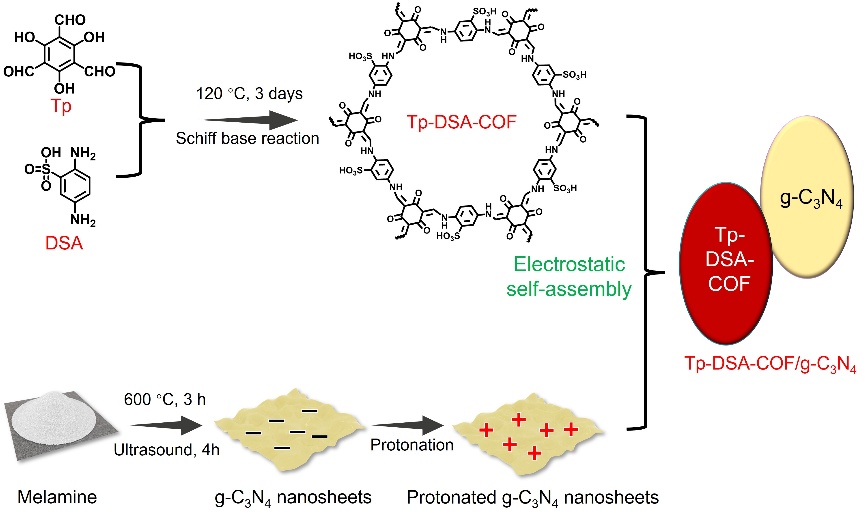
Fig. 1. Schematic illustration of the synthesis of Tp-DSA-COF/g-C3N4 composites.
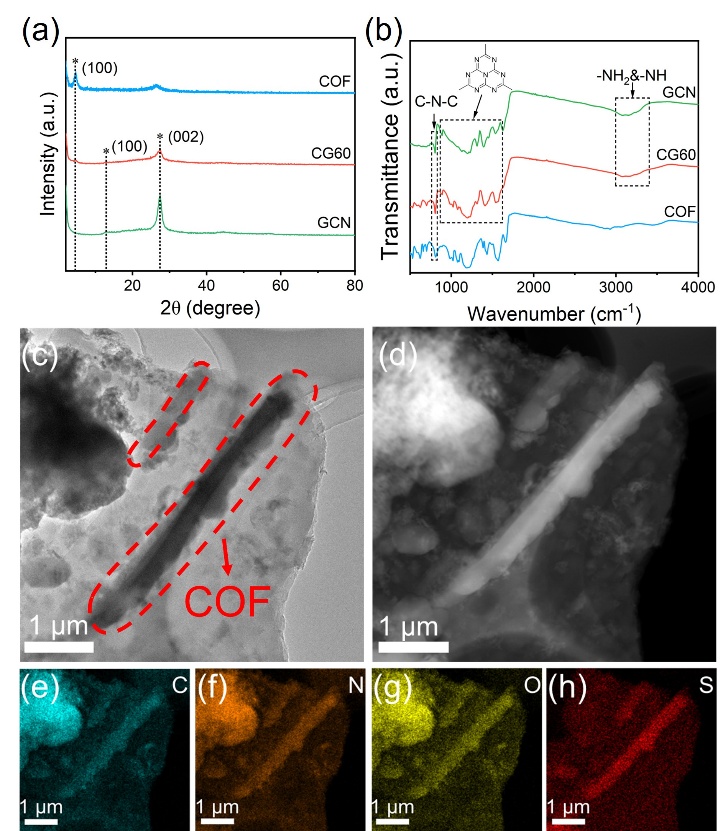
Fig. 2. (a) XRD patterns of Tp-DSA-COF (COF), g-C3N4 (GCN), and the composite CG60. (b) FTIR spectra of COF, GCN, and CG60. (c) TEM image of CG60. (d) HAADF-STEM image of CG60. (e-h) Corresponding EDS elemental mapping images of C, N, O, and S in CG60.
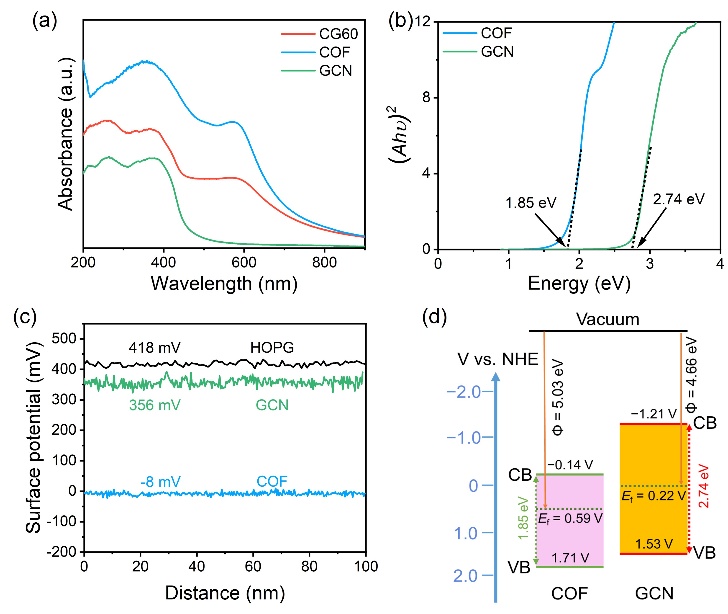
Fig. 3. (a) UV-vis DRS spectra of COF, GCN and CG60. (b) UPS spectra of COF. (c) Surface potentials of HOPG, COF, and GCN measured by KPFM. (d) Schematic band alignment of COF and GCN.
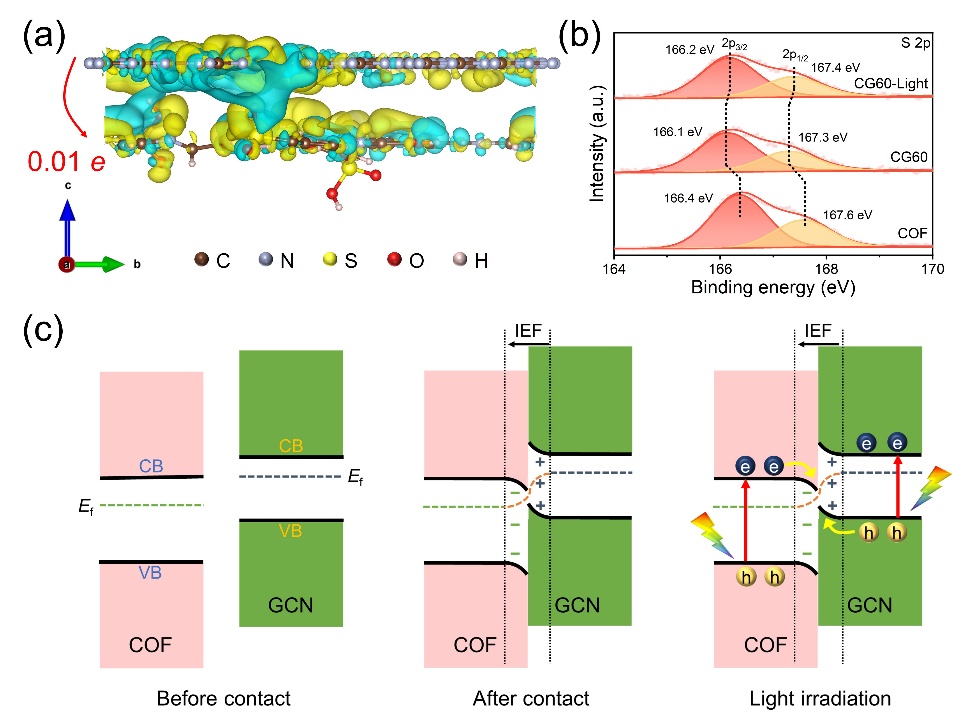
Fig. 4. (a) Charge-density difference of the COF/GCN heterojunction obtained from DFT calculations; the yellow and blue regions indicate charge accumulation and charge depletion, respectively. (b) ISI-XPS spectra of S 2p under dark and light irradiation conditions. (c) Schematic illustration of the charge transfer mechanism in the S-scheme COF/GCN heterojunction.
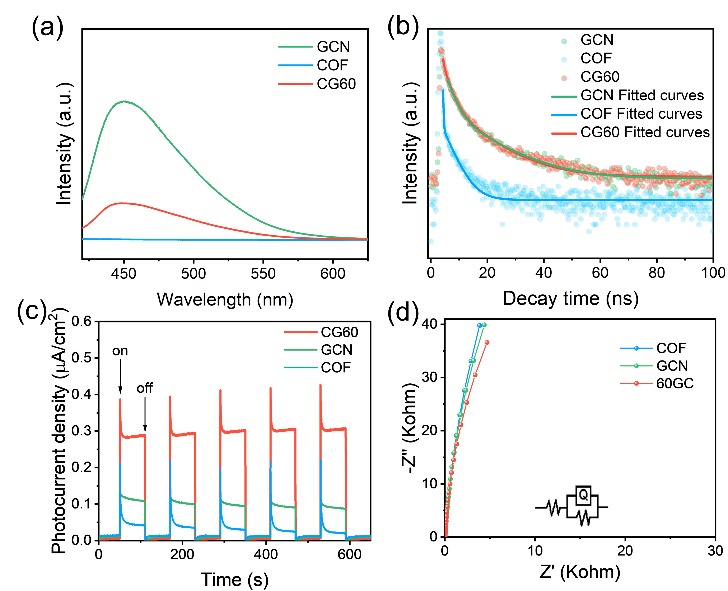
Fig. 5. PL spectra (a), TRPL spectra (b), photocurrent density responses (c), and EIS Nyquist plots (d) of COF, GCN and CG60.
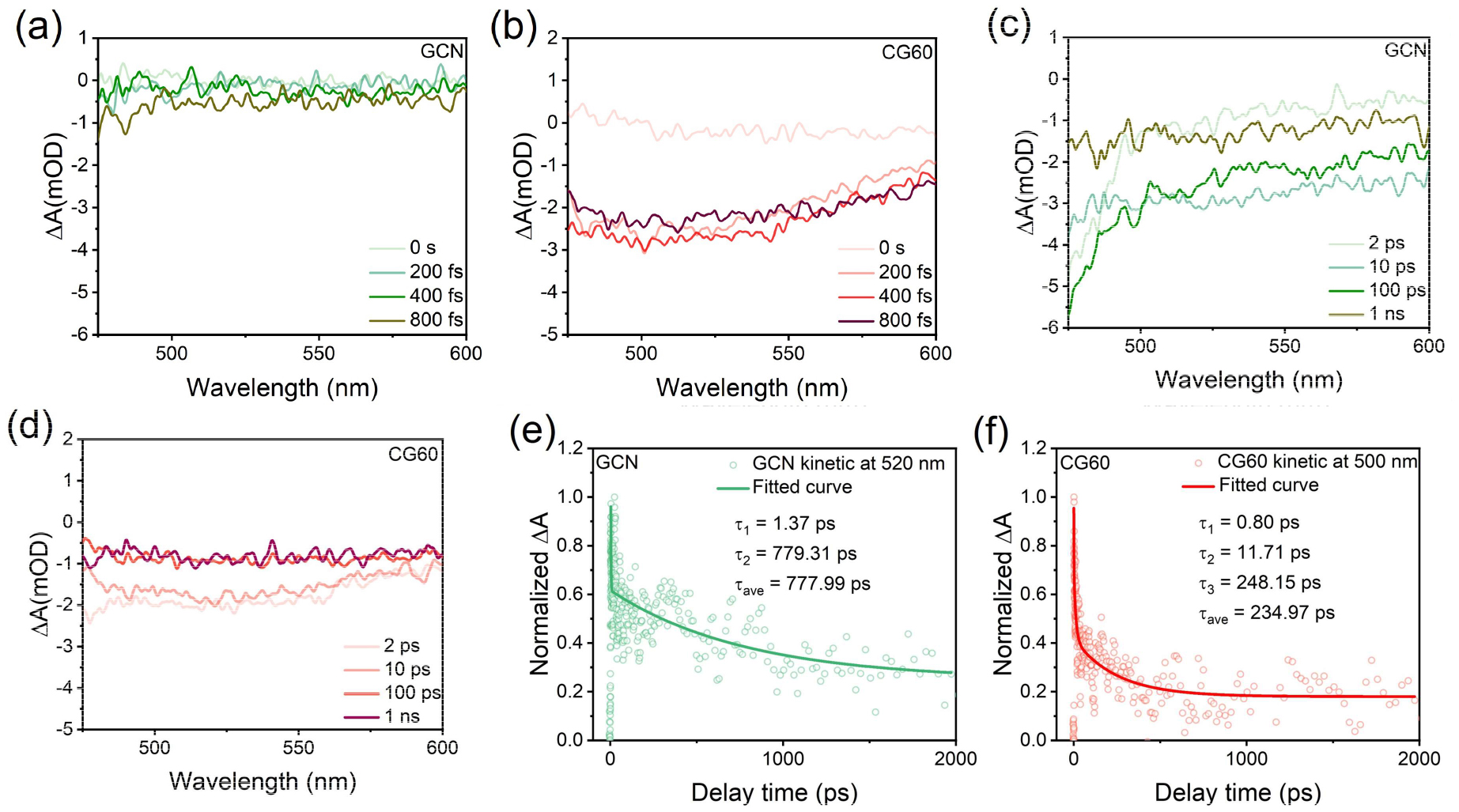
Fig. 6. Transient absorption spectra depicting the femtosecond-time-scale dynamics of GCN (a) and CG60 (b). Time-resolved picosecond-time-scale transient absorption signals of GCN (c) and CG60 (d). Decay kinetics and corresponding fitted curves of GCN at 520 nm (e) and CG60 at 500 nm (f).
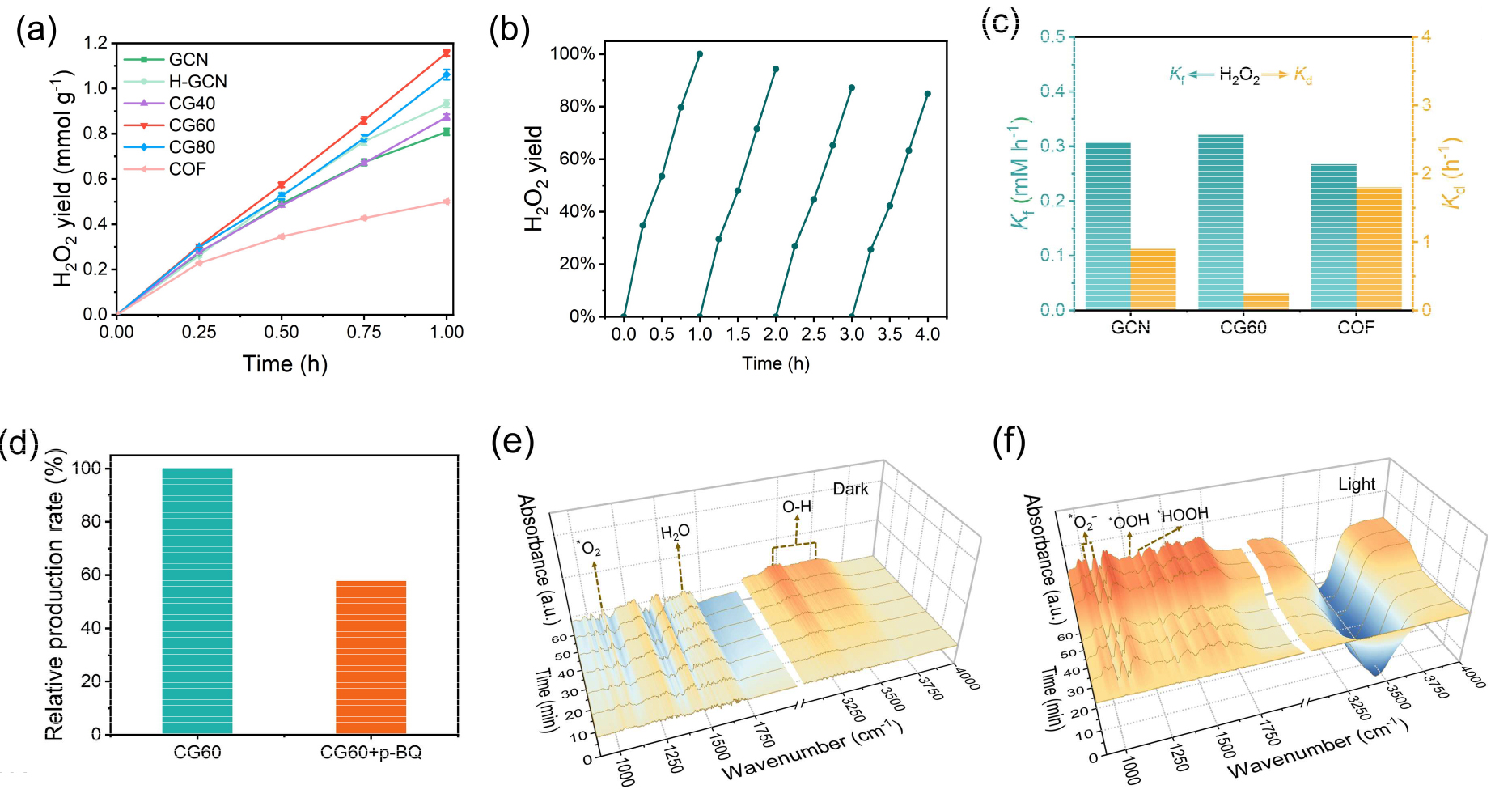
Fig. 7. (a) Photocatalytic H2O2 production rates of COF, GCN and CGx. (b) Cycle stability of CG60. (c) Fitted Kf and Kd for COF, GCN and CG60. (d) Effect of p-BQ on the photocatalytic H2O2 production activity of CG60. In-situ DRIFTS spectra of CG60 in the dark (e) and under light irradiation (f).
|
| [1] | Vladimir I. Kurganskii, Dmitry P. Lubov, Alexander G. Medvedev, Ruihu Wang, Konstantin P. Bryliakov. Bioinspired asymmetric syn-hydroxyazidation of electron-deficient olefins in the presence of nonheme Mn complexes [J]. Chinese Journal of Catalysis, 2026, 88(9): 468-477. |
| [2] | Jiayu Zhang, Kun Wang, Jinglu Yu, Kaiyang Xu, Lu Yang, Jiali Rao, Shuqin Song, Yi Wang. Modulating active sites via Mn-doping in NiCo LDH for energy-saving paired electrosynthesis of H2O2 and formate [J]. Chinese Journal of Catalysis, 2026, 88(9): 307-321. |
| [3] | Songling Wang, Anhua Huang, Fengxing Yin, Ruixiang Lu, Wengang Liu, Yun Zhang, Botao Qiao. In-situ synthesis of hydrogen peroxide for highly selective oxidation of methane to methanol over noble-metal-free catalyst [J]. Chinese Journal of Catalysis, 2026, 88(9): 347-355. |
| [4] | Shufang Liu, Fengyu Chen, Siyuan Li, Yu-Xin Ye, Gangfeng Ouyang. Recent advances in oxygen-centered organic radicals: Characterization, synthesis, and applications [J]. Chinese Journal of Catalysis, 2026, 88(9): 183-206. |
| [5] | Xiaolong Ma, Zhiqiang Wu, Huiqin Yao, Bin Liu, Zhiliang Jin, Paolo Fornasiero. Charging dynamics engineering: Quantum dots-induced full-space electric field cooperative Ag2S QDs/CoWO₄ S-scheme heterojunction boosting photocatalytic hydrogen evolution [J]. Chinese Journal of Catalysis, 2026, 88(9): 233-246. |
| [6] | Yueling Chen, Yuling Lin, Ziyan Chen, Xiangyu Kong, Jinhong Bi, Guocheng Huang, Ling Wu. Asymmetric N-Ru-S dipole within covalent organic framework enhances internal electric field for efficient CO2 photoreduction [J]. Chinese Journal of Catalysis, 2026, 87(8): 59-69. |
| [7] | Gaoxiong Liu, Rundong Chen, Bingquan Xia, Xianlong Zhou, Laiquan Li, Shantang Liu. Thiadiazole-functionalized covalent triazine frameworks for constructing S-scheme heterojunctions enabling boosted H2O2 photosynthesis [J]. Chinese Journal of Catalysis, 2026, 87(8): 170-184. |
| [8] | Hao Wu, Xinyu Zeng, Wang Wang, Bei Cheng, Jingzhao Cheng, Jingsan Xu, Shaowen Cao. The organic-inorganic S-scheme heterojunction with enhanced charge separation simultaneously catalyze the production of hydrogen and imine [J]. Chinese Journal of Catalysis, 2026, 87(8): 185-196. |
| [9] | Sue-Faye Ng, Joel Jie Foo, Karlo Nolkemper, Zahra Hajiahmadi, Jaya Bharti, Nannan Hou, Jiankang Zheng, Thomas D. Kühne, Markus Antonietti, Christian Mark Pelicano, Wee-Jun Ong. Triazole ring functionalized poly(heptazine imide): Leveraging donor- acceptor configuration toward enhanced solar-driven H2O2 synthesis [J]. Chinese Journal of Catalysis, 2026, 87(8): 140-155. |
| [10] | Keke Zhang, Fulin Zhang, Yuexin Wang, Fengwei Huang, Kanghui Xiong, Xiang-Kui Gu, Xianjun Lang. Tweaking the electron push-pull effect of vinylene-linked thienothiophene covalent organic frameworks for enhanced selective photocatalysis [J]. Chinese Journal of Catalysis, 2026, 87(8): 206-216. |
| [11] | Shijie Li, Rui Li, Yanping Liu, Xin Yu, Deyun Ma, Jianhui Jiang, Xiaosong Zhou, Chunqiang Zhuang, Zaiwang Zhao, Wei Jiang. Augmented reactive oxygen species generation in Ag/AgBr/C3N5 via LSPR-enhanced S-scheme charge transfer for efficient photocatalytic antibiotic wastewater remediation [J]. Chinese Journal of Catalysis, 2026, 87(8): 126-139. |
| [12] | Hanxi Li, Zhendong Luo, Qiang Xue, Yunfei Zhi, Jun Du, Xukai Zhou. Engineering channel microenvironment and charge dynamics in covalent organic frameworks through linkage-specific povarov cyclization for enhanced photocatalytic hydrogen evolution [J]. Chinese Journal of Catalysis, 2026, 86(7): 363-374. |
| [13] | Yatai Zhou, Chengcheng Yuan, Wei Xia, Jun Wang, Xiaofeng Zhu, Yong Zhang, Bicheng Zhu, Jiaguo Yu. Synergistic optimization of interfacial electron transfer and surface hydrogen adsorption in a CdS/ZnO S-scheme heterojunction by site-specific doping: A DFT study [J]. Chinese Journal of Catalysis, 2026, 86(7): 327-337. |
| [14] | Qing Lan, Su-Juan Jin, Ying-Ying Jiao, Zhi-Ming Zhang. Anchoring single/dual metal centers on carbon nitride: Sustainable routes for greenhouse gas conversion and organic photosynthesis [J]. Chinese Journal of Catalysis, 2026, 85(6): 13-33. |
| [15] | Jiaying Liu, Yu Fang. Unraveling structure-activity relationships in 2-D covalent organic frameworks for photocatalysis: From molecular engineering to high-performance optimization [J]. Chinese Journal of Catalysis, 2026, 85(6): 47-87. |
| Viewed | ||||||
|
Full text |
|
|||||
|
Abstract |
|
|||||


