
Chinese Journal of Catalysis ›› 2026, Vol. 89: 127-141.DOI: 10.1016/S1872-2067(26)65172-8
• Review • Previous Articles Next Articles
Meijun Guoa, Elhussein M. Hashema, Jaenudin Ridwana, Tian Chena, Peng Zhoub,*( ), Jingrun Rana,*()
Received:2026-02-02
Accepted:2026-04-17
Online:2026-10-18
Published:2026-09-01
Contact:
*E-mail:pengzhou1209@pku.edu.cn(P. Zhou),jingrun.ran@adelaide.edu.au(J. Ran).
About author:Peng Zhou (Peking University Shenzhen Graduate School) joined Peking University Shenzhen Graduate School as an Assistant Professor in 2023. His research focuses on the controlled synthesis of emerging inorganic semiconductor photocatalysts and their photochemical energy-conversion properties, including photocatalytic overall water splitting for hydrogen production, the preparation of single-atom photocatalysts, and photocatalytic synthesis of value-added organic compounds. According to Web of Science, his work has received over 15000 citations with an h-index of 56. He was awarded the Excellent Young Scientists Fund (Overseas) of National Natural Science Foundation of China in 2023 and was selected for Stanford University’s 2025 World’s Top 2% Scientists and Career-long Impact Ranking lists.Meijun Guo, Elhussein M. Hashem, Jaenudin Ridwan, Tian Chen, Peng Zhou, Jingrun Ran. Research progress on copper chalcogenide compounds in photocatalysis[J]. Chinese Journal of Catalysis, 2026, 89: 127-141.
Add to citation manager EndNote|Ris|BibTeX
URL: https://www.cjcatal.com/EN/10.1016/S1872-2067(26)65172-8
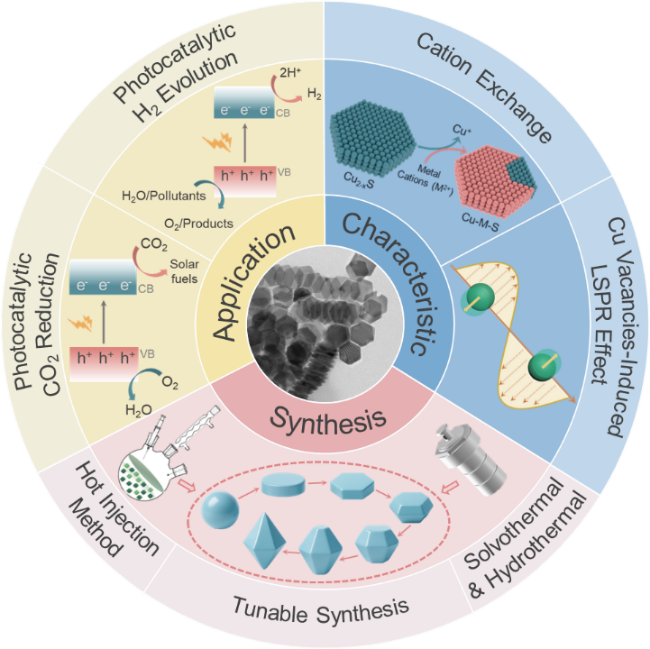
Fig. 1. Schematic summary of the aspects covered in this review.
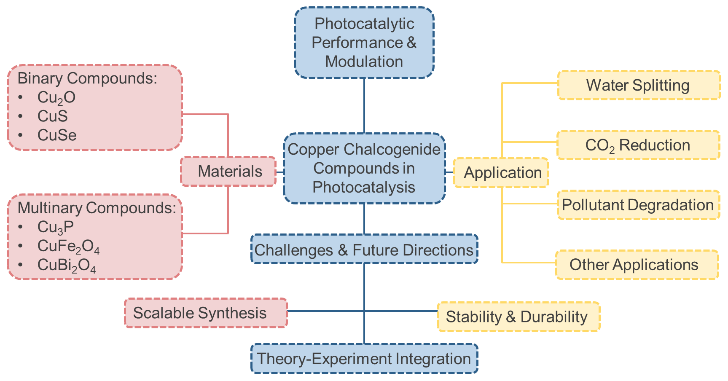
Fig. 2. Schematic overview of copper chalcogenide compounds in photocatalysis.
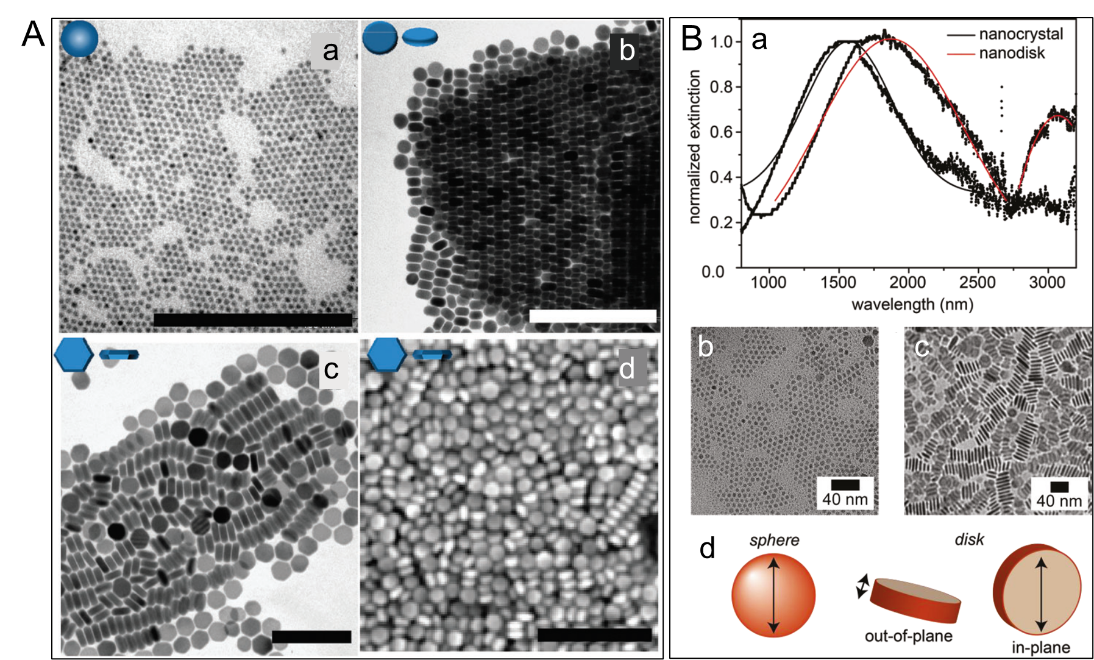
Fig. 3. (A) TEM (a-c) and SEM (d) images of Cu2-xS nanoparticles with various morphologies. Scale bars = 200 nm. Reprinted with permission from Ref. [53]. Copyright 2011, Royal Society of Chemistry. (B) Shape-dependent LSPRs of Cu2-xS nanocrystals. (a) NIR extinction spectra (black dots) for colloidal dispersions of spherical nanocrystals and nanodisks. TEM image of spherical nanocrystals (b) and nanodisks (c). (d) Schematic of LSPR polarizations for spherical and disk-shaped nanocrystals. Reprinted with permission from Ref. [54]. Copyright 2011, American Chemical Society.
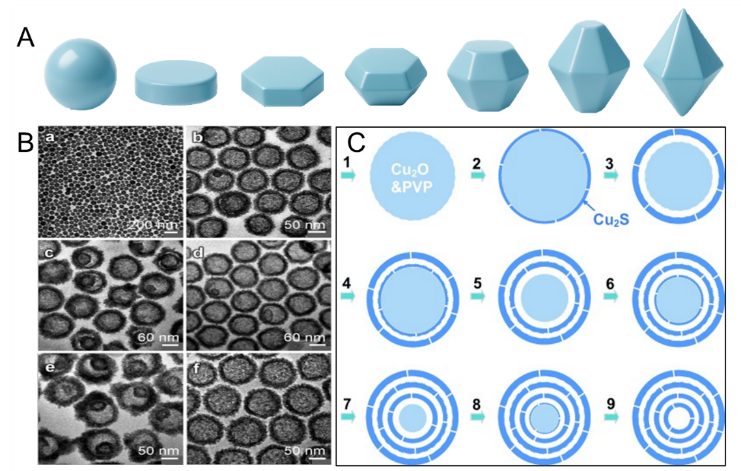
Fig. 4. Morphological evolution and structural transformation of Cu2O-Cu2S nanostructures. (A) Schematic illustration of different possible nanocrystal morphologies formed during growth, showing the evolution from spherical particles to faceted polyhedral structures with increasing structural complexity. (B) TEM image of various core-shell structures at different transformation stages. (C) Proposed schematic mechanism for the formation of Cu2S shells on Cu2O-PVP nanocrystals. The process involves the initial formation of a Cu2S layer on the Cu2O surface followed by gradual shell growth and structural reconstruction, ultimately leading to multi-shell or hollow architectures through sequential diffusion and interfacial conversion. Reprinted with permission from Ref. [100]. Copyright 2012, John Wiley and Sons.
| Phase category | Structural/compositional characteristics | Dominant vacancy features | Representative photocatalytic applications | Ref. |
|---|---|---|---|---|
| Binary copper sulfides (Cu2-xS) | non-stoichiometric, phase-rich, Cu-deficient structures common | intrinsic Cu vacancies dominate | H2 evolution, pollutant degradation, organic oxidation | [ |
| Binary copper selenides (Cu2-xSe) | Cu-deficient, electronically delocalized Se-based lattice | tunable Cu vacancies with strong electronic impact | H2 evolution, pollutant removal, photothermal-assisted catalysis | [ |
| Ternary copper chalcogenides (e.g., CuInS2, CuGaS2) | more ordered cation framework | Cu vacancies plus antisite defects | H2 production, CO2 reduction, pollutant removal | [ |
| Alloyed/multinary systems | compositionally tunable lattice | coupled composition-vacancy regulation | biomass conversion, selective redox reactions | [ |
| Heterostructured systems | vacancy-containing copper chalcogenides integrated with secondary semiconductors | interfacial defect redistribution | H2 evolution, CO2 reduction, environmental remediation | [ |
Table 1 Representative copper chalcogenide phases discussed in this review, with comparison of their structural characteristics, vacancy features, key properties, and typical photocatalytic applications.
| Phase category | Structural/compositional characteristics | Dominant vacancy features | Representative photocatalytic applications | Ref. |
|---|---|---|---|---|
| Binary copper sulfides (Cu2-xS) | non-stoichiometric, phase-rich, Cu-deficient structures common | intrinsic Cu vacancies dominate | H2 evolution, pollutant degradation, organic oxidation | [ |
| Binary copper selenides (Cu2-xSe) | Cu-deficient, electronically delocalized Se-based lattice | tunable Cu vacancies with strong electronic impact | H2 evolution, pollutant removal, photothermal-assisted catalysis | [ |
| Ternary copper chalcogenides (e.g., CuInS2, CuGaS2) | more ordered cation framework | Cu vacancies plus antisite defects | H2 production, CO2 reduction, pollutant removal | [ |
| Alloyed/multinary systems | compositionally tunable lattice | coupled composition-vacancy regulation | biomass conversion, selective redox reactions | [ |
| Heterostructured systems | vacancy-containing copper chalcogenides integrated with secondary semiconductors | interfacial defect redistribution | H2 evolution, CO2 reduction, environmental remediation | [ |
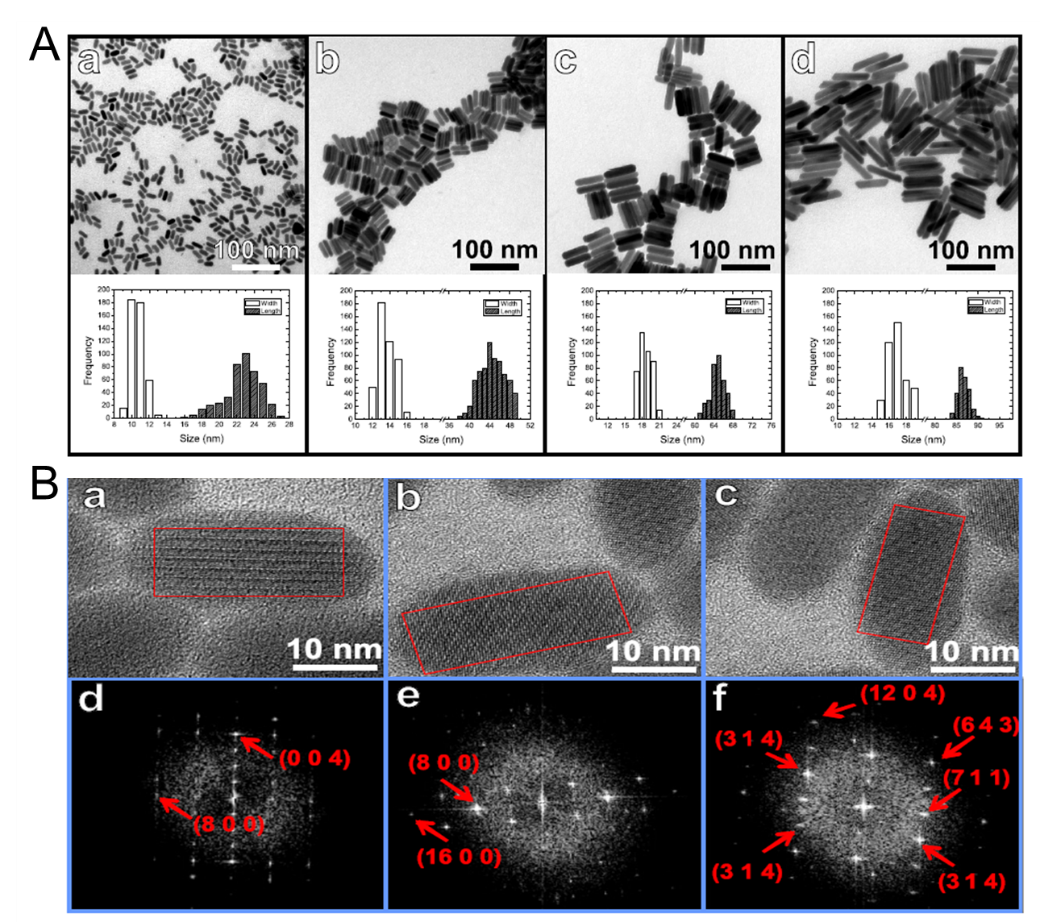
Fig. 5. Structural characterization of copper chalcogenide nanorods with tunable sizes. (A) TEM images of the nanorods synthesized under different reaction conditions: (a-d) representative TEM micrographs showing the morphology and size evolution of the nanorods. The corresponding size distribution histograms are shown below each image, indicating gradual changes in particle length and diameter. (B) HRTEM images and corresponding FFT analyses of representative nanorods. (a-c) HRTEM images highlighting the well-resolved lattice fringes in selected regions (red boxes). (d-f) Corresponding FFT patterns revealing the crystalline nature and indexed diffraction spots of the nanorods, confirming their well-defined crystal structure. Reprinted with permission from Ref. [101]. Copyright 2012, American Chemical Society.
|
| [1] | Wenmin Lei, Yan Zhang, Dalin Sun, Lin Ban, Heng Zhou, Song Yang, Liquan Jing, Jinguang Hu, Heng Zhang. Transition-metals photocatalysts for lignin valorization toward sustainable biofuel production [J]. Chinese Journal of Catalysis, 2026, 88(9): 35-85. |
| [2] | Yaowen Wei, Jianwei Wang, Hao Guo, Tao Ban, Yufeng Yue, Di Hu, Haibao Huang. Highly selective oxidation of methane to acetic acid enabled by deficient UiO-66 under mild conditions [J]. Chinese Journal of Catalysis, 2026, 88(9): 356-368. |
| [3] | Shufang Liu, Fengyu Chen, Siyuan Li, Yu-Xin Ye, Gangfeng Ouyang. Recent advances in oxygen-centered organic radicals: Characterization, synthesis, and applications [J]. Chinese Journal of Catalysis, 2026, 88(9): 183-206. |
| [4] | Xiangfeng Chen, Siyu Huang, Yuhang Yang, Jiahao Ni, Cheng Fang, Yang-Fan Xu, Dai-Bin Kuang. Hybrid photocatalysis with halide perovskite materials [J]. Chinese Journal of Catalysis, 2026, 88(9): 9-34. |
| [5] | Hua Gao, Yong Zhu, Zhibing Wen, Ran Zhao, Zhi Chen, Siyao Wang, Shuanglin He, Kuang Peng, Yiwen Tang, Licheng Sun, Fei Li. Efficient and selective photocatalytic CO2 conversion enabled by FePc nanosheets in a dye-sensitized system [J]. Chinese Journal of Catalysis, 2026, 86(7): 350-362. |
| [6] | Yatai Zhou, Chengcheng Yuan, Wei Xia, Jun Wang, Xiaofeng Zhu, Yong Zhang, Bicheng Zhu, Jiaguo Yu. Synergistic optimization of interfacial electron transfer and surface hydrogen adsorption in a CdS/ZnO S-scheme heterojunction by site-specific doping: A DFT study [J]. Chinese Journal of Catalysis, 2026, 86(7): 327-337. |
| [7] | Wei Zhong, Yiyao Gan, Jingtao Wang, Peiyi Yang, Aiyun Meng, Yaorong Su. Achieving near-equilibrium Had adsorption/desorption by introducing asymmetric S-Re-Se modules in a-ReSxSe2-x cocatalysts for enhanced photocatalytic H2 evolution [J]. Chinese Journal of Catalysis, 2026, 85(6): 322-332. |
| [8] | Jia Ruan, Wenjing Chen, Ziqian Li, Peng Hu, Cheng-Yong Su. Intermolecular asymmetric dearomative photocycloaddition of (benzo)furans with excited alkenes via cage-confined catalysis [J]. Chinese Journal of Catalysis, 2026, 85(6): 346-355. |
| [9] | Jing-Yu Li, Yi-Jun Xu. Regioselective ring-opening of epoxides triggered by light [J]. Chinese Journal of Catalysis, 2026, 85(6): 34-46. |
| [10] | Jintao Dong, Rui Zhang, Zhishuai Wang, Shengqun Cao, Lina Li, Gaopeng Liu, Bin Wang, Yixuan Gao, Jiexiang Xia. Construction of S-scheme MnO2/BiOCl heterojunction boosting photocatalytic low-concentration peroxymonosulfate activation for contaminants removal [J]. Chinese Journal of Catalysis, 2026, 85(6): 310-321. |
| [11] | Baolong Zhang, Bin Sun, Xingpeng Liu, Wenyu Liu, Shaonan Gu, Guowei Zhou. Defect-engineered S-scheme charge transfer in TiO2/Zn0.5Cd0.5S heterojunction for high-efficiency photocatalytic hydrogen evolution [J]. Chinese Journal of Catalysis, 2026, 84(5): 117-129. |
| [12] | Yi-Wen Han, Run-Yu Liu, Yu-Xin Zhang, Lei Ye, Phuc T. T. Nguyen, Tian-Jun Gong, Xue-Bin Lu, Yao Fu, Ning Yan. Establishing built-in electric field within single-atom-anchored hollow architectures for efficient solar-thermal regulation in plastic photoreforming [J]. Chinese Journal of Catalysis, 2026, 84(5): 301-313. |
| [13] | Ran Sun, Yuqi Zhang, Kunge Hou, Yujie Tan, Xingang Liu, Jianyuan Hou, Weixuan Zhao, Andrew E. H. Wheatley, Renxi Zhang. Designing hydrogen-bonds in covalent organic frameworks: accelerating proton-coupled electron transfer for enhanced photocatalytic H2O2 synthesis [J]. Chinese Journal of Catalysis, 2026, 84(5): 274-287. |
| [14] | Jingyao Wu, Yujing Lv, Qiang Zhao, Shuo Wang, Ying Wang, Na Wen, Zhengxin Ding, Zizhong Zhang, Jinlin Long. Electron-proton duet in covalent organic frameworks for efficient direct oxygen reduction to hydrogen peroxide [J]. Chinese Journal of Catalysis, 2026, 84(5): 288-300. |
| [15] | Peng Liu, Lian Duan, Baopeng Yang, Mingwei Sun, Gen Chen, Xiaohe Liu, Min Liu, Ning Zhang. Tuning surface electronic structure of (CuGa)xZn1‒2xGa2S4 photocatalyst for efficient nitrate-to-ammonia conversion [J]. Chinese Journal of Catalysis, 2026, 83(4): 172-182. |
| Viewed | ||||||
|
Full text |
|
|||||
|
Abstract |
|
|||||


