
Chinese Journal of Catalysis ›› 2026, Vol. 90: 220-230.DOI: 10.1016/S1872-2067(26)65181-9
• Articles • Previous Articles Next Articles
Chengzheng Mena, Miaoting Huanga, Tongming Sub, Siwei Liaoa, Jianying Shia,*( )
)
Received:2026-04-25
Accepted:2026-06-25
Online:2026-11-18
Published:2026-11-19
Supported by:Chengzheng Men, Miaoting Huang, Tongming Su, Siwei Liao, Jianying Shi. Fine-tuning the energy level of defect states in doped ultrathin carbon nitride polymer for enhanced photocatalytic performance[J]. Chinese Journal of Catalysis, 2026, 90: 220-230.
Add to citation manager EndNote|Ris|BibTeX
URL: https://www.cjcatal.com/EN/10.1016/S1872-2067(26)65181-9
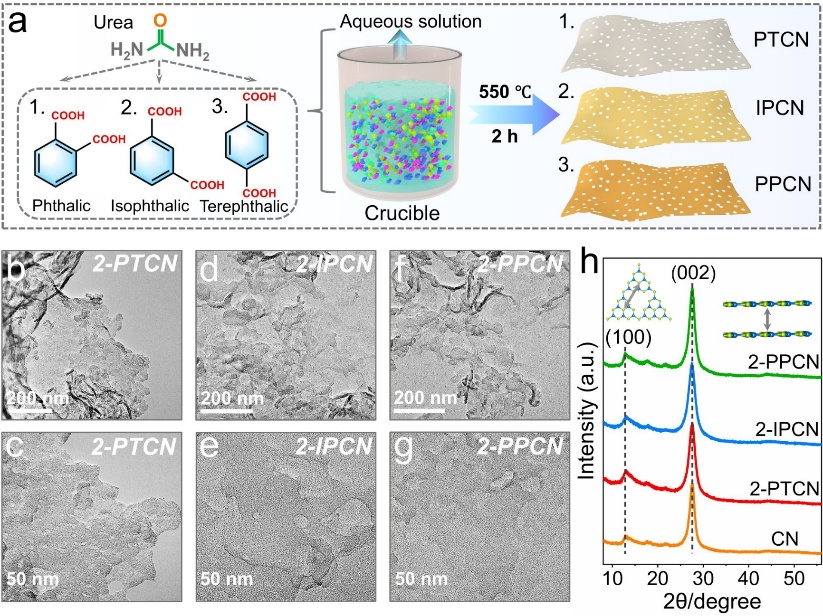
Fig. 1. (a) Schematic illustration of the synthesis process of ultrathin porous CN nanosheets. The buff, yellow, and brown nanosheets represent PTCN, IPCN, and PPCN, respectively. TEM images of 2-PTCN (b,c), 2-IPCN (d,e), and 2-PPCN (f,g). (h) Wide-angle XRD patterns of CN, 2-PTCN, 2-IPCN and 2-PPCN.
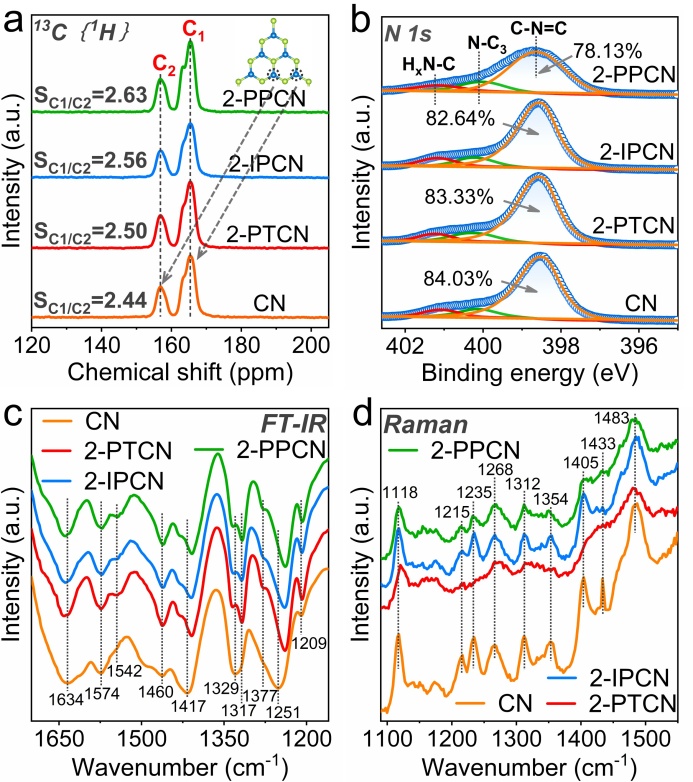
Fig. 2. Solid-state 13C NMR (a) and high-resolution N 1s XPS (b) spectra of CN, 2-PTCN, 2-IPCN, and 2-PPCN. Magnified FT-IR (c) and Raman (d) spectra of CN, 2-PTCN, 2-IPCN, and 2-PPCN.
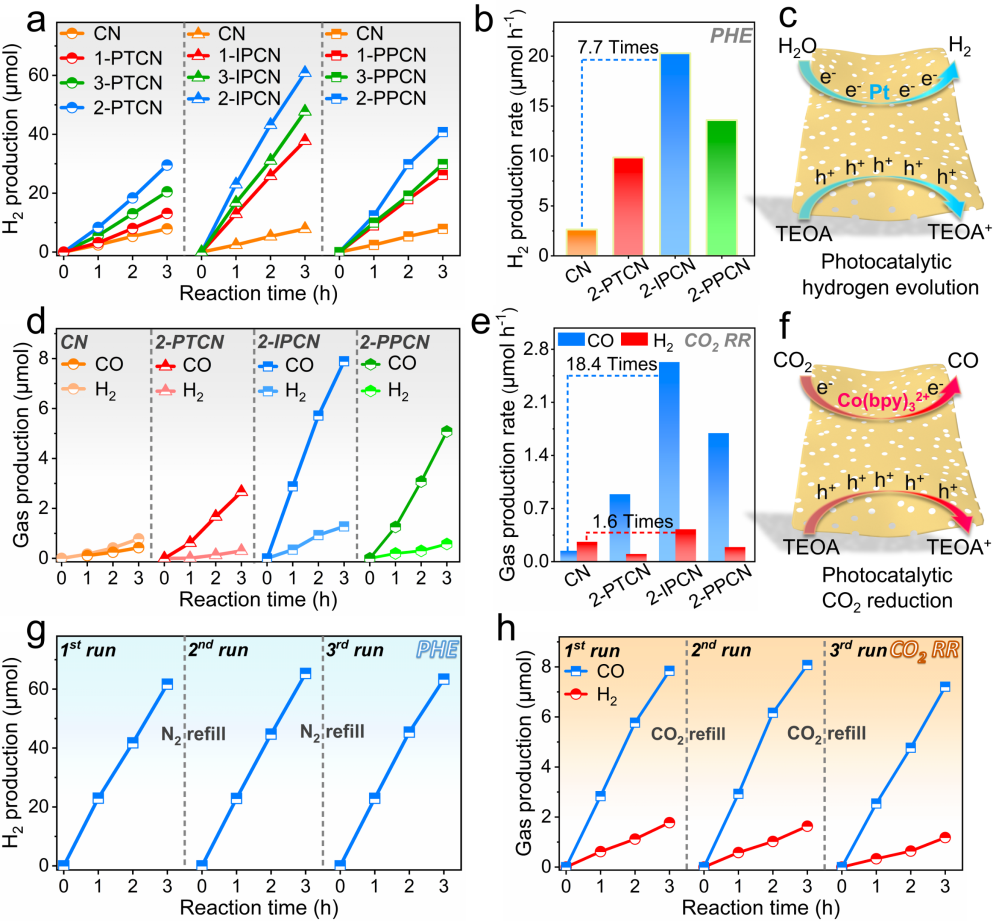
Fig. 3. Time course of photocatalytic H2 production (a) and photocatalytic H2 production rate (b) of CN, x-PTCN, x-IPCN, x-PPCN (x = 1, 2, 3). (c) Schematic diagram system model of the photocatalytic hydrogen production. Time course of photocatalytic CO2 reduction for gas generation (d) and CO and H2 production rate (e) of CN, 2-PTCN, 2-IPCN, 2-PPCN. (f) Schematic diagram system model of photocatalytic CO2 reduction. (g,h) Cyclic experiments of photocatalytic H2 production and CO2 reduction over the 2-IPCN photocatalyst.
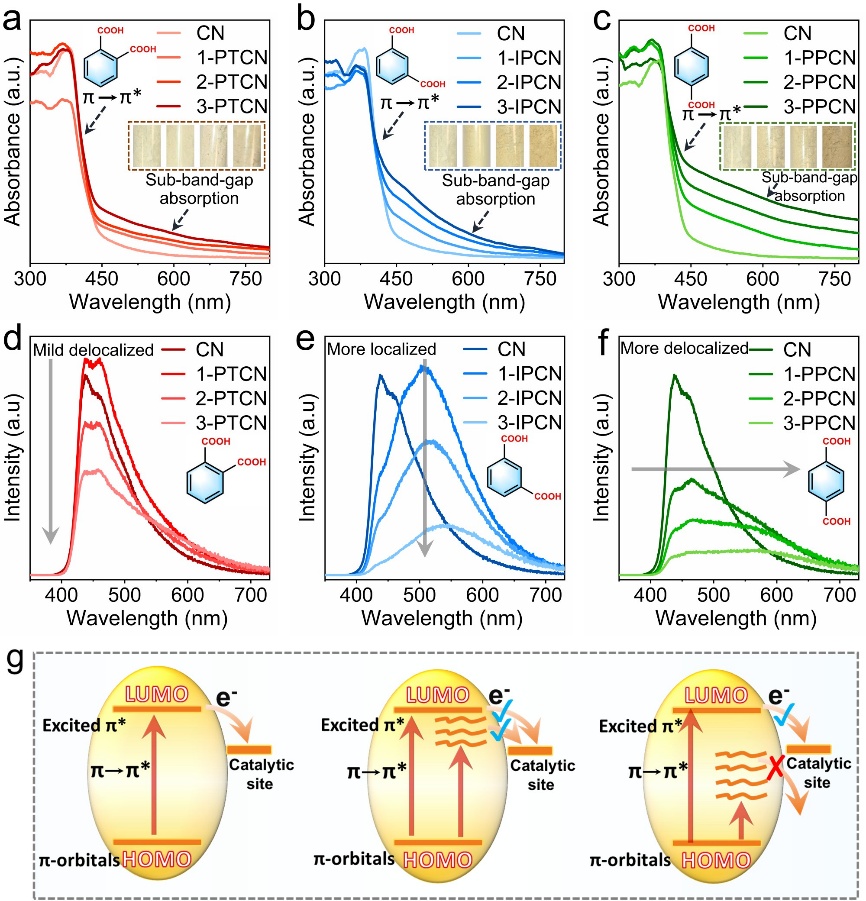
Fig. 4. UV-vis spectra (inset: photographs showing the colors of the samples) and PL spectra (excitation wavelength: 340 nm) of CN, x-PTCN (a,d), x-IPCN (b,e), x-PPCN (c,f) (x = 1, 2, and 3).
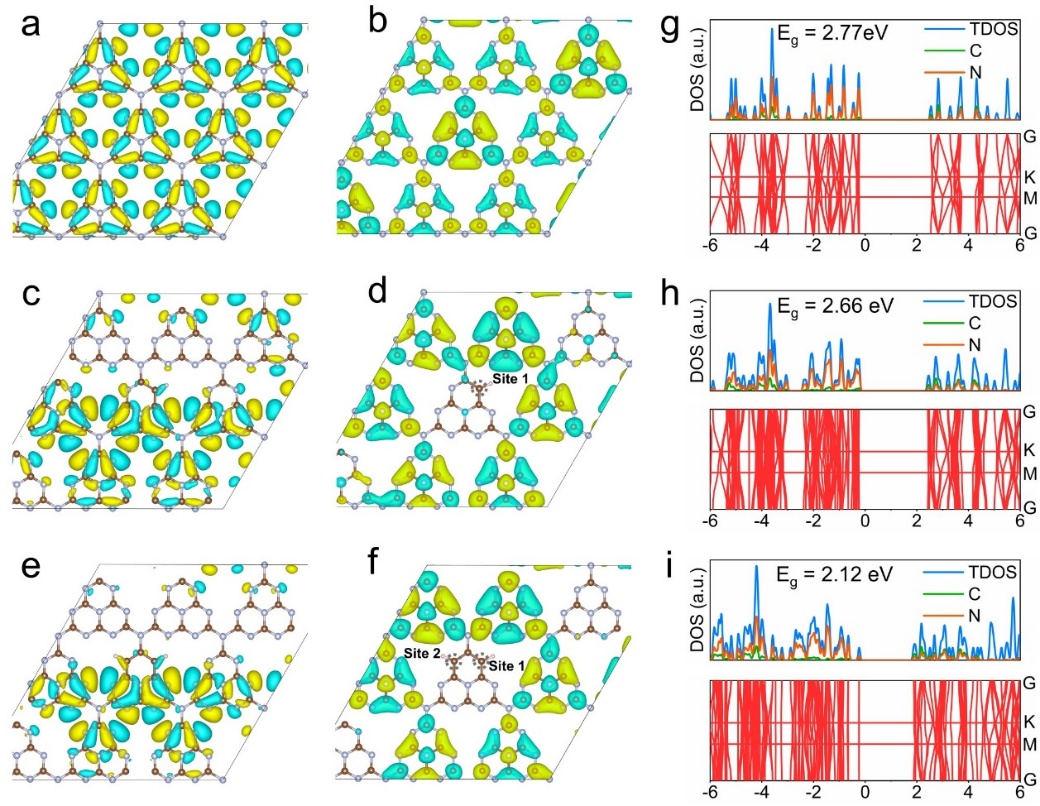
Fig. 5. DFT-derived frontier orbital and electronic structure maps. HOMO (a,c,e) and LUMO (b,d,f) isosurfaces, band diagrams and corresponding DOS (g-i) for pristine CN and CN with carbon substituted at distinct pyridinic-nitrogen positions.
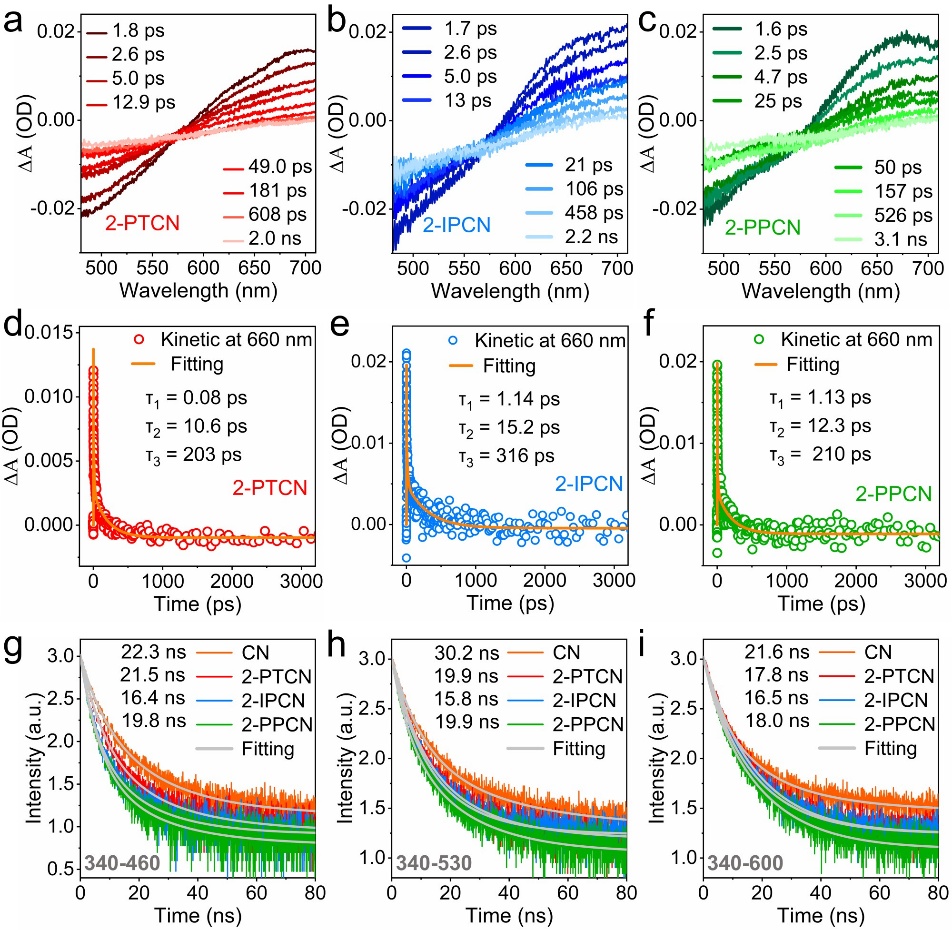
Fig. 6. Fs-TA spectra of 2-PTCN (a), 2-IPCN (b), and 2-PPCN (c) at different delay times under a 370 nm pump pulses. Kinetic curves at 660 nm for 2-PTCN (d), 2-IPCN (e), and 2-PPCN (f) samples with corresponding exponential fits. The time-resolved fluorescence decay spectra of CN, 2-PTCN, 2-IPCN, and 2-PPCN were presented as follows: excited at 340 nm and monitored at 460 nm (g), excited at 340 nm and monitored at 530 nm (h), and excited at 340 nm and monitored at 600 nm (i).
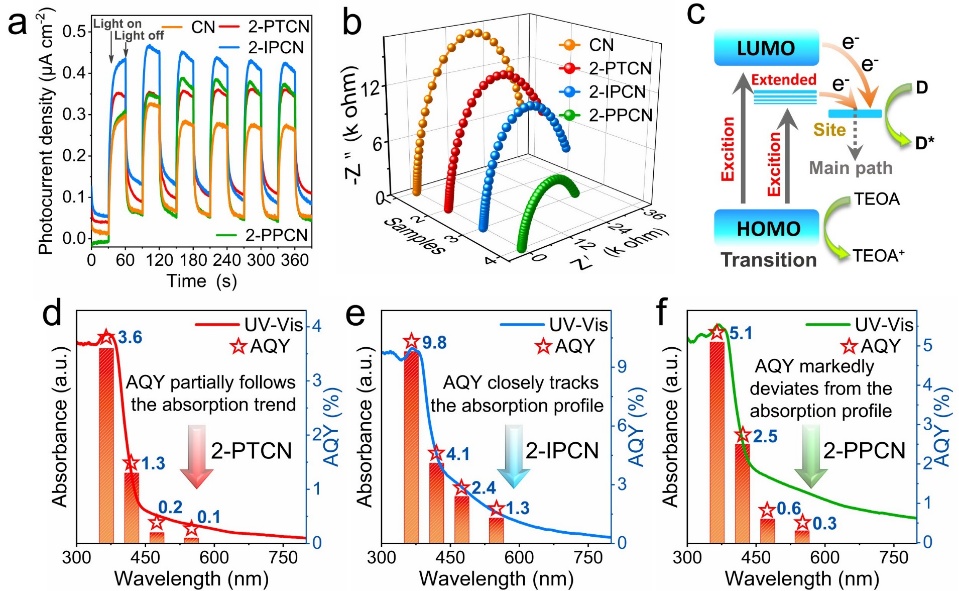
Fig. 7. Transient photocurrent response plots (a) and EIS, Nyquist plots (b) of CN, 2-PTCN, 2-IPCN, and 2-PPCN. (c) Schematic diagram of the proposed mechanism for the enhanced photocatalytic performance over 2-IPCN. The UV-vis wavelength-dependent AQY of 2-PTCN (d), 2-IPCN (e), and 2-PPCN (f).
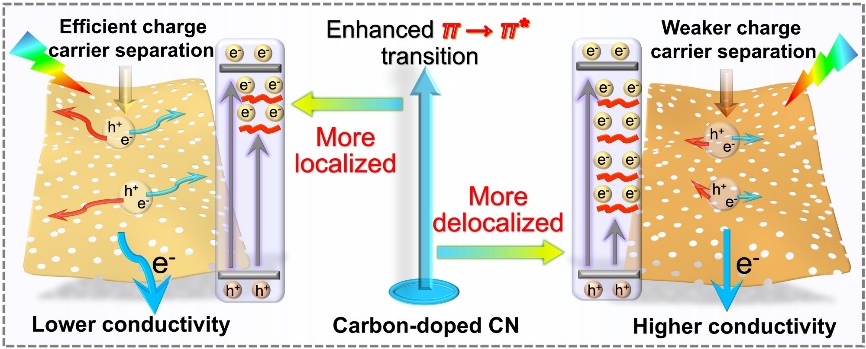
Fig. 8. Comparison of photogenerated carrier migration and separation behaviors in carbon-doped carbon nitrides with localized versus delocalized electronic structures.
|
| [1] | Wenmin Lei, Yan Zhang, Dalin Sun, Lin Ban, Heng Zhou, Song Yang, Liquan Jing, Jinguang Hu, Heng Zhang. Transition-metals photocatalysts for lignin valorization toward sustainable biofuel production [J]. Chinese Journal of Catalysis, 2026, 88(9): 35-85. |
| [2] | Yaowen Wei, Jianwei Wang, Hao Guo, Tao Ban, Yufeng Yue, Di Hu, Haibao Huang. Highly selective oxidation of methane to acetic acid enabled by deficient UiO-66 under mild conditions [J]. Chinese Journal of Catalysis, 2026, 88(9): 356-368. |
| [3] | Shufang Liu, Fengyu Chen, Siyuan Li, Yu-Xin Ye, Gangfeng Ouyang. Recent advances in oxygen-centered organic radicals: Characterization, synthesis, and applications [J]. Chinese Journal of Catalysis, 2026, 88(9): 183-206. |
| [4] | Xiangfeng Chen, Siyu Huang, Yuhang Yang, Jiahao Ni, Cheng Fang, Yang-Fan Xu, Dai-Bin Kuang. Hybrid photocatalysis with halide perovskite materials [J]. Chinese Journal of Catalysis, 2026, 88(9): 9-34. |
| [5] | Hua Gao, Yong Zhu, Zhibing Wen, Ran Zhao, Zhi Chen, Siyao Wang, Shuanglin He, Kuang Peng, Yiwen Tang, Licheng Sun, Fei Li. Efficient and selective photocatalytic CO2 conversion enabled by FePc nanosheets in a dye-sensitized system [J]. Chinese Journal of Catalysis, 2026, 86(7): 350-362. |
| [6] | Wei Zhong, Yiyao Gan, Jingtao Wang, Peiyi Yang, Aiyun Meng, Yaorong Su. Achieving near-equilibrium Had adsorption/desorption by introducing asymmetric S-Re-Se modules in a-ReSxSe2-x cocatalysts for enhanced photocatalytic H2 evolution [J]. Chinese Journal of Catalysis, 2026, 85(6): 322-332. |
| [7] | Jia Ruan, Wenjing Chen, Ziqian Li, Peng Hu, Cheng-Yong Su. Intermolecular asymmetric dearomative photocycloaddition of (benzo)furans with excited alkenes via cage-confined catalysis [J]. Chinese Journal of Catalysis, 2026, 85(6): 346-355. |
| [8] | Jing-Yu Li, Yi-Jun Xu. Regioselective ring-opening of epoxides triggered by light [J]. Chinese Journal of Catalysis, 2026, 85(6): 34-46. |
| [9] | Jintao Dong, Rui Zhang, Zhishuai Wang, Shengqun Cao, Lina Li, Gaopeng Liu, Bin Wang, Yixuan Gao, Jiexiang Xia. Construction of S-scheme MnO2/BiOCl heterojunction boosting photocatalytic low-concentration peroxymonosulfate activation for contaminants removal [J]. Chinese Journal of Catalysis, 2026, 85(6): 310-321. |
| [10] | Baolong Zhang, Bin Sun, Xingpeng Liu, Wenyu Liu, Shaonan Gu, Guowei Zhou. Defect-engineered S-scheme charge transfer in TiO2/Zn0.5Cd0.5S heterojunction for high-efficiency photocatalytic hydrogen evolution [J]. Chinese Journal of Catalysis, 2026, 84(5): 117-129. |
| [11] | Yi-Wen Han, Run-Yu Liu, Yu-Xin Zhang, Lei Ye, Phuc T. T. Nguyen, Tian-Jun Gong, Xue-Bin Lu, Yao Fu, Ning Yan. Establishing built-in electric field within single-atom-anchored hollow architectures for efficient solar-thermal regulation in plastic photoreforming [J]. Chinese Journal of Catalysis, 2026, 84(5): 301-313. |
| [12] | Ran Sun, Yuqi Zhang, Kunge Hou, Yujie Tan, Xingang Liu, Jianyuan Hou, Weixuan Zhao, Andrew E. H. Wheatley, Renxi Zhang. Designing hydrogen-bonds in covalent organic frameworks: accelerating proton-coupled electron transfer for enhanced photocatalytic H2O2 synthesis [J]. Chinese Journal of Catalysis, 2026, 84(5): 274-287. |
| [13] | Jingyao Wu, Yujing Lv, Qiang Zhao, Shuo Wang, Ying Wang, Na Wen, Zhengxin Ding, Zizhong Zhang, Jinlin Long. Electron-proton duet in covalent organic frameworks for efficient direct oxygen reduction to hydrogen peroxide [J]. Chinese Journal of Catalysis, 2026, 84(5): 288-300. |
| [14] | Peng Liu, Lian Duan, Baopeng Yang, Mingwei Sun, Gen Chen, Xiaohe Liu, Min Liu, Ning Zhang. Tuning surface electronic structure of (CuGa)xZn1‒2xGa2S4 photocatalyst for efficient nitrate-to-ammonia conversion [J]. Chinese Journal of Catalysis, 2026, 83(4): 172-182. |
| [15] | Yixin Li, Jianhao Qiu, Guanglu Xia, Qiying Liu, Biyao Fang, Meng Liu, Chen Chen, Jianfeng Yao. Hollow tubular In2O3 modified carbon nitride for photocatalytic high-yield cleavage of lignin C-C bonds under 395 nm light [J]. Chinese Journal of Catalysis, 2026, 83(4): 209-218. |
| Viewed | ||||||
|
Full text |
|
|||||
|
Abstract |
|
|||||


