
Chinese Journal of Catalysis ›› 2026, Vol. 91: 232-240.DOI: 10.1016/S1872-2067(26)65231-X
• Articles • Previous Articles Next Articles
Muhammad Umair Ul Hassana,b,1, Jizhang Wanga,1, Rashid Mehmooda,*( ), Fazal Shaha,b, Kun Qia, Fuxiang Zhanga,*()
Received:2026-03-12
Accepted:2026-05-25
Online:2026-12-18
Published:2026-10-13
About author:1Contributed equally to this work.
Supported by:Muhammad Umair Ul Hassan, Jizhang Wang, Rashid Mehmood, Fazal Shah, Kun Qi, Fuxiang Zhang. Chromium-doped CoFe2O4 for enhanced oxygen evolution via hydroxyl spillover[J]. Chinese Journal of Catalysis, 2026, 91: 232-240.
Add to citation manager EndNote|Ris|BibTeX
URL: https://www.cjcatal.com/EN/10.1016/S1872-2067(26)65231-X
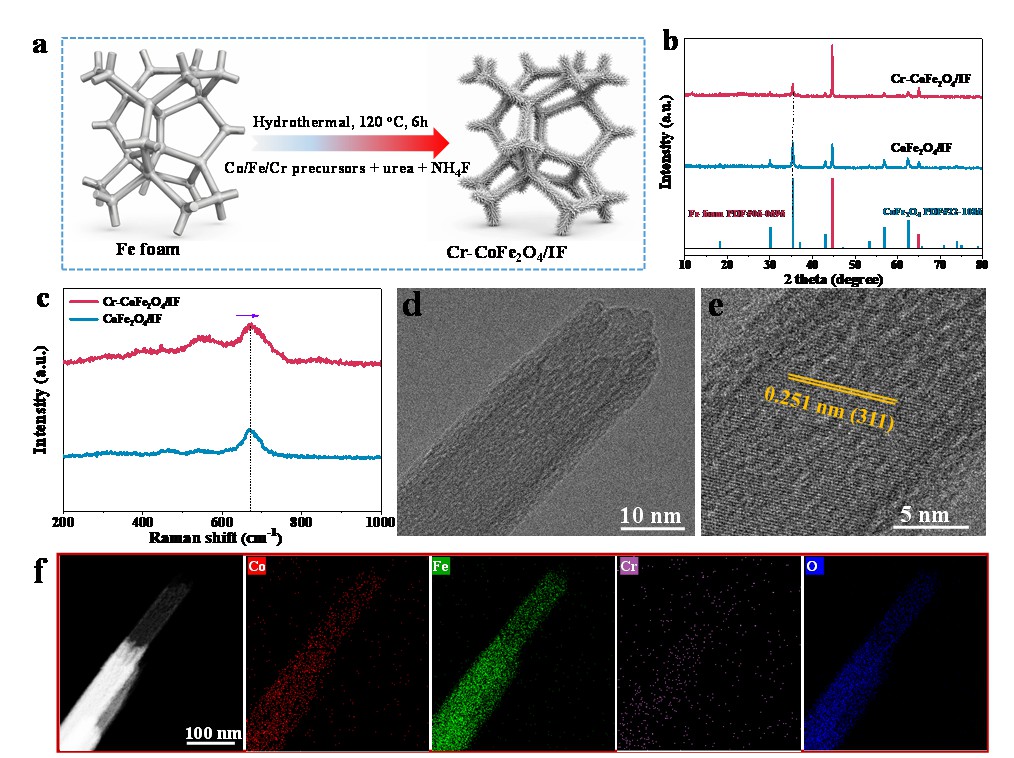
Fig. 1. Synthesis and structural characterization of Cr-CoFe2O4/IF. (a) Schematic illustration of the synthesis of Cr-CoFe2O4/IF. (b) XRD patterns of Cr-CoFe2O4/IF and control sample CoFe2O4/IF. (c) Raman spectra for Cr-CoFe2O4/IF and control sample. (d,e) HRTEM images of Cr-CoFe2O4/IF. (f) Elemental mapping images of Cr-CoFe2O4/IF.

Fig. 2. Electronic structure characterizations. (a) Co 2p XPS spectra of Cr-CoFe2O4/IF and control sample. (b) Co K-edge XANES spectra of Cr-CoFe2O4/IF and control sample. (c) Corresponding Co EXAFS spectra of both samples. (d) Fe 2p XPS spectra of Cr-CoFe2O4/IF and control sample. Fe K-edge XANES spectra of Cr-CoFe2O4/IF and control sample (e), and corresponding Fe EXAFS spectra (f). (g) Cr 2p XPS spectra of Cr-CoFe2O4/IF. Cr K-edge XANES spectra of Cr-CoFe2O4/IF and Cr2O3 reference sample (h), and corresponding Cr EXAFS spectra (i).

Fig. 3. Electrocatalytic OER performance of Cr-CoFe2O4/IF and control samples. (a) LSV curves of Cr-CoFe2O4/IF and control samples. (b) Overpotential comparison of Cr-CoFe2O4/IF at different current densities. (c) Comparison of overpotential of our catalyst with some state-of-the-art OER catalysts. (d) Tafel plots for Cr-CoFe2O4/IF and control samples. (e) EIS of Cr-CoFe2O4/IF and control samples. (f) ECSA normalized current density of Cr-CoFe2O4/IF and control samples. (g) Long term stability test of Cr-CoFe2O4/IF at a current density of 100 mA cm-2.
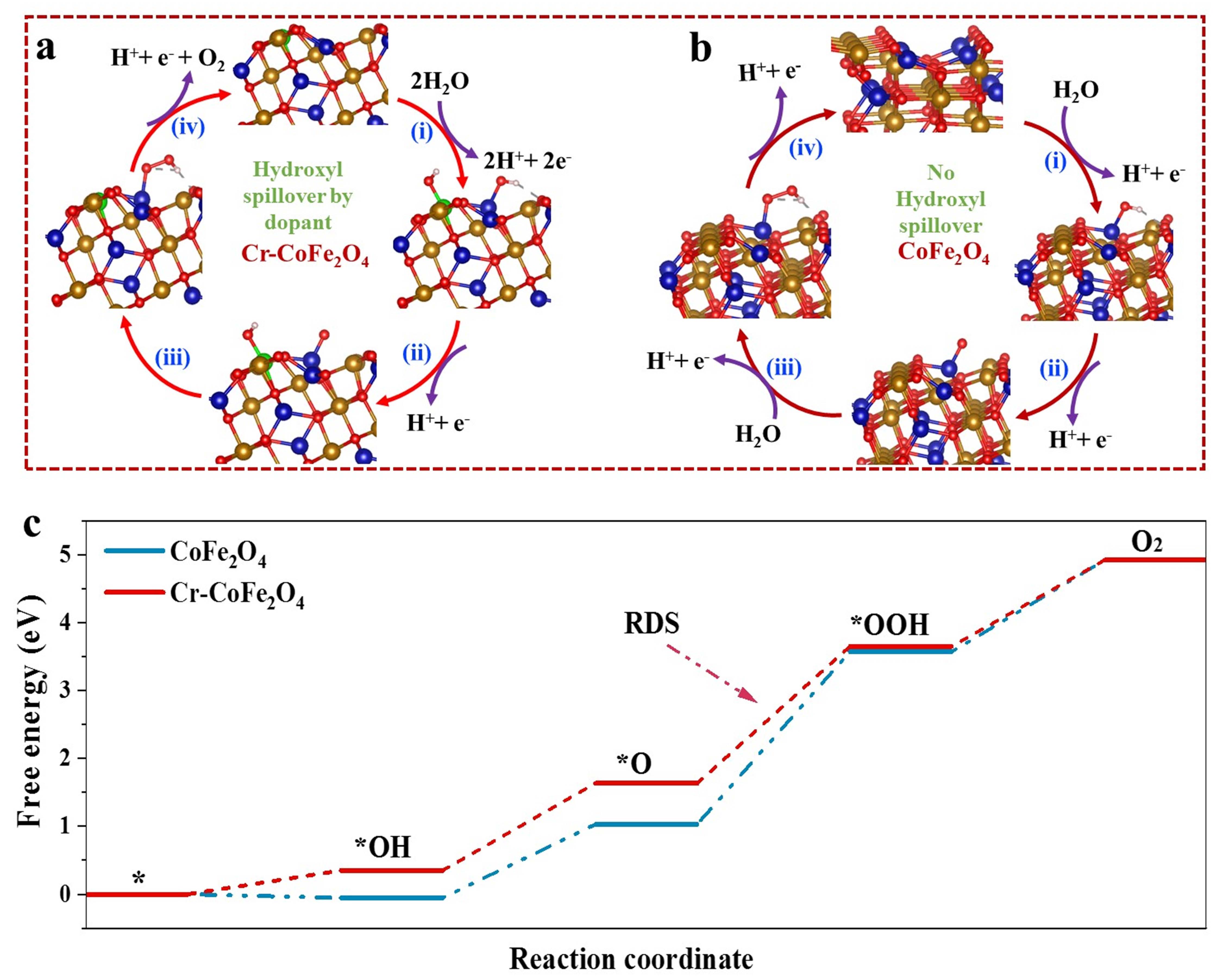
Fig. 4. DFT calculations. (a) Dopant-assisted OH spillover mechanism on Cr-CoFe2O4 during OER. (b) OER pathway without OH spillover on CoFe2O4. (c) Calculated free energy profiles of Cr-CoFe2O4 and CoFe2O4.
|
| [1] | Bashir Adegbemiga Yusuf, Hennayaka Mudiyanselage Charitha Madusanka Jayawardana, Waleed Yaseen, Jimin Xie, Yilin Deng, Suci Meng, Yongming Li, Abdussamad Mukhtar Mohammed, Aminu Magaji, Min Chen, Meng Xie, Yuanguo Xu. Vacancy-engineered Ru-based CNT electrocatalysts for ampere-level water splitting in alkaline and anion-exchange membrane water electrolyzers [J]. Chinese Journal of Catalysis, 2026, 88(9): 279-294. |
| [2] | Fengjuan Guo, Chunyao Ma, Yue Huang, Sitong Hang, Junwei Ma, Hongtao Gao. Unveiling the dominant distal-alternating hybrid mechanism in B-modulated Mo2TiC2Tx/MoO2 MXene for highly selective ambient NRR [J]. Chinese Journal of Catalysis, 2026, 87(8): 269-281. |
| [3] | Chao Wang, Kun Feng, Liangshuyu Tang, Wujun Zhang, Muyu Zhou, Jialu Li, Tianyu Shao, Flemming Besenbacher, Yanbin Shen, Jun Zhong, Ren Su. In-situ developed active sites of MOFs in aqueous electrocatalytic ammoxidation [J]. Chinese Journal of Catalysis, 2026, 86(7): 171-180. |
| [4] | Xiaohu Liu, Shoujie Li, Jianing Mao, Aohui Chen, Xiao Dong, Yiheng Wei, Jiayu Xia, Huanyi Zhu, Xiaotong Wang, Ziran Xu, Guihua Li, Yanfang Song, Wei Wei, Wei Chen. Engineering substitutional AgZn3 on penetration electrodes via in-situ reconstruction for ampere-level CO2 electroreduction [J]. Chinese Journal of Catalysis, 2026, 86(7): 201-211. |
| [5] | Quan Zhang, Hejin Ma, Ruobing Han, Tonglin Yang, Zhenhui Chen, Miaoyang Zhu, Jiawei Shi, Weiwei Cai, Fangqi Yang, Zehui Yang. Lattice-expanded NiSe catalyst via lanthanum incorporation for accelerating urea electrooxidation in assisting water electrolysis [J]. Chinese Journal of Catalysis, 2026, 86(7): 254-264. |
| [6] | Xiang Wang, Min Zhou, Xiaobin Liao, Xu Han, Congcong Xing, René Bes, Simo Huotari, Jordi Arbiol, Andreu Cabot. Enhanced oxygen evolution and reduction by phosphorus-doped Co9S8 derived from MOFs: Toward high-performance zinc-air batteries [J]. Chinese Journal of Catalysis, 2026, 85(6): 204-215. |
| [7] | Kefu Zhang, Luxiao Zhang, Jianyi Chu, Cenyu Mei, Siyuan Liu, Guilan Fan, Fenrong Liu, Youngkook Kwon, Fenghua Bai, Wenhao Luo. Species heterogeneity for efficient electrocatalytic nitrate reduction to ammonia [J]. Chinese Journal of Catalysis, 2026, 85(6): 247-257. |
| [8] | Donghua Li, Hongyin Hu, Jinye Zhou, Hanyun Miao, Yu Wu, Jinyan Wang, Baochun Guo, Mingliang Du, Shuanglong Lu. Steering product selectivity via metallic site-dependent pathways in porphyrin-based covalent organic frameworks for electrocatalytic nitrite reduction [J]. Chinese Journal of Catalysis, 2026, 83(4): 258-270. |
| [9] | Wenfeng Li, Guocheng Lv, Meng Liu, Fanyue Zhao, Zetian He, Guihong Li, Wenping Wang, Libing Liao, Daimei Chen. Innovative strategies and perspectives for enhancing photoelectrochemical water splitting: Physical field engineering [J]. Chinese Journal of Catalysis, 2026, 81(2): 9-36. |
| [10] | Shihao Yu, Yueying Yan, Yang Yang, Bohan Yao, Ziwen Zhu, Dewen Wang, Zhicai Xing, Xiurong Yang. Interfacial engineering of an advanced NiV-LDH@MoS2 heterostructure electrocatalyst for efficient alkaline hydrogen evolution [J]. Chinese Journal of Catalysis, 2026, 91(12): 222-231. |
| [11] | Zeng Li, Mingfei Yu, Liuyi Li, Yan Yu. Hole-confining covalent organic frameworks for photosynthesis of H2O2 and H2 from pure water [J]. Chinese Journal of Catalysis, 2026, 91(12): 263-273. |
| [12] | Mingyi Zhao, Zhengyang Liu, Cong Yang, Zhaodi He, Yujun Guo, Rui Cai, Xiangqian Yin, Jianwei Wang, Xueqin Mu, Suli Liu, Dingsheng Wang, Zhihui Dai. Multiscale optimization design of porphyrin electrocatalysts for redox reactions under operational conditions [J]. Chinese Journal of Catalysis, 2026, 90(11): 52-81. |
| [13] | Irshad Ahmad, Shasha Wang, Mohammed Qasem Alfaifi, Yousef I. Alrashed, Fahad M. Albaqi, Gao Li. Advancing metal cluster-based electrocatalysis for C-N synthesis: Fundamental, design strategies, and applications [J]. Chinese Journal of Catalysis, 2026, 90(11): 82-116. |
| [14] | Linxiao Wu, Yumeng Han, Jinshui Cheng, Yushuai Sang, Xiang Chen, Yaqing Zhang, Xuewen Fu, Jingshan Luo. Low-defect Cu2O films with vertical grains via tartaric acid assisted solution growth for efficient photoelectrochemical water splitting [J]. Chinese Journal of Catalysis, 2026, 90(11): 243-252. |
| [15] | Zhirong Ren, Haihan Zhou, Tanyuan Wang, Hua-Jin Zhai, Qing Li. Hierarchical nitride/phosphide heterostructure for efficient and ultrastable Ampere-level hydrogen production [J]. Chinese Journal of Catalysis, 2026, 89(10): 184-195. |
| Viewed | ||||||
|
Full text |
|
|||||
|
Abstract |
|
|||||


