
Chinese Journal of Catalysis ›› 2026, Vol. 91: 327-340.DOI: 10.1016/S1872-2067(26)65130-3
• Articles • Previous Articles Next Articles
Yujia Zhaoa,b, Xianquan Lia, Rizheng Jinga,b, Jifeng Panga, Wenguang Yuc, Hua Wanga, Feifei Xuc, Mingyuan Zhenga,*( )
)
Received:2026-02-19
Accepted:2026-04-13
Online:2026-12-18
Published:2026-10-13
Supported by:Yujia Zhao, Xianquan Li, Rizheng Jing, Jifeng Pang, Wenguang Yu, Hua Wang, Feifei Xu, Mingyuan Zheng. Efficient and stable conversion of ethanol/acetaldehyde to 1,3-butadiene over a Zr1/NC@SBA-15 single-atom catalyst[J]. Chinese Journal of Catalysis, 2026, 91: 327-340.
Add to citation manager EndNote|Ris|BibTeX
URL: https://www.cjcatal.com/EN/10.1016/S1872-2067(26)65130-3
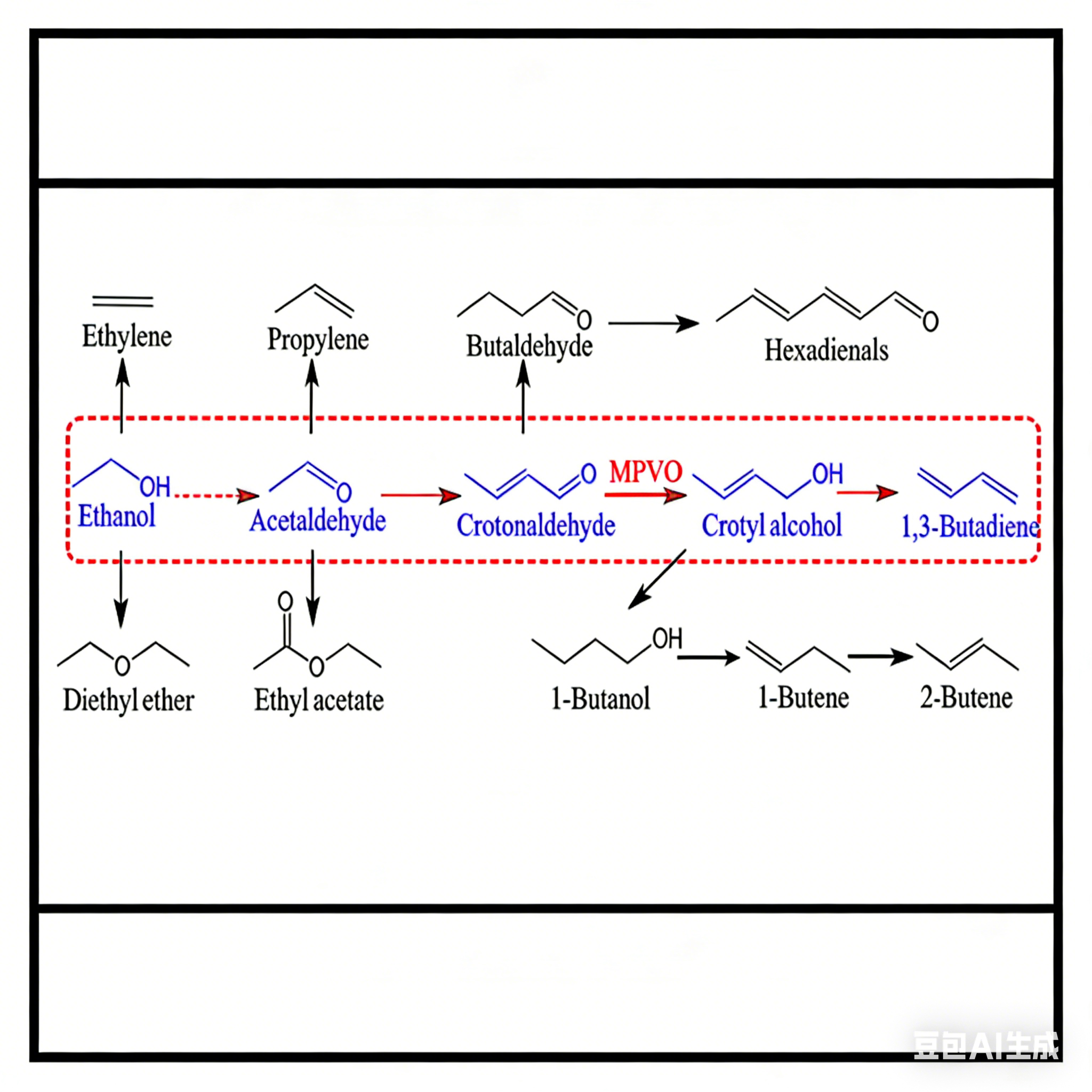
Scheme 1. Schematic illustration of the proposed pathway for the ETB process (red) and the possible side reactions (black). Reproduced from Ref. [3]. Copyright 2025, American Chemical Society.
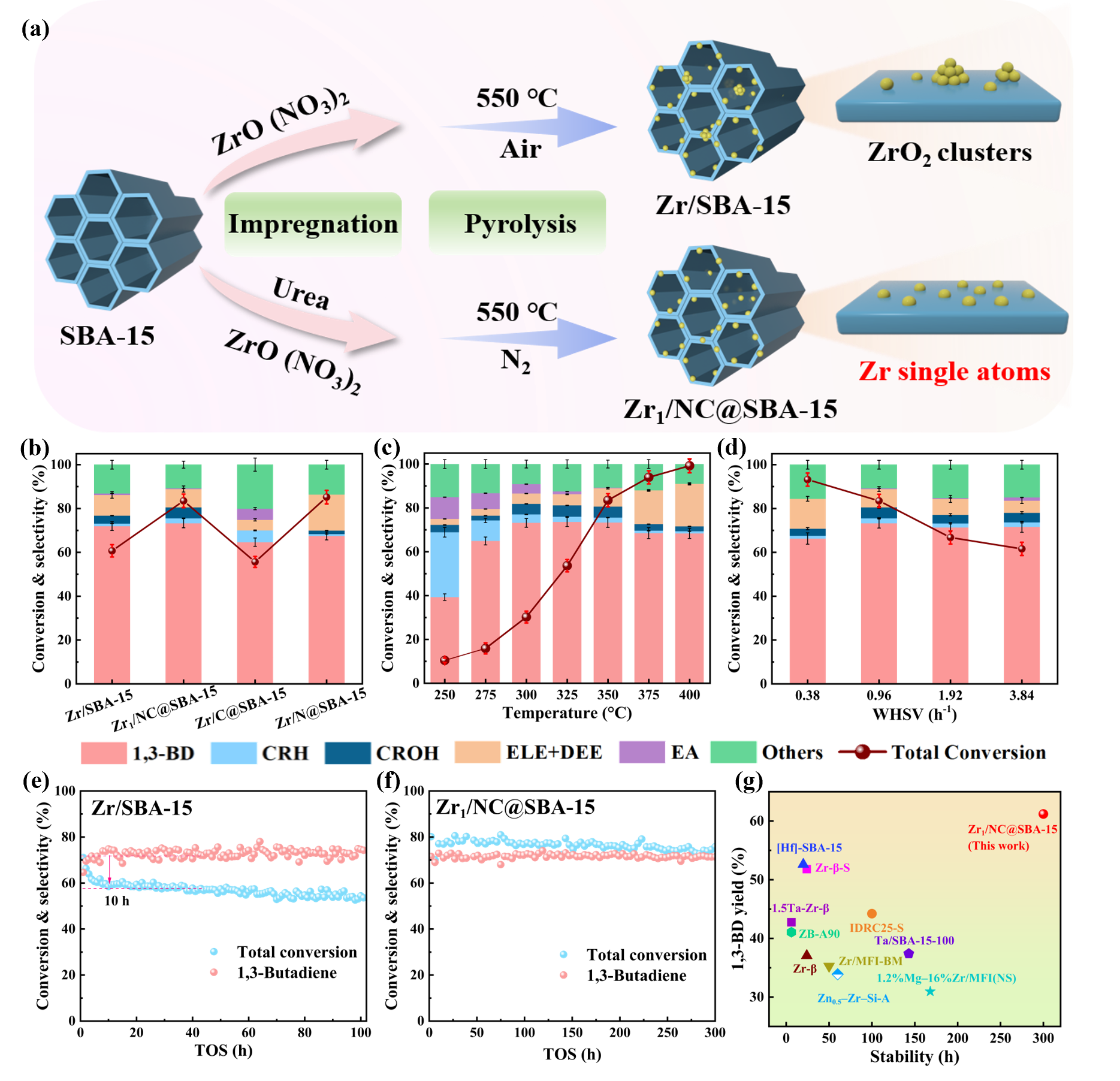
Fig. 1. (a) Schematic illustration of the synthesis of Zr1/NC@SBA-15 and nano-Zr/SBA-15 catalysts. (b) Catalytic performance of the Zr-SBA-15 catalysts at 350 °C and a WHSV of 0.96 h-1. (c) Effect of temperature on Zr1/NC@SBA-15 at a WHSV of 0.96 h-1. (d) Effect of WHSV on Zr1/NC@SBA-15 at 350 °C. Stability tests over Zr/SBA-15 (e) and Zr1/NC@SBA-15 (f) (350 °C, WHSV 0.96 h-1). (g) Comparison of ETB performance over Zr1/NC@SBA-15 and other catalysts reported in literature. CRH, CROH, ELE, DEE, EA are abbreviations for crotonaldehyde, crotyl alcohol, ethylene, diethyl ether, ethyl acetate. The “Others” category mainly includes propylene, butanol, butenes and C6+ species.
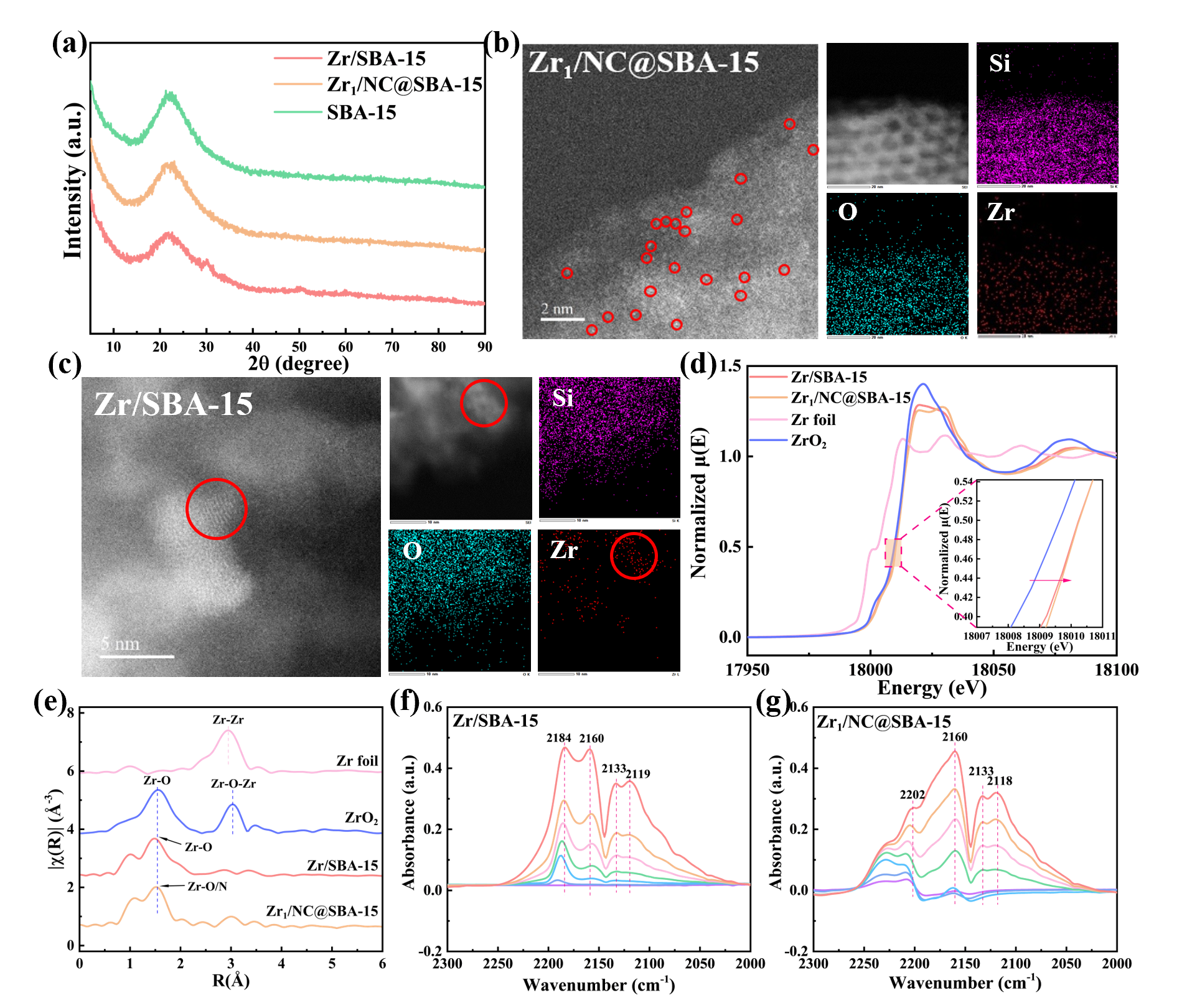
Fig. 2. (a) XRD patterns of the as-synthesized Zr-SBA-15 catalysts. AC-HAADF-STEM images and EDS mapping of Zr1/NC@SBA-15 (b) and Zr/SBA-15 (c). XANES (d) and k3-weighted Fourier transform (e) spectra of Zr foil, ZrO2 and the Zr-SBA-15 catalysts; CO-FTIR spectra of Zr/SBA-15 (f) and Zr1/NC@SBA-15 (g).
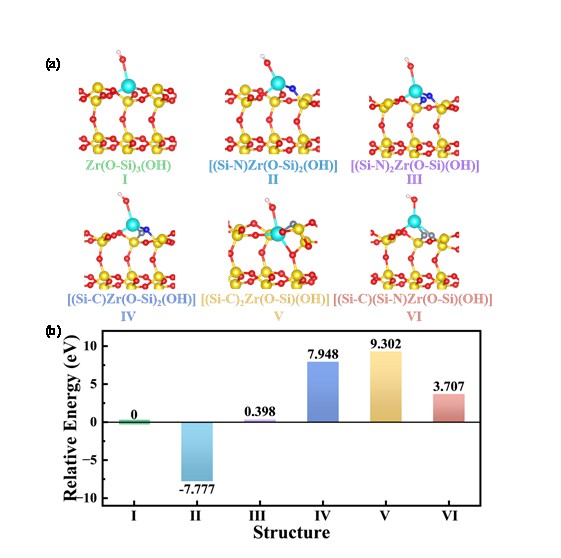
Fig. 3. (a) Schematic illustration of possible structures of single Zr sites in Zr1/NC@SBA-15. (b) DFT calculated energies of these structures.
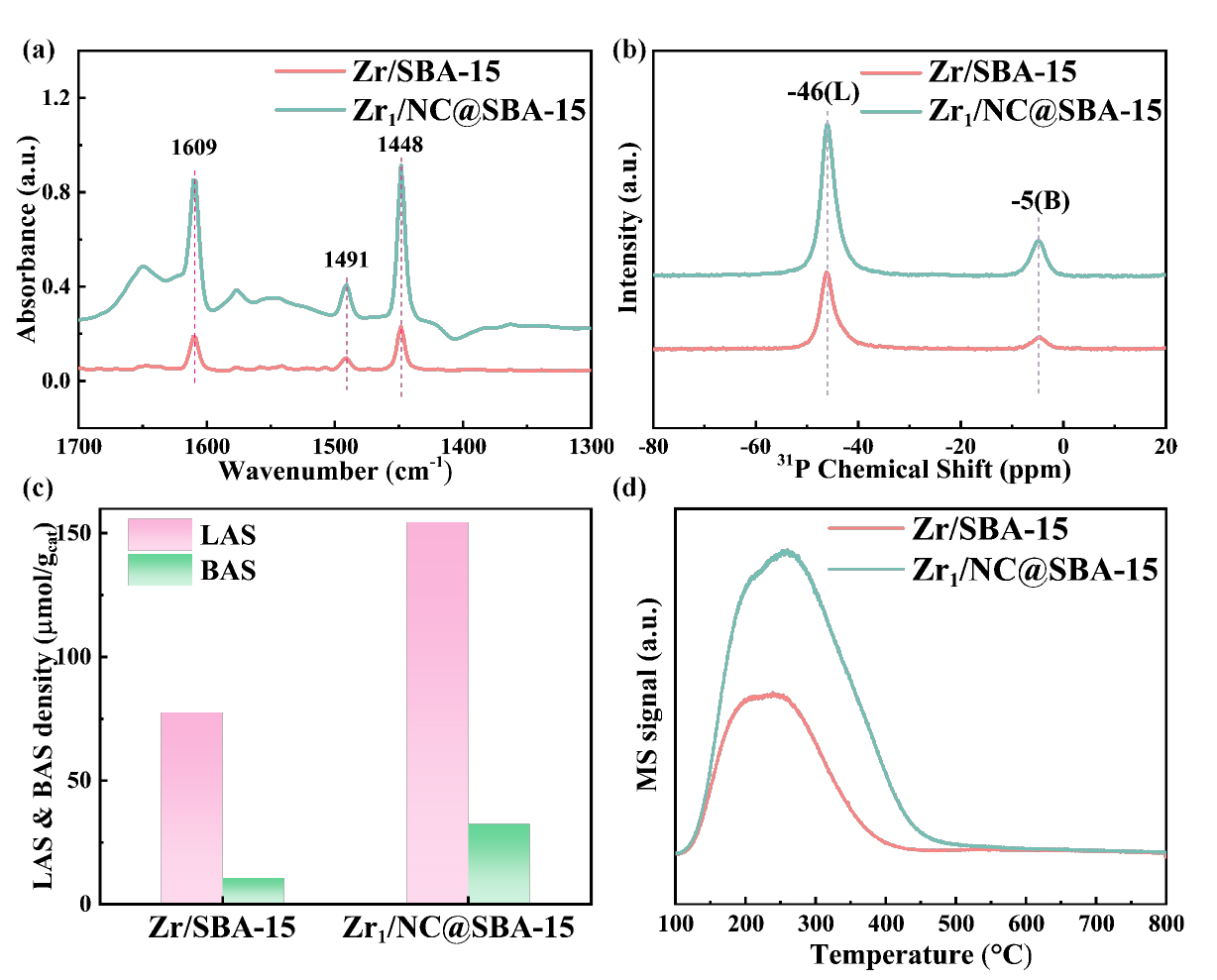
Fig. 4. Py-FTIR spectra (a) and 31P MAS NMR spectra (b) of TMP adsorption on the Zr-SBA-15 catalysts. (c) LAS and BAS amounts quantified from 31P MAS NMR spectra. (d) NH3-TPD profiles of the Zr-SBA-15 catalysts.
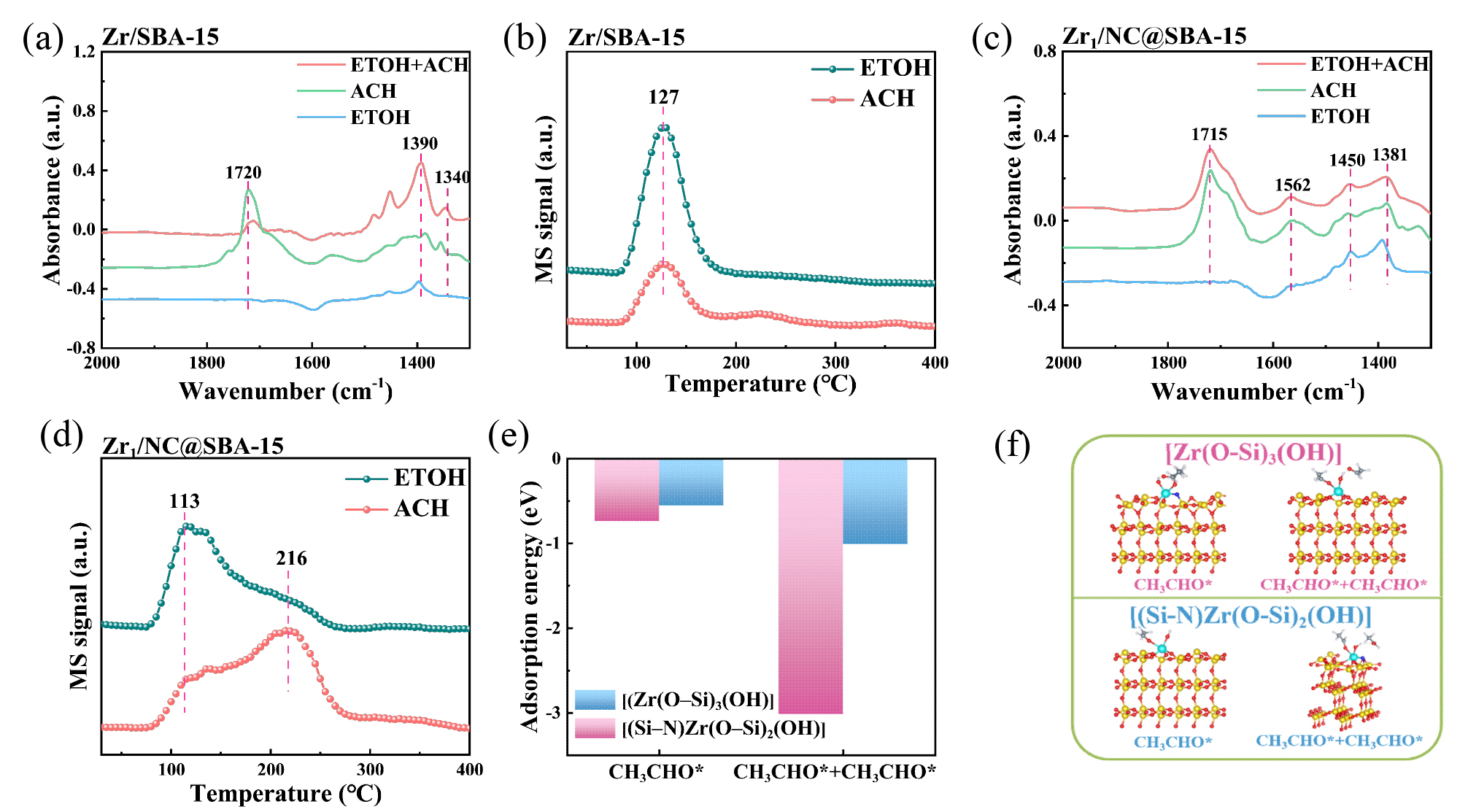
Fig. 5. In-situ FTIR spectra for the adsorption of EtOH (blue), ACH (green), and EtOH+ACH (red) at 30 °C over Zr/SBA-15 (a) and Zr1/NC@SBA-15 (c) catalysts. EtOH+ACH-TPD profiles of Zr/SBA-15 (b) and Zr1/NC@SBA-15 catalysts (d). Adsorption energies of single ACH and two ACH molecules over [Zr(O-Si)3(OH)] and [(Si-N)Zr(O-Si)2(OH)] sites calculated by D
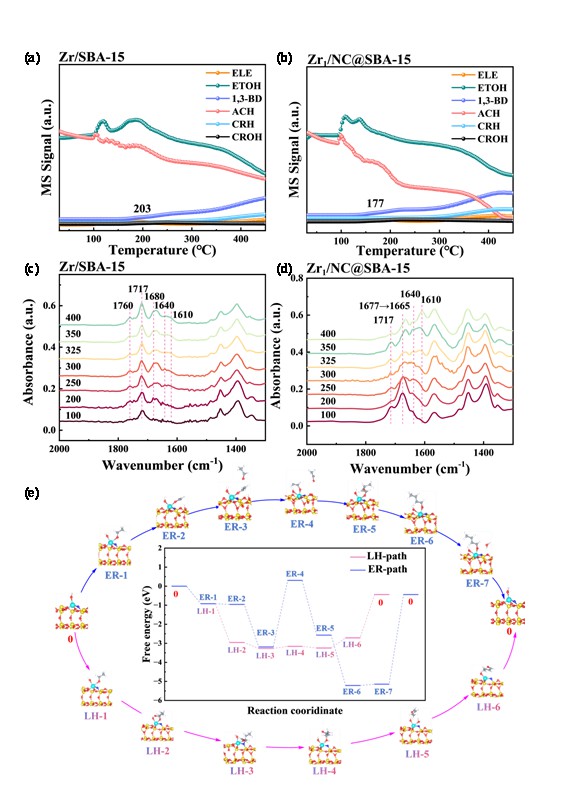
Fig. 6. Operando EtOH/ACH-TPSR profiles over Zr/SBA-15 (a) and Zr1/NC@SBA-15 (b) catalysts; In-situ reactant-FTIR spectra over Zr/SBA-15 (c) and Zr1/NC@SBA-15 (d) catalysts. (e) Free energies of the E-R and L-H mechanisms calculated by DFT at the [(Si-N)Zr(O-Si)2(OH)] site of the Zr1/NC@SBA-15 catalyst.
|
| [1] | Yang Wang, Cun-Feng Fan, Yang Liu, Xiao-Qin Zheng, Xuan-Yi Liu, Kai Zhang, Jiahui Kou, Hengming Huang, Lin-Bing Sun. Iron single-atom catalysts created in constrained space with in-situ-formed carbon layers for efficient Fenton reaction [J]. Chinese Journal of Catalysis, 2026, 88(9): 432-441. |
| [2] | Sathi Chatterjee, Hongmei Li, Kang Liu, Zhang Lin, Liyuan Chai, Min Liu. Single-atom catalysts on two-dimensional (2D) materials for photocatalytic CO2 reduction: Fundamentals, design, and emerging strategies [J]. Chinese Journal of Catalysis, 2026, 88(9): 86-128. |
| [3] | Jiayu Zhang, Kun Wang, Jinglu Yu, Kaiyang Xu, Lu Yang, Jiali Rao, Shuqin Song, Yi Wang. Modulating active sites via Mn-doping in NiCo LDH for energy-saving paired electrosynthesis of H2O2 and formate [J]. Chinese Journal of Catalysis, 2026, 88(9): 307-321. |
| [4] | Xinyi Zhang, Weichen Dong, Yi Cao, Caixia Zhou, Jiaxiu Guo, Hailong Zhang. Efficient continuous synthesis of methanol by direct methane conversion on Cu-KFI zeolite catalysts [J]. Chinese Journal of Catalysis, 2026, 88(9): 369-381. |
| [5] | Songling Wang, Anhua Huang, Fengxing Yin, Ruixiang Lu, Wengang Liu, Yun Zhang, Botao Qiao. In-situ synthesis of hydrogen peroxide for highly selective oxidation of methane to methanol over noble-metal-free catalyst [J]. Chinese Journal of Catalysis, 2026, 88(9): 347-355. |
| [6] | Yueling Chen, Yuling Lin, Ziyan Chen, Xiangyu Kong, Jinhong Bi, Guocheng Huang, Ling Wu. Asymmetric N-Ru-S dipole within covalent organic framework enhances internal electric field for efficient CO2 photoreduction [J]. Chinese Journal of Catalysis, 2026, 87(8): 59-69. |
| [7] | Jianglin Duan, Pengcheng Deng, Huifeng Xiong, Na Yang, Xueling Zhou, Jingwen Wang, Rui Zhang, Dan Feng, Ji Yang, Yong Qin, Yujing Ren. Subangstrom spatial regulation of Fe1-N4 coordination structure for remarkably efficient C‒H bond oxidation [J]. Chinese Journal of Catalysis, 2026, 87(8): 305-315. |
| [8] | Xiaojie Liu, Zhifu Yu, Qi Li, Yang Wang, Xinze Bi, Kaixuan Huo, Dingyao Li, Zhiang Yuan, Yifan Yan, Shibin Li, Yiwu Lu, Qiang Liu, Wenhang Wang, Mingbo Wu. Fe-based catalyst for thermo-catalytic CO2 hydrogenation into ethanol: The essential role of water management and Fe-based carbide/oxide ratio [J]. Chinese Journal of Catalysis, 2026, 86(7): 112-124. |
| [9] | Jiahao Wang, Qiliang Gao, Chao Li, Xiujuan Gao, Jian Gong, Faen Song, Junfeng Zhang, Yizhuo Han, Qingde Zhang. A Cu-incorporated NASICON catalyst executing one-step conversion of methanol and acetic acid to acrylic acid and its esters [J]. Chinese Journal of Catalysis, 2026, 85(6): 356-370. |
| [10] | Lanlan Chen, Li Sheng, Yanan Zhou, Qiquan Luo, Zhenyu Li, Wenhua Zhang, Jinlong Yang. Unraveling the superiority of Ni1-MoS2 single-atom catalyst in CO2 hydrogenation to methanol: A DFT combined microkinetic study [J]. Chinese Journal of Catalysis, 2026, 85(6): 143-152. |
| [11] | Yi-Wen Han, Run-Yu Liu, Yu-Xin Zhang, Lei Ye, Phuc T. T. Nguyen, Tian-Jun Gong, Xue-Bin Lu, Yao Fu, Ning Yan. Establishing built-in electric field within single-atom-anchored hollow architectures for efficient solar-thermal regulation in plastic photoreforming [J]. Chinese Journal of Catalysis, 2026, 84(5): 301-313. |
| [12] | Zhiyao Liu, Tangkang Liu, Chuan Qin, Guoliang Liu, Anmin Zheng. Zirconia-mediated interfacial catalysis for CO2 hydrogenation [J]. Chinese Journal of Catalysis, 2026, 84(5): 1-24. |
| [13] | Xinyi Wang, Chaoqi Wang, Miao Yang, Xiaoguang Wang, Yuezhong Zuo, Zhuangzhuang Zhang, Yimo Wu, Jingfeng Han, Bing Li, Wei Huang, Limin Ren, Yingxu Wei, Xinmei Liu, Peng Tian, Zhongmin Liu. Machine-learning-aided discovery of methanol-to-olefins zeolite catalysts with ultra-high initial selectivity [J]. Chinese Journal of Catalysis, 2026, 81(2): 124-135. |
| [14] | Chunjie Yang, Na Wei, Shu Wang, Qi Zhang, Xiyang Liu, Wenchao Xu, Keke Hou, Ningqiang Zhang, Lingcong Li, Zhen Zhao. Progress in unraveling the mechanisms of dual functional materials for CO2 capture and reduction [J]. Chinese Journal of Catalysis, 2026, 89(10): 1-39. |
| [15] | Ting Li, Xiaohui Chen, Xiaolin Li, Qi Xiao, Hongqun Luo, Nianbing Li. Autogenous force-mediated assembly: A general strategy for constructing single-atom architectures in hierarchical hybrid electrocatalysts [J]. Chinese Journal of Catalysis, 2026, 89(10): 232-245. |
| Viewed | ||||||
|
Full text |
|
|||||
|
Abstract |
|
|||||


