
Chinese Journal of Catalysis ›› 2026, Vol. 91: 365-375.DOI: 10.1016/S1872-2067(26)65207-2
• Articles • Previous Articles Next Articles
Yachuan Wanga,1, Runan Leia,1, Wei Wanga,1, Qixuan Wua,1, Kaiwen Kangb,c,1, Dachao Yuand, Zhibo Zhangc, Yuan Tanga,*( ), Linjie Gaoa,*(), Yaguang Lia,*(), Jinhua Yea,e,f,*()
Received:2026-01-15
Accepted:2026-03-19
Online:2026-12-18
Published:2026-10-13
About author:1Contributed equally to this work.
Supported by:Yachuan Wang, Runan Lei, Wei Wang, Qixuan Wu, Kaiwen Kang, Dachao Yuan, Zhibo Zhang, Yuan Tang, Linjie Gao, Yaguang Li, Jinhua Ye. Coordination reconfigured Ni single-atoms for scaled photothermal COx free hydrogen production from ammonia[J]. Chinese Journal of Catalysis, 2026, 91: 365-375.
Add to citation manager EndNote|Ris|BibTeX
URL: https://www.cjcatal.com/EN/10.1016/S1872-2067(26)65207-2
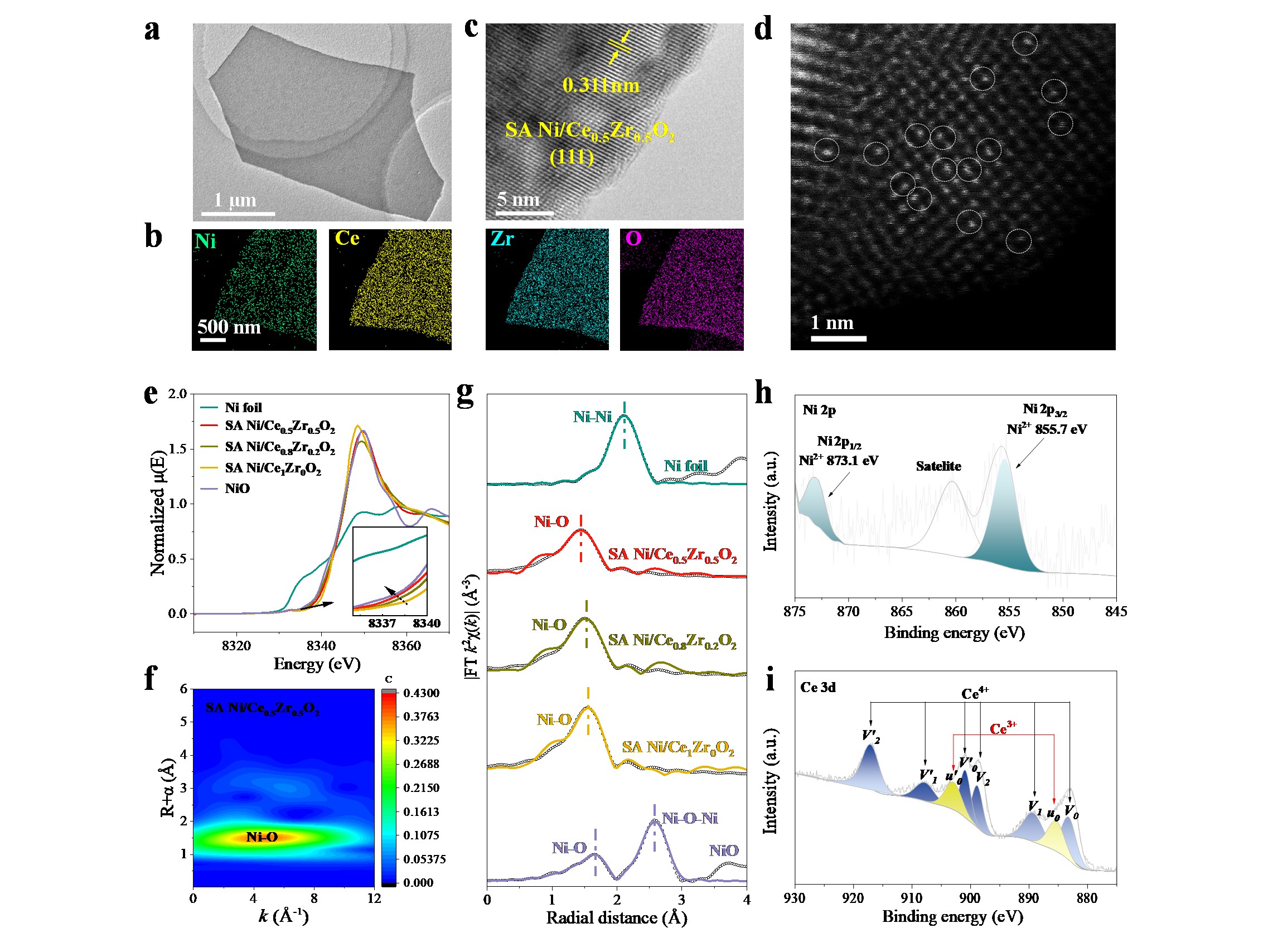
Fig. 1. The phase composition and coordination chemical state of SA Ni/Ce0.5Zr0.5O2. TEM image (a), EDS mapping (b), HRTEM image (c) and aberration-corrected STEM image (d) of SA Ni/Ce0.5Zr0.5O2. (e) XANES spectra at the Ni K-edge for SA Ni/Ce0.5Zr0.5O2, SA Ni/Ce0.8Zr0.2O2, SA Ni/Ce1Zr0O2, Ni foil and NiO, inset of panel (e) is magnified absorption edge. (f) EXAFS wavelet-transform plots of SA Ni/Ce0.5Zr0.5O2. (g) EXAFS curves (dotted lines) and corresponding EXAFS fitting curves (solid lines) of Ni foil, SA Ni/Ce0.5Zr0.5O2, SA Ni/Ce0.8Zr0.2O2, SA Ni/Ce1Zr0O2 and NiO. Ni 2p (h) and Ce 3d (i) XPS spectra of SA Ni/Ce0.5Zr0.5O2. The scale bars in Figs. 1(a), (b), (c) and (d) are 1 µm, 500 nm, 5 nm, 1 nm, respectively.
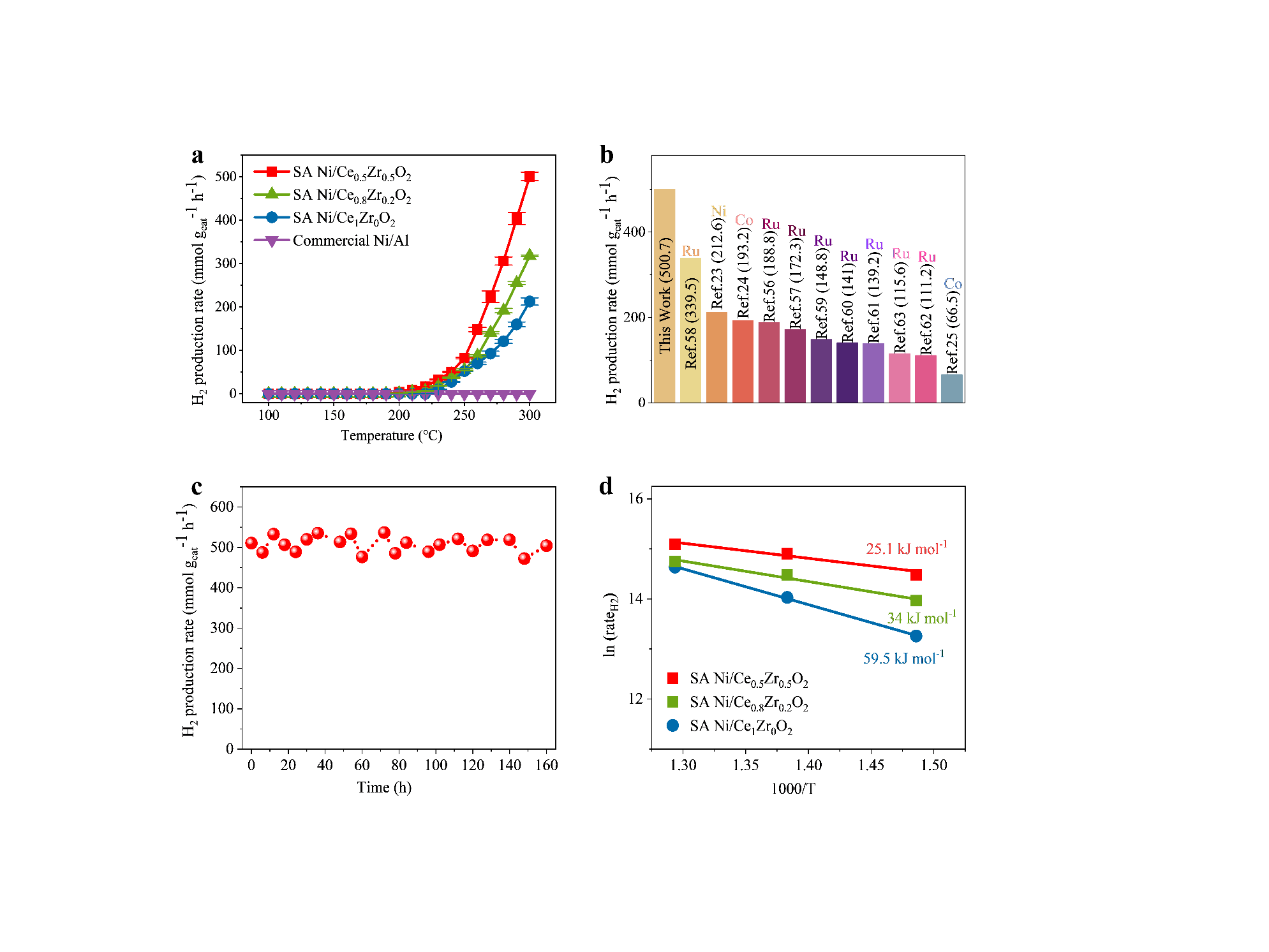
Fig. 2. The performance of catalysts for NH3 decomposition to H2. (a) The H2 generation rate of thermocatalytic NH3 decomposition over different catalysts. (b) The H2 generation performance comparison between SA Ni/Ce0.5Zr0.5O2 and reported advanced non-noble, noble metal catalysts from NH3 decomposition. (c) The stability test of SA Ni/Ce0.5Zr0.5O2 for NH3 decomposition at 300 °C for 160 h. (d) Apparent activation energy (Ea) of SA Ni/Ce0.5Zr0.5O2, SA Ni/Ce0.8Zr0.2O2, SA Ni/Ce1Zr0O2 for thermocatalytic NH3 decomposition.
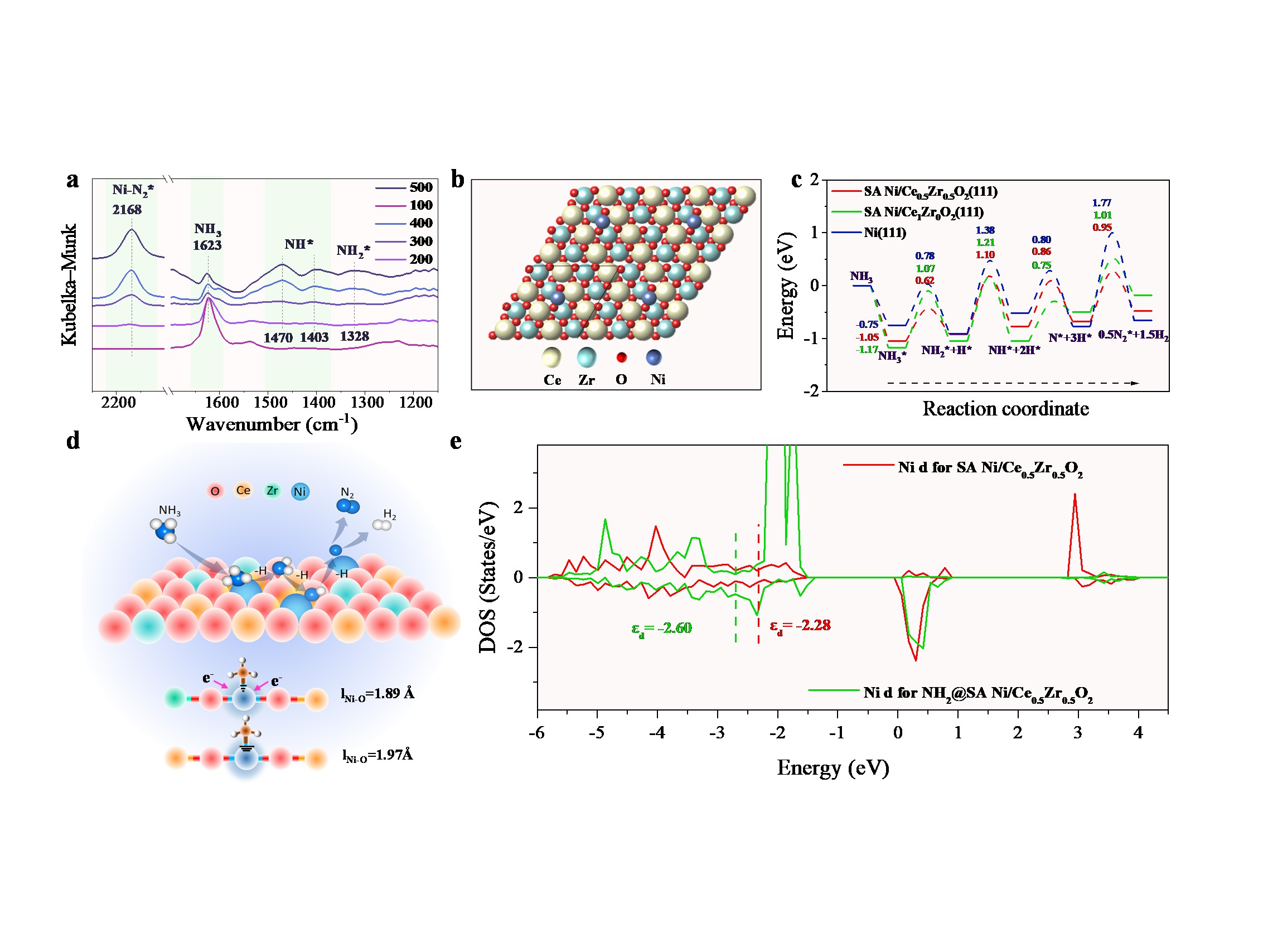
Fig. 3. Reaction mechanism of NH3 decomposition. (a) In-situ DRIFTS spectra obtained for SA Ni/Ce0.5Zr0.5O2 under NH3 decomposition reaction operating conditions. (b) Constructed SA Ni/Ce0.5Zr0.5O2 (111) model based on theoretical calculations. (c) Potential energy diagram of NH3 decomposition, including ZPE correction energy, X* denotes the adsorbed substance. (d) Bader charge analysis of SA Ni/Ce0.5Zr0.5O2 for NH3 decomposition to hydrogen. (e) PDOS comparison of SA Ni/Ce0.5Zr0.5O2 (111) and NH2@SA Ni/Ce0.5Zr0.5O2 (111) models.

Fig. 4. The photothermal NH3 decomposition. (a) Photothermal device for NH3 decomposition. (b) Photothermal NH3 decomposition performance of SA Ni/Ce0.5Zr0.5O2. (c) STH of photothermal NH3 decomposition over SA Ni/Ce0.5Zr0.5O2. The photograph (d) and H2 generation rate (e) of the outdoor photothermal NH3 decomposition system. (f) Evaluation of the cost of H2 produced from photothermal NH3 decomposition and thermocatalytic NH3 decomposition.
|
| [1] | Khalid Umer, Xiao Fang, Khuram Hasnain, Hira Shahid, Weize Sun, Chenyu Shi, Junhan Xie, Baochun Ma, Yong Ding. Carbon quantum dot-mediated Fe11 polyoxometalate enrichment for accelerated photocatalytic H2 evolution in a Zn0.5Cd0.5S system [J]. Chinese Journal of Catalysis, 2026, 88(9): 218-232. |
| [2] | Shijian Luo, Hao Chen, Yuran Yang, Yang Song, Yongduo Liu, Daojun Long, Siguo Chen, Zidong Wei. Hydride-enhanced plasma catalysis enables ultrahigh-rate ammonia synthesis at room temperature and atmospheric pressure [J]. Chinese Journal of Catalysis, 2026, 88(9): 269-278. |
| [3] | Zihao Gao, Kai Huang, Qingling Xu, Xin Wang, Zhicheng Liu, Bin Shao, Jun Hu. Engineering catalytic microenvironments for enhancing ethylene production in CO2 capture and in-situ oxidative dehydrogenation of ethane [J]. Chinese Journal of Catalysis, 2026, 88(9): 322-334. |
| [4] | Vladimir I. Kurganskii, Dmitry P. Lubov, Alexander G. Medvedev, Ruihu Wang, Konstantin P. Bryliakov. Bioinspired asymmetric syn-hydroxyazidation of electron-deficient olefins in the presence of nonheme Mn complexes [J]. Chinese Journal of Catalysis, 2026, 88(9): 468-477. |
| [5] | Han Xiang, Lu Lin, Yu Li, Qisong Yi, Chaoran Jiang, Rui Chen, Yuanshuai Liu, Na Sai, Jinlu He, Fenghua Bai, Wenhao Luo. Silicalite-1 encapsulated Cu nanoclusters with La modification for enhanced performance in hydrogenation of furfural to furfuryl alcohol [J]. Chinese Journal of Catalysis, 2026, 88(9): 382-392. |
| [6] | Jiayu Zhang, Kun Wang, Jinglu Yu, Kaiyang Xu, Lu Yang, Jiali Rao, Shuqin Song, Yi Wang. Modulating active sites via Mn-doping in NiCo LDH for energy-saving paired electrosynthesis of H2O2 and formate [J]. Chinese Journal of Catalysis, 2026, 88(9): 307-321. |
| [7] | Yingzhen Zhang, Wei Zhang, Zhangzheng Huang, Weilong Cai, Yun Hau Ng, Jianying Huang, Yuekun Lai. Mn-triggered dynamic phase transition in NiSe2 catalyst via doping engineering for boosted urea electrolysis [J]. Chinese Journal of Catalysis, 2026, 88(9): 335-346. |
| [8] | Songling Wang, Anhua Huang, Fengxing Yin, Ruixiang Lu, Wengang Liu, Yun Zhang, Botao Qiao. In-situ synthesis of hydrogen peroxide for highly selective oxidation of methane to methanol over noble-metal-free catalyst [J]. Chinese Journal of Catalysis, 2026, 88(9): 347-355. |
| [9] | Miao Wang, Tianyu Shen, Heng Zhou, Shuaikang Yang, Fengkun Hao, Chaohui Wang, Mohan Kumar, Zuoxiu Tie, Shuangming Chen, Zhanxi Fan, Zhong Jin. Direct electrosynthesis of ammonia from nitrate reduction using atomically precise carbonyl-rich metal clusters in neutral media [J]. Chinese Journal of Catalysis, 2026, 88(9): 259-268. |
| [10] | Shufang Liu, Fengyu Chen, Siyuan Li, Yu-Xin Ye, Gangfeng Ouyang. Recent advances in oxygen-centered organic radicals: Characterization, synthesis, and applications [J]. Chinese Journal of Catalysis, 2026, 88(9): 183-206. |
| [11] | Pengfei Wu, Zhihao Lou, Yuanshuo Ma, Pengfei Wang, Da Xue, Fangyi Ma, Xuejing Cui, Guangbo Liu, Xin Zhou, Erdong Wang, Luhua Jiang. Local-atomic environment engineering of Ni-sites for industrial hydrogen production from seawater [J]. Chinese Journal of Catalysis, 2026, 87(8): 254-268. |
| [12] | Fengjuan Guo, Chunyao Ma, Yue Huang, Sitong Hang, Junwei Ma, Hongtao Gao. Unveiling the dominant distal-alternating hybrid mechanism in B-modulated Mo2TiC2Tx/MoO2 MXene for highly selective ambient NRR [J]. Chinese Journal of Catalysis, 2026, 87(8): 269-281. |
| [13] | Jiaxiang Qin, Songpei Zhang, Xingju Li, Xintai Chen, Jia Zhao, Xiaoling Mou, Xiangen Song, Li Yan, Ronghe Lin, Yunjie Ding. Decoding structure-selectivity interplay in Pd-Ag nanocatalysts for butadiene semi-hydrogenation [J]. Chinese Journal of Catalysis, 2026, 87(8): 342-352. |
| [14] | Hao Wu, Xinyu Zeng, Wang Wang, Bei Cheng, Jingzhao Cheng, Jingsan Xu, Shaowen Cao. The organic-inorganic S-scheme heterojunction with enhanced charge separation simultaneously catalyze the production of hydrogen and imine [J]. Chinese Journal of Catalysis, 2026, 87(8): 185-196. |
| [15] | Heng Zhou, Longfei Hong, Yan Zhang, Yuyue Zhou, Sheng Chu, Huiyan Zhang, Hui Li, Tianyi Ma, Heng Zhang. Efficient solar-simulated-driven valorization of non-edible oils for biodiesel production via interfacial localized photothermal catalysis [J]. Chinese Journal of Catalysis, 2026, 87(8): 156-169. |
| Viewed | ||||||
|
Full text |
|
|||||
|
Abstract |
|
|||||


