
Chinese Journal of Catalysis ›› 2027, Vol. 92: 115-122.DOI: 10.1016/S1872-2067(26)65228-X
• Communications • Previous Articles Next Articles
Xinyu Songa, Wei Wanga, Xiaomin Laoa, Yitong Liua, Huanmin Liua, Peng Zhoua,b,c,*( )
Received:2026-01-31
Accepted:2026-04-16
Online:2027-01-02
Published:2026-10-30
Contact:
*E-mail: pengzhou1209@pku.edu.cn (P. Zhou).About author:First author contact: Xinyu Song: Investigation, Visualization, Writing-original draft. Wei Wang: Validation. Xiaomin Lao: Formal analysis. Yitong Liu: Formal analysis. Huanmin Liu: Writing-review. Peng Zhou: Conceptualization, Supervision, Investigation, Writing-review & editing.
Supported by:Xinyu Song, Wei Wang, Xiaomin Lao, Yitong Liu, Huanmin Liu, Peng Zhou. Anaerobic photocatalytic dihydroxylation of propylene to propylene glycol and hydrogen at ambient temperature and pressure[J]. Chinese Journal of Catalysis, 2027, 92: 115-122.
Add to citation manager EndNote|Ris|BibTeX
URL: https://www.cjcatal.com/EN/10.1016/S1872-2067(26)65228-X
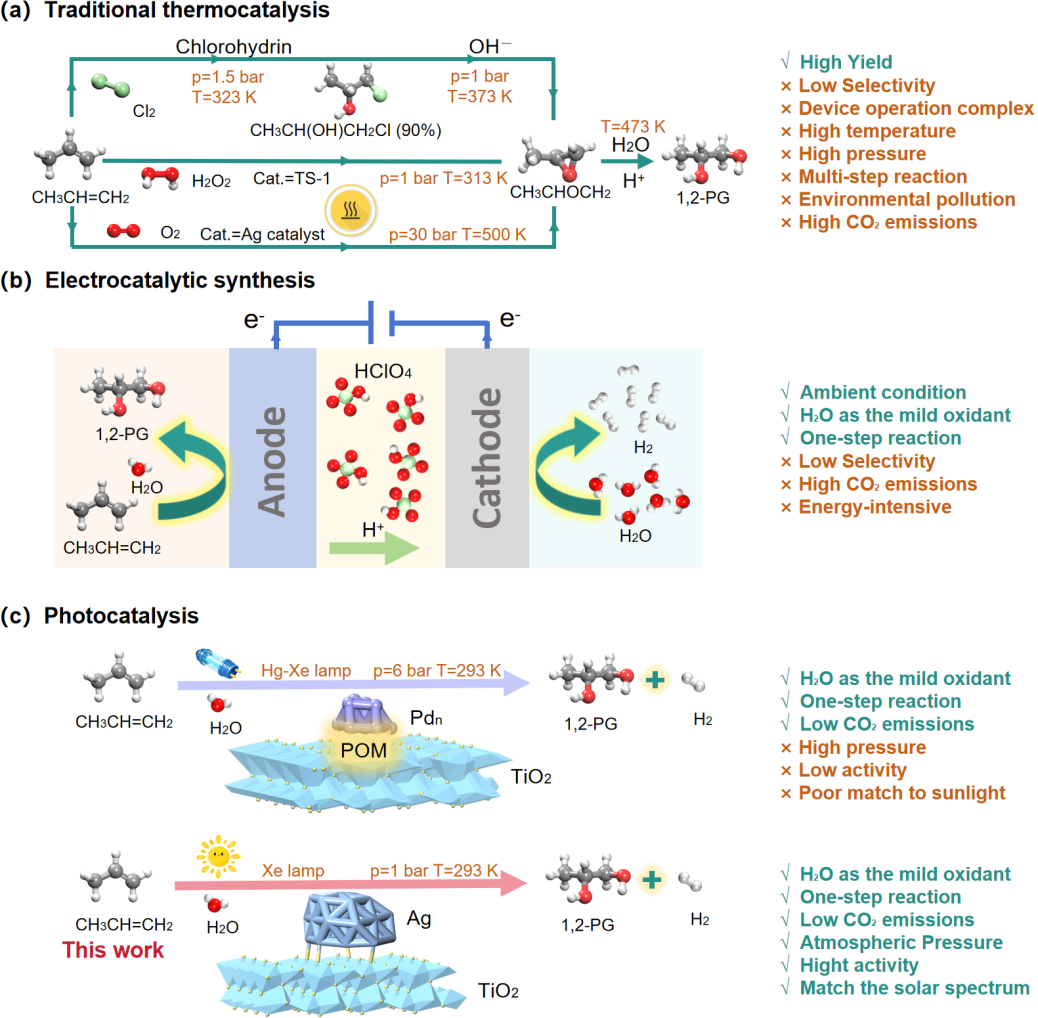
Scheme 1. Illustration of different reaction processes to synthesize glycols from olefins, and their main advantages and disadvantages are compared.
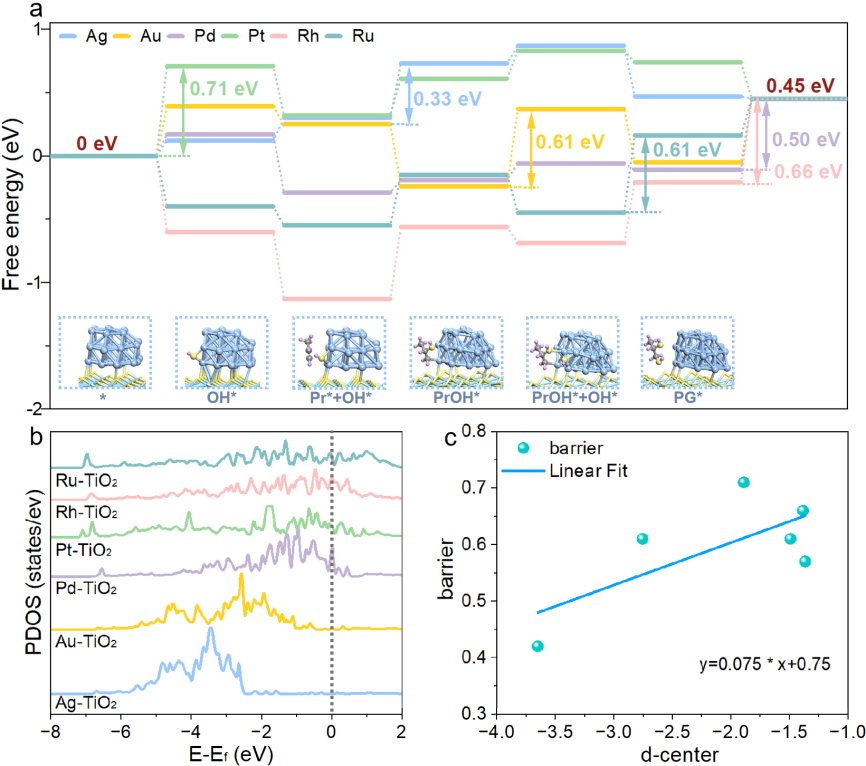
Fig. 1. (a) Comparative Gibbs free energy profiles for the dihydroxylation of C3H6 over different metal-TiO2 catalysts. Stick models represent the TiO2 substrate with supported metal nanoparticles (color code: gray, C; light yellow, O; light purple, H). Configuration of the reaction species during the hydroxylation of C3H6 over Ag-TiO2. OH*, Pr*, PrOH* and PG* represent surface hydroxyl group, adsorbed propylene, the hydroxypropyl intermediate (C3H6OH*), and the final product 1,2-PG. (b) Comparison of the density of states (DOS) for various metal clusters supported on TiO2. (c) Linear correlation between the d-band center of different metal-TiO2 catalysts and the reaction energy barrier of the rate-determining step.
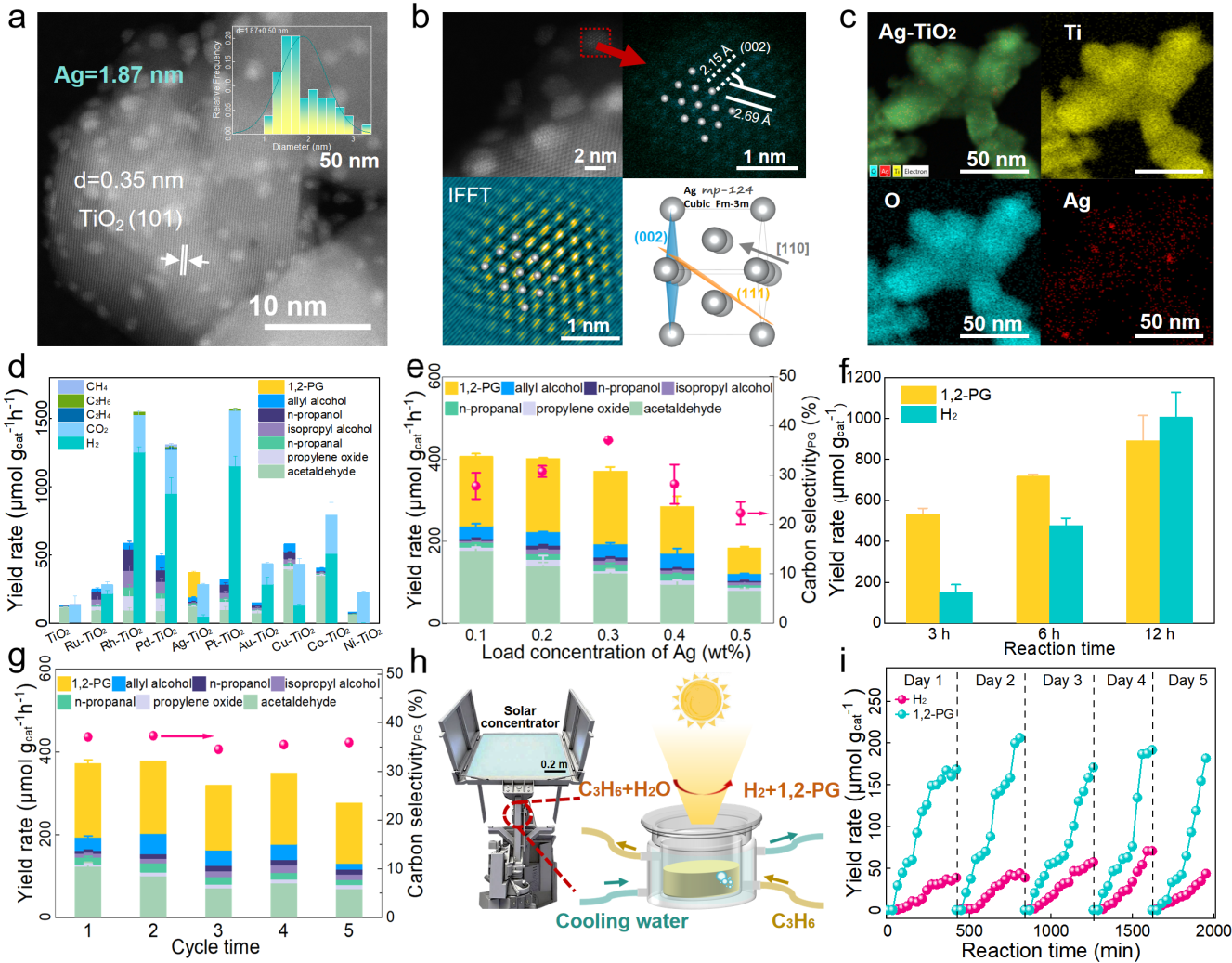
Fig. 2. (a) AC-HAADF-STEM image of Ag-TiO2 and corresponding particle size distribution of Ag nanoparticles. (b) The FFT and IFFT processing diagrams of Ag nanoparticles, along with corresponding metal lattice diagrams. (c) The elemental distribution analysis conducted through HRTEM, along with its complementary EDS elemental mapping of Ag-TiO2. (d) Comparison of liquid-phase products from C3H6 photocatalytic conversion over different catalysts. Reaction conditions: [catalyst] = 0.5 mg mL-1, T = 20 °C, p = atmospheric pressure, light intensity = 462 mW cm-2. (e) Effect of Ag loading amount on liquid product yields and total carbon selectivity toward 1,2-PG. (f) Time-dependent product selectivity in the photocatalytic propylene hydration over Ag-TiO2. (g) Reusability of the Ag-TiO2 photocatalyst over consecutive cycles. (h) Schematic illustration of the outdoor photocatalytic setup driven by natural sunlight. (i) Co-production yields of 1,2-PG and H2 during five consecutive days of outdoor solar experiments. Experiment conditions: [catalyst] = 0.5 mg mL-1, T = 20 °C, p = 1 bar, volume = 1630 mL.
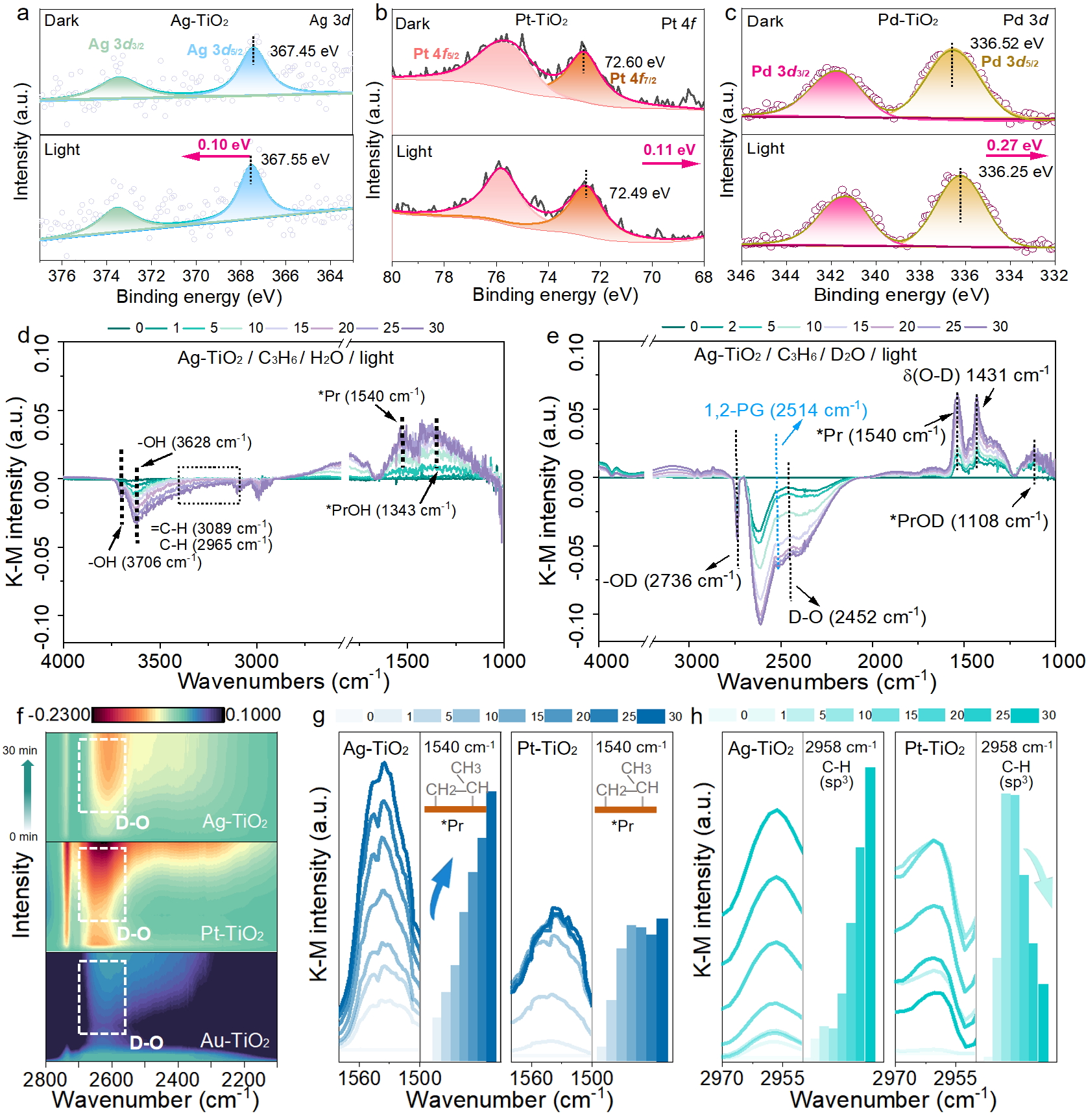
Fig. 3. In-situ XPS spectra of Ag-TiO2 (a), Pt-TiO2 (b), and Pd-TiO2 (c). In-situ DRIFTS spectra of Ag-TiO2 in H2O (d) and D2O (e) under light irradiation. (f) Time-resolved intensity maps of D-O vibrations in the in-situ DRIFTS Ag-TiO2, Pt-TiO2, and Au-TiO2. Time-dependent evolution of C=C bands (1540 cm-1) (g) and C-H(sp3) bands (2958 cm-1) (h) of Ag-TiO2 and Pt-TiO2 in D2O and C3H6 under light irradiation.
|
| [1] | Yangpeng Zhang, You Wu, Qianfeng Gu, Yue Gao, Chencheng Cai, Haoyu Liu, Yuehan Zhao, Zhonghua Li, Feng-Ming Zhang, Yang Liu, Qichun Zhang. Engineering local electronic asymmetry in isostructural covalent organic frameworks to maximize charge separation for H2O2 photosynthesis [J]. Chinese Journal of Catalysis, 2027, 92(1): 130-144. |
| [2] | Jiaqi Li, Haojie Song, YuXin Gao, Xinming Zhang, Jingnan Li, Siyu Wang, Huiquan Gu, Laiyu Luo, Baojiang Jiang. Decoupled active centers on crystalline carbon nitride nanoarrays for synergistic photocatalytic hydrogen peroxide synthesis [J]. Chinese Journal of Catalysis, 2027, 92(1): 157-169. |
| [3] | Shike Wang, Man Lang, Feng Wang, Pengfei Xia, Dieqing Zhang. Recent advances in g-C3N4-based S-scheme photocatalyst [J]. Chinese Journal of Catalysis, 2027, 92(1): 37-64. |
| [4] | Lifang Yang, Yuge Zhang, Yong Liu, Zhijun Yang, Guanghui Li, Jianwei Zhou, Sugang Meng, Raf Dewil. Zn vacancy-anchored Ag clusters on single-unit-cell ZnIn2S4 nanosheets for efficient dual-function photocatalysis [J]. Chinese Journal of Catalysis, 2027, 92(1): 285-299. |
| [5] | Banghu Wei, Wei Ren, Jinhe Li, Weikang Wang, Qinqin Liu. S-scheme heterojunctions for coupled redox photocatalysis: Orchestrating electron-hole synergy to unlock dual half-reactions [J]. Chinese Journal of Catalysis, 2027, 92(1): 1-36. |
| [6] | Wenmin Lei, Yan Zhang, Dalin Sun, Lin Ban, Heng Zhou, Song Yang, Liquan Jing, Jinguang Hu, Heng Zhang. Transition-metals photocatalysts for lignin valorization toward sustainable biofuel production [J]. Chinese Journal of Catalysis, 2026, 88(9): 35-85. |
| [7] | Shufang Liu, Fengyu Chen, Siyuan Li, Yu-Xin Ye, Gangfeng Ouyang. Recent advances in oxygen-centered organic radicals: Characterization, synthesis, and applications [J]. Chinese Journal of Catalysis, 2026, 88(9): 183-206. |
| [8] | Xiangfeng Chen, Siyu Huang, Yuhang Yang, Jiahao Ni, Cheng Fang, Yang-Fan Xu, Dai-Bin Kuang. Hybrid photocatalysis with halide perovskite materials [J]. Chinese Journal of Catalysis, 2026, 88(9): 9-34. |
| [9] | Hua Gao, Yong Zhu, Zhibing Wen, Ran Zhao, Zhi Chen, Siyao Wang, Shuanglin He, Kuang Peng, Yiwen Tang, Licheng Sun, Fei Li. Efficient and selective photocatalytic CO2 conversion enabled by FePc nanosheets in a dye-sensitized system [J]. Chinese Journal of Catalysis, 2026, 86(7): 350-362. |
| [10] | Jiawei Cheng, Kai Wang, Yuhan Meng, Jiachen Wang, Zuozheng Liu, Jingjuan Wang, Jiaxu Liu, Kang Cheng, Qinghong Zhang, Ye Wang. Silica-confined Cu2O nanoparticles for propylene epoxidation with molecular oxygen [J]. Chinese Journal of Catalysis, 2026, 86(7): 77-88. |
| [11] | Wei Zhong, Yiyao Gan, Jingtao Wang, Peiyi Yang, Aiyun Meng, Yaorong Su. Achieving near-equilibrium Had adsorption/desorption by introducing asymmetric S-Re-Se modules in a-ReSxSe2-x cocatalysts for enhanced photocatalytic H2 evolution [J]. Chinese Journal of Catalysis, 2026, 85(6): 322-332. |
| [12] | Jia Ruan, Wenjing Chen, Ziqian Li, Peng Hu, Cheng-Yong Su. Intermolecular asymmetric dearomative photocycloaddition of (benzo)furans with excited alkenes via cage-confined catalysis [J]. Chinese Journal of Catalysis, 2026, 85(6): 346-355. |
| [13] | Jing-Yu Li, Yi-Jun Xu. Regioselective ring-opening of epoxides triggered by light [J]. Chinese Journal of Catalysis, 2026, 85(6): 34-46. |
| [14] | Jintao Dong, Rui Zhang, Zhishuai Wang, Shengqun Cao, Lina Li, Gaopeng Liu, Bin Wang, Yixuan Gao, Jiexiang Xia. Construction of S-scheme MnO2/BiOCl heterojunction boosting photocatalytic low-concentration peroxymonosulfate activation for contaminants removal [J]. Chinese Journal of Catalysis, 2026, 85(6): 310-321. |
| [15] | Yi-Wen Han, Run-Yu Liu, Yu-Xin Zhang, Lei Ye, Phuc T. T. Nguyen, Tian-Jun Gong, Xue-Bin Lu, Yao Fu, Ning Yan. Establishing built-in electric field within single-atom-anchored hollow architectures for efficient solar-thermal regulation in plastic photoreforming [J]. Chinese Journal of Catalysis, 2026, 84(5): 301-313. |
| Viewed | ||||||
|
Full text |
|
|||||
|
Abstract |
|
|||||


