
Chinese Journal of Catalysis ›› 2027, Vol. 92: 157-169.DOI: 10.1016/S1872-2067(26)65229-1
• Articles • Previous Articles Next Articles
Jiaqi Lia, Haojie Songa, Yuxin Gaoa, Xinming Zhanga, Jingnan Lia, Siyu Wangb,*( ), Huiquan Gua,*(), Laiyu Luob,*(), Baojiang Jianga,*()
Received:2026-02-27
Accepted:2026-04-17
Online:2027-01-02
Published:2026-10-30
Contact:
*E-mail: ghq@hlju.edu.cn (H. Gu),Supported by:Jiaqi Li, Haojie Song, Yuxin Gao, Xinming Zhang, Jingnan Li, Siyu Wang, Huiquan Gu, Laiyu Luo, Baojiang Jiang. Decoupled active centers on crystalline carbon nitride nanoarrays for synergistic photocatalytic hydrogen peroxide synthesis[J]. Chinese Journal of Catalysis, 2027, 92: 157-169.
Add to citation manager EndNote|Ris|BibTeX
URL: https://www.cjcatal.com/EN/10.1016/S1872-2067(26)65229-1
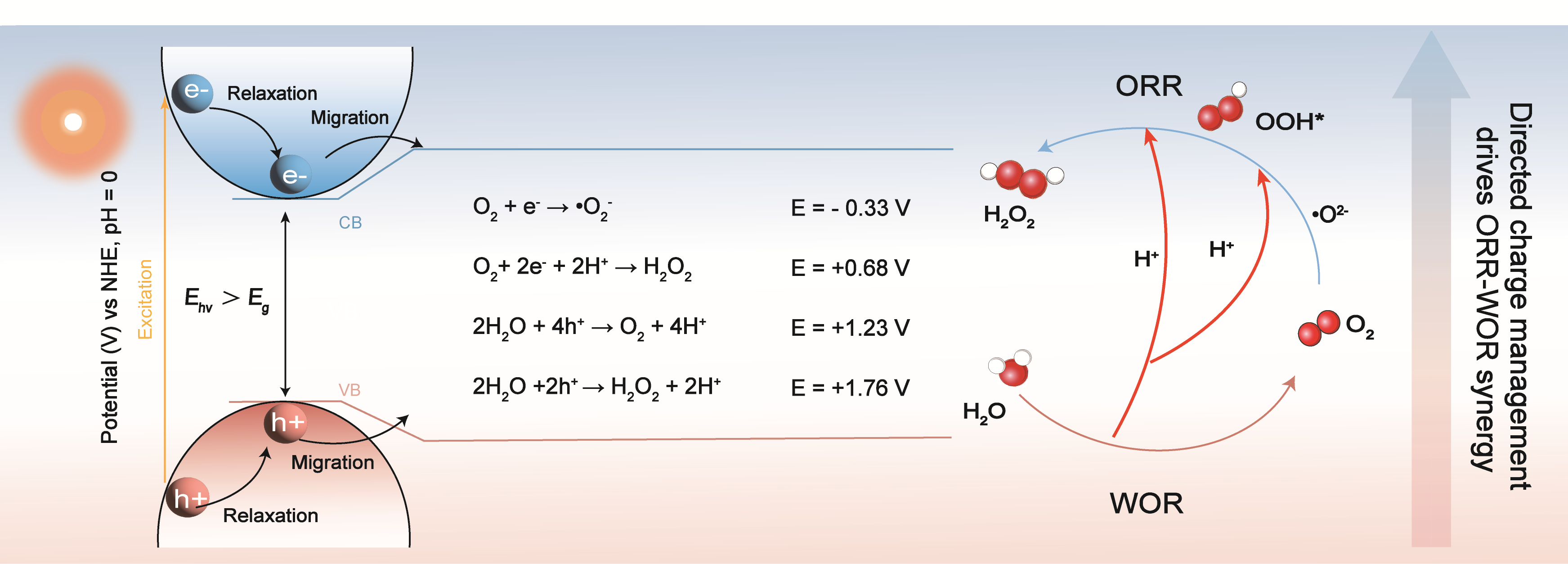
Scheme 1. Mechanism and energy-level diagram of H2O2 photogeneration on a semiconductor.
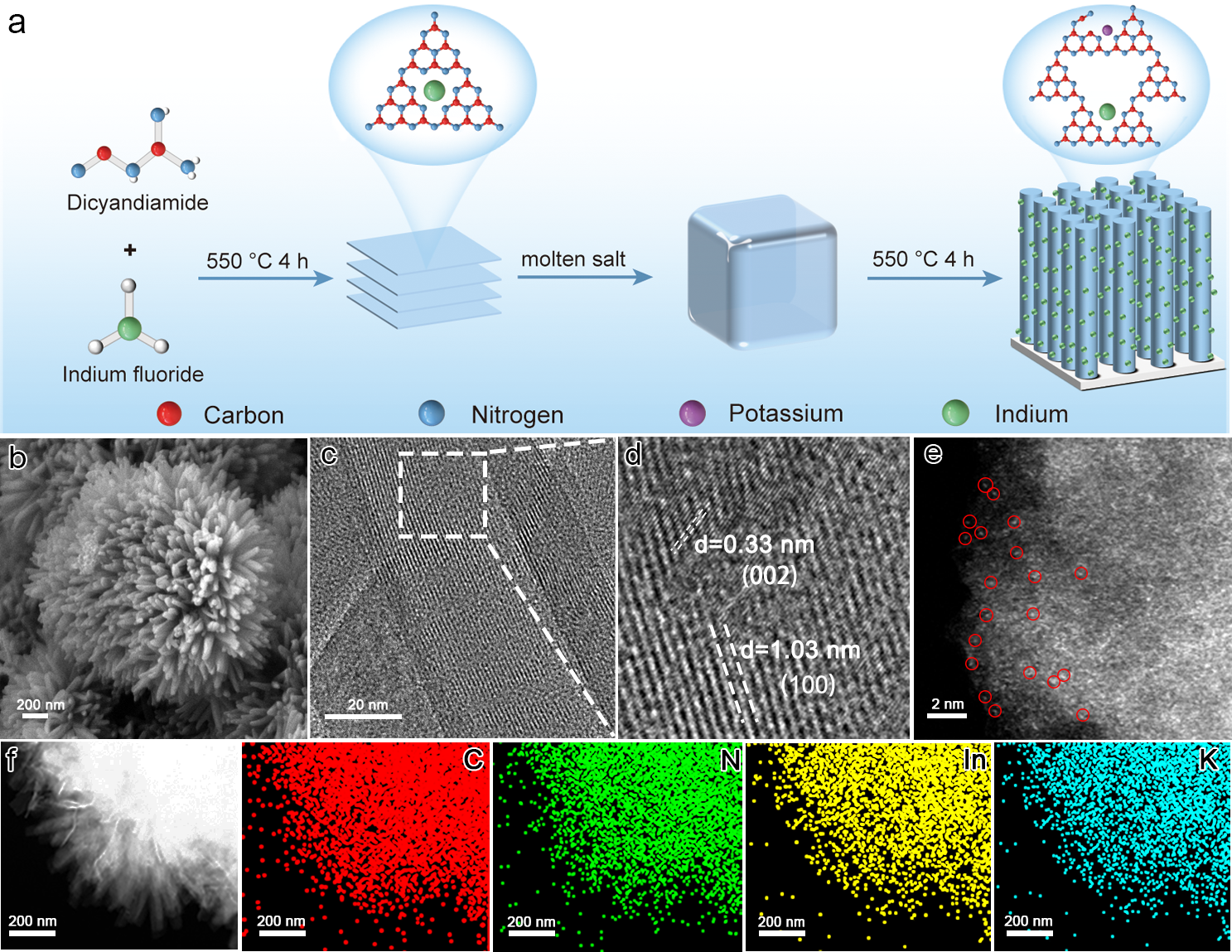
Fig. 1. (a) Schematic diagram of the In-CCN synthesis process. (b) SEM image, (c,d) HR-TEM images, (e) AC-HAADF-STEM image and (f) EDX images with C (red), N (green), In (yellow), K (blue) distributions of In-CCN.
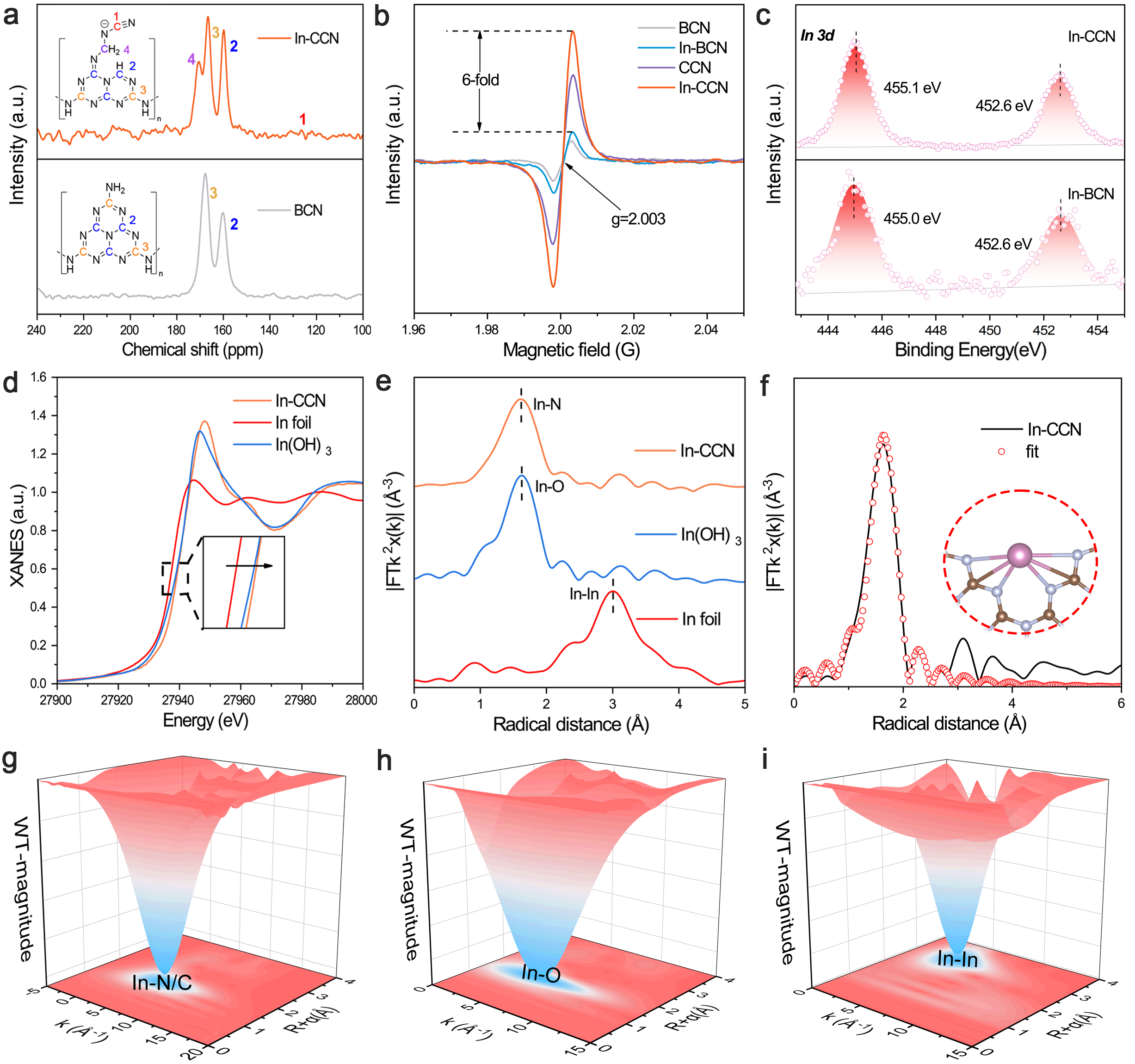
Fig. 2. (a) Solid-state13C NMR spectra of the BCN and In-CCN. (b) EPR patterns of BCN, In-BCN, CCN and In-CCN. (c) High-resolution XPS spectra of In 3d in the In-BCN and In-CCN. In K-edge XANES spectra (d) and the Fourier-transformed (FT) k2-weighted EXAFS spectra (e) of In-CCN, In(OH)3, and In foil. (f) In K-edge EXAFS (line) and fit curve (points) for In-CCN, shown in k2 weighted R-space. The inset is structure model of In-N4C2. g-i) WT-EXAFS plots of In-CCN, In and In(OH)3.
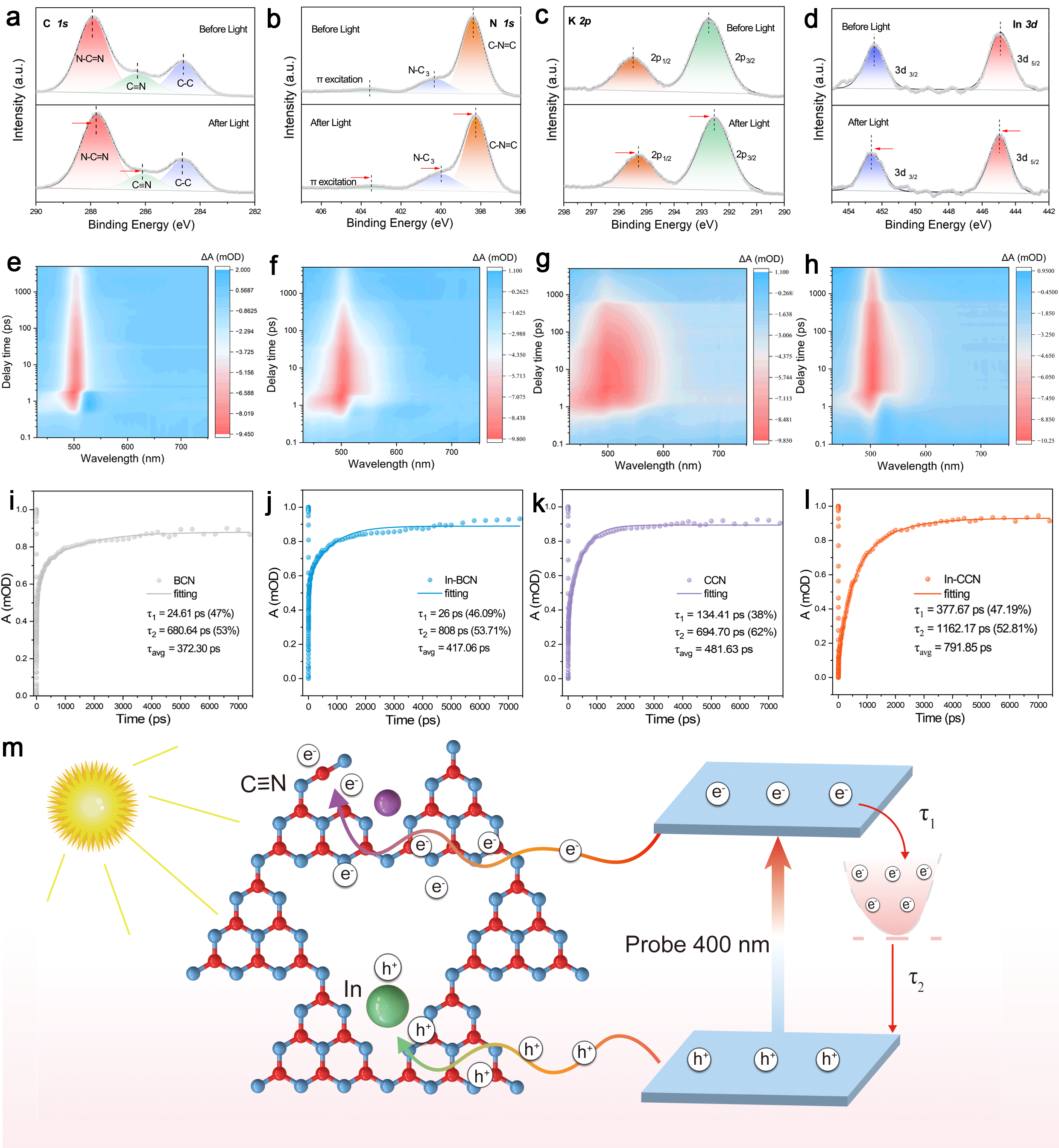
Fig. 3. In-situ high-resolution C 1s (a), N 1s (b), K 2p (c), and In 3d (d) XPS spectra of In-CCN under dark and light irradiation. Two‑dimensional pseudo-color fs-TAS of BCN (e), In-BCN (f), CCN (g) and In-CCN (h) at various probe delays. The fs-TAS kinetic plots and corresponding fitting curves at 500 nm for BCN (i), In-BCN (j), CCN (k) and In-CCN (l). (m) Schematic illustration of carrier transfer and the corresponding TA signals detected in In-CCN.
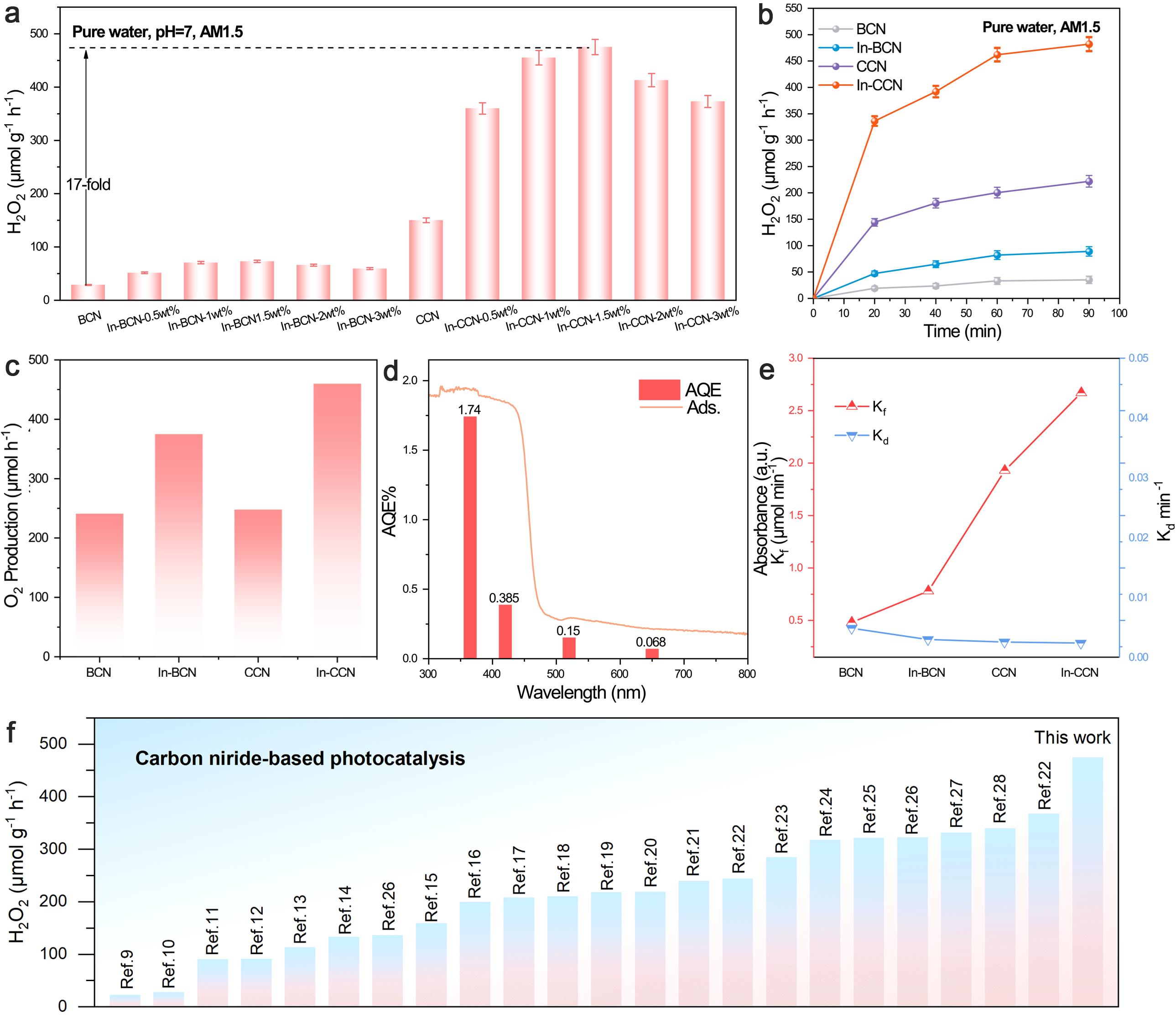
Fig. 4. (a) Photocatalytic H2O2 production performance of BCN, In-BCN, CCN and In-CCN. Reaction conditions: 10 mg catalyst in 50 mL of oxygen-saturated pure water under AM 1.5 illumination (pH = 7.0). (b) Time-dependent profiles of H2O2 photoproduction over BCN, In-BCN, CCN and In-CCN. (c) Photocatalytic O2 evolution performance of BCN, In-BCN, CCN, In-CCN. (d) AQE for H2O2 production of In-CCN at different wavelengths and its corresponding UV-Vis DRS. (e) Formation rate constant (Kf) and decomposition rate constant (Kd) of H2O2 for BCN, In-BCN, CCN and In-CCN. (f) Comparison of H2O2 generation performance between In-CCN and other recently reported g-C3N4 based photocatalysts in pure water.

Fig. 5. Surface potential mapping by light-assisted KPFM for BCN (a-c) and In-CCN (d-f). (g) RRDE polarization curves of BCN and In-CCN measured at 1600 rpm in O2 saturated 0.1 mol L-1 KOH solution with a ring current (upper part) and disk current (bottom part). (h) Calculated average number of transferred electrons of BCN and In-CCN. (i) Photocatalytic H2O2 generation rates of different samples under different reaction atmospheres or with different sacrificial agents. (j) DMPO spin-trapping EPR spectra recorded for radicals under light irradiation for BCN, In-BCN, CCN and In-CCN. (k) O2-TPD profiles of BCN, In-BCN, CCN, In-CCN. (l) GC-MS spectra of O2 produced by H218O+16O2.

Fig. 6. (a) In-situ DRIFTS of photocatalytic H2O2 synthesis under H2O, O2, dark or illumination of 30 min. (b) Infrared contour map for In-CCN in O2 and H2O atmospheres under illumination for 30 min. Calculated ESP distributions of BCN (c), In-BCN (d), CCN (f) and In-CCN (g). (e,h) PDOS of BCN and In-CCN. (i) Free energy diagrams for 2e- RR processes on BCN, In-BCN, CCN and In-CCN with optimized configurations for each step, where the asterisk (*) denotes the active site of the catalyst. (j) Schematic of redox reactions involved in In-CCN.
|
| [1] | Yangpeng Zhang, You Wu, Qianfeng Gu, Yue Gao, Chencheng Cai, Haoyu Liu, Yuehan Zhao, Zhonghua Li, Feng-Ming Zhang, Yang Liu, Qichun Zhang. Engineering local electronic asymmetry in isostructural covalent organic frameworks to maximize charge separation for H2O2 photosynthesis [J]. Chinese Journal of Catalysis, 2027, 92(1): 130-144. |
| [2] | Yuxing Xu, Yin Li, Hengwei Wang, Botao Teng, Junling Lu. Frontier orbital insights into the stability and activity of zero-valent single-atom catalysts [J]. Chinese Journal of Catalysis, 2027, 92(1): 123-129. |
| [3] | Xinyu Song, Wei Wang, Xiaomin Lao, Yitong Liu, Huanmin Liu, Peng Zhou. Anaerobic photocatalytic dihydroxylation of propylene to propylene glycol and hydrogen at ambient temperature and pressure [J]. Chinese Journal of Catalysis, 2027, 92(1): 115-122. |
| [4] | Anqi Li, Yusen Chen, Xiaoli Pan, Yujing Ren, Hongchen Cao, Guiyue Bi, Xiaofeng Yang, Aiqin Wang, Tao Zhang. Pt1/FeOx single-atom catalyst with dual-valent Pt sites for water-promoted hydrogenation of nitroarenes [J]. Chinese Journal of Catalysis, 2027, 92(1): 410-419. |
| [5] | Ke Fan, Yuqing Zhu, Yiran Ying. Bidirectional catalysis of polysulfides and Li2S redox kinetics by single-atom modified S-MXene for advanced Li-S batteries [J]. Chinese Journal of Catalysis, 2027, 92(1): 420-427. |
| [6] | Shike Wang, Man Lang, Feng Wang, Pengfei Xia, Dieqing Zhang. Recent advances in g-C3N4-based S-scheme photocatalyst [J]. Chinese Journal of Catalysis, 2027, 92(1): 37-64. |
| [7] | Lifang Yang, Yuge Zhang, Yong Liu, Zhijun Yang, Guanghui Li, Jianwei Zhou, Sugang Meng, Raf Dewil. Zn vacancy-anchored Ag clusters on single-unit-cell ZnIn2S4 nanosheets for efficient dual-function photocatalysis [J]. Chinese Journal of Catalysis, 2027, 92(1): 285-299. |
| [8] | Banghu Wei, Wei Ren, Jinhe Li, Weikang Wang, Qinqin Liu. S-scheme heterojunctions for coupled redox photocatalysis: Orchestrating electron-hole synergy to unlock dual half-reactions [J]. Chinese Journal of Catalysis, 2027, 92(1): 1-36. |
| [9] | Wenmin Lei, Yan Zhang, Dalin Sun, Lin Ban, Heng Zhou, Song Yang, Liquan Jing, Jinguang Hu, Heng Zhang. Transition-metals photocatalysts for lignin valorization toward sustainable biofuel production [J]. Chinese Journal of Catalysis, 2026, 88(9): 35-85. |
| [10] | Yang Wang, Cun-Feng Fan, Yang Liu, Xiao-Qin Zheng, Xuan-Yi Liu, Kai Zhang, Jiahui Kou, Hengming Huang, Lin-Bing Sun. Iron single-atom catalysts created in constrained space with in-situ-formed carbon layers for efficient Fenton reaction [J]. Chinese Journal of Catalysis, 2026, 88(9): 432-441. |
| [11] | Vladimir I. Kurganskii, Dmitry P. Lubov, Alexander G. Medvedev, Ruihu Wang, Konstantin P. Bryliakov. Bioinspired asymmetric syn-hydroxyazidation of electron-deficient olefins in the presence of nonheme Mn complexes [J]. Chinese Journal of Catalysis, 2026, 88(9): 468-477. |
| [12] | Sathi Chatterjee, Hongmei Li, Kang Liu, Zhang Lin, Liyuan Chai, Min Liu. Single-atom catalysts on two-dimensional (2D) materials for photocatalytic CO2 reduction: Fundamentals, design, and emerging strategies [J]. Chinese Journal of Catalysis, 2026, 88(9): 86-128. |
| [13] | Jiayu Zhang, Kun Wang, Jinglu Yu, Kaiyang Xu, Lu Yang, Jiali Rao, Shuqin Song, Yi Wang. Modulating active sites via Mn-doping in NiCo LDH for energy-saving paired electrosynthesis of H2O2 and formate [J]. Chinese Journal of Catalysis, 2026, 88(9): 307-321. |
| [14] | Songling Wang, Anhua Huang, Fengxing Yin, Ruixiang Lu, Wengang Liu, Yun Zhang, Botao Qiao. In-situ synthesis of hydrogen peroxide for highly selective oxidation of methane to methanol over noble-metal-free catalyst [J]. Chinese Journal of Catalysis, 2026, 88(9): 347-355. |
| [15] | Shufang Liu, Fengyu Chen, Siyuan Li, Yu-Xin Ye, Gangfeng Ouyang. Recent advances in oxygen-centered organic radicals: Characterization, synthesis, and applications [J]. Chinese Journal of Catalysis, 2026, 88(9): 183-206. |
| Viewed | ||||||
|
Full text |
|
|||||
|
Abstract |
|
|||||


