
Chinese Journal of Catalysis ›› 2027, Vol. 92: 145-156.DOI: 10.1016/S1872-2067(26)65227-8
• Articles • Previous Articles Next Articles
Guobang Lia,1( ), Zhilin Wanga,1, Mengkai Wanga, Yanchun Liua, Cong Wangb,*(), Xianggang Zhoua, Yonghui Wanga,*(), Xuzheng Caoa, Huaqiao Tana,*()
Received:2026-02-04
Accepted:2026-04-17
Online:2027-01-02
Published:2026-10-30
Contact:
*E-mail: wangc813@cust.edu.cn (C. Wang),About author:First author contact:1 Contributed to this work equally.
Supported by:Guobang Li, Zhilin Wang, Mengkai Wang, Yanchun Liu, Cong Wang, Xianggang Zhou, Yonghui Wang, Xuzheng Cao, Huaqiao Tan. Methyl steric-hindrance-induced twisted acridine-based conjugated porous polymers for efficient 1O2-driven photocatalytic H2O2 production[J]. Chinese Journal of Catalysis, 2027, 92: 145-156.
Add to citation manager EndNote|Ris|BibTeX
URL: https://www.cjcatal.com/EN/10.1016/S1872-2067(26)65227-8
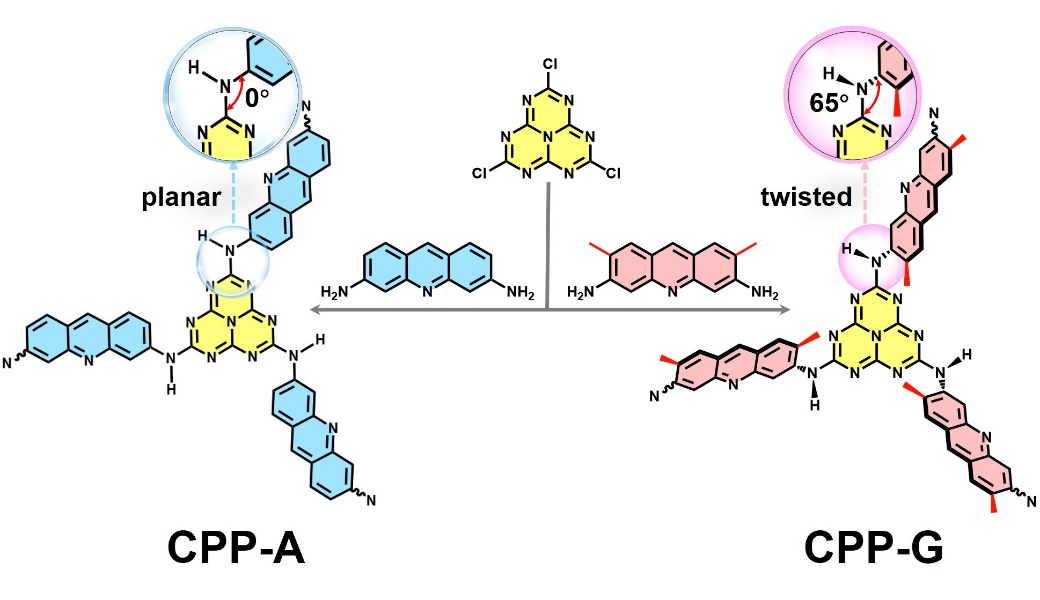
Scheme 1. The method for constructing CPPs from the relevant precursors.
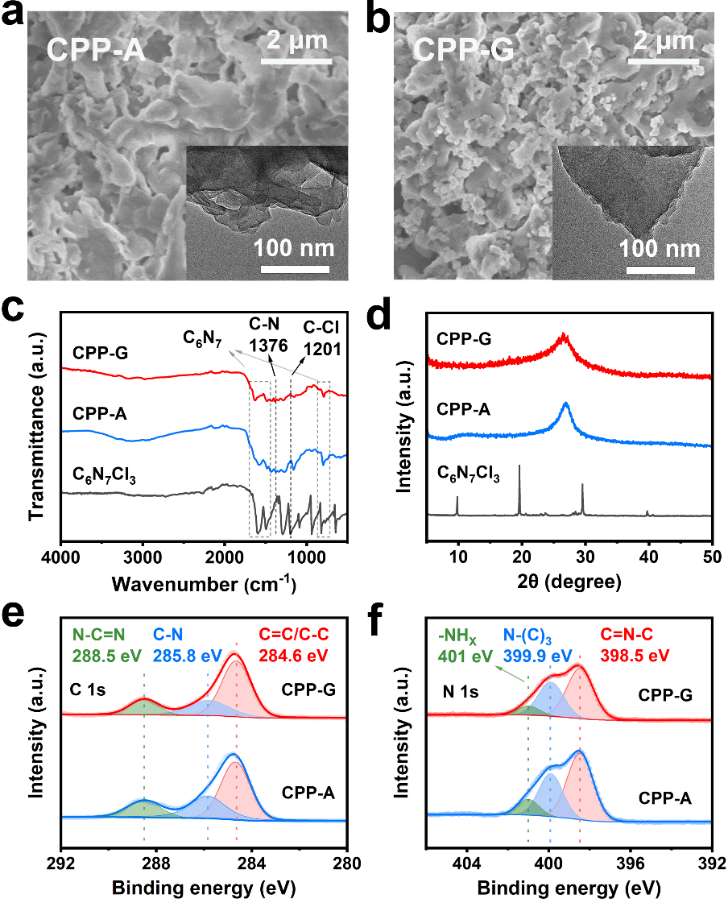
Fig. 1. SEM and TEM images of CPP-A (a) and CPP-G (b). (c) FT-IR spectra for the CPPs and C6N7Cl3. (d) XRD spectra of the CPPs and C6N7Cl3. (e) C 1s spectra of XPS related to the CPPs. (f) N 1s spectra of XPS corresponding to the CPPs.
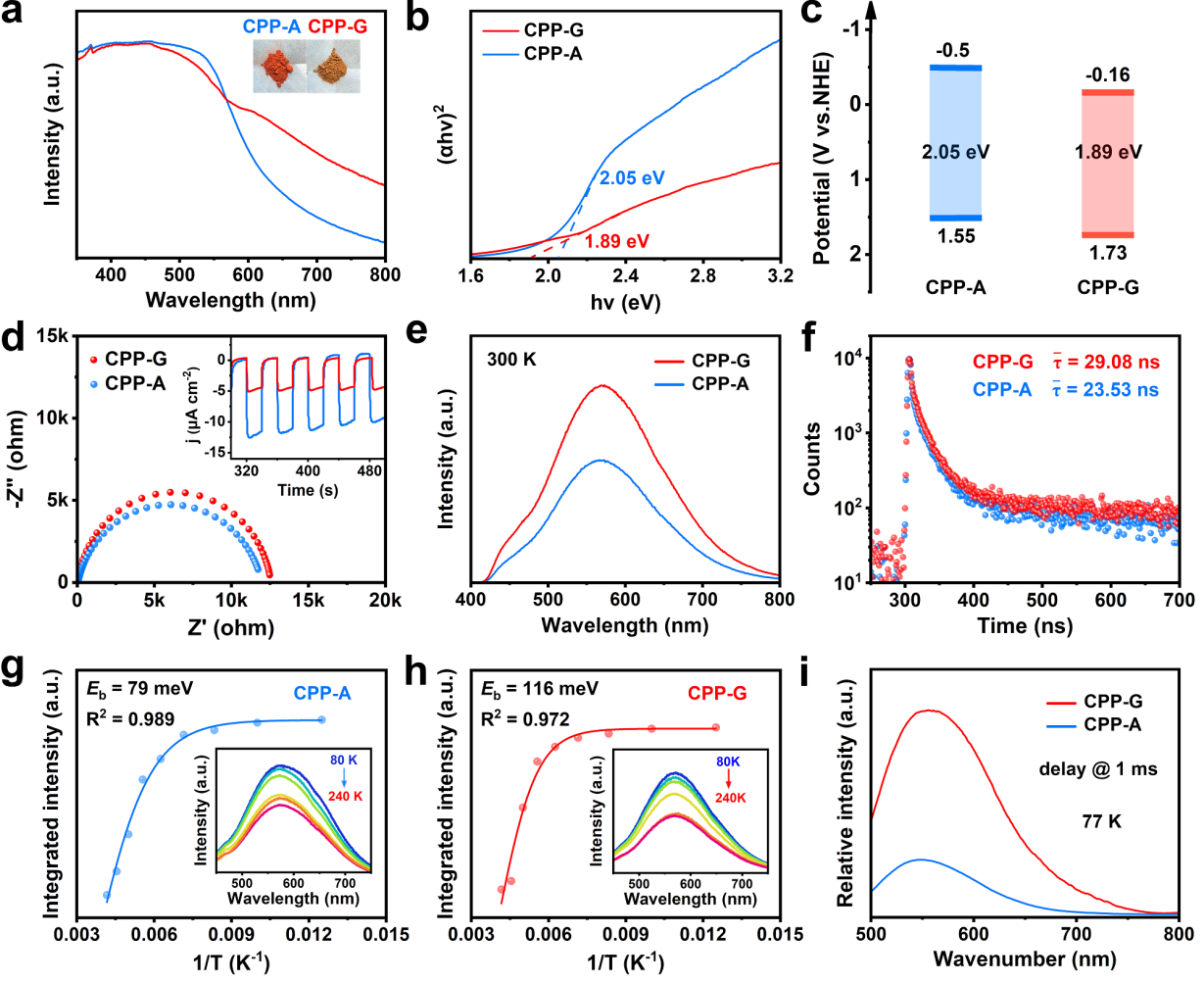
Fig. 2. (a) UV-vis DRS of the CPPs. (b) Tauc-plots related to the CPPs. (c) Energy band structures pertaining to the CPPs. (d) EIS plots and transient photocurrent (inset) of CPPs. (e) PL spectra recorded at 300 K for the CPPs. (f) TR-PL of the CPPs. Integrated PL intensity as a function of temperature for CPP-A (g) and CPP-G (h) (with inset showing the relevant temperature-dependent PL spectra). The value of Eb is obtained using the Arrhenius equation. (i) Delayed phosphorescence spectra of the CPPs measured at 77 K after 1 ms.
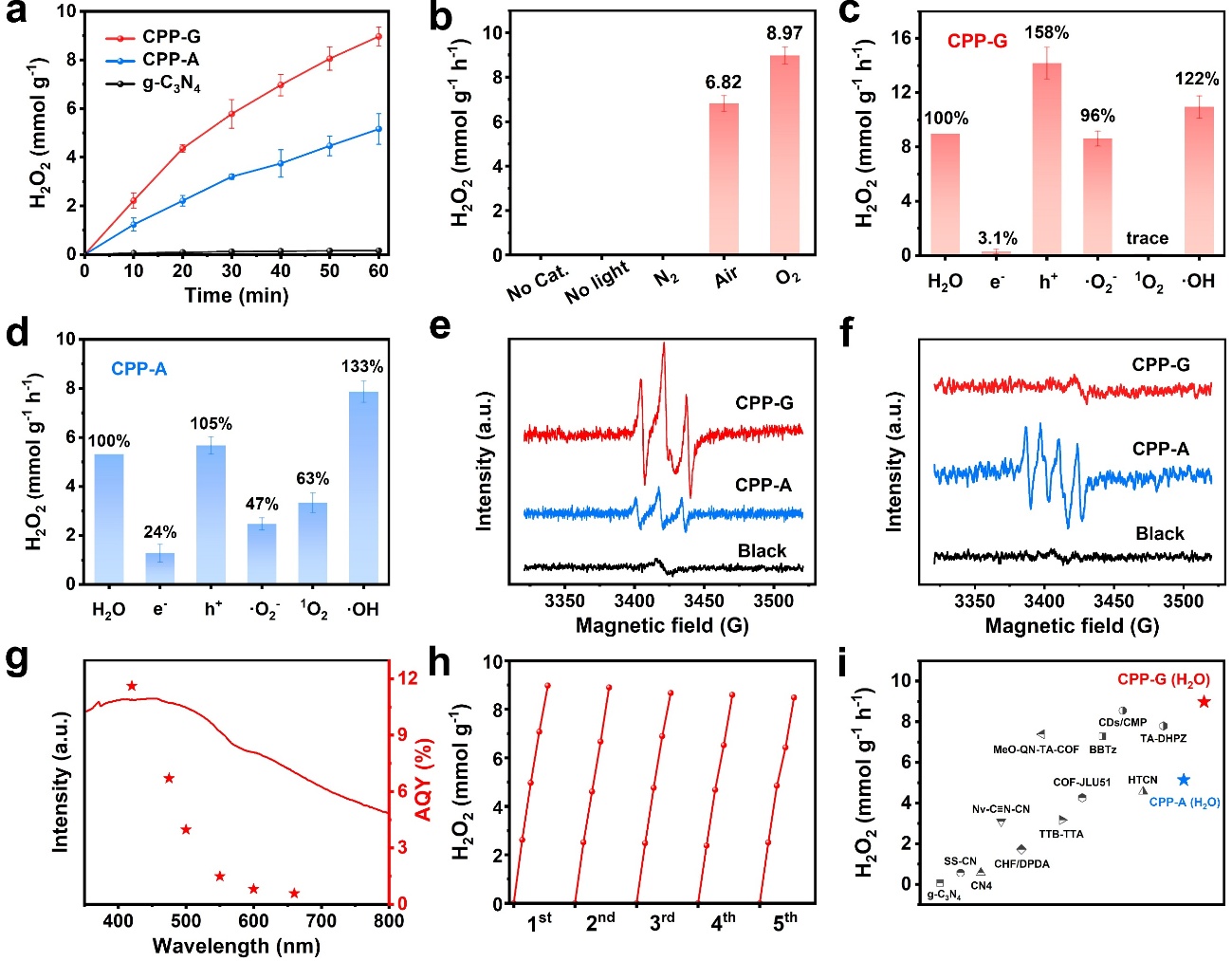
Fig. 3. (a) The photocatalytic activities of CPPs. (b) H2O2 production rates of CPP-G under different conditions. H2O2 production rates of CPP-G (c) and CPP-A (d) when different scavengers are present. (e) ESR spectra obtained from TEMP-1O2 radical trapping experiments facilitated by CPPs. (f) ESR spectra from DMPO-O2•- radical trapping experiments conducted using CPPs. (g) The AQY of CPP-G under different wavelengths. (h) The photocatalytic production of H2O2 catalyzed by recycled CPP-G for five times. (i) Comparison of CPPs with representative materials in terms of the H2O2 production rate.
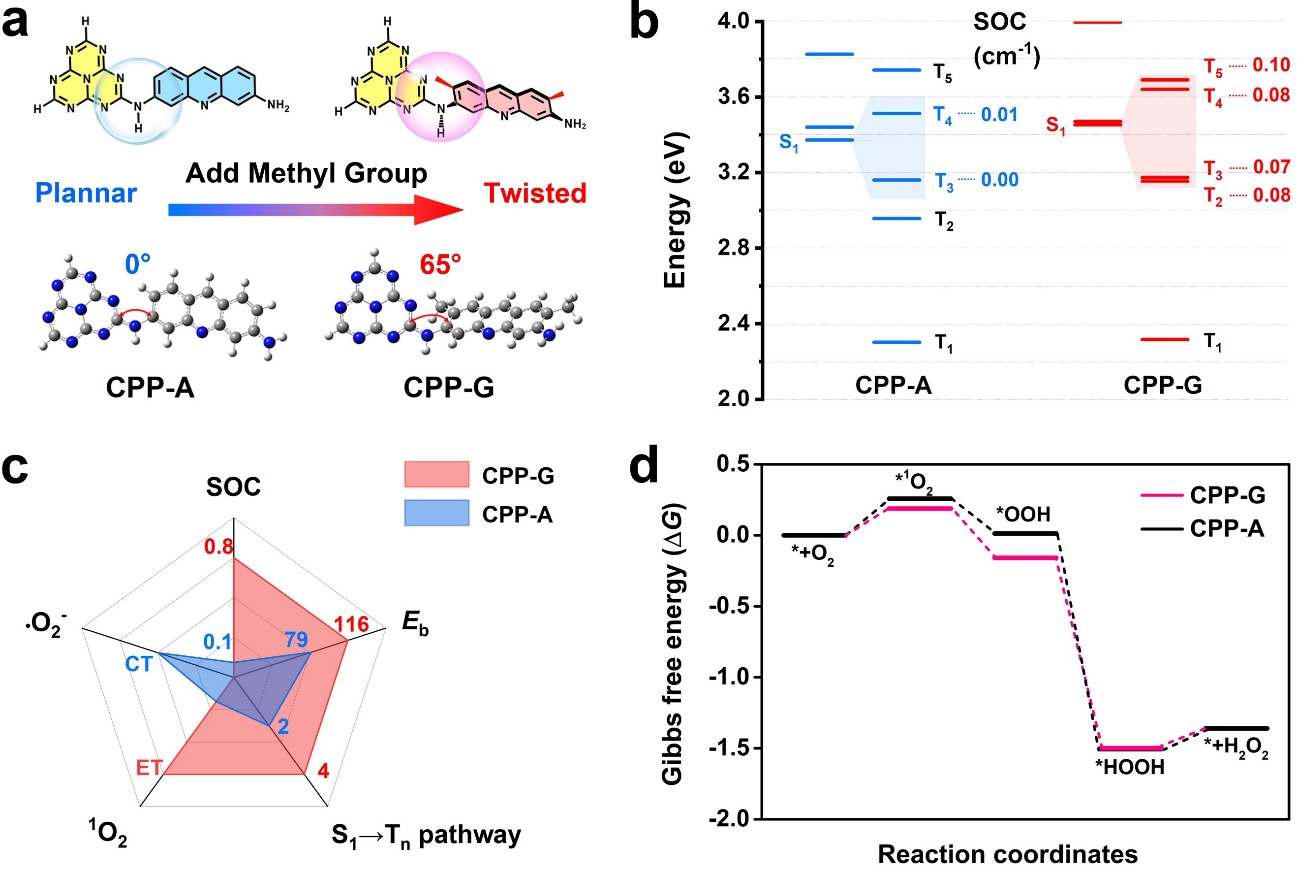
Fig. 4. (a) Schematic structures of CPPs optimized by DFT. (b) Theoretical vertical excitation energy for singlet and triplet states, along with SOC constants for S1 and Tn. (c) Radar plot with the major characteristics of CPP-A and CPP-G. SOC refers to theoretical spin-orbit coupling constant measured in cm-1. Eb is experimentally measured exciton binding energy in meV. S1 → Tn pathway indicates calculated number of transition pathways shifting from singlet to triplet excited states. 1O2 is used to roughly evaluate the energy transfer process in CPPs. O2•- employed to assess the charge transfer processes occurring within CPPs. (d) Gibbs free energy diagrams for the reduction of O2 to H2O2 via 1O2 pathway on the CPP-G.
|
| [1] | Yong Zhang, Wenjun Zhu, Yanyan Zhao, Shumin Zhang. In2S3/HOF S-scheme heterojunction for enhanced photocatalytic H2O2 production [J]. Chinese Journal of Catalysis, 2026, 84(5): 261-273. |
| [2] | Haoyi Wang, Yankai Zhang, Chunying Si, Yunbiao Qi, Quanxing Zhang, Wei Jiang. Dual-functional ionic liquid catalysts for efficient photooxidative upcycling of polystyrene to benzoic acid [J]. Chinese Journal of Catalysis, 2026, 83(4): 231-243. |
| [3] | Jing Zhang, Xidong Zhang, Kaiyan Wang, Xuefei Wang, Ping Wang, Feng Chen, Huogen Yu. Citric directional coordination for efficient photocatalytic synthesis of H2O2 with high value-added β-Ketoglutaric acid [J]. Chinese Journal of Catalysis, 2026, 82(3): 201-211. |
| [4] | Bei Han, Chen Jin, Cuihong Luo, Yuntao Liu, Zhichao Dai, Yunqiang Sun, Zibao Gan, Chong-Chen Wang, Xiuwen Zheng, Zunfu Hu. FeNi nanoparticles cooperate with single-atom sites to drive non-radical fenton-like catalysis: Dominant singlet oxygen and electron transfer pathways for efficient wastewater purification [J]. Chinese Journal of Catalysis, 2026, 82(3): 187-200. |
| [5] | Zhiqi Li, Chen Guan, Kaiqiang Xu, Wei Xia, Dilshod D. Nematov, Quanjun Xiang. Synergy of spatially adjacent redox sites and spin polarization in ZnIn2S4 for boosted H2O2 photosynthesis [J]. Chinese Journal of Catalysis, 2026, 91(12): 252-262. |
| [6] | Haoran Chen, Junwei Fu, Graham Dawson, Jinfeng Zhang, Qingpo Peng, Kai Dai. 2D Ag modified g-C3N4/1D CdS-diethylenetriamine S-scheme heterojunction with enhanced photocatalytic H2O2 production [J]. Chinese Journal of Catalysis, 2026, 90(11): 231-242. |
| [7] | Yandong Xu, Zihui Jing, Wenhao Su, Jiale Xu, Mingliang Wang. Synergistic coupling of H2O2 production and furoic acid synthesis over B-TiO2@COF S-scheme bifunctional photocatalyst [J]. Chinese Journal of Catalysis, 2026, 80(1): 135-145. |
| [8] | Xuelu He, Wenyan Ma, Siteng Zhu, Dan Li, Jia-Xing Jiang. The effect of electronic structure matching between building blocks in conjugated porous polymers on photocatalytic hydrogen evolution activity [J]. Chinese Journal of Catalysis, 2025, 73(6): 279-288. |
| [9] | Bingquan Xia, Gaoxiong Liu, Kun Fan, Rundong Chen, Xin Liu, Laiquan Li. Boosting hydrogen peroxide photosynthesis via a 1D/2D S-scheme heterojunction constructed by a covalent triazine framework with dual O2 reduction centers [J]. Chinese Journal of Catalysis, 2025, 69(2): 315-326. |
| [10] | Tao Wen, Sisheng Guo, Hengxin Zhao, Yuqi Zheng, Xinyue Zhang, Pengcheng Gu, Sai Zhang, Yuejie Ai, Xiangke Wang. Nano-MnO2 anchored on exfoliated MXene with exceptional and stable Fenton oxidation performance for organic micropollutants [J]. Chinese Journal of Catalysis, 2024, 61(6): 215-225. |
| [11] | Haoran Yu, Danxu Liu, Hengyi Wang, Haishuang Yu, Qingyun Yan, Jiahui Ji, Jinlong Zhang, Mingyang Xing. Singlet oxygen synergistic surface-adsorbed hydroxyl radicals for phenol degradation in CoP catalytic photo-Fenton [J]. Chinese Journal of Catalysis, 2022, 43(10): 2678-2689. |
| [12] | Yu Zhang, Ling Zhang, Di Zeng, Wenjing Wang, Juxue Wang, Weimin Wang, Wenzhong Wang. An efficient strategy for photocatalytic hydrogen peroxide production over oxygen-enriched graphitic carbon nitride with sodium phosphate [J]. Chinese Journal of Catalysis, 2022, 43(10): 2690-2698. |
| [13] | Gang Nie, Jia Huang, Yezhou Hu, Yaobin Ding, Xiaoyan Ha, Heqing Tan. Heterogeneous catalytic activation of peroxymonosulfate for efficient degradation of organic pollutants by magnetic Cu0/Fe3O4 submicron composites [J]. Chinese Journal of Catalysis, 2017, 38(2): 227-239. |
| Viewed | ||||||
|
Full text |
|
|||||
|
Abstract |
|
|||||


