
催化学报 ›› 2026, Vol. 89: 337-352.DOI: 10.1016/S1872-2067(26)65118-2
陈伟a, Massimo Bocusa, Unni Olsbyeb, Veronique Van Speybroecka,*( )
)
收稿日期:2025-12-12
接受日期:2026-02-22
出版日期:2026-10-18
发布日期:2026-09-01
通讯作者:
*电子信箱: Veronique.VanSpeybroeck@UGent.be (V. Van Speybroeck).
Wei Chena, Massimo Bocusa, Unni Olsbyeb, Veronique Van Speybroecka,*()
Received:2025-12-12
Accepted:2026-02-22
Online:2026-10-18
Published:2026-09-01
Contact:
*E-mail:Veronique.VanSpeybroeck@UGent.be(V. Van Speybroeck).
摘要:
AEI拓扑分子筛(MAPO-18)作为OX-ZEO型串联催化剂的组分显示出有前景的性能, 其中骨架原子取代类型决定了布朗斯特酸位点(BAS)的性质, 进而显著影响CO2制烃反应的催化机制. 作为关键中间体的烯酮,其演化行为是阐明该机制的关键. 此外烯酮是甲醇转化为烃类的关键中间体. 本文采用第一性原理分子动力学(FPMD)模拟结合增强采样技术, 在真实反应条件下对三种烯酮(烯酮、甲基烯酮和二甲基烯酮)与MAPO-18(M = Si, Mg)分子筛中BAS的反应提供了分子层面的见解. 由FPMD模拟构建的自由能表面揭示了不同的动力学和热力学性能, 将它们与生产烯烃的不同反应路线联系起来. 相关研究表明, 烯酮及其酰基阳离子是两种不同烯烃形成途径的关键中间体, 与H-MgAPO-18相比, 这三种烯酮在H-SAPO-18中表现出比质子化形式更高的动力学稳定性, 这表明在H-SAPO-18中通过(环)加成-脱羧途径生产烯烃的趋势显著. 相比之下, H-MgAPO-18中酰基阳离子稳定性的提高和烯酮的低质子化势垒有利于它们直接脱羰为烯烃. 表面结合物种显示出从表面乙酸盐到表面丙酸盐再到表面异丁酸盐的稳定性下降, 这与表面醇盐的既定趋势一致. 相比动态模拟, 静态计算难以准确描述真实反应条件下熵贡献和动态效应占主导的活性中间体行为, 这突显了分子动力学(MD)方法对催化反应精确机理建模的必要性. 与高水平随机相近似(RPA)计算的基准测试进一步表明, 密度泛函理论结合FPMD模拟中使用的revPBE-D3泛函可能会高估酰基阳离子的稳定性, 低估乙烯酮的质子化势垒. 这些发现共同强调了将动态模拟与准确的势能描述相结合的重要性, 以用于可靠地模拟受限微孔环境中的活性中间体.
综上, 本文提供了分子筛框架中乙烯酮演化的关键步骤, 将计算和实验见解与二氧化碳转化为烃类的途径联系起来. 这些结果强调了骨架组成和取代基的细微变化如何决定反应机理, 为选择性催化转化的分子筛的合理设计提供了指导.
陈伟, Massimo Bocus, Unni Olsbye, Veronique Van Speybroeck. MAPO-18(M = Si或Mg)中烯酮的动态演化和稳定性: CO2制烃反应机理的分子层面见解[J]. 催化学报, 2026, 89: 337-352.
Wei Chen, Massimo Bocus, Unni Olsbye, Veronique Van Speybroeck. Dynamic evolution and stability of ketenes in MAPO-18 (M = Si or Mg): Molecular insights into the reaction mechanism for CO2-to-hydrocarbons[J]. Chinese Journal of Catalysis, 2026, 89: 337-352.
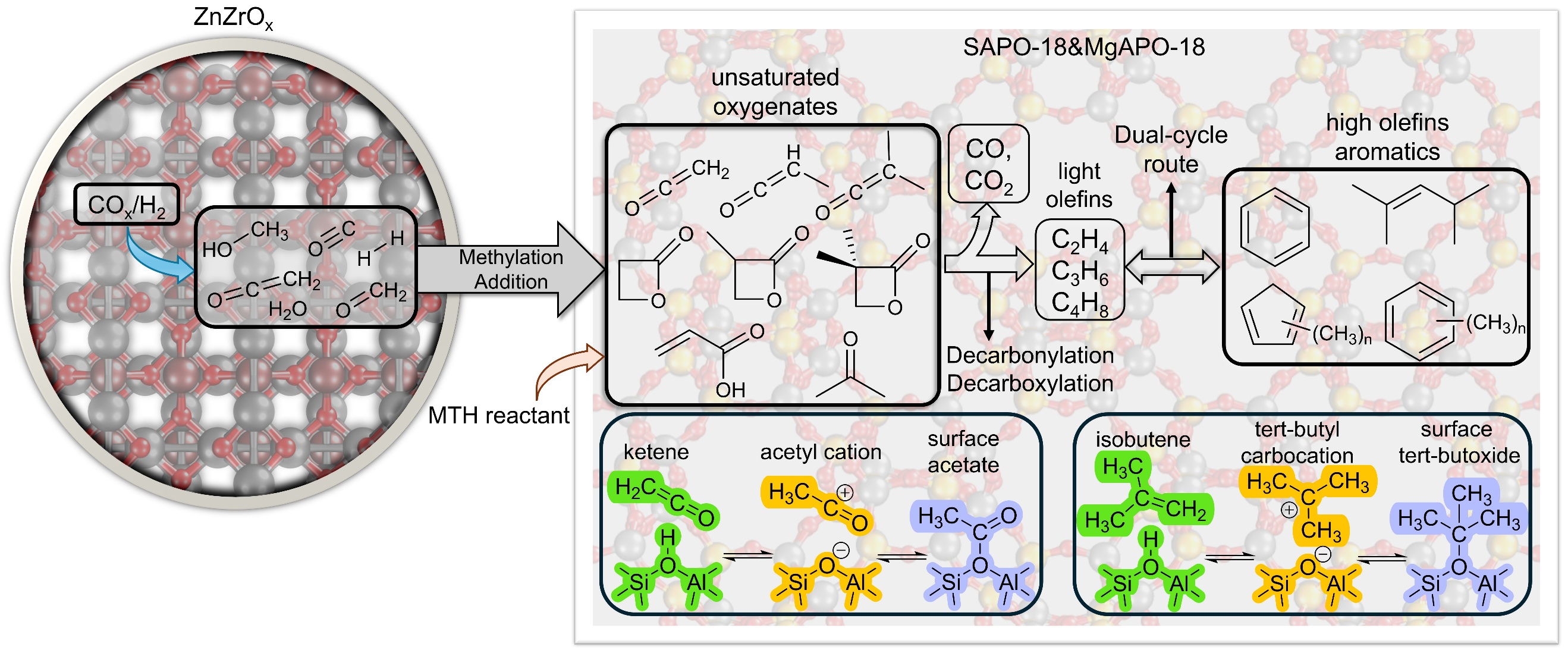
Fig. 1. An overview of the role of ketene in the reaction mechanism of COx-to-hydrocarbon (x = 1 or 2) over OX-ZEO catalyst and MTH over zeolite catalyst, and a comparison of the interconversion between ketene-acetyl cation-surface acetate and isobutene-tert-butyl carbocation-surface tert-butoxide in zeolites.
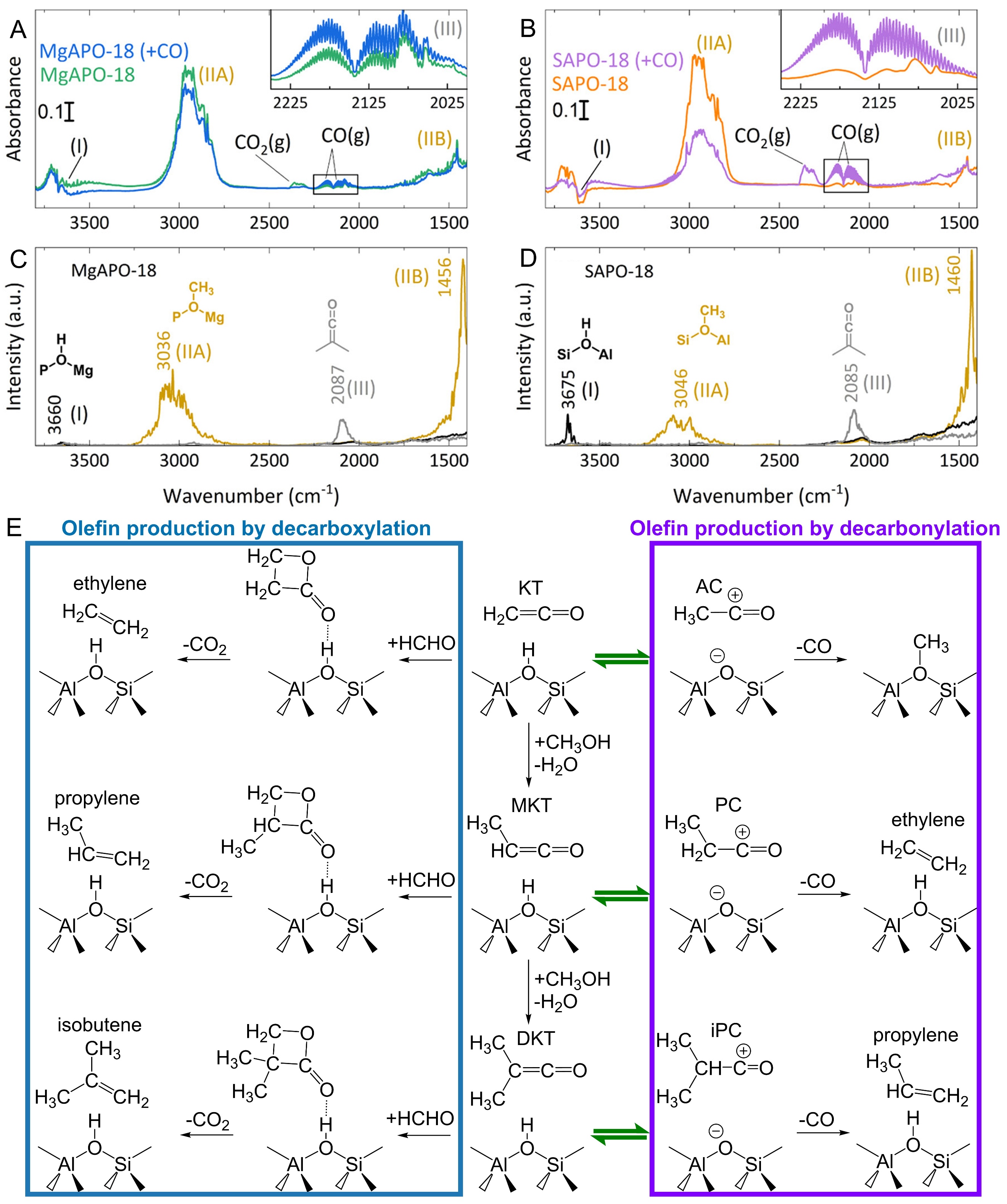
Fig. 2. Time-resolved in-situ IR spectra during the early stages of methanol conversion before the formation of hydrocarbons using MAPO-18 (M = Mg, Si): calcined and stored MgAPO-18 (A) and SAPO-18 (B) at MTH conditions and co-feeding CO at 673 K and 1 atm. Simulated power spectra of Br?nsted acid site, surface methoxy species, and dimethyl ketene on MgAPO-18 (C) and SAPO-18 (D). Reproduced under the terms of the CC BY 4.0 license from reference [48]. Copyright 2024, American Chemical Society. (E) Reaction schemes of ketene-based decarbonylation and decarboxylation routes for olefin production. The green arrows indicate the protonation of ketene studied in this work.
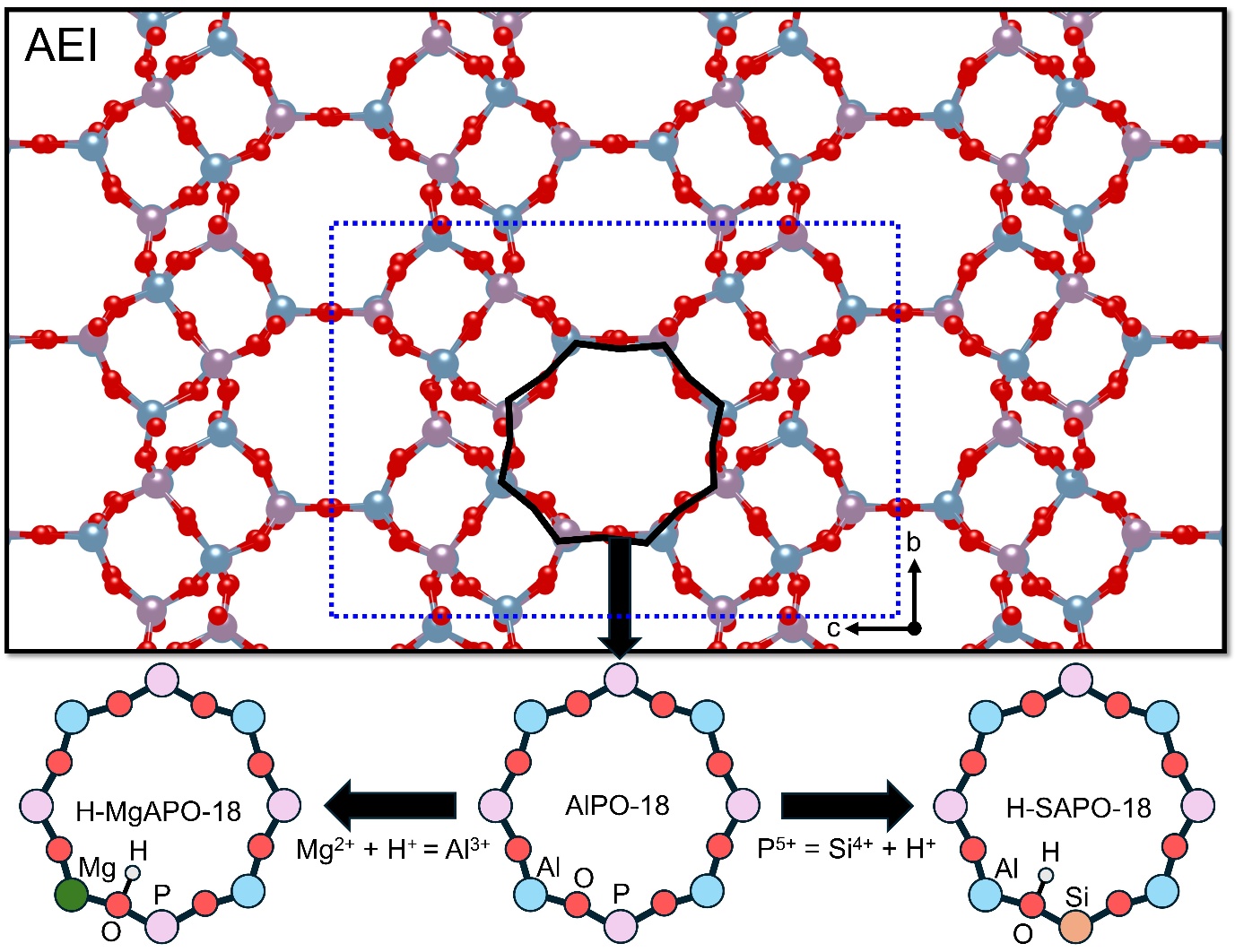
Fig. 3. Periodic models and strategies for introducing BAS into the 8R window of AlPO-18 for H-SAPO-18 and H-MgAPO-18. The blue square represents the unit cell of the AEI topology used in this study. Atom colors: oxygen, red; hydrogen, white; silicon, orange; aluminum, cyan; phosphorus, purple; and magnesium, green.
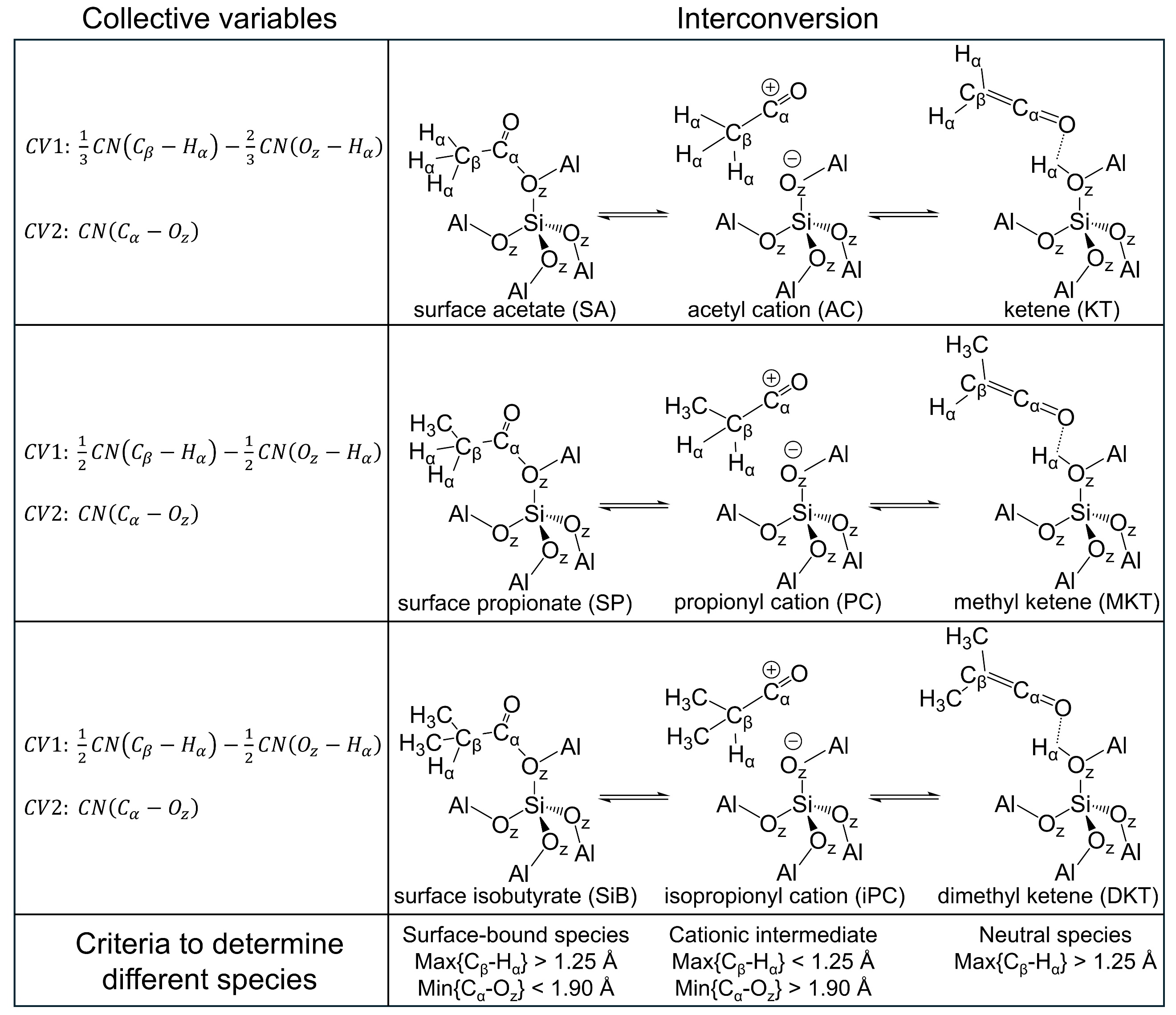
Fig. 4. Two collective variables (CV1 and CV2) were used to describe the interconversion of neutral species, cationic intermediates, and surface-bound species for ketene, methyl ketene, and dimethyl ketene in H-SAPO-18, and the criteria for determining these three species in the FPMD trajectories. The same settings were also used for H-MgAPO-18.
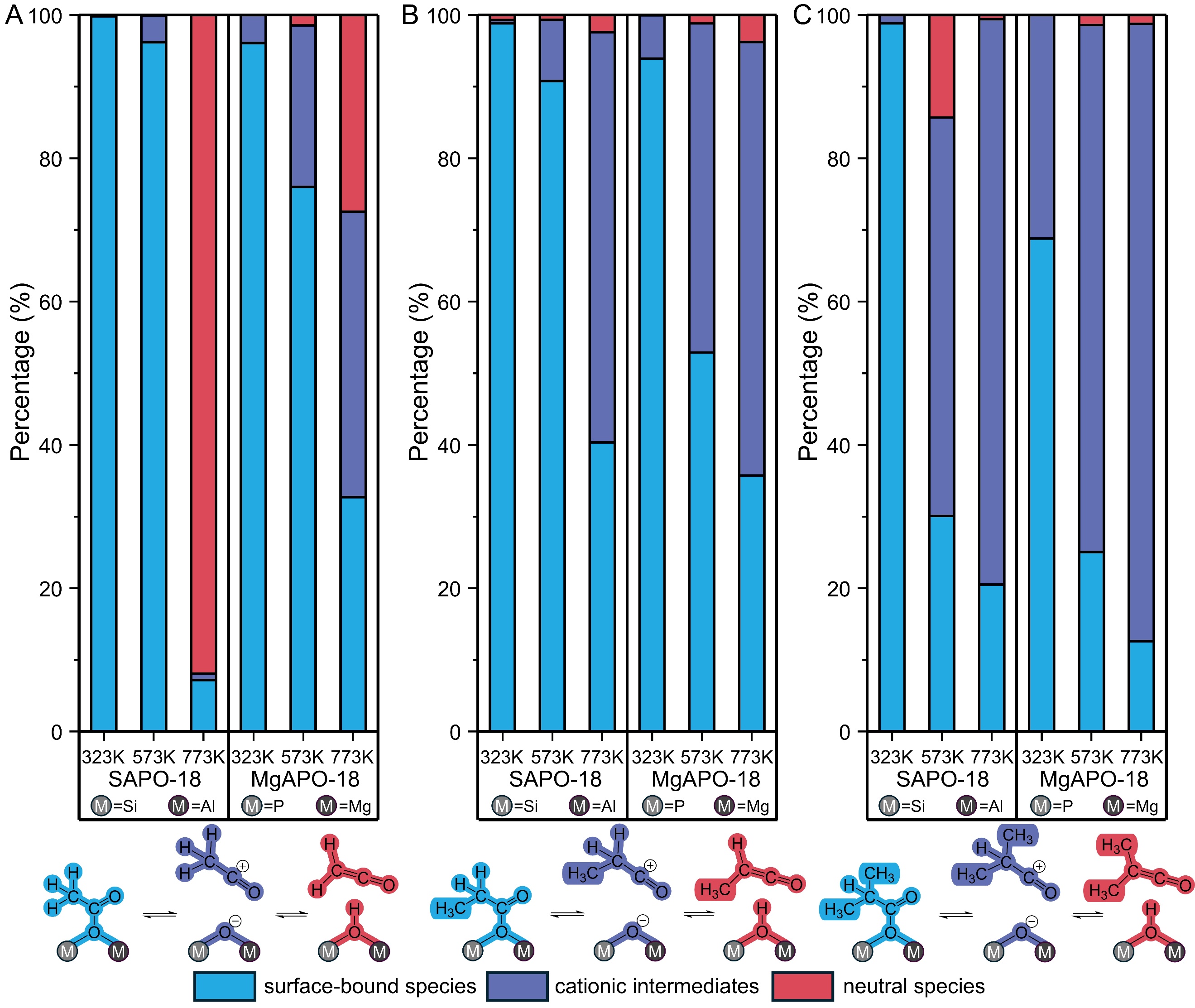
Fig. 5. The percentages of different species (surface-bound species, cationic intermediates, and neutral species) in SAPO-18 and MgAPO-18 at 323, 573, and 773 K during FPMD simulations with a timescale of 100 ps. The dynamic evolutions of surface acetate ? acetyl cation ? ketene (A), surface propionate ? propionyl cation ? methyl ketene (B), and surface isobutyrate ? isopropionyl cation ? dimethyl ketene (C). Surface-bound species were used as the initial species in the FPMD simulations.
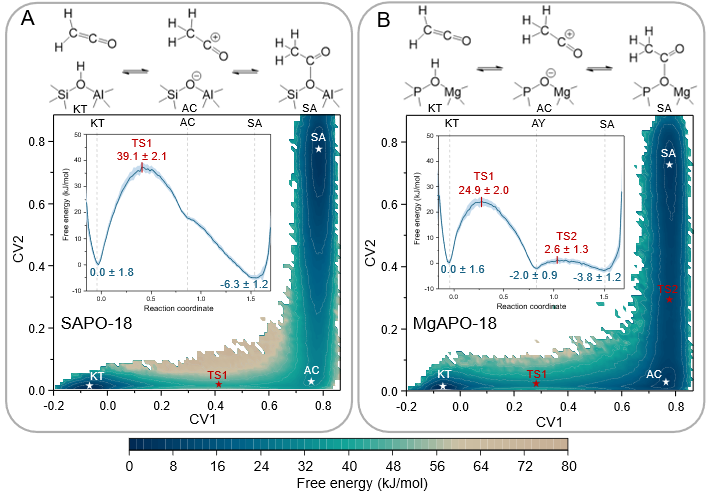
Fig. 6. 2D free energy surfaces of ketene (KT) protonation to acetyl cation (AC) and surface acetate (SA) in SAPO-18 (A) and MgAPO-18 (B) at 673 K, obtained by umbrella sampling simulations. The inset graphs show the 1D projection of the 2D free energy surface along with the reaction coordinate (CV1+CV2).
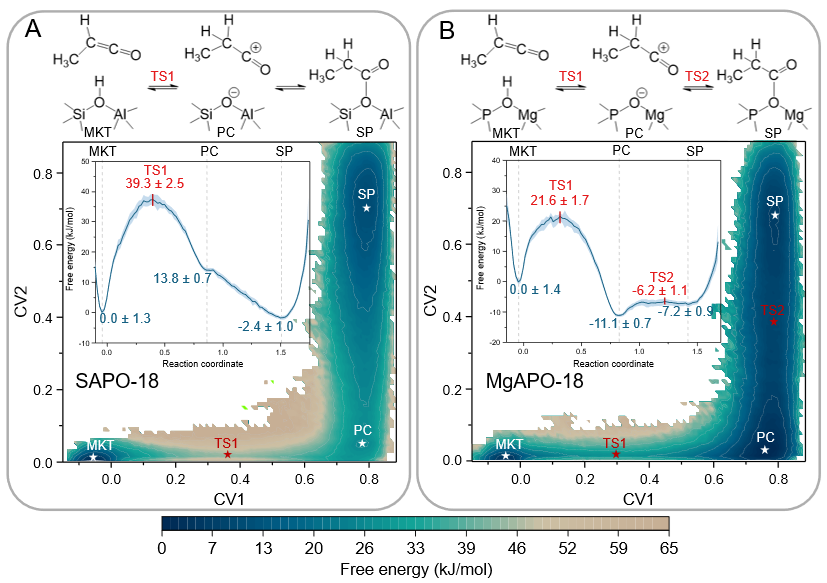
Fig. 7. 2D free energy surfaces of methyl ketene (MKT) protonation to propionyl cation (PC) and surface propionate (SP) in SAPO-18 (A) and MgAPO-18 (B) at 673 K. The inset graphs show the 1D projection of the 2D free energy surface along with the reaction coordinate (CV1+CV2).
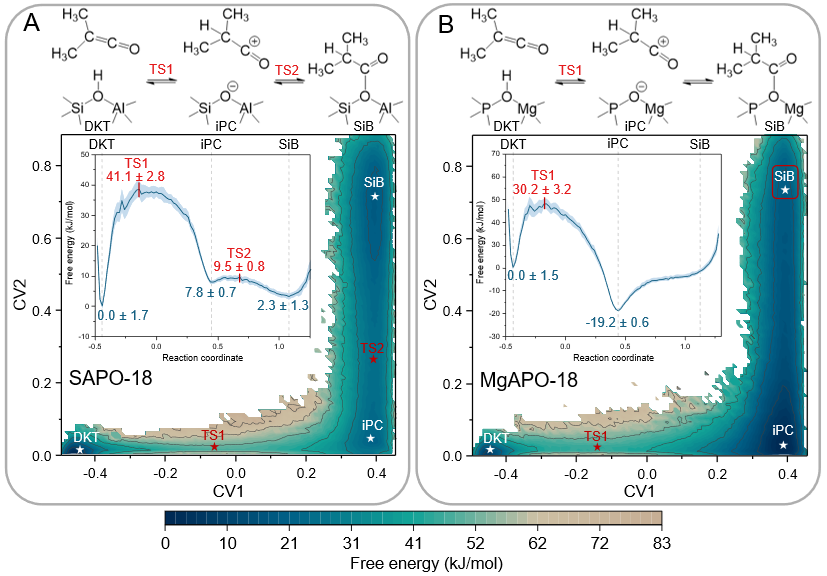
Fig. 8. 2D free energy surfaces of dimethyl ketene (DKT) protonation to isopropionyl cation (iPC) and surface isobutyrate (SiB) in SAPO-18 (A) and MgAPO-18 (B) at 673 K. The inset graphs show the 1D projection of the 2D free energy surface along with the reaction coordinate (CV1+CV2).
| SAPO-18 | MgAPO-18 | |
|---|---|---|
| Ketene | 24.6% | 22.7% |
| Acetyl cation | — | 32.5% |
| Surface acetate | 73.4% | 44.8% |
| Methyl ketene | 39.5% | 8.4% |
| Propionyl cation | — | 61.1% |
| Surface propionate | 60.5% | 30.5% |
| Dimethyl ketene | 52.2% | 3.1% |
| Isopropionyl cation | 13.0% | 96.9% |
| Surface isobutyrate | 34.8% | — |
Table 1 Thermodynamic stability analysis of all three species in steady states at 673 K based on FPMD-US simulations.
| SAPO-18 | MgAPO-18 | |
|---|---|---|
| Ketene | 24.6% | 22.7% |
| Acetyl cation | — | 32.5% |
| Surface acetate | 73.4% | 44.8% |
| Methyl ketene | 39.5% | 8.4% |
| Propionyl cation | — | 61.1% |
| Surface propionate | 60.5% | 30.5% |
| Dimethyl ketene | 52.2% | 3.1% |
| Isopropionyl cation | 13.0% | 96.9% |
| Surface isobutyrate | 34.8% | — |
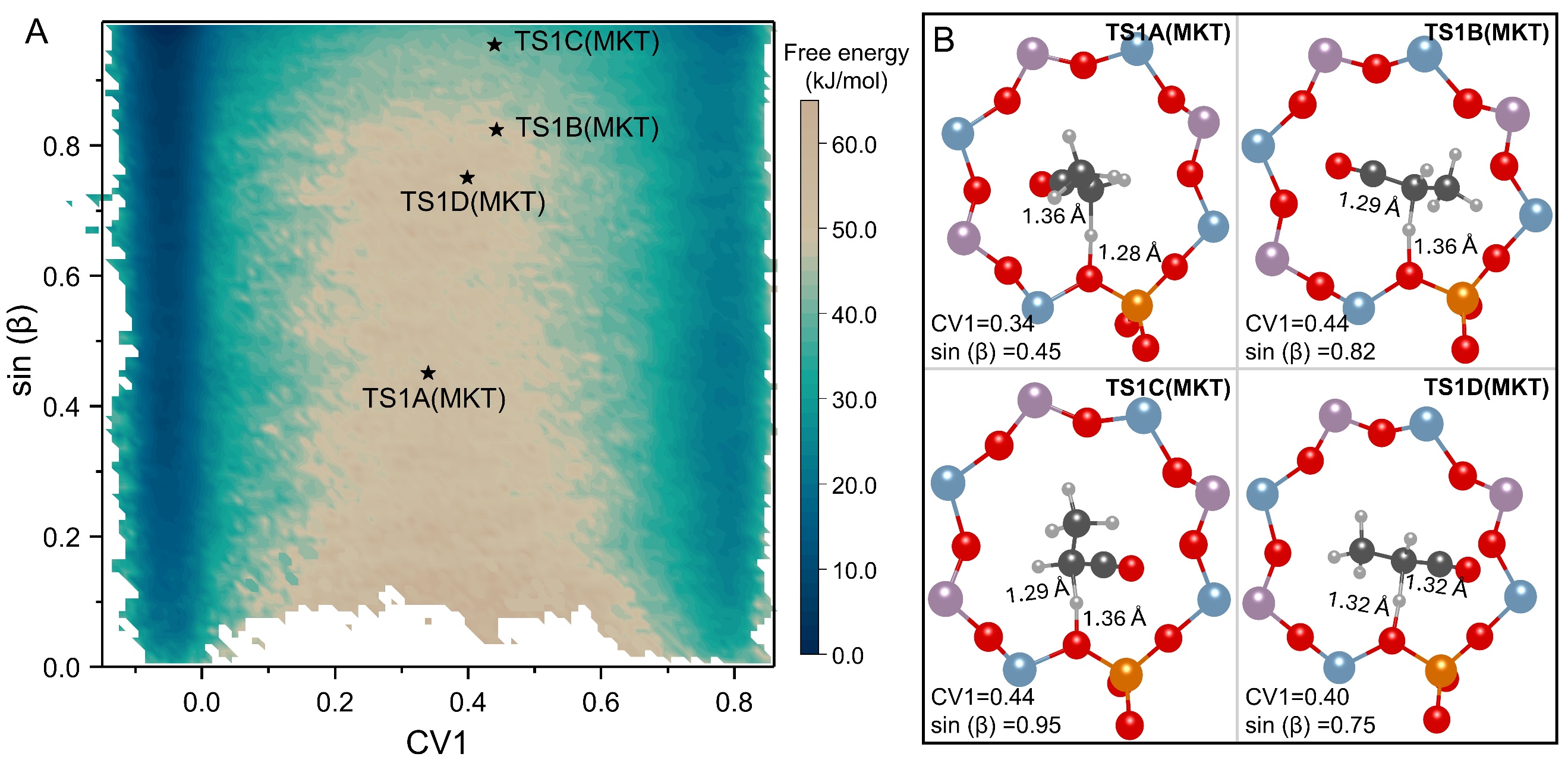
Fig. 9. (A) 2D deprojection of free energy surface for MKT protonation in SAPO-18 along with sin (β), β is the angle between $\overrightarrow{r_{c}}$ and $\overrightarrow{r_{M K T}}$ to describe the orientation of MKT protonation. More details about the definition of β are provided in Fig. S7. (B) Transition state structures for MKT protonation in SAPO-18 using the revPBE-D3/TZVP method. All other atoms were hidden for better visualization. Atom colors: carbon, black; oxygen, red; hydrogen, white; silicon, orange; aluminum, cyan; phosphorus, purple.
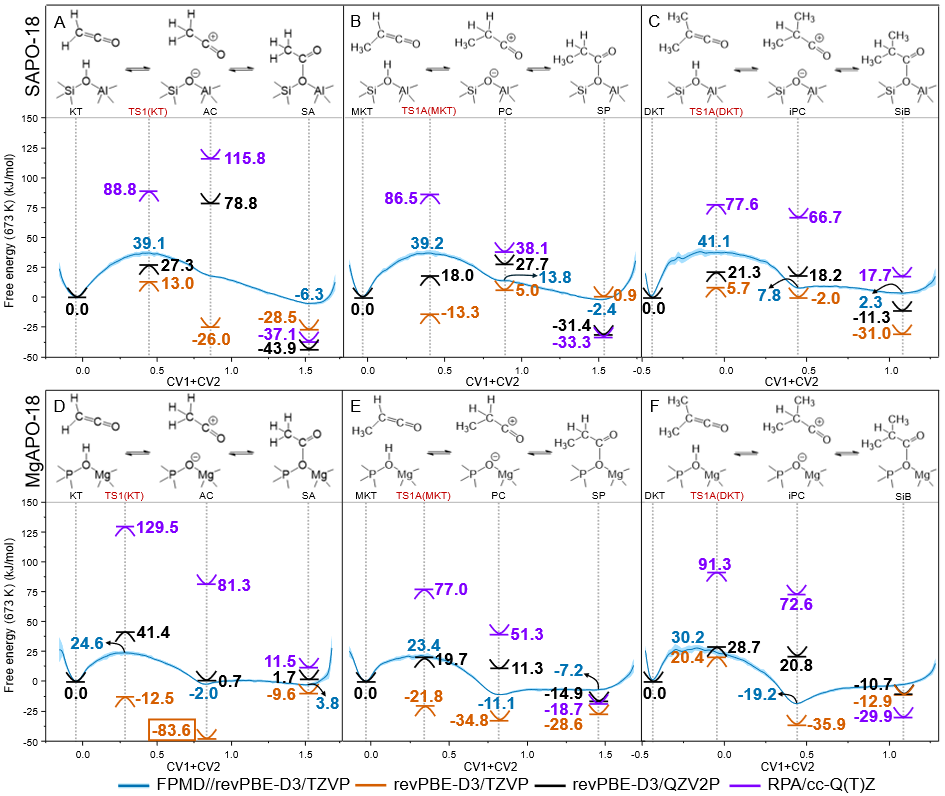
Fig. 10. Free energy surfaces of the protonation of ketene (A,D), methyl ketene (B,E), and dimethyl ketene (C,F) in SAPO-18 (A-C) and MgAPO-18 (D-F) obtained by static calculations and FPMD simulations at 673 K. Upward-opening parabola: local minima; downward-opening parabola: transition states.
|
| [1] | 姜建伟, Minji Kang, Jeongcheol Shin, Kiyoung Park, Sungho Yoon. 具有磁性回收性能的钴纳米颗粒催化剂用于高选择性高性能环氧化合物羰基化制备β-内酯[J]. 催化学报, 2026, 86(7): 89-98. |
| [2] | 万自杰, 杨矞琦, 王振权, 武林睿, 张海鹏, 时晴芳, 刘翔, 杨翰林, 康博晗, 徐泉, 罗佳庆, 刘坚. 空间限制与含氮缺陷锚定协同增强钌纳米颗粒催化剂在工业电流密度下的析氢性能[J]. 催化学报, 2026, 84(5): 130-143. |
| [3] | 潘润, Abubakar Yusuf, 王成俊, 李建荣, 肖旨育, 刘帅, 钟易东, 任勇, 王筝, 杜海南, 周俊良, 陈政, 何俊. 核壳结构Pd@CeO2/γ-Al2O3催化剂: 提升化学计量比天然气车辆废气处理的效率与耐久性[J]. 催化学报, 2026, 82(3): 348-362. |
| [4] | 李锋, 马野, 万明宇, 吕雅婷, 袁家敏, 韩世超, 马后逾, 王亮, 孟祥举, 郑安民, 马延航, 肖丰收. 纯硅β沸石担载的Ag-Mn催化剂高效臭氧分解[J]. 催化学报, 2026, 82(3): 292-300. |
| [5] | 石苗苗, 何月轩, 张宁, 鲍迪, 赵大明, 钟海霞, 鄢俊敏, 蒋青. 室温下直接电化学液氨分解实现现场产氢[J]. 催化学报, 2026, 81(2): 310-318. |
| [6] | 刘瑞源, 殷成阳, 钟城明, 侯嘉, 宋潇飞, 刘坚, 赵震. 铜基分子筛NH3-SCR催化剂的基本见解:二十年的进展和未来展望[J]. 催化学报, 2026, 89(10): 76-101. |
| [7] | 时文博, 朱凯, 付小刚, 刘陈红, 原洋, 潘家梁, 张庆, 白正宇. 双位点限域策略调控Fe-N-C电子结构提升质子交换膜燃料电池氧还原性能[J]. 催化学报, 2026, 80(1): 293-303. |
| [8] | 徐燕东, 景子慧, 苏雯皓, 徐加乐, 王明亮. B-TiO2@COF S型双功能光催化剂上过氧化氢生产与糠酸合成的协同耦合效应[J]. 催化学报, 2026, 80(1): 135-145. |
| [9] | 王舟舟, 周前程, 罗丽, 史雅然, 李浩然, 王春春, 林可聖, 王成思, 朱利兵, 韩凌云, 邢卓, 余颖. 钨掺杂稳定钼酸钴的钴-氧-钼点对点连接结构用于中性析氧反应[J]. 催化学报, 2025, 76(9): 146-158. |
| [10] | 衣启松, 林露, 耿华伟, 陈少华, 邵元超, 何平, 刘志峰, 许海梅, 陈铁红, 刘远帅, Valentin Valtchev. 氟离子介导酸性体系合成H-ZSM-5分子筛及其液相环己醇催化转化性能研究[J]. 催化学报, 2025, 74(7): 97-107. |
| [11] | 张昊, 熊小松, 汪涛, 吴宇平. 动态氢插层催化[J]. 催化学报, 2025, 74(7): 1-3. |
| [12] | 李晨浩, 王昊, 王卫卫, 白烁, 公忠彬, 桑勤勤, 张雨晴, 霍锋, 刘艳荣. PtCu纳米枝晶催化剂及其增强质子交换膜燃料电池稳定性研究[J]. 催化学报, 2025, 73(6): 322-333. |
| [13] | 李如硕, 班涛, 赵丹凤, 胡发杰, 林璟, 黄秀兵, 陶志平, 王戈. 缺陷UiO-66(Ce)负载的具有优化微环境和电子态的镍纳米颗粒用于高效烯烃加氢反应[J]. 催化学报, 2025, 72(5): 344-358. |
| [14] | 陈繁荣, 傅佳驹, 丁亮, 卢晓英, 蒋哲, 张小玲, 胡劲松. 硫锚定策略提升亚3纳米In2S3纳米颗粒电还原CO2至甲酸盐的稳定性[J]. 催化学报, 2025, 71(4): 138-145. |
| [15] | 李德正, 刘会敏, 肖雪文, 赵曼淇, 贺德华, 雷一鸣. 碳扩散机制作为有效的稳定性增强策略——以镍基催化剂用于光热催化甲烷干重整为例的研究[J]. 催化学报, 2025, 70(3): 399-409. |
| 阅读次数 | ||||||
|
全文 |
|
|||||
|
摘要 |
|
|||||


