
Chinese Journal of Catalysis ›› 2026, Vol. 90: 276-286.DOI: 10.1016/S1872-2067(26)65119-4
• Articles • Previous Articles Next Articles
Bingzhi Li, Ganggang Li*( ), Zeyu Zhao, Fenglian Zhang, Zhongshen Zhang, Jie Cheng, Zhengping Hao*()
Received:2026-02-23
Accepted:2026-04-17
Online:2026-11-05
Published:2026-09-09
About author:First author contact: Bingzhi Li: Investigation, Formal analysis, Data curation, Validation, Writing-original draft. Ganggang Li: Investigation, Methodology, Writing review and editing, Funding acquisition. Zeyu Zhao: Formal analysis, Data curation. Fenglian Zhang: Formal analysis. Zhongshen Zhang: Formal analysis. Jie Cheng: Formal analysis. Zhengping Hao: Methodology, Formal analysis, Writing review and editing, Funding acquisition.
Supported by:Bingzhi Li, Ganggang Li, Zeyu Zhao, Fenglian Zhang, Zhongshen Zhang, Jie Cheng, Zhengping Hao. Oxygen vacancy-mediated asymmetric Ni-Ov-Co sites for efficient low-temperature N2O decomposition[J]. Chinese Journal of Catalysis, 2026, 90: 276-286.
Add to citation manager EndNote|Ris|BibTeX
URL: https://www.cjcatal.com/EN/10.1016/S1872-2067(26)65119-4
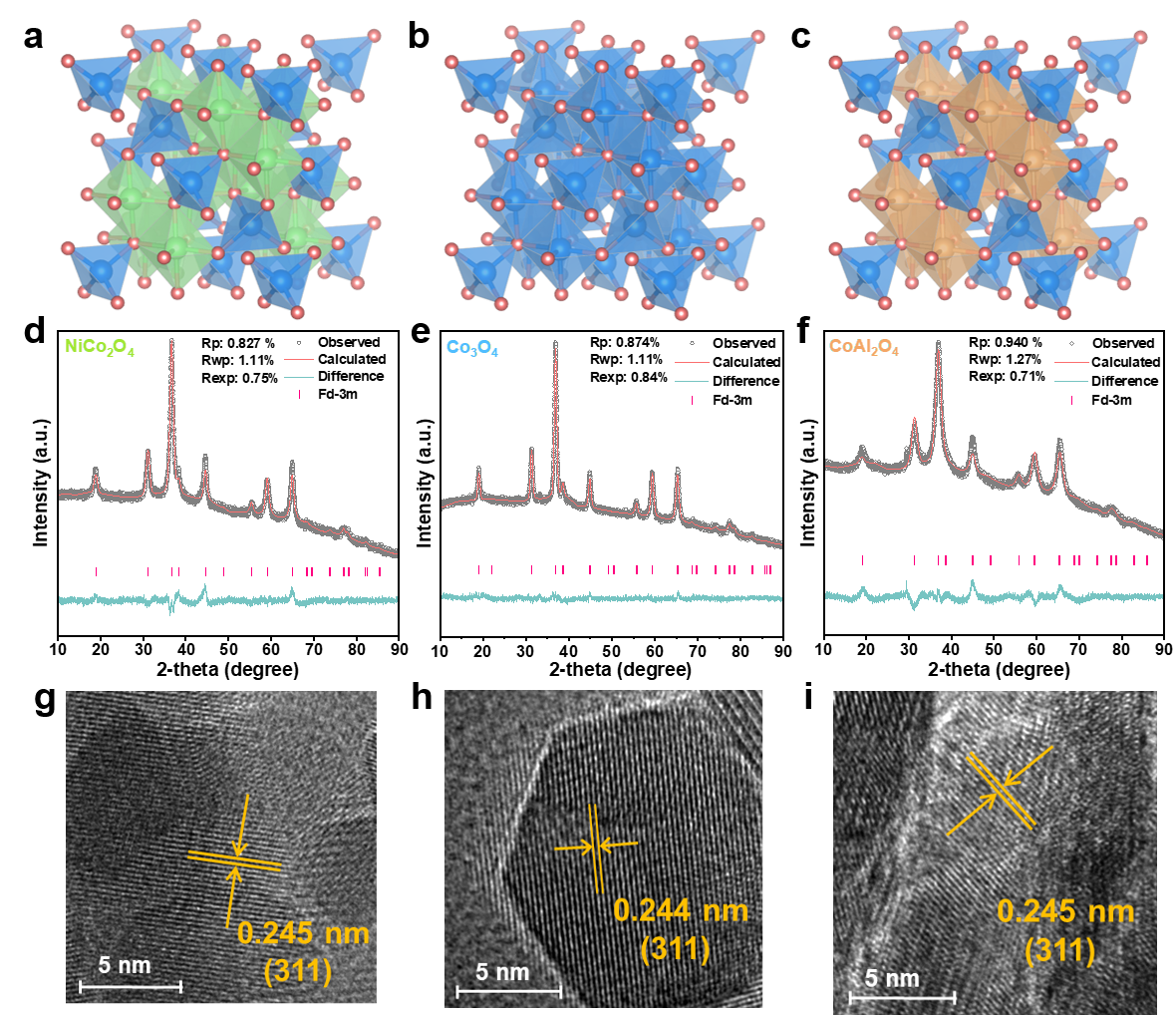
Fig. 1. Structural and morphological characterization of spinel oxide catalysts. (a-c) Crystal structure models of NiCo2O4, Co3O4, and CoAl2O4. (d-f) Rietveld-refined XRD patterns of NiCo2O4, Co3O4, and CoAl2O4. (g-i) HAADF-STEM images of NiCo2O4, Co3O4, and CoAl2O4.
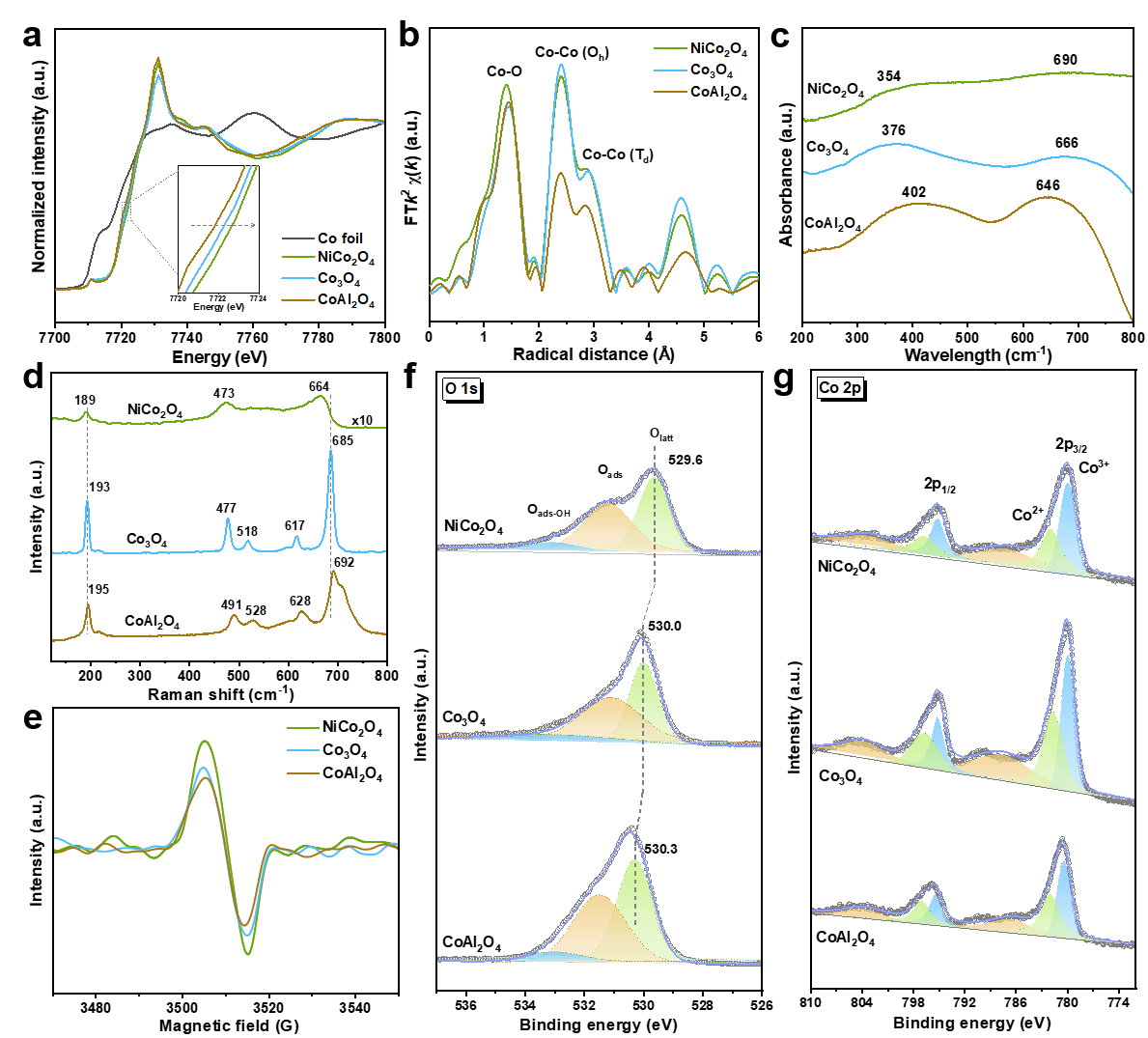
Fig. 2. Electronic structure and defect characterization of spinel oxide catalysts. Co K-edge XANES (a) and Fourier-transformed EXAFS spectra (b) of NiCo2O4, Co3O4, and CoAl2O4. (c) UV-vis spectra. (d) Raman spectra. (e) EPR spectra. O 1s (f) and Co 2p (g) XPS spectra.
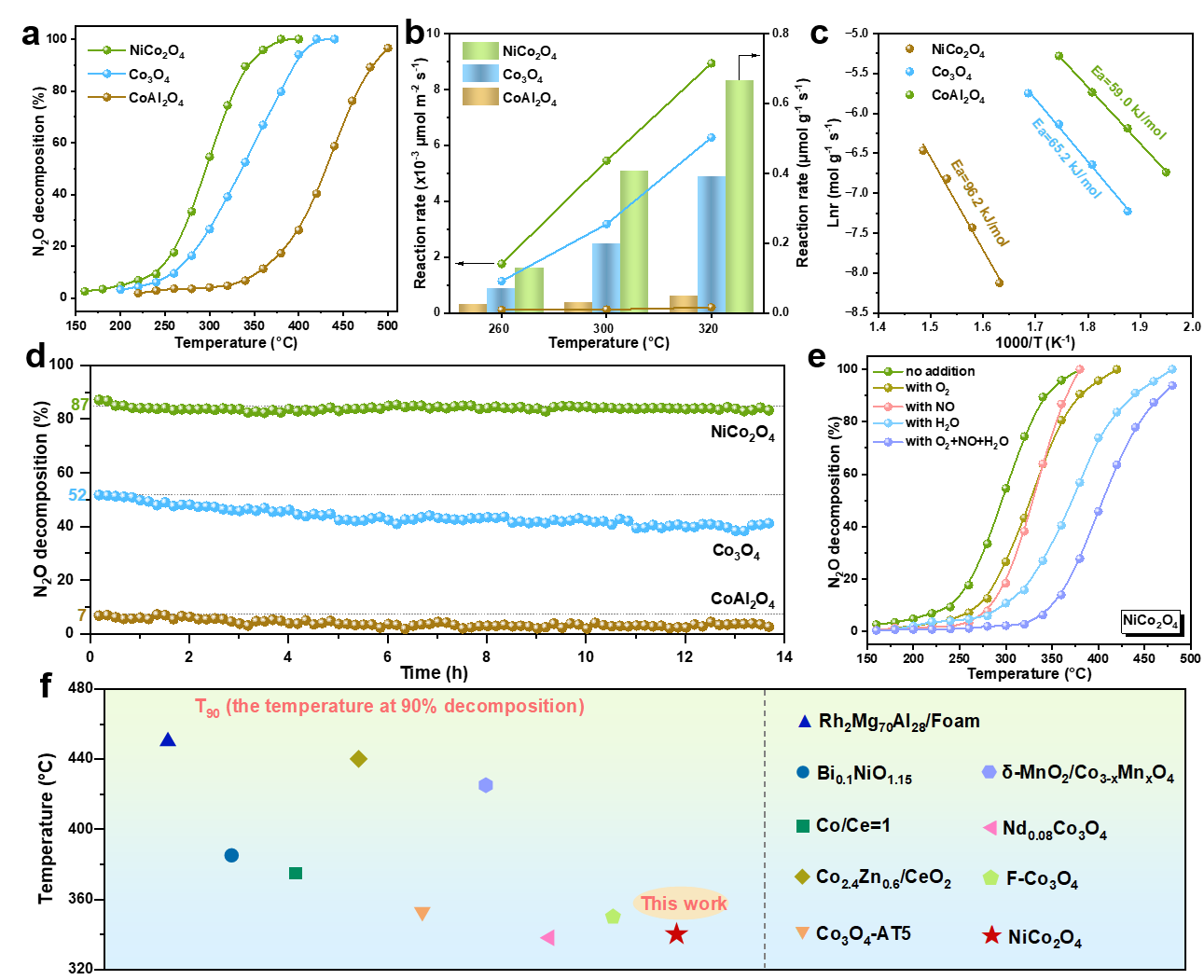
Fig. 3. Catalytic performance and stability of spinel oxide catalysts toward N2O decomposition. (a) N2O decomposition profiles over NiCo2O4, Co3O4, and CoAl2O4. (b) Reaction rates of the catalysts at different temperatures. (c) Arrhenius plots used to calculate apparent activation energies. (d) Stability tests conducted at 340 °C. (e) Tolerance evaluation of NiCo2O4 in the presence of potential impurities (O2, NO, and H2O). (f) The comparison of T90 for different reported catalysts (the X-axis has no physical significance).
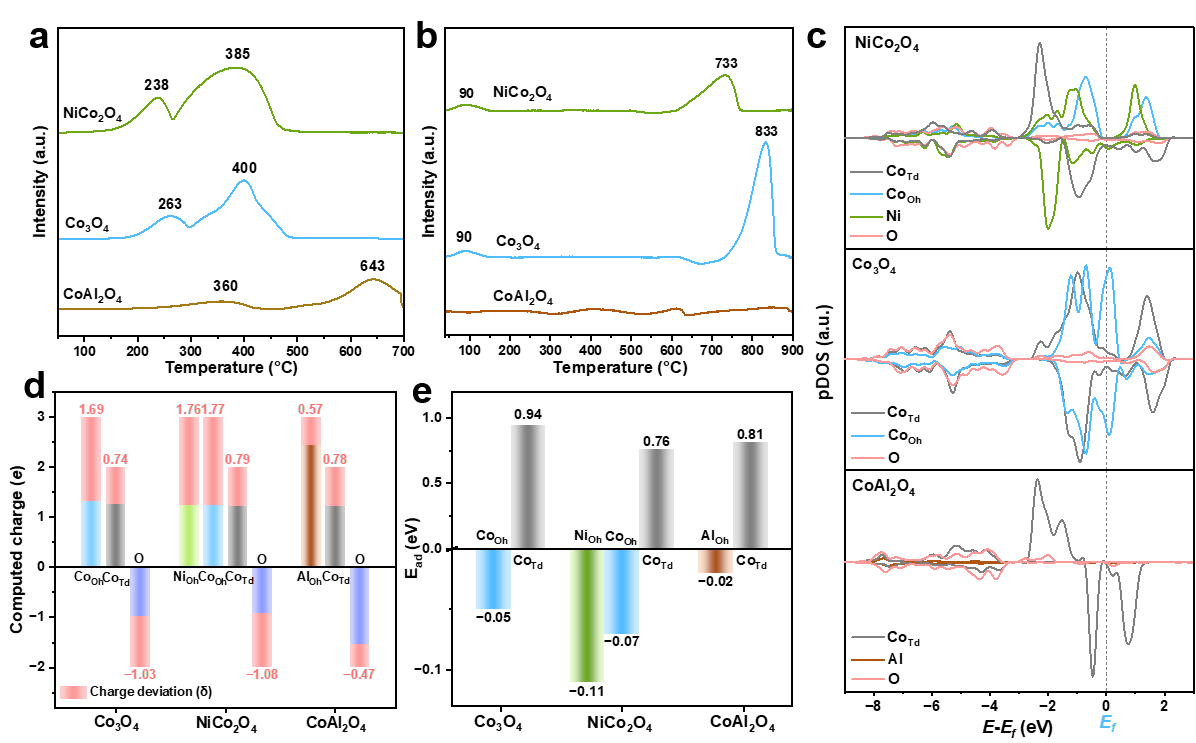
Fig. 4. Redox properties and electronic structure analysis of spinel oxide catalysts. H2-TPR profiles (a), O2-TPD profiles (b), PDOS (c) of Ni, Co, Al, and O orbitals, the blue dashed line implies the Fermi level energy (Ef). (d) Computed charge distributions of metal and oxygen atoms. (e) Calculated N2O adsorption energies on different surface sites of perfect surfaces of NiCo2O4, Co3O4, and CoAl2O4 spinel oxides.
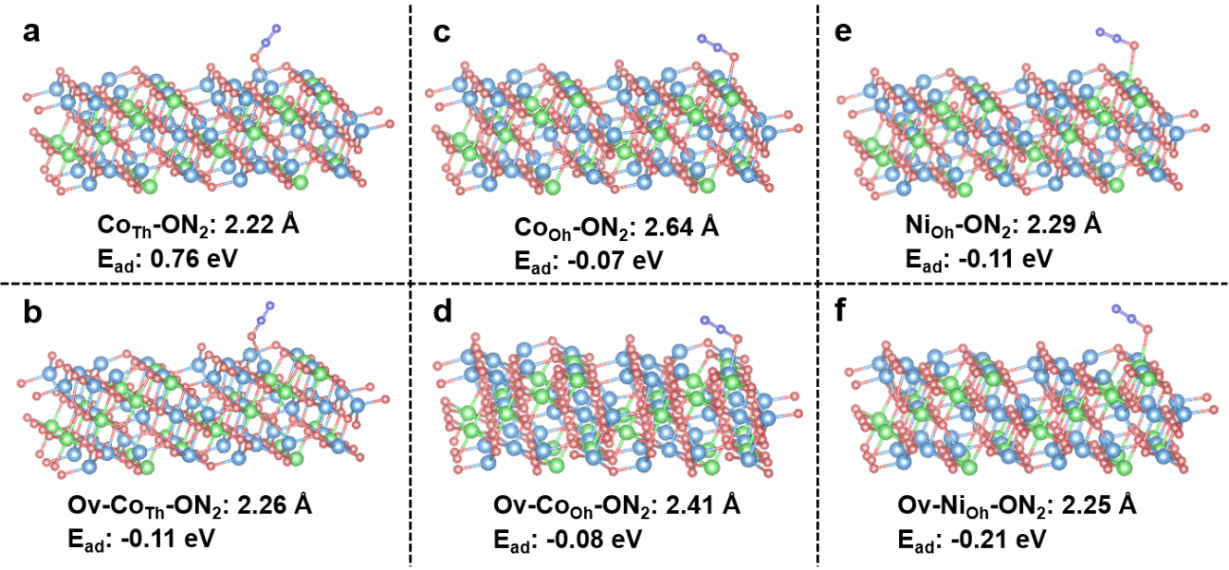
Fig. 5. Model structures of N2O adsorbed on CoTh sites (a,b), CoOh sites (c,d), NiOh sites (e,f) in NiCo2O4 without and with an oxygen vacancy, respectively. The blue balls represent Co, red balls represent O, green balls represent Ni, and purple balls represent N.
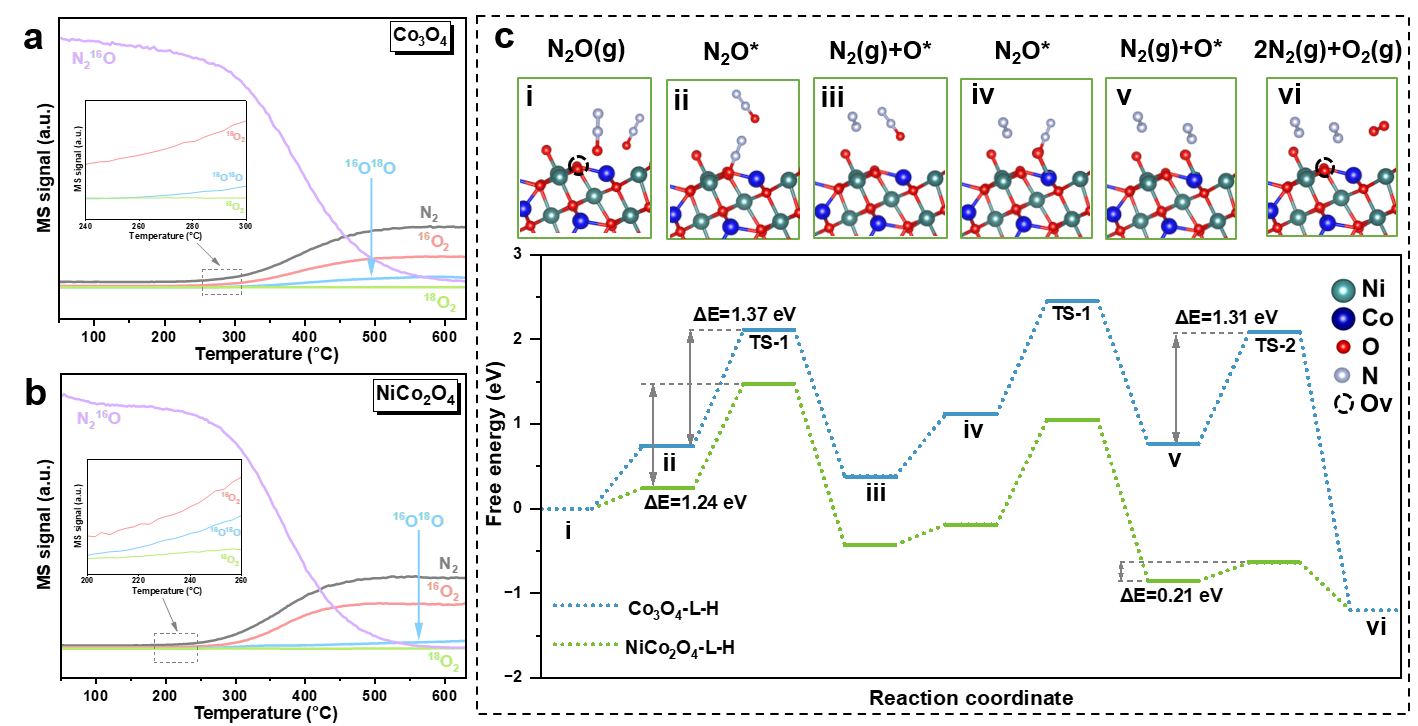
Fig. 6. Mechanistic investigation of N2O decomposition over spinel oxide catalysts. (a,b) TPSR profiles of isotopically labeled Co318O4 and NiCo218O4. (c) Calculated free energy diagrams for N2O decomposition on Co3O4 (311) and NiCo2O4 (311) surfaces with oxygen vacancy.
|
| [1] | Sen Wang, Shiying Li, Rui Geng, Bo Zhou, Pengfei Wang, Zhangfeng Qin, Mei Dong, Jianguo Wang, Unni Olsbye, Weibin Fan. The smallest Ni species triggering selective hydrogenation of CO2 to methane: Ni dimer embedded in MFI and enhancement of MnOx [J]. Chinese Journal of Catalysis, 2026, 87(8): 113-125. |
| [2] | Yang Ding, Yizhen Lu, Tianrong Yu, Mingrui Zhang, Rui Zhao, Ruijie Yang, Qixin Li, Shiqun Wu, Jinlong Zhang. Dual pathways in photo-driven Fischer-Tropsch synthesis for high selective hydrocarbon production [J]. Chinese Journal of Catalysis, 2026, 87(8): 22-46. |
| [3] | Shahla Karimi, Mehran Rezaei, Jiguang Deng, Hongxing Dai, Ali Rastegarpanah. Recent advances in noble metal-based catalysts for methane decomposition: Performance, mechanism, and optimization [J]. Chinese Journal of Catalysis, 2026, 86(7): 9-48. |
| [4] | Jiaying Liu, Yu Fang. Unraveling structure-activity relationships in 2-D covalent organic frameworks for photocatalysis: From molecular engineering to high-performance optimization [J]. Chinese Journal of Catalysis, 2026, 85(6): 47-87. |
| [5] | Jingyao Wu, Yujing Lv, Qiang Zhao, Shuo Wang, Ying Wang, Na Wen, Zhengxin Ding, Zizhong Zhang, Jinlin Long. Electron-proton duet in covalent organic frameworks for efficient direct oxygen reduction to hydrogen peroxide [J]. Chinese Journal of Catalysis, 2026, 84(5): 288-300. |
| [6] | Zhiyao Liu, Tangkang Liu, Chuan Qin, Guoliang Liu, Anmin Zheng. Zirconia-mediated interfacial catalysis for CO2 hydrogenation [J]. Chinese Journal of Catalysis, 2026, 84(5): 1-24. |
| [7] | Yu Gu, Shujia Zhang, Minglu Xu, Hao Yan, Minghao Zhou, Lei Wang, Hui Shi. Dehydroaromatization of methane and methane co-aromatization process with propane: Reaction mechanism, catalyst design, carbon deposition and process optimization [J]. Chinese Journal of Catalysis, 2026, 84(5): 25-60. |
| [8] | Haifeng Fan, Di Xu, Ting Zeng, Guoqiang Hou, Yangyang Li, Siyi Huang, Yanfei Xu, Zheng Wang, Xinhua Gao, Xiang-Kui Gu, Mingyue Ding. Highly efficient electron-enriched Y2O3‒x-Ni interfaces boosting low-temperature CO2 methanation [J]. Chinese Journal of Catalysis, 2026, 84(5): 200-213. |
| [9] | Fan Dang, Chunli Ai, Chi Ma, Zeyu Jiang, Jicheng Liu, Mingjiao Tian, Mingzhuo Zhang, Chi He. Advances in metal oxide catalysts for efficient VOCs oxidation: Synthesis strategy and catalytic mechanism [J]. Chinese Journal of Catalysis, 2026, 81(2): 97-123. |
| [10] | Lingtong Ji, Peimeng Qiu, Qingjun Ma, Peng Li, Shengli Chen. Praseodymium and nickel co-doped Co3O4 enhances oxygen evolution reaction performance via interfacial water optimization and cobalt pre-oxidation for proton exchange membrane water electrolysis [J]. Chinese Journal of Catalysis, 2026, 90(11): 253-263. |
| [11] | Yueyang Yao, Nan Zhang, Ruiqian Jiao, Panpan Liu, Xiangbo Feng, Dandan Ma, Jun Li, Yu Chen, Jian-Wen Shi. Rational design of rare earth-modified Mn-based catalysts for low-temperature NH3-SCR: Mechanisms, strategies, and prospects [J]. Chinese Journal of Catalysis, 2026, 89(10): 40-75. |
| [12] | Lingji Liu, Xiaosheng Yu, Zhou Chen, Xueqing Hai, Yongzhao Wang, Changzhen Wang, Tiancun Xiao. Assembly-line synergistic catalysis in isomorphic substituted Co3O4 nanocomposite for enhanced N2O decomposition [J]. Chinese Journal of Catalysis, 2026, 89(10): 430-443. |
| [13] | Ruiyuan Liu, Chengyang Yin, Chengming Zhong, Jia Hou, Xiaofei Song, Jian Liu, Zhen Zhao. Fundamental insight into copper-based zeolite catalysts for NH3-SCR: Two decades’ progress and future perspectives [J]. Chinese Journal of Catalysis, 2026, 89(10): 76-101. |
| [14] | Ai Yating, A. C. Carabineiro Sónia, Xiong Xianqiang, Zhu Huayue, Wang Qi, Weng Bo, Yang Min-Quan. Systematic assessment of emerging contaminants elimination using an S-scheme Mn0.5Cd0.5S/In2S3 photocatalyst: Degradation pathways, toxicity evaluation and mechanistic analysis [J]. Chinese Journal of Catalysis, 2025, 75(8): 147-163. |
| [15] | Jian-Feng Wu, Li-Ye Liang, Zheng Che, Yu-Ting Miao, Lingjun Chou. Bimetallic oxide catalysts for CO2 hydrogenation to methanol: Recent advances and challenges [J]. Chinese Journal of Catalysis, 2025, 73(6): 62-78. |
| Viewed | ||||||
|
Full text |
|
|||||
|
Abstract |
|
|||||


