
Chinese Journal of Catalysis ›› 2027, Vol. 92: 420-427.DOI: 10.1016/S1872-2067(26)65250-3
• Articles • Previous Articles Next Articles
Ke Fana,*( ), Yuqing Zhua, Yiran Yingb,*()
Received:2026-04-07
Accepted:2026-05-09
Online:2027-01-02
Published:2026-10-30
Contact:
*E-mail: kefan@ahu.edu.cn (K. Fan),Supported by:Ke Fan, Yuqing Zhu, Yiran Ying. Bidirectional catalysis of polysulfides and Li2S redox kinetics by single-atom modified S-MXene for advanced Li-S batteries[J]. Chinese Journal of Catalysis, 2027, 92: 420-427.
Add to citation manager EndNote|Ris|BibTeX
URL: https://www.cjcatal.com/EN/10.1016/S1872-2067(26)65250-3
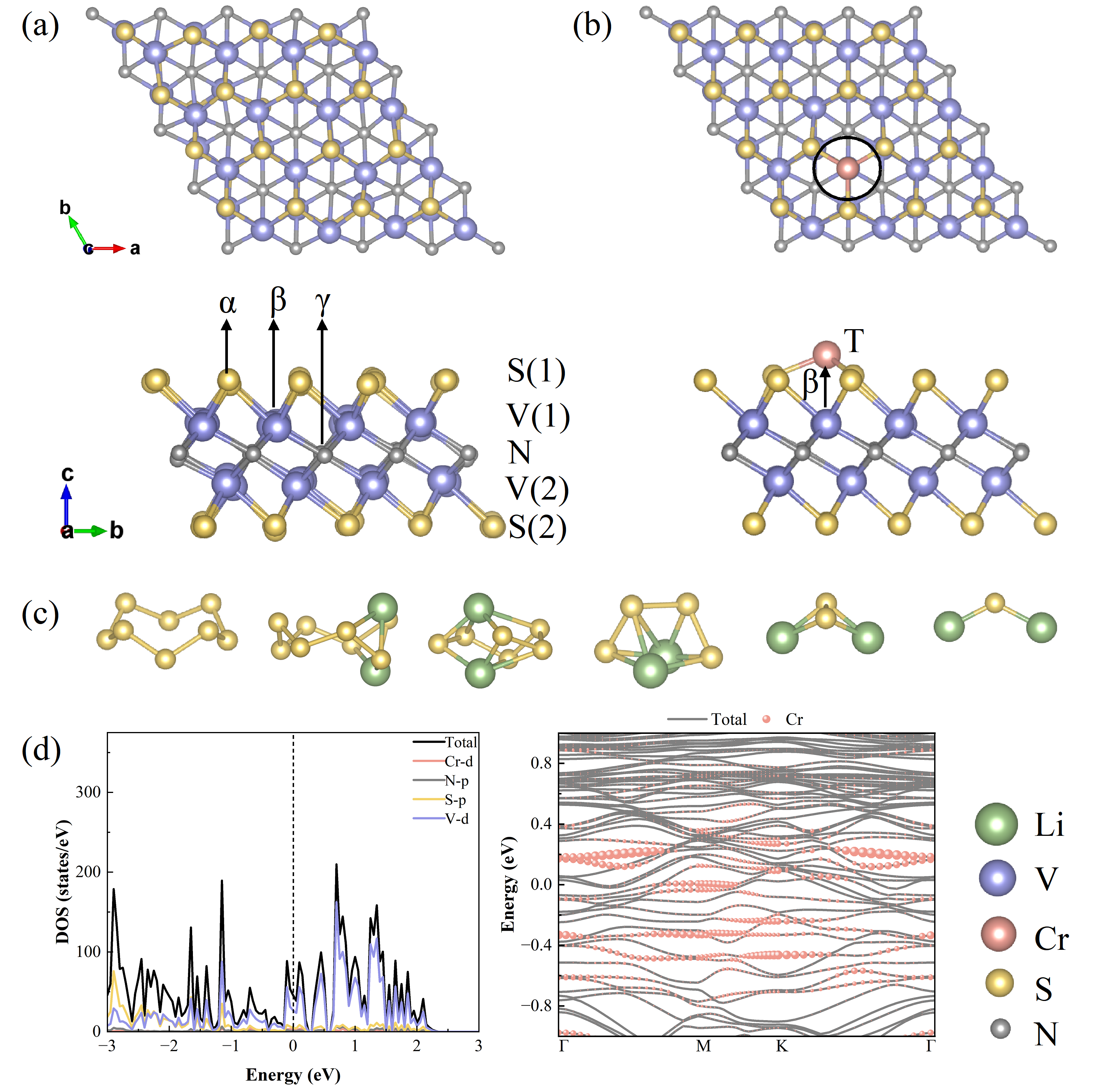
Fig. 1. DFT-optimized geometric structures and electronic structures of V2NS2-T. (a) Top and side view of V2NS2. (b) Top and side view of V2NS2-T (T occupies the β site). (c) S8 and Li2Sn structures. (d) DOS and electronic band structures of V2NS2-Cr.
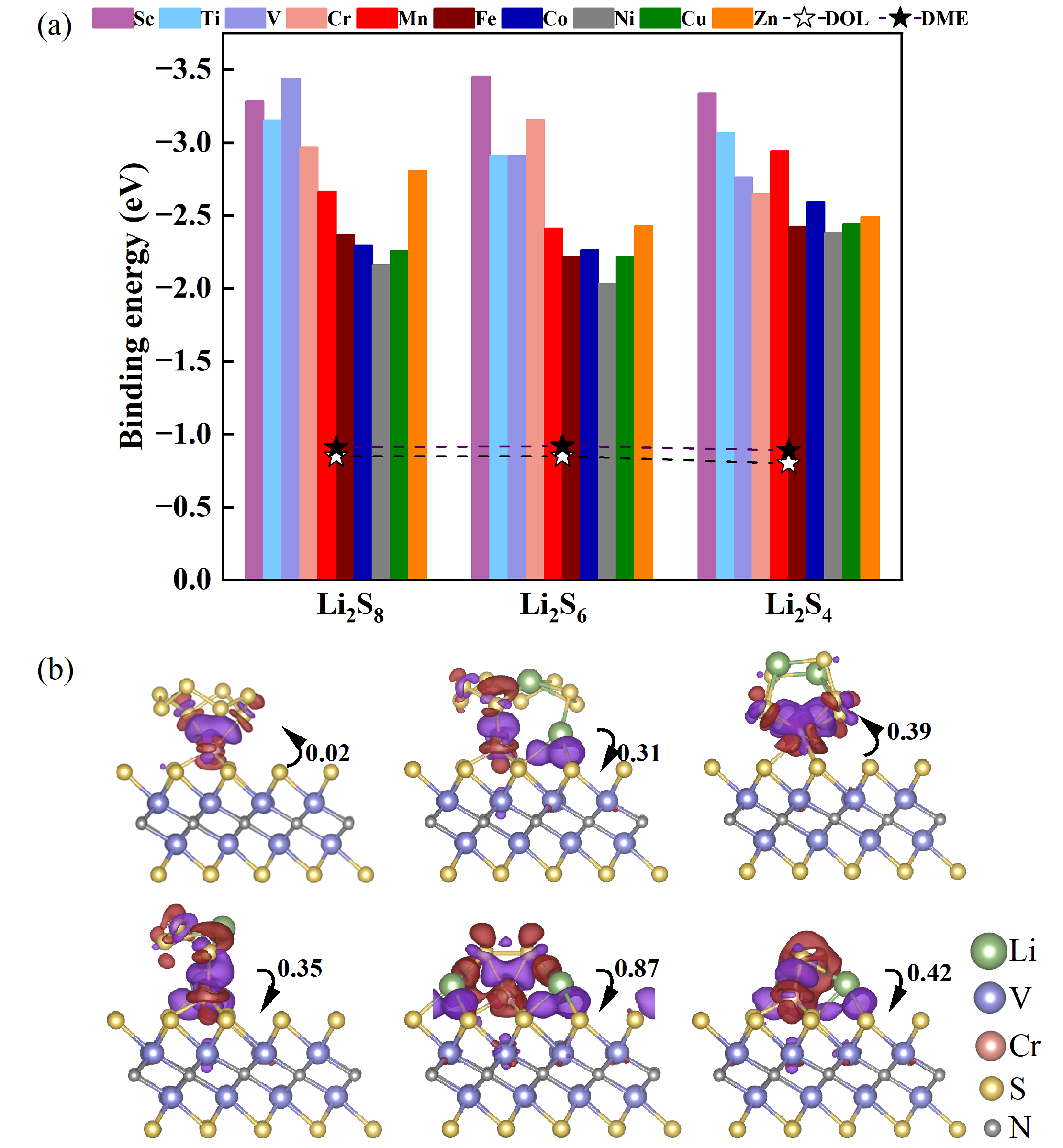
Fig. 2. Li2Sn (n = 4, 6, and 8) adsorption on V2NS2-T. (a) Adsorption energies of Li2Sn on V2NS2-T. (b) The charge density difference maps of S8 and Li2Sn species adsorbed on V2NS2-Cr. The purple and red denote charge accumulation and depletion (isosurface = 0.003 e Bohr‒3). The Bader charge transfer values between adsorbates and substrate are labeled.
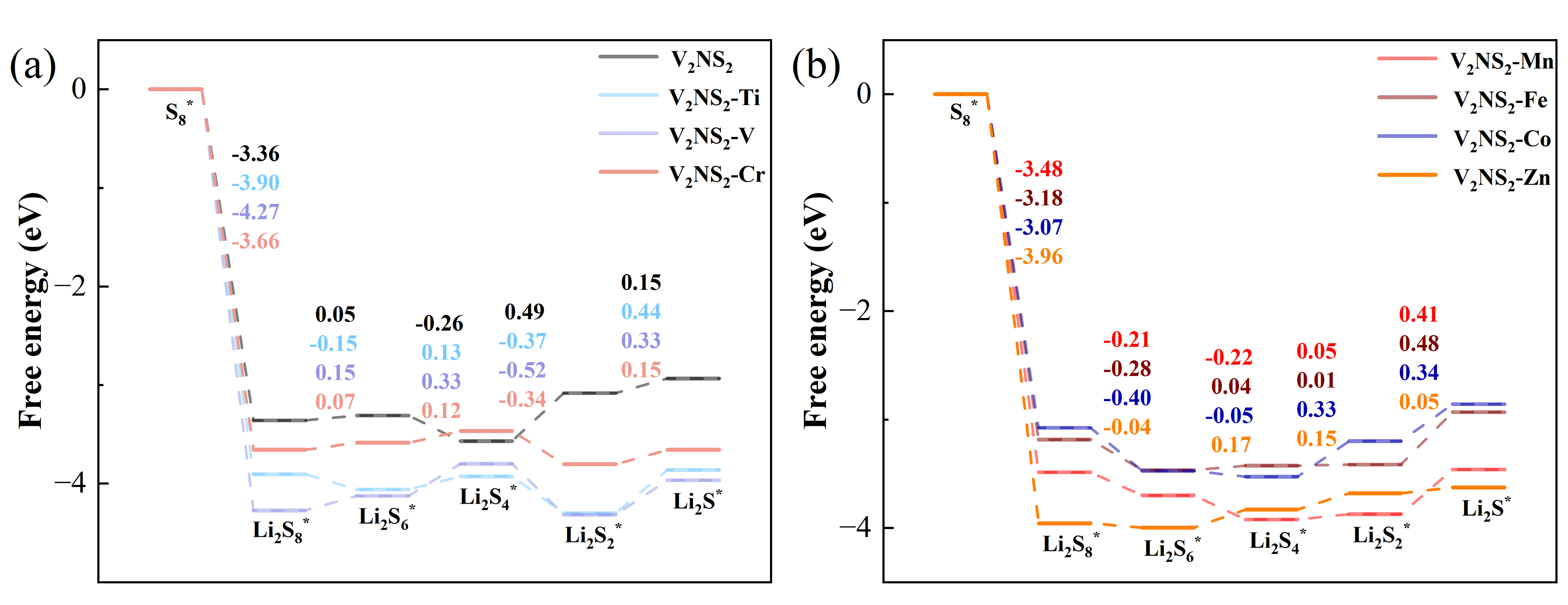
Fig. 3. Profiles of Gibbs free energy along the SRR pathway on V2NS2 and V2NS2-T.

Fig. 4. Li2S adsorption behavior on V2NS2-T. (a) Schematic illustration of the three representative Li2S adsorption configurations on V2NS2-T. (b) Adsorption energies of Li2S on V2NS2-T. (c) ELF maps of V2NS2-Cr. (d) COHP diagrams for V2NS2-V and V2NS2-Co.
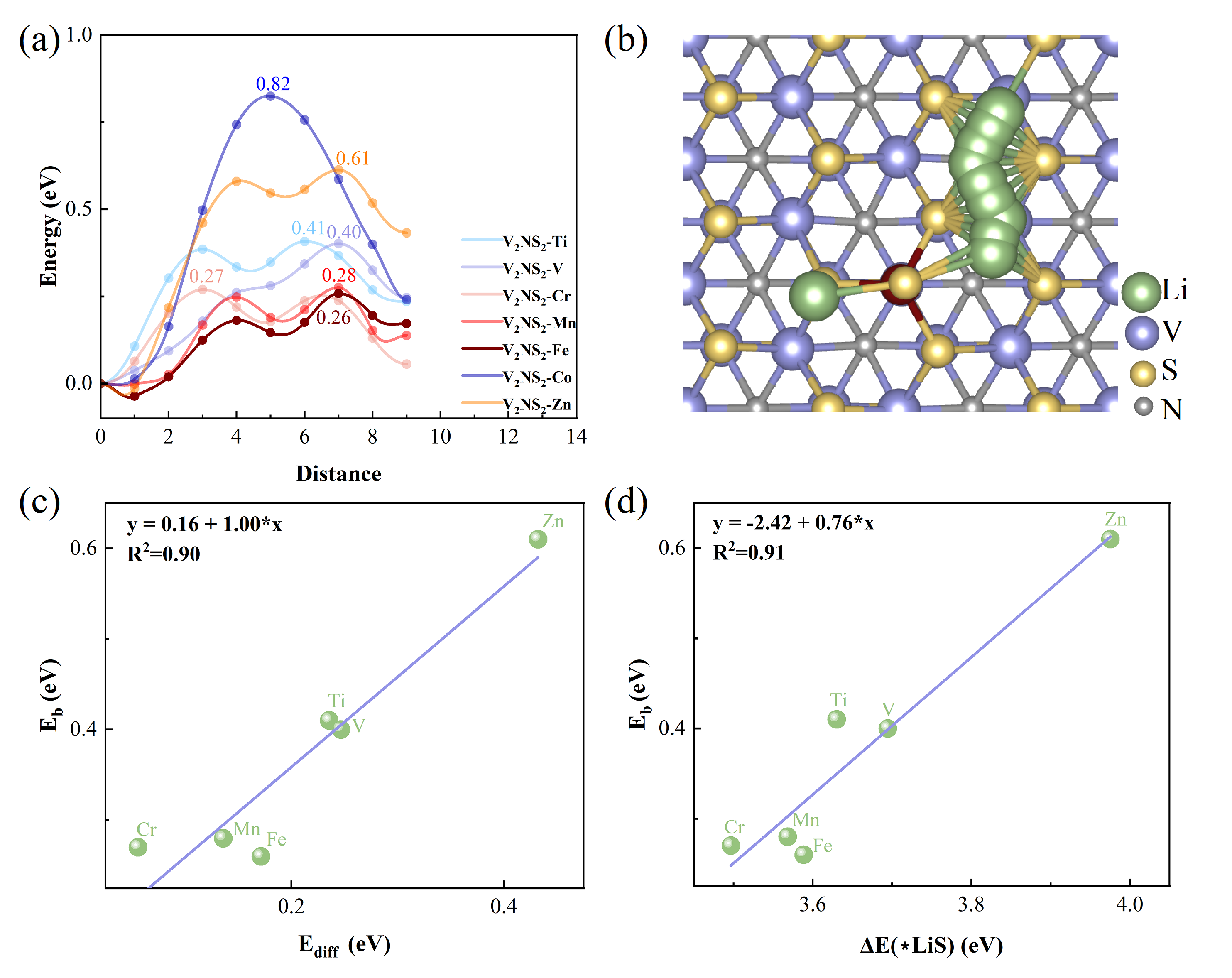
Fig. 5. Li2S decomposition barriers (Eb) and corresponding descriptors. (a) Energy profiles of Li2S decomposition on V2NS2-T monolayer. (b) The energetically preferable Li2S decomposition pathway on V2NS2-Cr. Scatters of Eb versus Ediff (c), and ΔE (d) (*LiS). The purple lines denote best-fit lines. The correlation functions and R2 values are provided.
|
| [1] | Yuxing Xu, Yin Li, Hengwei Wang, Botao Teng, Junling Lu. Frontier orbital insights into the stability and activity of zero-valent single-atom catalysts [J]. Chinese Journal of Catalysis, 2027, 92(1): 123-129. |
| [2] | Jiaqi Li, Haojie Song, Yuxin Gao, Xinming Zhang, Jingnan Li, Siyu Wang, Huiquan Gu, Laiyu Luo, Baojiang Jiang. Decoupled active centers on crystalline carbon nitride nanoarrays for synergistic photocatalytic hydrogen peroxide synthesis [J]. Chinese Journal of Catalysis, 2027, 92(1): 157-169. |
| [3] | Anqi Li, Yusen Chen, Xiaoli Pan, Yujing Ren, Hongchen Cao, Guiyue Bi, Xiaofeng Yang, Aiqin Wang, Tao Zhang. Pt1/FeOx single-atom catalyst with dual-valent Pt sites for water-promoted hydrogenation of nitroarenes [J]. Chinese Journal of Catalysis, 2027, 92(1): 410-419. |
| [4] | Yang Wang, Cun-Feng Fan, Yang Liu, Xiao-Qin Zheng, Xuan-Yi Liu, Kai Zhang, Jiahui Kou, Hengming Huang, Lin-Bing Sun. Iron single-atom catalysts created in constrained space with in-situ-formed carbon layers for efficient Fenton reaction [J]. Chinese Journal of Catalysis, 2026, 88(9): 432-441. |
| [5] | Sathi Chatterjee, Hongmei Li, Kang Liu, Zhang Lin, Liyuan Chai, Min Liu. Single-atom catalysts on two-dimensional (2D) materials for photocatalytic CO2 reduction: Fundamentals, design, and emerging strategies [J]. Chinese Journal of Catalysis, 2026, 88(9): 86-128. |
| [6] | Yueling Chen, Yuling Lin, Ziyan Chen, Xiangyu Kong, Jinhong Bi, Guocheng Huang, Ling Wu. Asymmetric N-Ru-S dipole within covalent organic framework enhances internal electric field for efficient CO2 photoreduction [J]. Chinese Journal of Catalysis, 2026, 87(8): 59-69. |
| [7] | Jianglin Duan, Pengcheng Deng, Huifeng Xiong, Na Yang, Xueling Zhou, Jingwen Wang, Rui Zhang, Dan Feng, Ji Yang, Yong Qin, Yujing Ren. Subangstrom spatial regulation of Fe1-N4 coordination structure for remarkably efficient C‒H bond oxidation [J]. Chinese Journal of Catalysis, 2026, 87(8): 305-315. |
| [8] | Yi-Wen Han, Run-Yu Liu, Yu-Xin Zhang, Lei Ye, Phuc T. T. Nguyen, Tian-Jun Gong, Xue-Bin Lu, Yao Fu, Ning Yan. Establishing built-in electric field within single-atom-anchored hollow architectures for efficient solar-thermal regulation in plastic photoreforming [J]. Chinese Journal of Catalysis, 2026, 84(5): 301-313. |
| [9] | Yongsheng Hu, Shiji Du, Jihui Lang, Huilian Liu, Xuefei Li, Qi Zhang, Ming Lu, Xin Li, Binrong Li, Maobin Wei, Lili Yang. Rational construction of MXene-derived TiO2/CoNiO2 dual-site S-scheme heterojunction for boosting C-C coupling toward efficient photocatalytic CO2-to-C2H4 conversion [J]. Chinese Journal of Catalysis, 2026, 81(2): 227-245. |
| [10] | Yujia Zhao, Xianquan Li, Rizheng Jing, Jifeng Pang, Wenguang Yu, Hua Wang, Feifei Xu, Mingyuan Zheng. Efficient and stable conversion of ethanol/acetaldehyde to 1,3-butadiene over a Zr1/NC@SBA-15 single-atom catalyst [J]. Chinese Journal of Catalysis, 2026, 91(12): 327-340. |
| [11] | Ting Li, Xiaohui Chen, Xiaolin Li, Qi Xiao, Hongqun Luo, Nianbing Li. Autogenous force-mediated assembly: A general strategy for constructing single-atom architectures in hierarchical hybrid electrocatalysts [J]. Chinese Journal of Catalysis, 2026, 89(10): 232-245. |
| [12] | Yufeng Jiang, Shaobin Li, Li Zhang, Yang Yang, Kun Cheng, Fengbo Li, Xiaoqing Lv. MXene quantum dots induced Ni site d-band center self-optimization for advanced photovoltaic-driven urea-assisted water splitting [J]. Chinese Journal of Catalysis, 2026, 89(10): 207-217. |
| [13] | Xin Song, Zhonghua Li, Li Sheng, Yang Liu. Spin density symmetry breaking-mediated hydrogen evolution in single-atom catalysts [J]. Chinese Journal of Catalysis, 2026, 80(1): 213-226. |
| [14] | Gang Wang, Imran Muhammad, Hui-Min Yan, Jun Li, Yang-Gang Wang. Regulating the local environment of Ni single-atom catalysts with heteroatoms for efficient CO2 electroreduction [J]. Chinese Journal of Catalysis, 2025, 74(7): 120-129. |
| [15] | Eryu Wang, Yi-Chun Chu, Wenjun Zhang, Yanping Wei, Chuanling Si, Regina Palkovits, Xin-Ping Wu, Zupeng Chen. Sustainable co-production of H2 and lactic acid from lignocellulose photoreforming using Pt-C3N4 single-atom catalyst [J]. Chinese Journal of Catalysis, 2025, 74(7): 308-318. |
| Viewed | ||||||
|
Full text |
|
|||||
|
Abstract |
|
|||||


