
Chinese Journal of Catalysis ›› 2026, Vol. 91: 376-385.DOI: 10.1016/S1872-2067(26)65034-6
• Articles • Previous Articles Next Articles
Rong Jia,b, Jingran Yia, Xinyu Suna, Yuming Donga,*( ), Chengsi Pana, Hui Zhaoa, Yongfa Zhuc
Received:2025-12-23
Accepted:2026-02-22
Online:2026-12-18
Published:2026-10-13
Supported by:Rong Ji, Jingran Yi, Xinyu Sun, Yuming Dong, Chengsi Pan, Hui Zhao, Yongfa Zhu. Enhanced Fe(III)/Fe(II) cycle in heterogeneous photocatalysis-self-Fenton system for organic pollutants degradation[J]. Chinese Journal of Catalysis, 2026, 91: 376-385.
Add to citation manager EndNote|Ris|BibTeX
URL: https://www.cjcatal.com/EN/10.1016/S1872-2067(26)65034-6
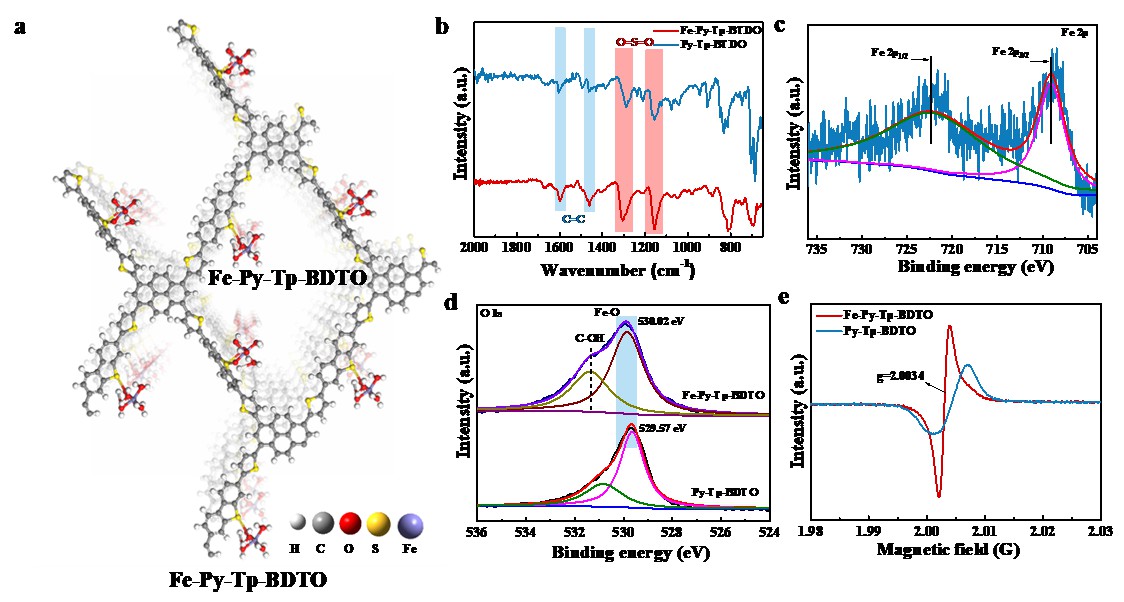
Fig. 1. (a) The structure of Fe-Py-Tp-BDTO. (b) FT-IR spectra of Fe-Py-Tp-BDTO and Py-Tp-BDTO. (c) The XPS spectra of Fe 2p of Fe-Py-Tp-BDTO. (d) O 1s XPS spectra of Py-Tp-BDTO and Fe-Py-Tp-BDTO. (e) The quasi in-situ EPR spectra of Py-Tp-BDTO and Fe-Py-Tp-BDTO.
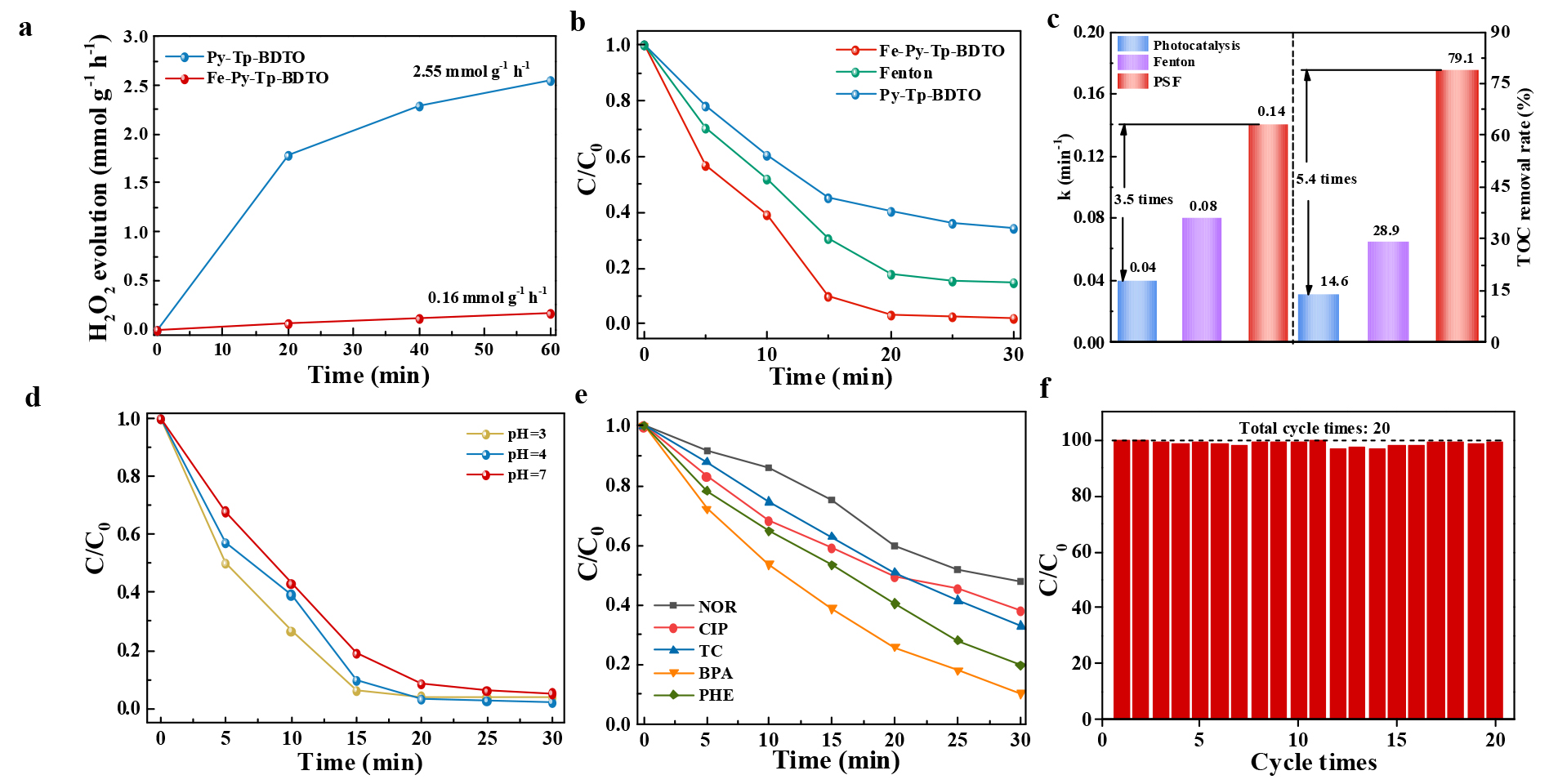
Fig. 2. (a) Time profiles of H2O2 production for all samples in 4-chlorophenol solution. (b) Degradation ability for 4-chlorophenol over different systems. (c) k-value and TOC removal rate for different systems. (d) Heterogeneous photocatalysis-self-Fenton (PSF) degradation curves at different pH. (e) Wide applicability for various organic pollutants over photocatalysis-self-Fenton system: removal rate within 30 min over Fe-Py-Tp-BDTO. (f) Heterogeneous photocatalysis-self-Fenton cycle performance (Condition: catalyst=0.6 g L-1, 4-chlorophenol=10 mg L-1, 300 W Xe lamp, AM1.5. Concentration of organic pollutants: 10 mg L-1, BPA: bisphenol A, CIP: ciprofloxacin; NOR: norfloxacin; PHE: phenol; TC: tetracycline).
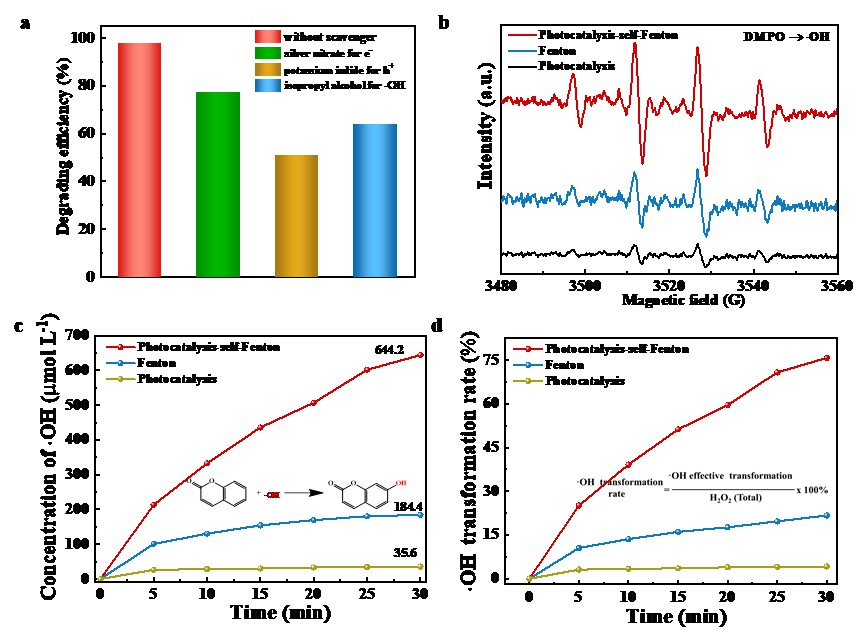
Fig. 3. (a) Free radical capture degradation curve over Fe-Py-Tp-BDTO. (b) EPR spectra of DMPO-•OH for all systems. (c) •OH yield profile of systems. (d) •OH transformation rate over photocatalysis-self-Fenton system and Fenton technology (Condition: catalyst=0.6 g L-1, 4-chlorophenol=10 mg L-1, 300 W Xe lamp, AM 1.5G).
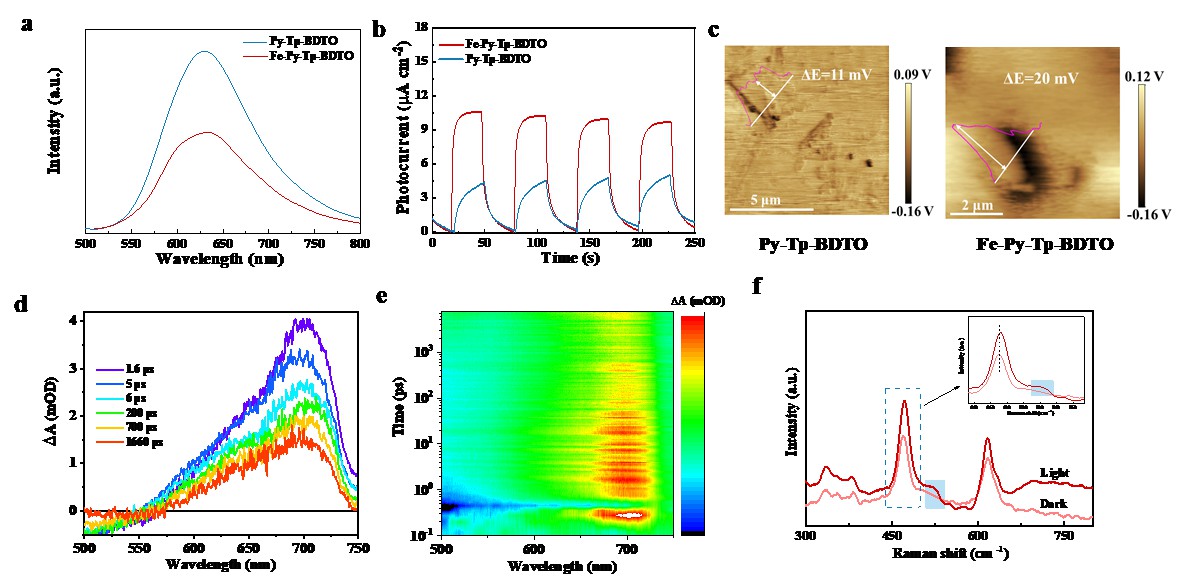
Fig. 4. Steady-state PL spectra (a) and transient photocurrent response (b) of Py-Tp-BDTO and Fe-Py-Tp-BDTO. (c) Surface potential of Py-Tp-BDTO and Fe-Py-Tp-BDTO. fs-TA spectra (d) and pseudocolor plots (e) of Fe-Py-Tp-BDTO (All the samples are tested under 400 nm laser pulse excitation in H2O). (f) Raman spectra of Fe-Py-Tp-BDTO.
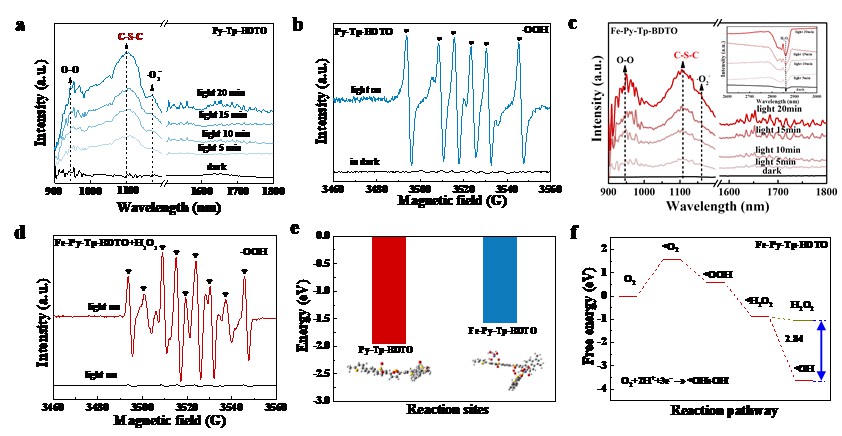
Fig. 5. In-situ DRIFT spectra recorded during photocatalytic H2O2 evolution of Py-Tp-BDTO (a) and Fe-Py-Tp-BDTO (b). ESR spectra of Py-Tp-BDTO (c) and Fe-Py-Tp-BDTO (d)+H2O2. (e) Eads of O2 on active sites of Py-Tp-BDTO and Fe-Py-Tp-BDTO. (f) The free-energy diagrams of Fe-Py-Tp-BDTO (Condition: catalyst=0.6 g L-1, 300 W Xe lamp, AM 1.5G).
|
| [1] | Yuhang Sun, Xu Li, Zhongtian Zeng, Hua Wei, Yulong Zhao, Xiaoyan Cai, Liang Mao, Chang-Long Tan, Bo Shen, Yi-Jun Xu. Sulfur-induced charge-site reconstruction and in-situ formed ZnO2 protection enable robust solar H2O2 production [J]. Chinese Journal of Catalysis, 2026, 88(9): 207-217. |
| [2] | Shufang Liu, Fengyu Chen, Siyuan Li, Yu-Xin Ye, Gangfeng Ouyang. Recent advances in oxygen-centered organic radicals: Characterization, synthesis, and applications [J]. Chinese Journal of Catalysis, 2026, 88(9): 183-206. |
| [3] | Sue-Faye Ng, Joel Jie Foo, Karlo Nolkemper, Zahra Hajiahmadi, Jaya Bharti, Nannan Hou, Jiankang Zheng, Thomas D. Kühne, Markus Antonietti, Christian Mark Pelicano, Wee-Jun Ong. Triazole ring functionalized poly(heptazine imide): Leveraging donor- acceptor configuration toward enhanced solar-driven H2O2 synthesis [J]. Chinese Journal of Catalysis, 2026, 87(8): 140-155. |
| [4] | Aiyun Meng, Wei Zhong, Miaoli Gu, Xiaoyuan Wu, Weilai Yu, Yaorong Su. Recent advances on CdS-based H2-production photocatalyst [J]. Chinese Journal of Catalysis, 2026, 86(7): 49-76. |
| [5] | Jiaying Liu, Yu Fang. Unraveling structure-activity relationships in 2-D covalent organic frameworks for photocatalysis: From molecular engineering to high-performance optimization [J]. Chinese Journal of Catalysis, 2026, 85(6): 47-87. |
| [6] | Yong Zhang, Wenjun Zhu, Yanyan Zhao, Shumin Zhang. In2S3/HOF S-scheme heterojunction for enhanced photocatalytic H2O2 production [J]. Chinese Journal of Catalysis, 2026, 84(5): 261-273. |
| [7] | Qinghua Liu, Peiqing Cai, Hengshuai Li, Xue-Yang Ji, Dafeng Zhang, Xipeng Pu. Visible-light-driven hydrogen evolution over CdS/CuWO4 S-Scheme heterojunctions: Dual synergistic enhancement via interfacial charge transfer and photothermal activation [J]. Chinese Journal of Catalysis, 2026, 81(2): 299-309. |
| [8] | Ikram Ullah, Risheng Duan, Muhammad Amin, Waqar Ahmad Qureshi, An-Wu Xu, Pei Zhao, Ning Qin. Innovative strategies in noble and earth abundant metal single-atom-based photocatalysts for hydrogen production [J]. Chinese Journal of Catalysis, 2026, 90(11): 1-26. |
| [9] | Wei Xia, Chenchen Jiang, Wenjun Zhu, Xinwen Zhang, Jianjun Zhang, Chuanbiao Bie. Electrostatically assembled metal-free COF/g-C3N4 S-scheme heterojunction for enhanced photocatalytic H2O2 production [J]. Chinese Journal of Catalysis, 2026, 89(10): 326-336. |
| [10] | Jiahui Xie, Luyao Ge, Pilang Zheng, Yuanzhen Ke, Qihua Yang, Xiaobo Li. Donor-engineered D-A nanophotocatalyst with dual surfactants-directed assembly for efficient photocatalytic hydrogen evolution [J]. Chinese Journal of Catalysis, 2026, 89(10): 269-278. |
| [11] | Xinyi Ma, Ziyi Xiao, Xueqing Hu, Haobin Hu, Wenhua Xue, Enzhou Liu. Synergetic photocatalytic H2 evolution and H2S conversion over S-scheme Co3(PO4)2/CoSx/twinned-Cd0.5Zn0.5S [J]. Chinese Journal of Catalysis, 2026, 80(1): 146-158. |
| [12] | Wang Qihang, Meng Li, Li Zhuo, Yang Zhuoran, Tang Yinan, Yu Lang, Li Zhijun, Sun Jianhui, Jing Liqiang. Cobalt single atom-phosphate functionalized reduced graphene oxide/perylenetetracarboxylic acid nanosheet heterojunctions for efficiently photocatalytic H2O2 production [J]. Chinese Journal of Catalysis, 2025, 75(8): 192-203. |
| [13] | Xinlong Zheng, Yiming Song, Chongtai Wang, Qizhi Gao, Zhongyun Shao, Jiaxin Lin, Jiadi Zhai, Jing Li, Xiaodong Shi, Daoxiong Wu, Weifeng Liu, Wei Huang, Qi Chen, Xinlong Tian, Yuhao Liu. Properties, applications, and challenges of copper- and zinc-based multinary metal sulfide photocatalysts for photocatalytic hydrogen evolution [J]. Chinese Journal of Catalysis, 2025, 74(7): 22-70. |
| [14] | Wenjing Gao, Yuchan Liu, Chenyao Chen, Ziqi Lian, Rongkai Ye, Chaorong Qi, Jianqiang Hu. Constructing dual-cocatalyst-directed quantifiable electron and hole transfer for enhanced photocatalytic performance [J]. Chinese Journal of Catalysis, 2025, 74(7): 319-328. |
| [15] | Lifang Liu, Yejun Xiao, Xiangyang Guo, Shengye Jin, Fuxiang Zhang. Facets-controllable synthesis of metal-organic frameworks via one supersaturation strategy to insight intrinsic facets effect [J]. Chinese Journal of Catalysis, 2025, 73(6): 153-158. |
| Viewed | ||||||
|
Full text |
|
|||||
|
Abstract |
|
|||||


