
Chinese Journal of Catalysis ›› 2026, Vol. 91: 176-191.DOI: 10.1016/S1872-2067(26)65221-7
• Articles • Previous Articles Next Articles
Deng Mina,b, Sebastian Cisnerosa,*( ), Abdallah I. M. Rabeec,d, Thanh Huyen Vuongc, Jiadong Xiaoe, Yaoyuan Zhangf, Rongsheng Caig, Feng Shia,*(), Jabor Rabeaha,c,*()
Received:2026-04-08
Accepted:2026-06-06
Online:2026-12-18
Published:2026-10-13
Supported by:Deng Min, Sebastian Cisneros, Abdallah I. M. Rabee, Thanh Huyen Vuong, Jiadong Xiao, Yaoyuan Zhang, Rongsheng Cai, Feng Shi, Jabor Rabeah. Low CeO2 content with superior performance: In-situ spectroscopic insights into multicomponent CuFeCe/γ-Al2O3 catalysts for mild-temperature reverse water-gas shift[J]. Chinese Journal of Catalysis, 2026, 91: 176-191.
Add to citation manager EndNote|Ris|BibTeX
URL: https://www.cjcatal.com/EN/10.1016/S1872-2067(26)65221-7
| Catalyst | Cu/wt% (1.0)a | Ce/wt% (5.0) | Fe/wt% (0.5) | SSA/ m2 g-1 | Average pore size/nm |
|---|---|---|---|---|---|
| Cu/γ-Al2O3 | 0.87 | — | — | 130 | 26.1 |
| CuCe/γ-Al2O3 | 0.85 | 3.3 | — | 137 | 25.9 |
| CuFe/γ-Al2O3 | 0.91 | — | 0.49 | 130 | 27.4 |
| CuFeCe/γ-Al2O3 | 0.84 | 4.5 | 0.46 | 130 | 28.5 |
| FeCe/γ-Al2O3 | — | 4.1 | 0.41 | 146 | 22.4 |
| Fe/γ-Al2O3 | — | — | 0.48 | —b | — |
| γ-Al2O3 | — | — | — | 144 | 23.3 |
Table 1 Structural properties of the distinct catalysts and bare γ-Al2O3 support.
| Catalyst | Cu/wt% (1.0)a | Ce/wt% (5.0) | Fe/wt% (0.5) | SSA/ m2 g-1 | Average pore size/nm |
|---|---|---|---|---|---|
| Cu/γ-Al2O3 | 0.87 | — | — | 130 | 26.1 |
| CuCe/γ-Al2O3 | 0.85 | 3.3 | — | 137 | 25.9 |
| CuFe/γ-Al2O3 | 0.91 | — | 0.49 | 130 | 27.4 |
| CuFeCe/γ-Al2O3 | 0.84 | 4.5 | 0.46 | 130 | 28.5 |
| FeCe/γ-Al2O3 | — | 4.1 | 0.41 | 146 | 22.4 |
| Fe/γ-Al2O3 | — | — | 0.48 | —b | — |
| γ-Al2O3 | — | — | — | 144 | 23.3 |
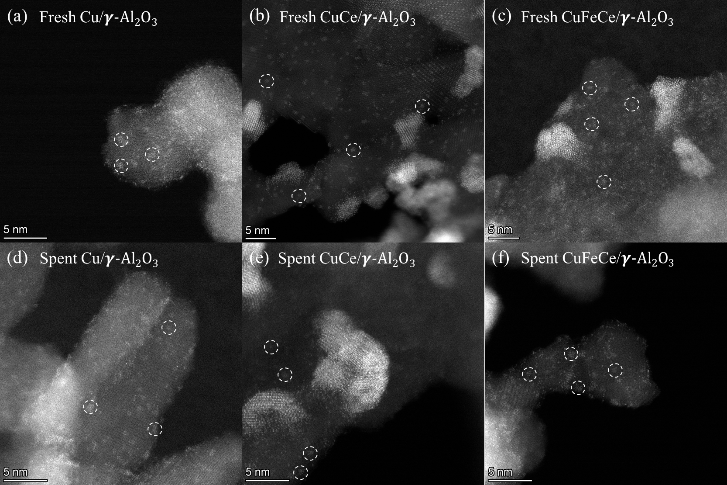
Fig. 1. Selected HAADF-STEM images of the catalysts before (a-c) and after (d-f) reaction. The dashed white circles enclose possible clusters of Cu species.
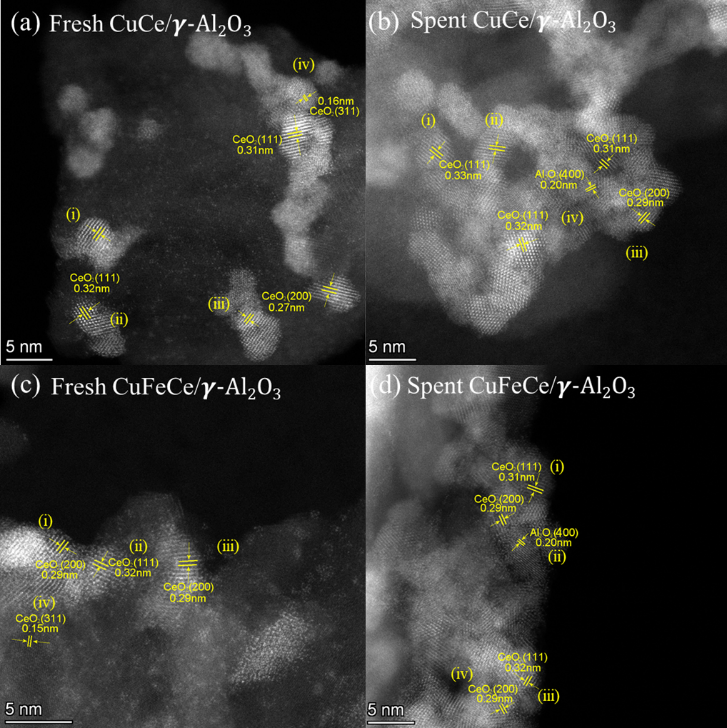
Fig. 2. Representative HAADF-STEM images of the fresh (a,c) and spent (b,d) Ce-containing catalysts indicating the presence of CeO2 (111), (200) and (311) planes.
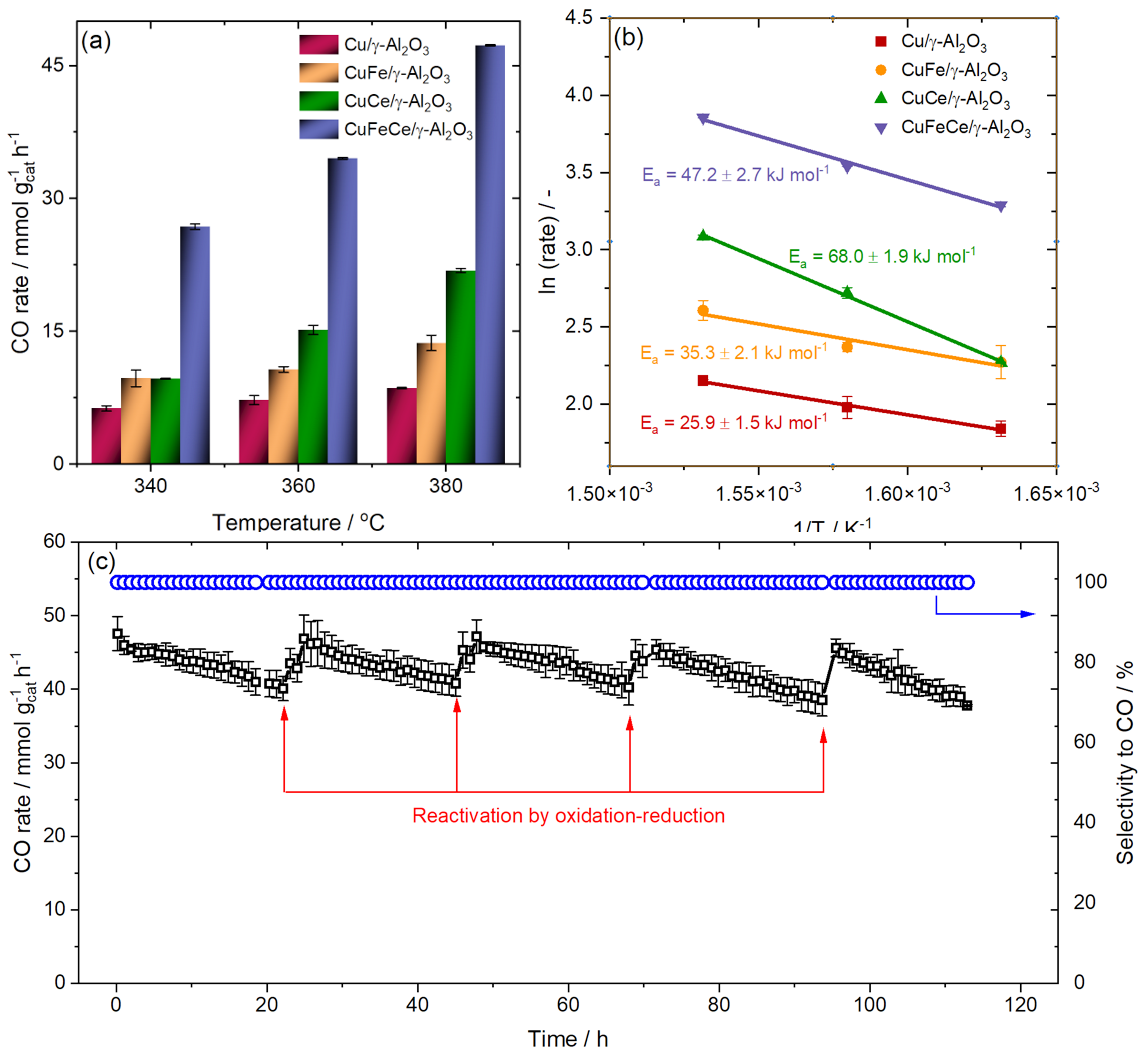
Fig. 3. (a) CO rate (mass-normalized) over the catalysts after 12 h at the corresponding temperature (CO2 conversion < 20%). Reaction conditions: P=1 bar, CO2:H2=1:3, GHSV=36000 mL g-1 h-1. (b) Apparent activation energy for CO production over the catalysts in the range 340-380 °C. (c) Long-term stability at 380 °C over CuFeCe/γ-Al2O3. Red arrows indicate catalyst reactivation by oxidation (5% O2 in N2, 15 min) and re-reduction (50% H2 in N2, 15 min). Error bars represent the standard deviation of two independent experiments under identical conditions.
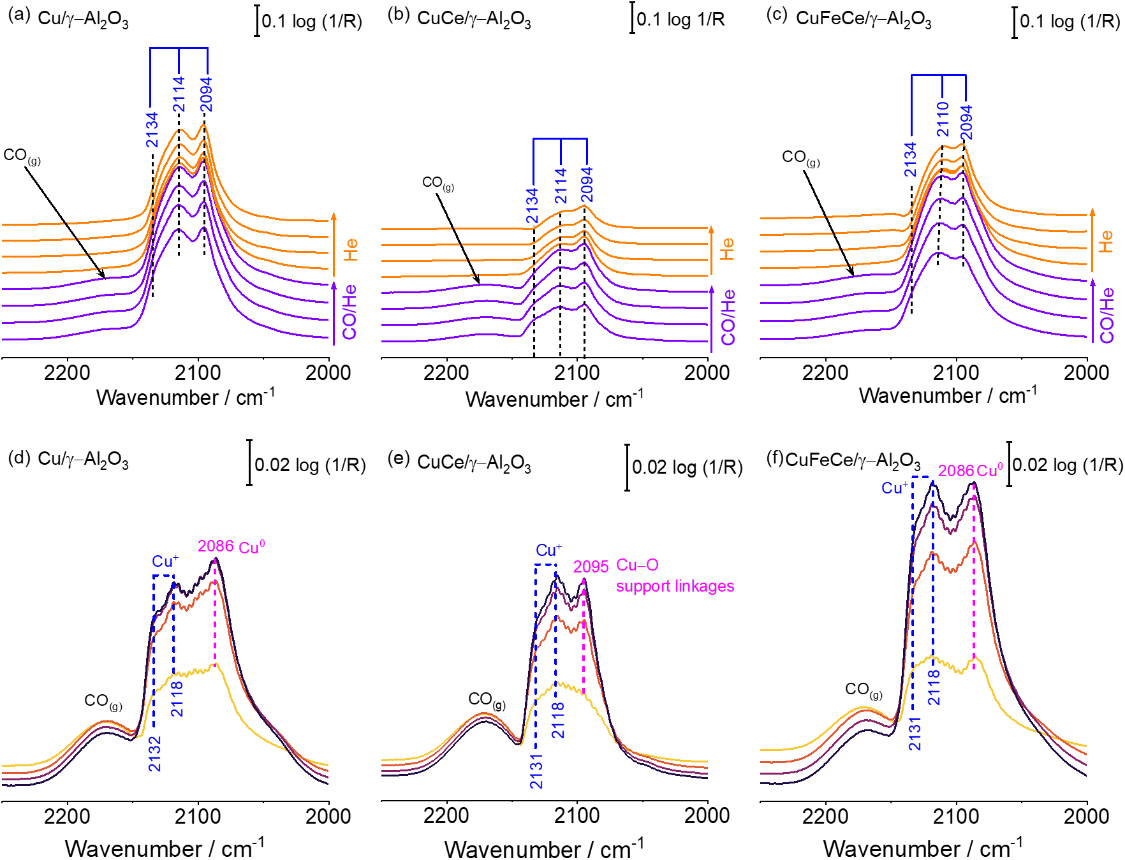
Fig. 7. (a-c) CO adsorption DRIFTS spectra obtained over the pre-reduced catalysts under 1% CO in He (25 mL min-1) during 15 min (purple spectra) and under 100% He (25 mL min-1) during 15 min (orange spectra). (d-f) CO adsorption DRIFT spectra computed after subtracting the spectrum collected after CO saturation from the spectra recorded under 100% He. All the spectra were recorded at RT.
| Gas switch | Cu/γ-Al2O3 | CuCe/γ-Al2O3 | CuFeCe/γ-Al2O3 | |||||
|---|---|---|---|---|---|---|---|---|
| k11/min-1 | k21/min-1 | k12/min-1 | k22/min-1 | k13/min-1 | k23/min-1 | |||
| 100% He → 50% H2 in He | 0.63 | 0.014 | 0.49 | 0.017 | — | — | ||
| 50% H2 in He → 15% CO2 in He | 0.35 | 0.016 | 0.15 | 0.025 | 0.71a | 0.048a | ||
| 15% CO2 in He → 50% H2 in He | 0.38 | 0.011 | 0.40 | 0.010 | — | — | ||
| 50% H2 in He → H2 + CO2 (3:1) | 0.33 | 0.28 | 0.35 | 0.22 | 0.13a | 0.34a | ||
Table 2 Kinetic parameters for the oxidation/reduction of Cu2+ sites over Cu/γ-Al2O3 and CuCe/γ-Al2O3 estimated by fitting the respective time evolution of the EPR second integrals of the spectra during distinct gas atmosphere switches.
| Gas switch | Cu/γ-Al2O3 | CuCe/γ-Al2O3 | CuFeCe/γ-Al2O3 | |||||
|---|---|---|---|---|---|---|---|---|
| k11/min-1 | k21/min-1 | k12/min-1 | k22/min-1 | k13/min-1 | k23/min-1 | |||
| 100% He → 50% H2 in He | 0.63 | 0.014 | 0.49 | 0.017 | — | — | ||
| 50% H2 in He → 15% CO2 in He | 0.35 | 0.016 | 0.15 | 0.025 | 0.71a | 0.048a | ||
| 15% CO2 in He → 50% H2 in He | 0.38 | 0.011 | 0.40 | 0.010 | — | — | ||
| 50% H2 in He → H2 + CO2 (3:1) | 0.33 | 0.28 | 0.35 | 0.22 | 0.13a | 0.34a | ||
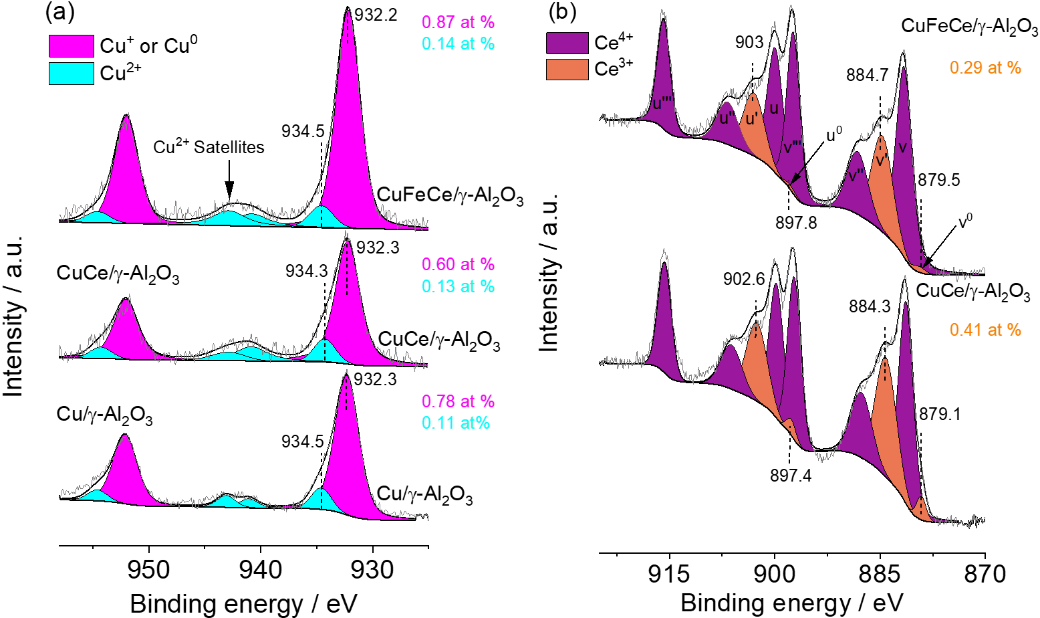
Fig. 4. (a) XPS spectra in the Cu 2p region of fresh Cu/γ-Al2O3, CuCe/γ-Al2O3, and CuFeCe/γ-Al2O3. (b) XPS spectra in the Ce 3d region of fresh CuCe/γ-Al2O3 and CuFeCe/γ-Al2O3. The percentages represent the atomic surface fractions estimated for the respective cations.
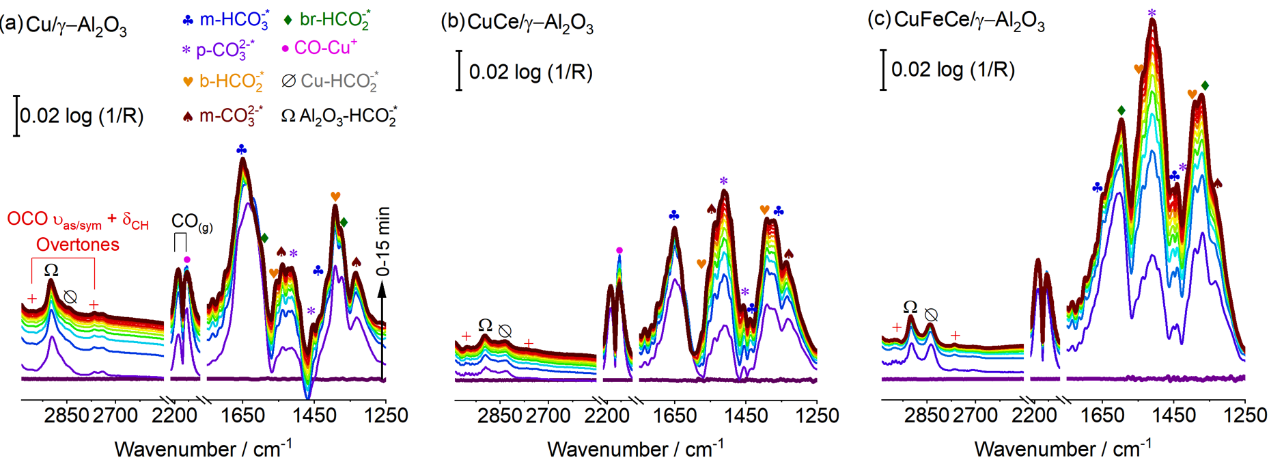
Fig. 5. (a-c) In-situ DRIFTS spectra recorded during 15 min at 350 °C over the distinct catalysts. RWGSR conditions: 25 mL min-1, 15% CO2, 45% H2 and balance He. The time separation between 2 consecutive spectra corresponds to 1 min.
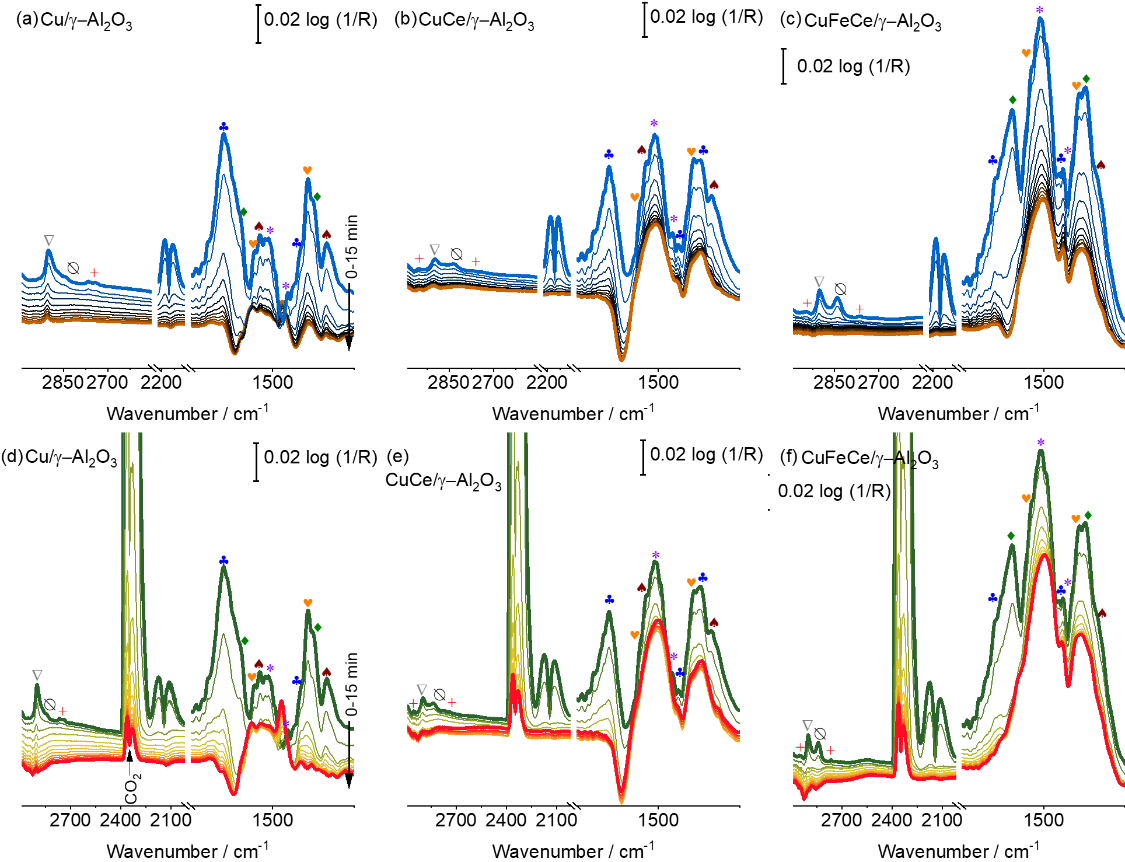
Fig. 6. DRIFTS spectra recorded during 15 min at 350 °C over the distinct catalysts after switch from SS-RWGSR to 50% H2 in He (a-c), and after switch from SS-RWGSR to 100% He (d-f). The time separation between 2 consecutive spectra corresponds to 1 min.
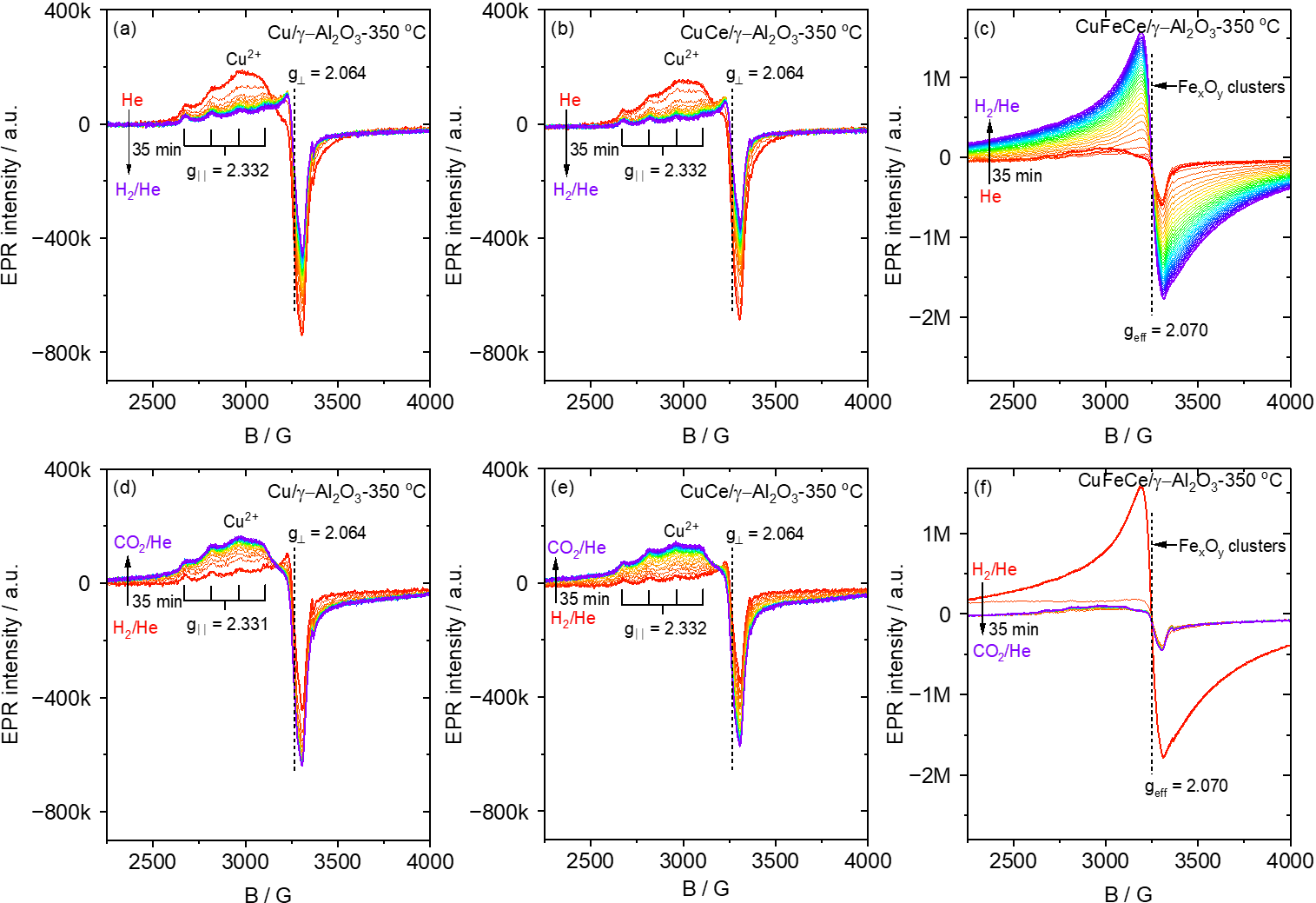
Fig. 8. In-situ EPR spectra recorded during reduction in 50% H2 in He (a-c) and during gas switch from 50% H2 in He to 15% CO2 in He (d-f) over the distinct catalysts. All the spectra were recorded at 350 °C and flow rate of 25 mL min-1. The time separation between 2 consecutive spectra corresponds to 1 min.
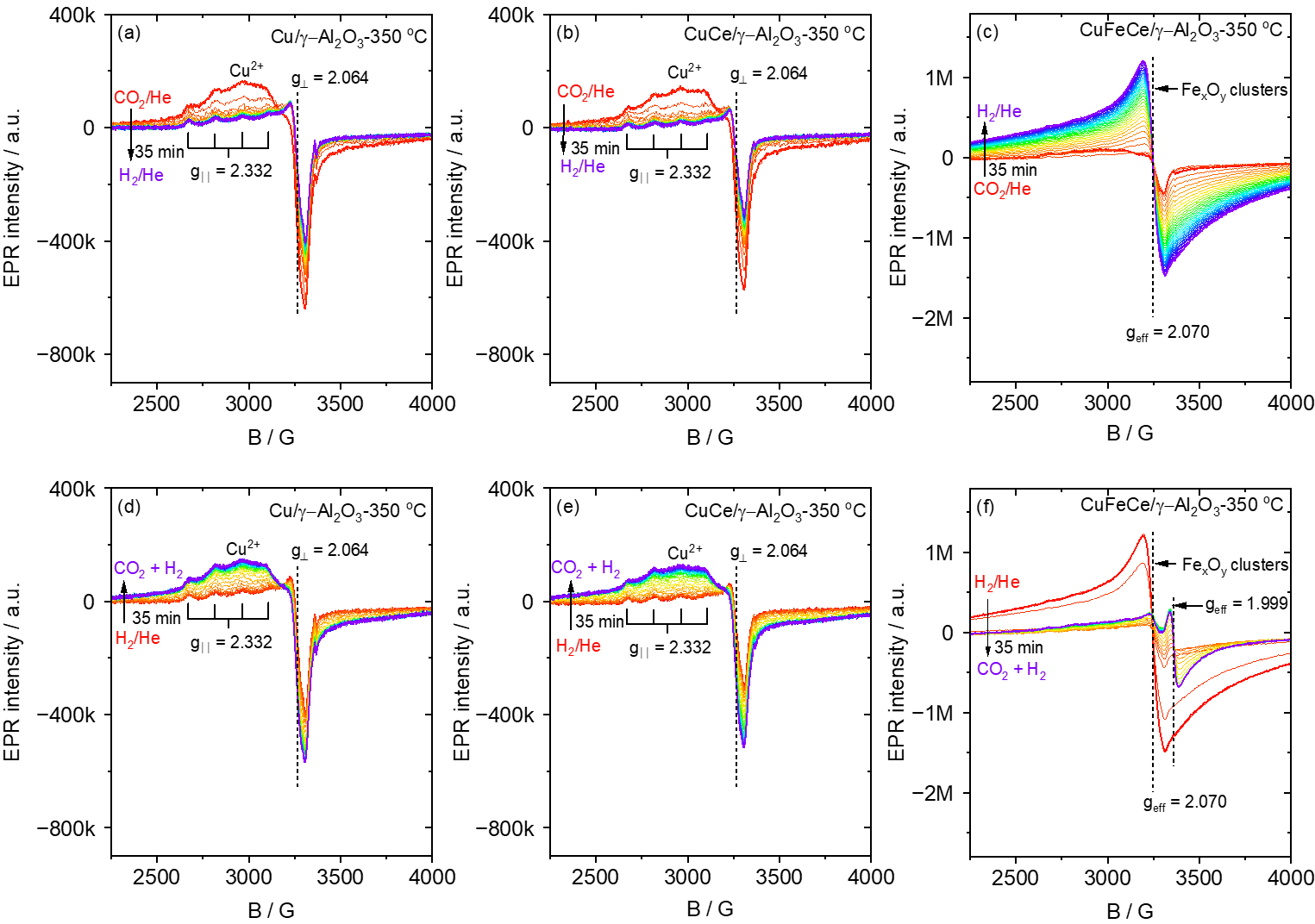
Fig. 9. In-situ EPR spectra recorded at 350 °C during the switch from 15% CO2 in He to 50% H2 in He (a-c) and from 50% H2 in He to RWGSR conditions (d-f) over the distinct catalysts (flow rate of 25 mL min-1). The time separation between 2 consecutive spectra corresponds to 1 min.
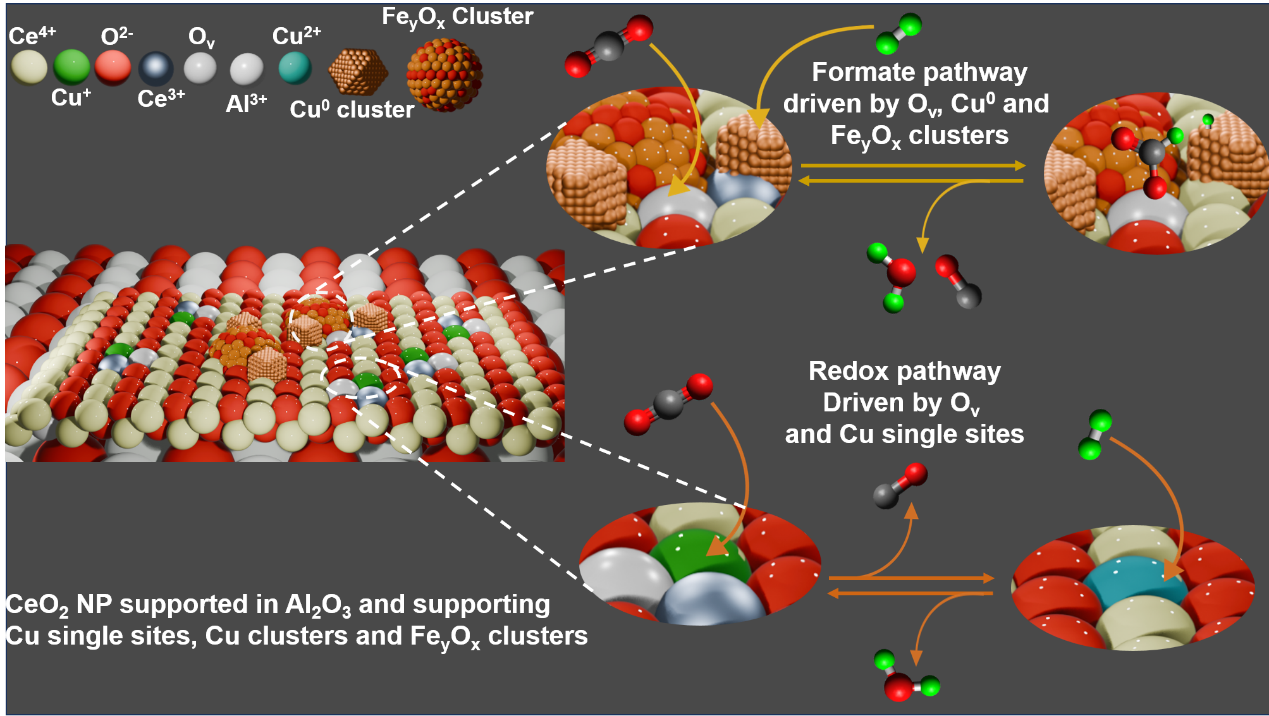
Scheme 1. Proposed active sites and operative mechanisms for the RWGSR occurring on the CuFeCe/γ-Al2O3 catalyst.
|
| [1] | Shufang Liu, Fengyu Chen, Siyuan Li, Yu-Xin Ye, Gangfeng Ouyang. Recent advances in oxygen-centered organic radicals: Characterization, synthesis, and applications [J]. Chinese Journal of Catalysis, 2026, 88(9): 183-206. |
| [2] | Tao Wei, Zhanpeng Liang, Boxin Zhang, Yunhao Xu, Zhaoxue Sun, Minghao Duo, Minghui Chen, Sheng Zhang, Bao Zhang. Efficient electrocatalytic CO2 reduction by crystalline polymetallophthalocyanine covalent organic frameworks unprecedentedly constructed involving 4-dimethylaminopyridine (DMAP)-type nucleophilic catalyst [J]. Chinese Journal of Catalysis, 2026, 83(4): 319-329. |
| [3] | Haoyu Zhang, Lujie Jin, Tanghong Zheng, Xinran Qiu, Yang Liu, Dongyun Chen, Qingfeng Xu, Youyong Li, Jianmei Lu. Carbene dual-function bridging of Ag-Cu sites enables *CO pooling for *COCHO coupling with > 80% C2+ selectivity in CO2 electroreduction [J]. Chinese Journal of Catalysis, 2026, 82(3): 105-114. |
| [4] | Xiong Wang, Chao Peng, Yongkang Xiao, Ziye Zhang, Huiping Zheng, Wenjie Yue, Sheng Tian, Xingsheng Hu, Weifan Shao, Guanghui Chen, Binghao Wang, Huijuan Wang, Mingming Yin, Jinxin Li, Yang Li, Lang Chen, Shuangfeng Yin. Surface engineering enhancing activity and stability of Bi2WO6-x for selective C-H bond photooxidation [J]. Chinese Journal of Catalysis, 2026, 81(2): 246-258. |
| [5] | Yuan-Xu Jiang, Zhi-Xin Yan, Long-Fu Wang, Yi-Chi Chen, Wen-Hao Xu, Shu-Rong Zhang, Jun-Ping Yue, Min Pan, Yong-Yuan Gui, Lei Song, Li-Li Liao, Jian-Heng Ye, Da-Gang Yu. Visible-light photocatalytic 1,1-difunctionalizing carboxylation of isocyanides with CO2 [J]. Chinese Journal of Catalysis, 2026, 91(12): 93-102. |
| [6] | Jiaqi Xiang, Limiao Chen, Shanyong Chen, You-Nian Liu. Alkali cation effects in electrochemical carbon dioxide reduction [J]. Chinese Journal of Catalysis, 2026, 80(1): 38-58. |
| [7] | Liyuan Xiao, Zhenlu Wang, Jingqi Guan. Advances in multinuclear metal-organic frameworks for electrocatalysis [J]. Chinese Journal of Catalysis, 2026, 80(1): 59-91. |
| [8] | Shi-Ning Li, Juntao Yao, Shuxin Pang, Jing-Peng Zhang, Shiying Li, Zhicheng Liu, Lu Han, Weibin Fan, Kake Zhu, Yi-An Zhu. Co particles separated by immiscible Ag on yttria-stabilized zirconia as durable methane dry reforming catalyst under pressurized conditions [J]. Chinese Journal of Catalysis, 2025, 74(7): 82-96. |
| [9] | Xueqing Zhang, Wusha Jiye, Yuhua Zhang, Jinlin Li, Li Wang. Advances in iron-based Fischer-Tropsch synthesis with high carbon efficiency [J]. Chinese Journal of Catalysis, 2025, 74(7): 4-21. |
| [10] | Yanwei Cao, Yunhao Qu, Bin Su, Gongwei Wang, Yang Huang, Zhenmin Luo, Lin Zhuang, Lin He. CO2-H2O co-electrolysis to CO/O2 for safe oxidative double carbonylation of ethylene/acetylene [J]. Chinese Journal of Catalysis, 2025, 74(7): 202-210. |
| [11] | Anees A. Ansari, Ruichan Lv, Shili Gai, Piaoping Yang. Chemistry of CeO2-derived nanocomposites photocatalysts for environment monitoring and energy conversion [J]. Chinese Journal of Catalysis, 2025, 71(4): 70-113. |
| [12] | Ziguo Cai, Xuefeng Yu, Penglong Wang, Huifang Wu, Ruifeng Chong, Limin Ren, Tao Hu, Xiang Wang. Role of Y2O3 in Cu/ZnO/Y2O3 catalysts for CO2 hydrogenation to methanol [J]. Chinese Journal of Catalysis, 2025, 70(3): 410-419. |
| [13] | Huimei Duan, Xiaofei Li, Chuanhui Wang, Congyun Zhang, Kaiwen Yu, Lei Chen, Yunshang Zhang, Jiabin Ji, Xianfeng Yang, Dongjiang Yang. TiO2-facet-dependent effect on methane combustion over Ir/TiO2 catalysts [J]. Chinese Journal of Catalysis, 2025, 70(3): 378-387. |
| [14] | Wenjun Qiang, Duohua Liao, Maolin Wang, Lingzhen Zeng, Weiqi Li, Xuedong Ma, Liang Yang, Shuang Li, Ding Ma. Synergistic sites over the ZnxZrO catalyst for targeted cleavage of the C-H bonds of ethane in tandem with CO2 activation [J]. Chinese Journal of Catalysis, 2025, 70(3): 272-284. |
| [15] | Zhaoyang Chen, Qingtian Zhong, Qiqige Wulan, Yuan Ji, Chunxiao Liu, Xu Li, Tingting Zheng, Qiu Jiang, Chuan Xia. Commercialization of electrochemical CO2 reduction: HCOOH pathway versus CO pathway [J]. Chinese Journal of Catalysis, 2025, 69(2): 52-57. |
| Viewed | ||||||
|
Full text |
|
|||||
|
Abstract |
|
|||||


