
催化学报 ›› 2027, Vol. 92: 1-36.DOI: 10.1016/S1872-2067(26)65276-X
• 综述 • 下一篇
魏邦虎, 任伟, 李金河, 王伟康, 刘芹芹*( )
收稿日期:2026-06-11
接受日期:2026-07-21
出版日期:2027-01-02
发布日期:2026-10-30
通讯作者:
*电子信箱: qqliu@ujs.edu.cn (刘芹芹).基金资助:
Banghu Wei, Wei Ren, Jinhe Li, Weikang Wang, Qinqin Liu*()
Received:2026-06-11
Accepted:2026-07-21
Online:2027-01-02
Published:2026-10-30
Contact:
*E-mail: qqliu@ujs.edu.cn (Q. Liu).About author:Qinqin Liu, (Professor and Ph.D. Supervisor at the School of Materials Science and Engineering, Jiangsu University, is a young academic leader of Jiangsu University. Her research interests mainly focus on the design and synthesis of nanomaterials and photo(electro)catalytic materials, as well as their applications in energy conversion and environmental remediation. She currently serves as a member of the Photocatalysis Professional Committee of the Chinese Society of Imaging Science and Technology, a young council member of the Chinese Society of Imaging Science and Technology, a member of the Chinese Chemical Society, a member of the Jiangsu Materials Society, and a young editorial board member of Chinese Journal of Catalysis, Acta Physico-Chimica Sinica, and Chinese Journal of Structural Chemistry. She also serves as a reviewer for several international academic journals. She has led more than 10 research projects, including projects supported by the National Natural Science Foundation of China. In recent years, she has published more than 200 SCI-indexed papers in internationally renowned journals, including Angewandte Chemie International Edition, Nano Letters, and National Science Review, with over 6000 citations and an H-index of 54. She has received the Second Prize of the Science and Technology Invention Award of the Ministry of Education, and has been granted 10 Chinese invention patents and 1 PCT international patent.)
Supported by:摘要:
在“双碳”战略和能源绿色转型背景下, 太阳能驱动光催化技术因能够同时实现清洁能源转化与高附加值化学品合成而广受关注. 然而, 传统单一光催化体系普遍存在光生载流子复合严重、氧化/还原半反应动力学不匹配以及电子-空穴利用率低等问题, 导致太阳能转化效率和整体经济性受到限制. 近年来, S-型异质结凭借其独特的能带排列和界面内建电场, 在异质结界面实现无用低能载流子的选择性复合, 同时保留具有强氧化还原能力的高能载流子, 从本质上平衡载流子分离效率与氧化还原热力学驱动力, 为构建高效光催化氧化还原耦合体系提供了新的设计思路. 因此, 系统总结S-型异质结在光催化氧化还原耦合中的研究进展及其协同机制, 对于推动太阳能高效利用具有重要意义.
本文系统综述了S-型异质结在光催化氧化还原耦合体系中的最新研究进展. 首先, 介绍了S-型异质结的发展历程、工作原理及界面电荷传输机制, 阐明了界面内建电场、能带弯曲及库仑相互作用共同驱动光生载流子定向迁移和选择性复合的本质. 随后, 围绕析氢、CO2还原及H2O2合成等典型还原反应, 结合有机分子选择性氧化、生物质高值化转化及污染物降解等氧化反应, 系统总结了S-型异质结实现氧化/还原半反应协同耦合的最新研究成果, 并重点讨论了电子-空穴协同利用对提升反应动力学、太阳能利用效率及产物选择性的关键作用. 此外, 从活性位点构筑、能带结构调控及界面工程三个方面, 深入分析了S-型异质结促进氧化还原耦合反应的多维调控策略, 进一步阐明了界面电子结构调控、反应中间体吸附优化及电荷迁移路径设计等因素对耦合反应性能的影响规律. 最后, 对S-型异质结光催化氧化还原耦合体系面临的关键挑战和未来发展方向进行了总结与展望: (1)深入揭示界面电荷迁移、反应中间体演化及氧化/还原协同机制, 建立更加完善的构效关系, 为高效S-型异质结的理性设计提供理论依据; (2)结合原位表征、超快光谱及密度泛函理论计算等先进技术, 深入解析复杂界面动态过程和真实反应机理; (3)发展多维界面工程、精准活性位调控及智能催化剂设计策略, 进一步提高太阳能利用效率及氧化还原协同效率; (4)推动S-型异质结光催化体系由实验室研究向连续流反应器及实际太阳能驱动应用拓展, 实现高效、稳定、低成本的太阳能光催化转化, 为清洁能源生产、碳资源利用及绿色化学品合成提供新的理论基础和技术参考.
魏邦虎, 任伟, 李金河, 王伟康, 刘芹芹. S-型异质结在耦合氧化还原光催化中的应用: 通过电子-空穴协同调控实现双半反应高效耦合[J]. 催化学报, 2027, 92: 1-36.
Banghu Wei, Wei Ren, Jinhe Li, Weikang Wang, Qinqin Liu. S-scheme heterojunctions for coupled redox photocatalysis: Orchestrating electron-hole synergy to unlock dual half-reactions[J]. Chinese Journal of Catalysis, 2027, 92: 1-36.
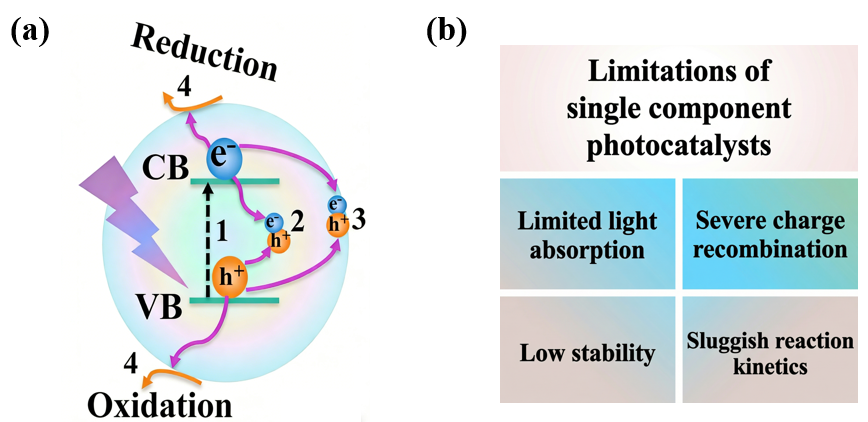
Fig. 1. (a) Schematic of photoinduced carrier dynamics in single semiconductors. (b) Intrinsic catalytic limitations.
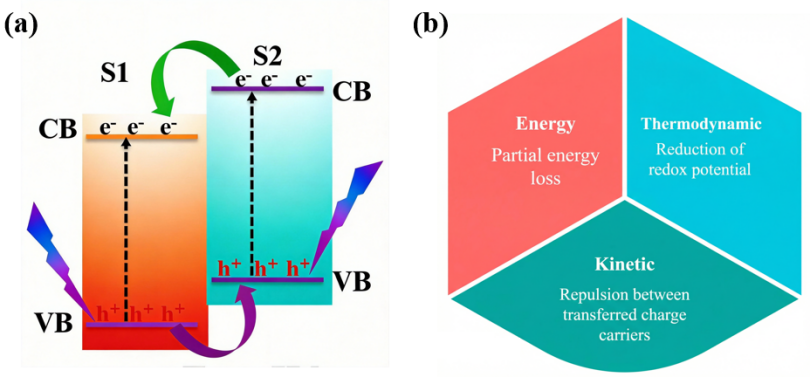
Fig. 2. (a) Charge-transfer pathway of Type-II heterojunctions (S1, S2 = two semiconductors). (b) Inherent thermodynamic/kinetic drawbacks.
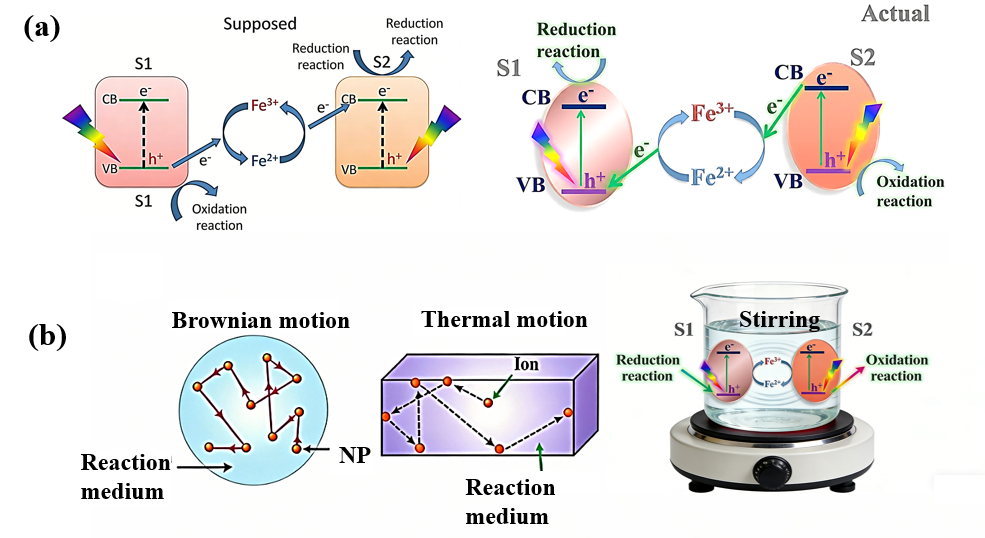
Fig. 3. (a) Charge-transfer discrepancy in liquid Z-scheme models. (b) Practical operational limitations.
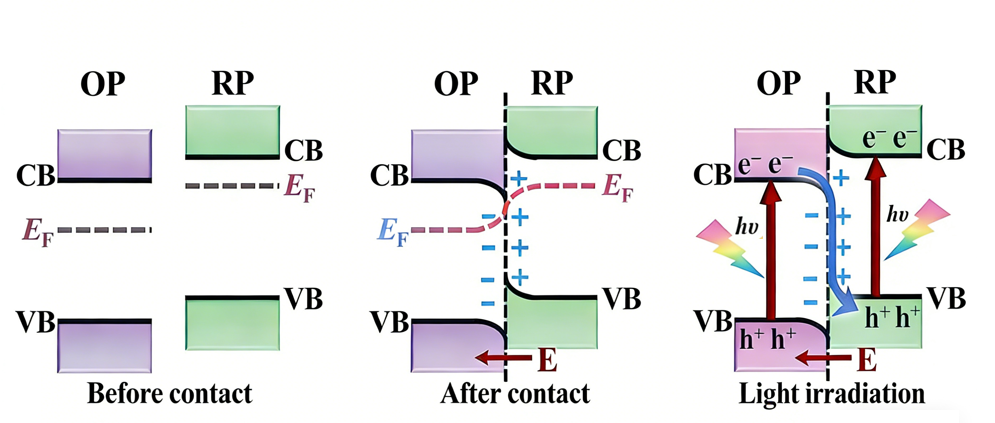
Fig. 4. Schematic representation of the charge transfer process in an S-scheme heterojunction.
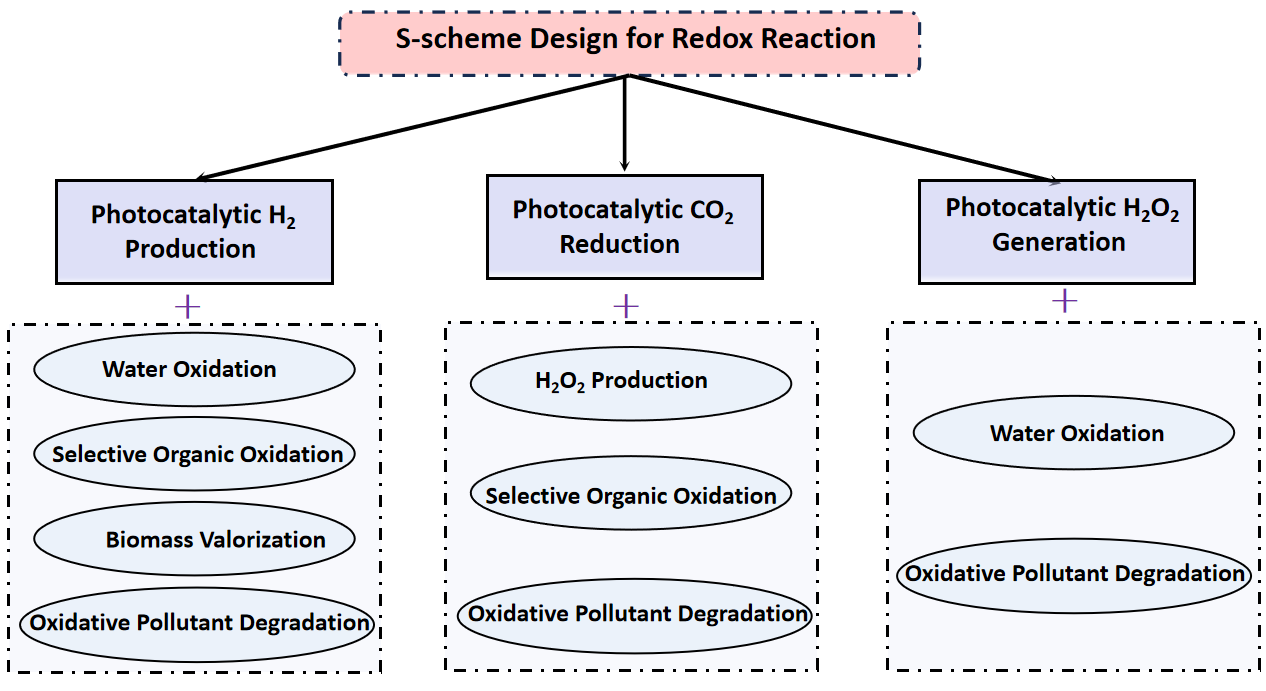
Fig. 5. Summary of S-scheme heterojunction for photocatalytic redox coupling systems.
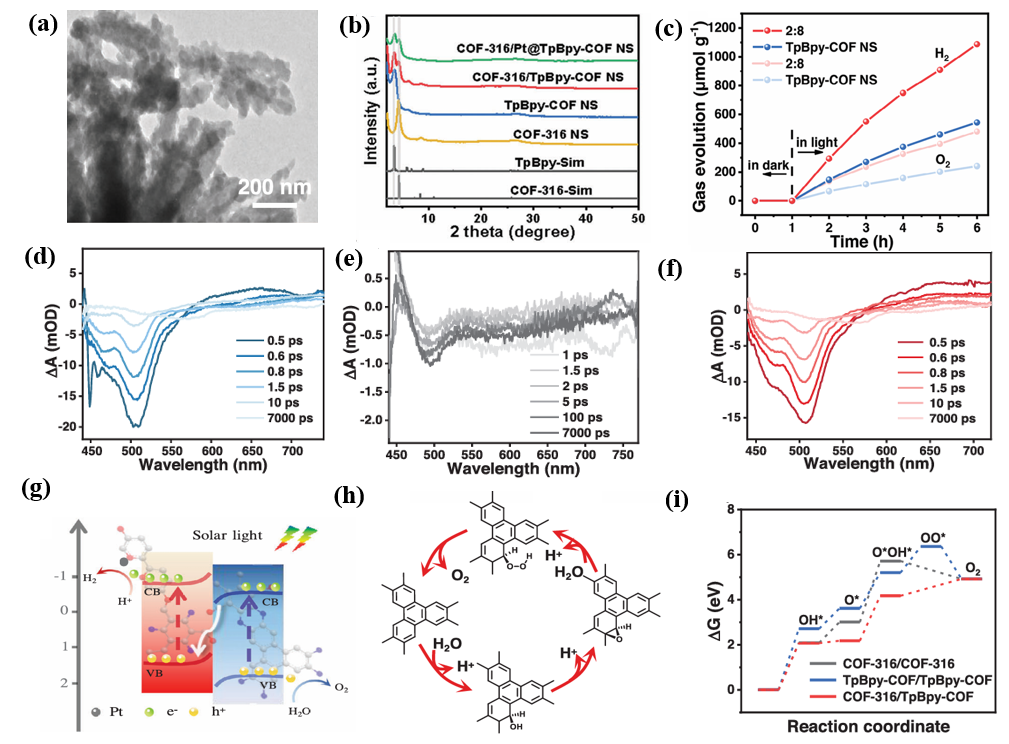
Fig. 6. (a) TEM image of the COF-316/Pt@TpBpy-COF heterojunction. (b) XRD patterns of TpBpy-COF, COF-316, and their heterojunctions. (c) Photocatalytic HER and OER activities of different samples under visible-light irradiation. The fs-TA spectra of TpBpy-COF (d), COF-316 (e), and COF-316/Pt@TpBpy-COF heterojunction (f). (g) Schematic diagram showing the S-scheme charge migration pathway in the COF-316/Pt@TpBpy-COF heterojunction. (h) Free-energy diagram of the OER pathway involving OH*, O*, and OOH* intermediates. (i) Gibbs free-energy comparison of HER and OER. Reprinted with permission from Ref. [140]. Copyright 2024, John Wiley and Sons.
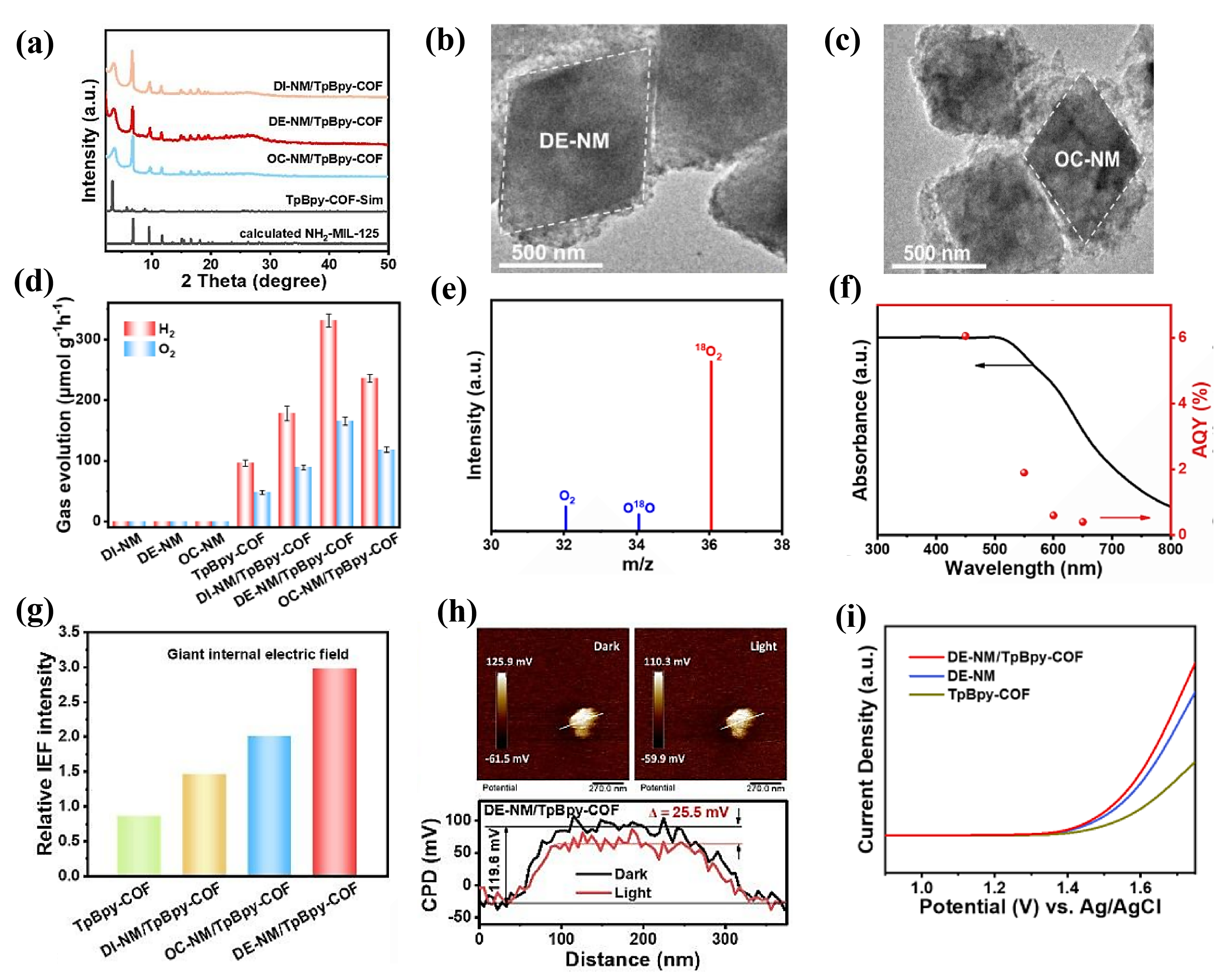
Fig. 7. (a) XRD patterns of sample. TEM images of DE-NM/TpBpy-COF (b) and OC-NM/TpBpy-COF (c). (d) H2 and O2 evolution over different samples. (e) Mass spectra of photocatalytic reaction products from the isotope-labeling experiment. (f) AQY curve of DE-NM/TpBpy-COF under different monochromatic light irradiation. (g) IEF strengths. (h) KPFM contact potential difference (CPD) images of DI-NM/TpBpy-COF, DE-NM/TpBpy-COF, and OC-NM/TpBpy-COF under dark and illuminated conditions. (i) LSV curves for the electrochemical oxidation of TpBpy-COF, DE-NM, and DE-NM/TpBpy-COF in N2-saturated electrolyte. Reprinted with permission from Ref. [151]. Copyright 2025, John Wiley and Sons.
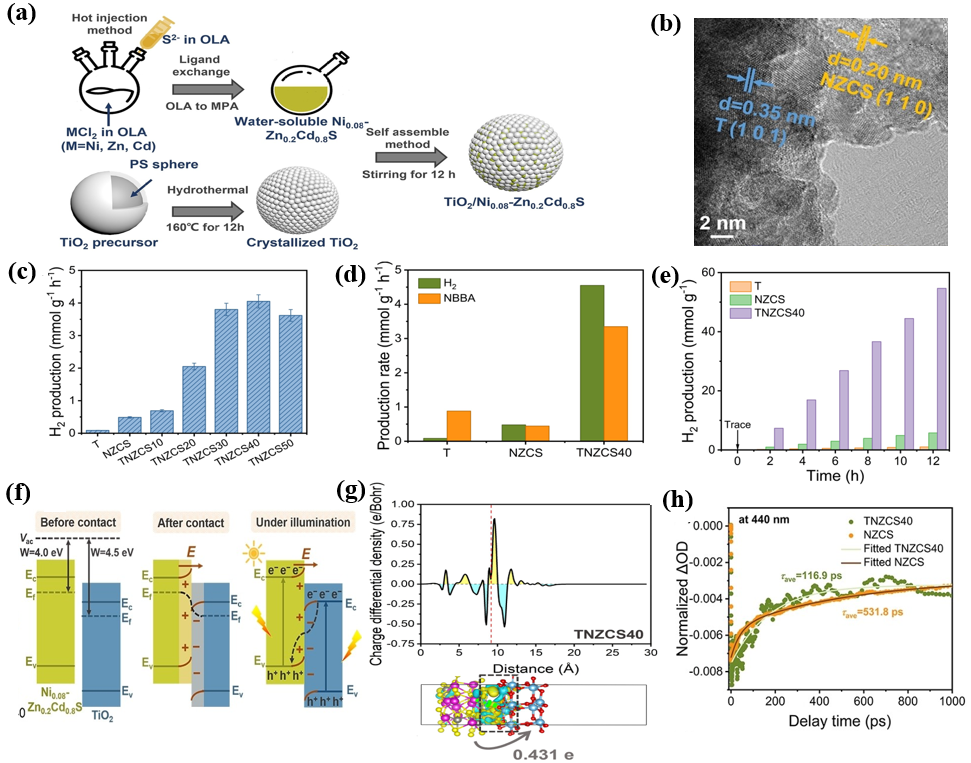
Fig. 8. (a) Schematic illustration of the synthesis procedure for the TNZCSx heterojunction photocatalyst. (b) HRTEM image of TNZCSx showing the interfacial contact between TiO2 and NZCS. (c) Photocatalytic H2 evolution rates of TNZCSx composites. (d) Formation rates of H2 and NBBA over TNZCS40 during photocatalytic reaction. (e) Stability test of TNZCS40 for photocatalytic H2 production over 12 h. (f) Schematic representation of the S-scheme. (g) Charge-density-difference plots obtained from DFT calculations. (h) GSB decay kinetics derived from fs-TA spectra of TZCS40 and TNZCS40. Reprinted with permission from Ref. [154]. Copyright 2023, John Wiley and Sons.
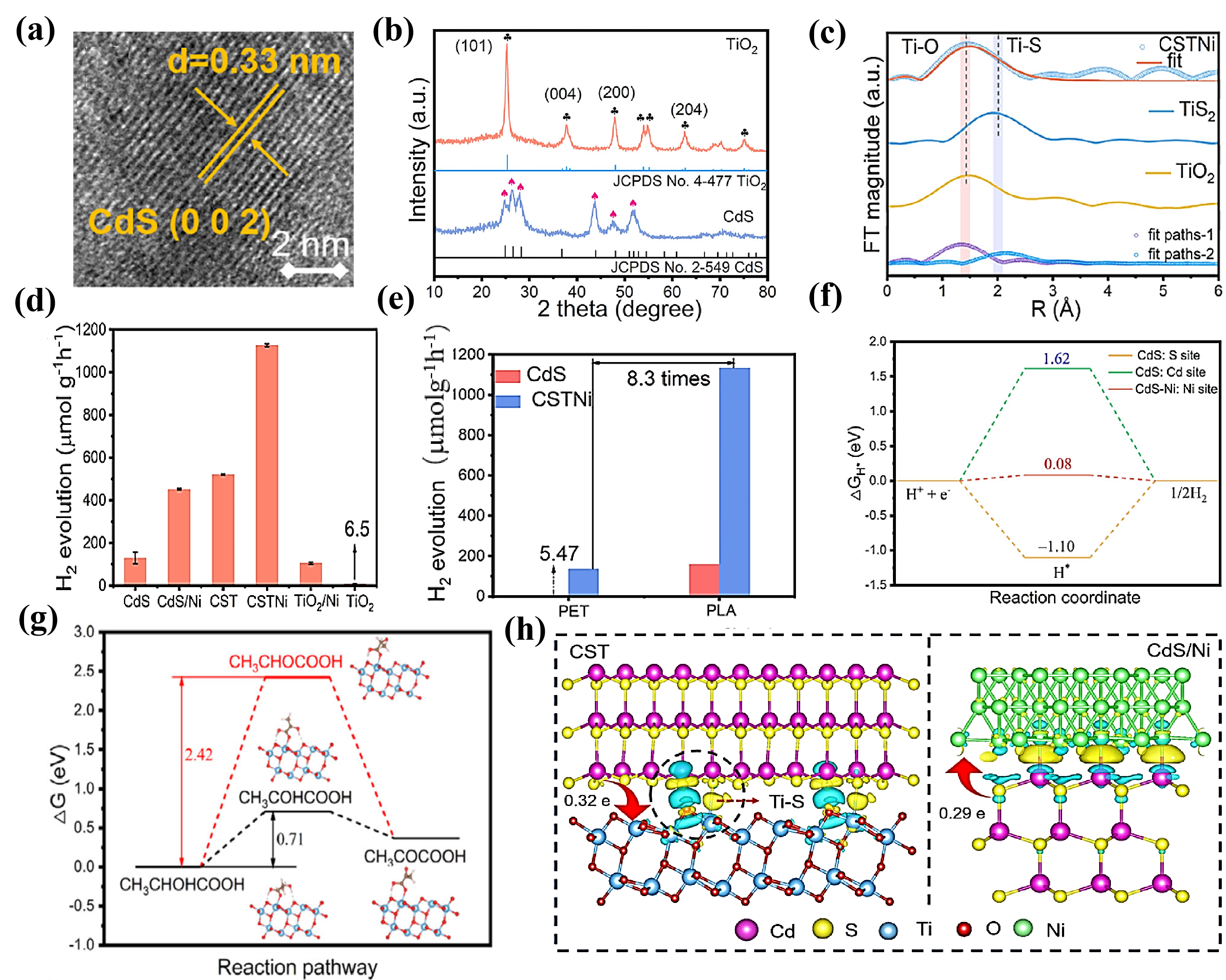
Fig. 9. (a) HRTEM image of CSTNi showing the lattice fringes of the CdS (002) crystal plane. (b) XRD patterns of CSTNi and related samples. (c) FT-EXAFS spectra confirming the existence of Ti-S and Ti-O coordination bonds. (d) Photocatalytic H2 evolution performance. (e) Comparison of H2 evolution rates during degradation of different microplastic substrates. (f) Gibbs free energy calculations of hydrogen adsorption at various active sites. (g) Free-energy pathways for the conversion pathway of lactic acid to pyruvic acid. (h) Charge-density difference distributions and corresponding Bader charge analysis of the CSTNi heterojunction. Reprinted with permission from Ref. [160]. Copyright 2025, John Wiley and Sons.
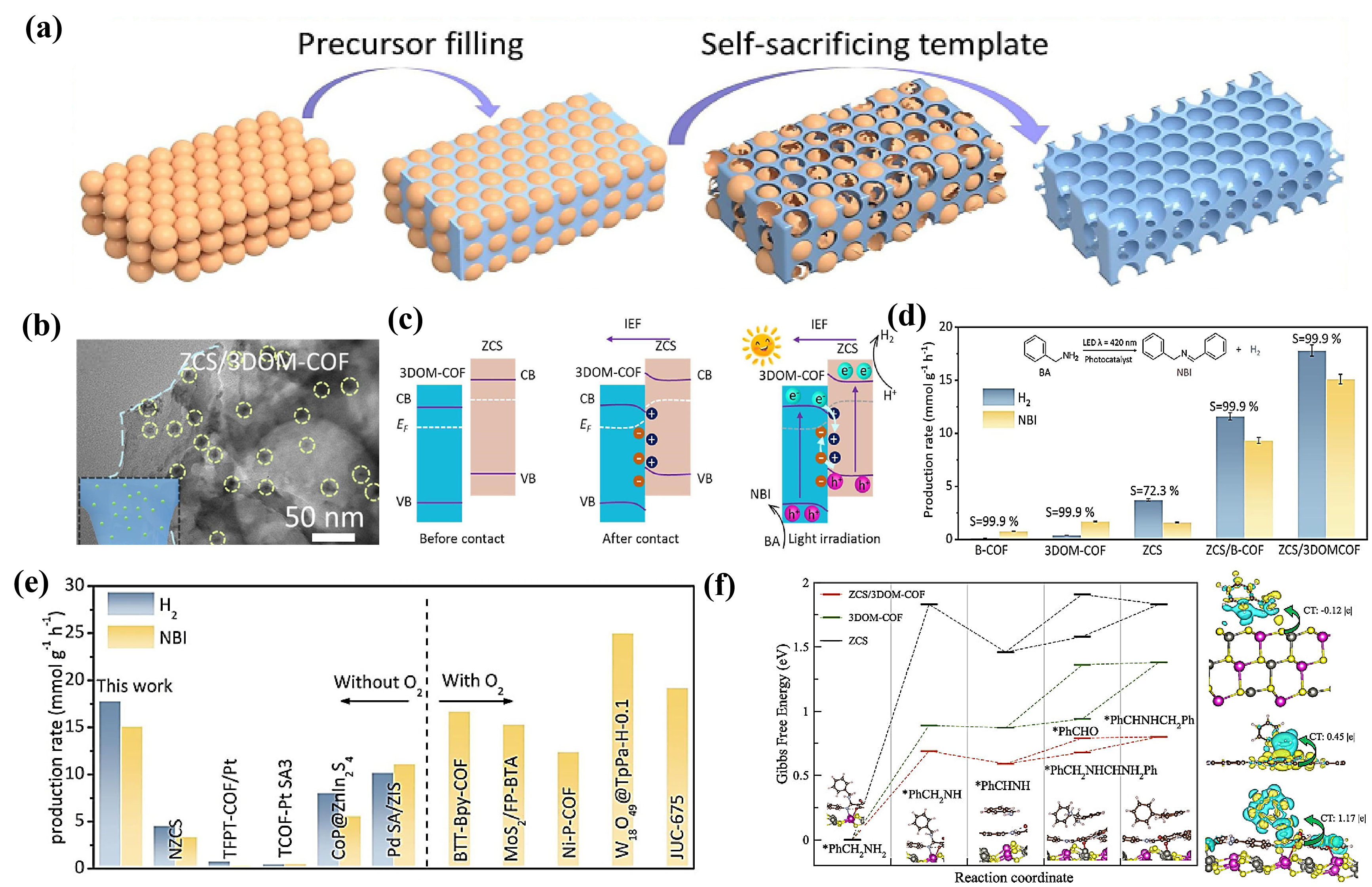
Fig. 10. (a) Schematic illustration of the one-step self-sacrificial template synthesis process for the 3DOM-COF and ZCS/3DOM-COF heterojunction photocatalyst. (b) TEM image of ZCS/3DOM-COF. (c) Proposed S-scheme charge-transfer mechanism. (d) Photocatalytic performances of different catalysts for simultaneous H2 evolution and NBI generation. (e) Comparison of the photocatalytic activity of ZCS/3DOM-COF with previously reported semiconductors. (f) DFT-calculated reaction energy barriers for benzylamine oxidation on different catalyst surfaces. Reprinted with permission from Ref. [161]. Copyright 2025, John Wiley and Sons.

Fig. 11. (a) Schematic representation of the synthesis procedure of the IOOV/TCN. (b) HRTEM images and XRD of samples. (c) HMF conversion toward DFF, FDCA, and FFCA over different photocatalysts. (d) Comparison of HMF conversion and product selectivity of IOOV/TCN-10 under different irradiation conditions. (e) EPR spectra of IOOV, TCN, and IOOV/TCN-10. (f) The band structures of IOOV and TCN. Photocurrent (g) and TRPL decay (h) curves of IOOV/TCN-10. (i) Proposed mechanism of the IOOV/TCN S-scheme heterojunction. Reprinted with permission from Ref. [170]. Copyright 2025, Elsevier.
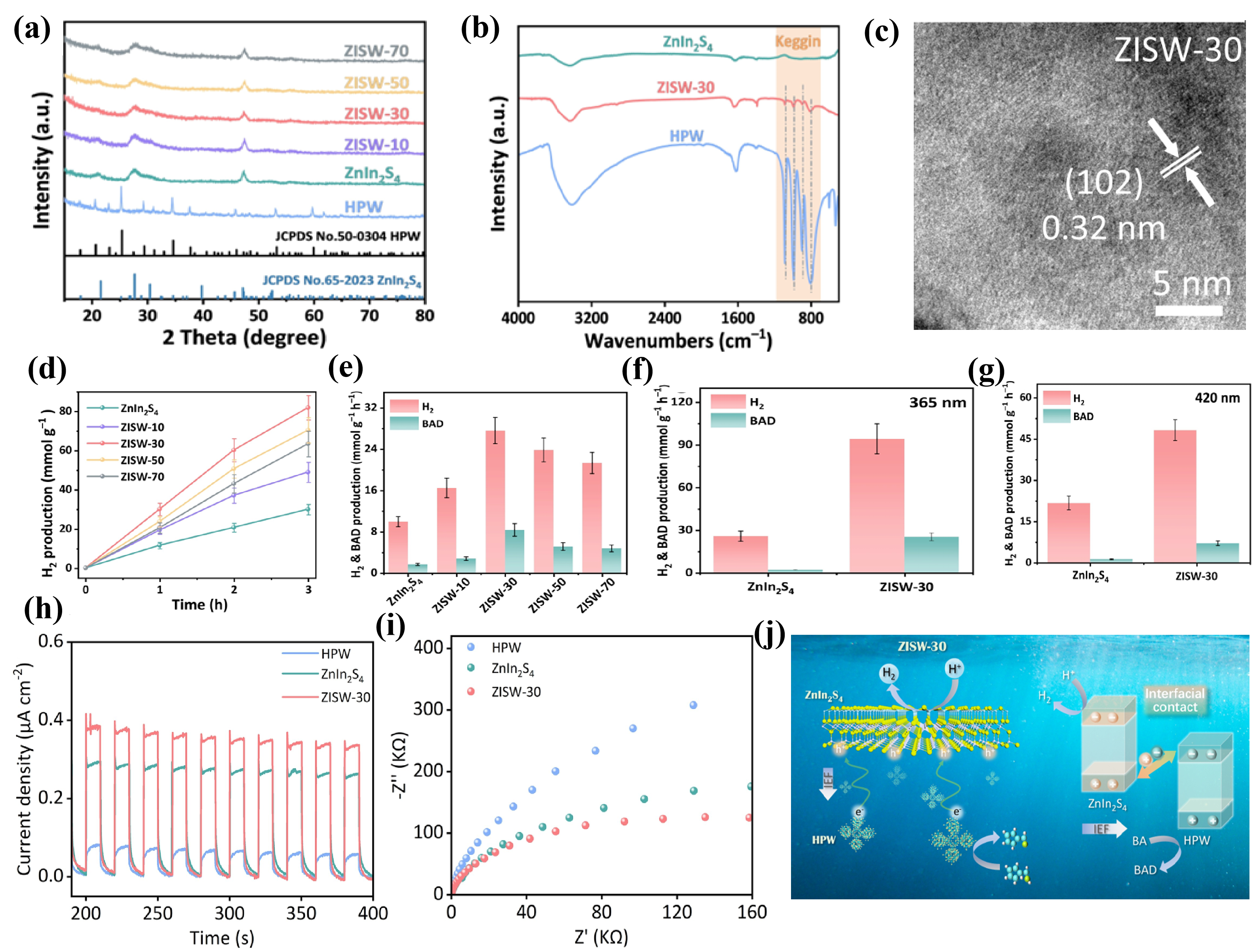
Fig. 12. (a) XRD patterns of samples. (b) FT-IR spectra of HPW, ZnIn2S4, and ZISW-30. (c) HRTEM image of ZISW-30. H2 evolution rates (d) and BAD production (e) over different samples. H2 evolution (f) and BAD production (g) rates of ZISW-30 and ZnIn2S4 under monochromatic LED irradiation (365, 420, 500, and 550 nm). Transient photocurrent response (h) and Nyquist plots of EIS curves (i) of HPW, ZnIn2S4, and ZISW-30. (j) Schematic illustration of the photocatalytic reaction mechanism. Reprinted with permission from Ref. [171]. Copyright 2024, John Wiley and Sons.
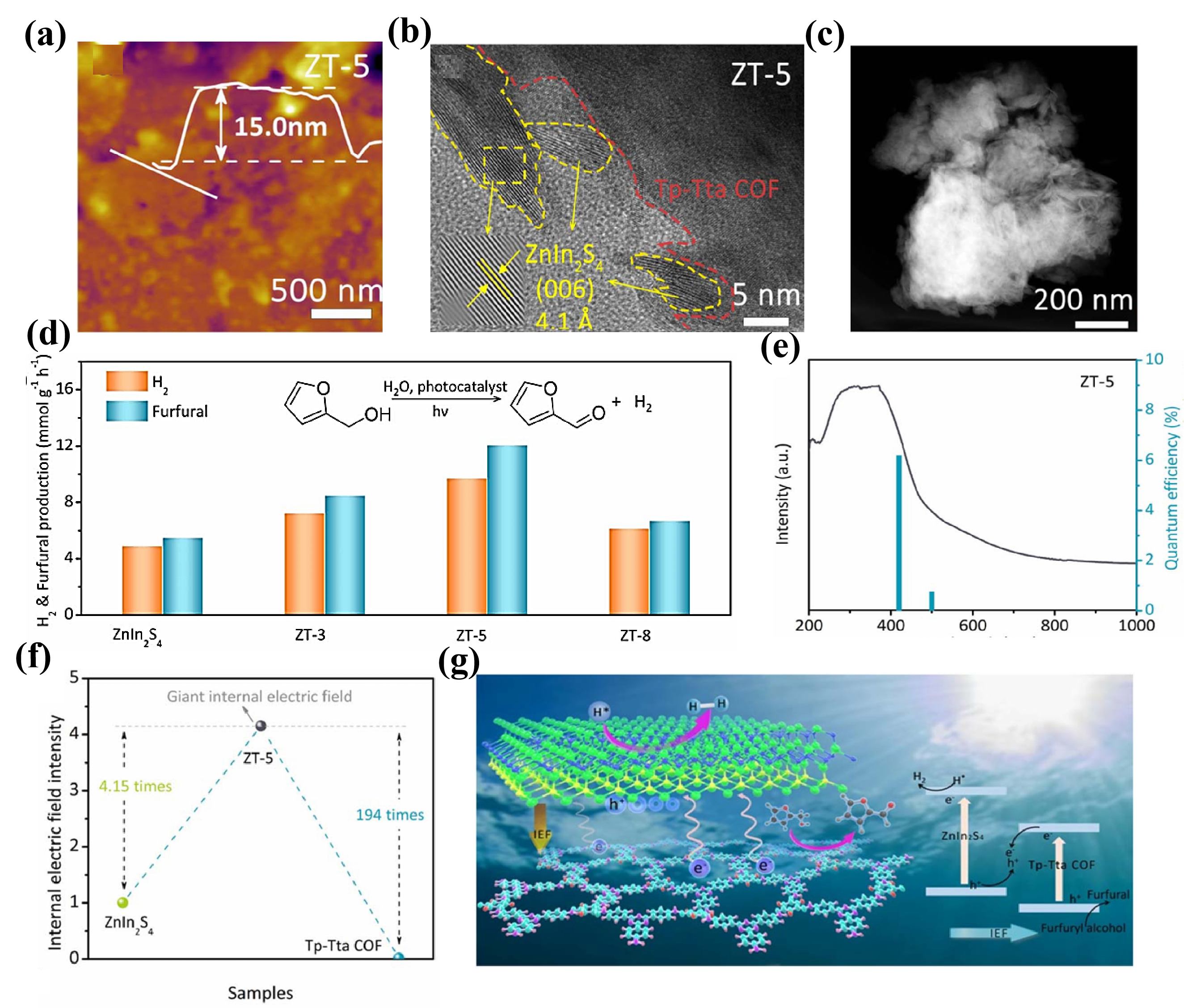
Fig. 13. AFM (a), HRTEM (b), HAADF-STEM (c) images of the ZT-5 composite. (d) Comparison of hydrogen evolution rates and furfural production rates among different samples. (e) AQY of the ZT-5. (f) IEF strength over different samples. (g) Schematic illustration of the S-scheme charge transfer mechanism. Reprinted with permission from Ref. [82]. Copyright 2023, Royal Society of Chemistry (RSC).

Fig. 14. (a) Schematic illustration of the synthesis process of the SS@SIS composite. (b) XRD patterns of Sb2S3, SnIn4S8, and SS@SIS composites. (c,d) H2 evolution curves of different samples. (e,f) Degradation efficiency curves and kinetic constants of TCH over different samples. H2 evolution and degradation efficiencies of SS@SIS-5 in different pollutant systems (g) and the presence of different radical scavengers (h). Schematic illustration of S-scheme heterojunction (i) and reaction mechanism (j). Reprinted with permission from Ref. [172]. Copyright 2025, Elsevier.
| Coupling type | Catalyst system | Hydrogen production capacity (μmol·g‒1·h‒1) | Properties of oxidation products (μmol·g‒1·h‒1) | Reaction conditions | AQY | Solar-to-chemical efficiency (SCC) | TOF (h‒1) | Cycle stability (Retention after N cycles) | Ref. |
|---|---|---|---|---|---|---|---|---|---|
| Pure water splitting | TpBpy-COF/COF-316 | 220.4 | O2:110.2 | 300 W Xe lamp, λ ≥ 420 nm visible light, pure water, 10 °C, sacrificial-agent-free | 5.75% (500 nm) | 0.17% | — | H2/O2 ratio maintained at 2:1 with slight activity loss after 5 cycles. | [ |
| Pure water splitting | DE-NM/TpBpy-COF(NH2-MIL-125/TpBpy-COF) | 331.6 | O2:165.7 | 300 W Xe lamp, λ ≥ 420 nm visible light, pure water, 10 °C, sacrificial-agent-free | 6.06% (450 nm) | 0.21% | — | Stable H2/O2 ratio with no structural damage after 5 cycles. | [ |
| Amino oxidation | Ni-Zn0.2Cd0.8S/TiO2 (TNZCS40) | 4550 | imines: 3350 | 300 W Xe lamp, 350-780 nm, N2-saturated 1, 4-dioxane solution, 0.1 mL H2O + 0.1 mL benzylamine, sacrificial-agent-free | 16.56% (365 nm) | — | — | Stable photocatalytic activity over 12 h. | [ |
| Pollutant degradation/PLA oxidation | TiO2/CdS/Ni (CSTNi) | 1126.9 | PLA degradation (polylactic acid oxidation) | 300 W Xe lamp, 2 M KOH containing PLA solution, air、aqueous solution sacrificial-agent-free | — | — | — | 3 cycles, 85% activity retention | [ |
| Biomass oxidation/furfural oxidation | ZnIn2S4/Tp-Tta COF (ZT-5) | 9730 | Furfural: 12100 | 80 W LED, 10 vol% ethanol solution, Air, aqueous solution, sacrificial-agent-free | 13.91% | — | — | 5 cycles, 90% activity retention | [ |
| Alcohol oxidation/benzyl alcohol oxidation | HPW/ZnIn2S4 (ZISW-30) | 27590 | Benzaldehyde: 8320 | 300 W Xe lamp, full spectrum, 10 vol% benzyl alcohol solution, sacrificial-agent-free | — | — | — | 4 cycles, 88% activity retention | [ |
| Amino oxidation/benzylamine oxidation | 3DOM-COF/ZnCdS (ZCS/3DOM-COF) | 1780 | Imines: 15100 (99% selectivity) | 80 W LED, λ = 420 nm, acetonitrile/H2O solution, N2 inert atmosphere, organic solvent, sacrificial-agent-free | — | — | — | Crystal structure and morphology preserved | [ |
| Antibiotic degradation | Sb2S3@SnIn4S8 (SS@SIS-5) | 3566 | TCH degradation: 90.5% (120 min) | 300 W Xe lamp, visible light, 50 mg·L-1 TCH solution, sacrificial-agent-free | — | — | — | 5 cycles, 91% H2 activity retained | [ |
| HMF oxidation | IOOV/TCN-10 (In2O3‒x/C3N4) | 754.05 | HMF conversion rate: 94.8% DFF + FDCA selectivity: 53.6% | LED lamp, λ = 420 nm, 5 mM HMF solution, N2 atmosphere/H2O, 15 °C, sacrificial agent: HMF | — | — | — | Slight activity loss after repeated cycles. | [ |
Table 1 Representative S-scheme heterojunction photocatalysts for photocatalytic H2 production coupled with value-added oxidation reactions.
| Coupling type | Catalyst system | Hydrogen production capacity (μmol·g‒1·h‒1) | Properties of oxidation products (μmol·g‒1·h‒1) | Reaction conditions | AQY | Solar-to-chemical efficiency (SCC) | TOF (h‒1) | Cycle stability (Retention after N cycles) | Ref. |
|---|---|---|---|---|---|---|---|---|---|
| Pure water splitting | TpBpy-COF/COF-316 | 220.4 | O2:110.2 | 300 W Xe lamp, λ ≥ 420 nm visible light, pure water, 10 °C, sacrificial-agent-free | 5.75% (500 nm) | 0.17% | — | H2/O2 ratio maintained at 2:1 with slight activity loss after 5 cycles. | [ |
| Pure water splitting | DE-NM/TpBpy-COF(NH2-MIL-125/TpBpy-COF) | 331.6 | O2:165.7 | 300 W Xe lamp, λ ≥ 420 nm visible light, pure water, 10 °C, sacrificial-agent-free | 6.06% (450 nm) | 0.21% | — | Stable H2/O2 ratio with no structural damage after 5 cycles. | [ |
| Amino oxidation | Ni-Zn0.2Cd0.8S/TiO2 (TNZCS40) | 4550 | imines: 3350 | 300 W Xe lamp, 350-780 nm, N2-saturated 1, 4-dioxane solution, 0.1 mL H2O + 0.1 mL benzylamine, sacrificial-agent-free | 16.56% (365 nm) | — | — | Stable photocatalytic activity over 12 h. | [ |
| Pollutant degradation/PLA oxidation | TiO2/CdS/Ni (CSTNi) | 1126.9 | PLA degradation (polylactic acid oxidation) | 300 W Xe lamp, 2 M KOH containing PLA solution, air、aqueous solution sacrificial-agent-free | — | — | — | 3 cycles, 85% activity retention | [ |
| Biomass oxidation/furfural oxidation | ZnIn2S4/Tp-Tta COF (ZT-5) | 9730 | Furfural: 12100 | 80 W LED, 10 vol% ethanol solution, Air, aqueous solution, sacrificial-agent-free | 13.91% | — | — | 5 cycles, 90% activity retention | [ |
| Alcohol oxidation/benzyl alcohol oxidation | HPW/ZnIn2S4 (ZISW-30) | 27590 | Benzaldehyde: 8320 | 300 W Xe lamp, full spectrum, 10 vol% benzyl alcohol solution, sacrificial-agent-free | — | — | — | 4 cycles, 88% activity retention | [ |
| Amino oxidation/benzylamine oxidation | 3DOM-COF/ZnCdS (ZCS/3DOM-COF) | 1780 | Imines: 15100 (99% selectivity) | 80 W LED, λ = 420 nm, acetonitrile/H2O solution, N2 inert atmosphere, organic solvent, sacrificial-agent-free | — | — | — | Crystal structure and morphology preserved | [ |
| Antibiotic degradation | Sb2S3@SnIn4S8 (SS@SIS-5) | 3566 | TCH degradation: 90.5% (120 min) | 300 W Xe lamp, visible light, 50 mg·L-1 TCH solution, sacrificial-agent-free | — | — | — | 5 cycles, 91% H2 activity retained | [ |
| HMF oxidation | IOOV/TCN-10 (In2O3‒x/C3N4) | 754.05 | HMF conversion rate: 94.8% DFF + FDCA selectivity: 53.6% | LED lamp, λ = 420 nm, 5 mM HMF solution, N2 atmosphere/H2O, 15 °C, sacrificial agent: HMF | — | — | — | Slight activity loss after repeated cycles. | [ |
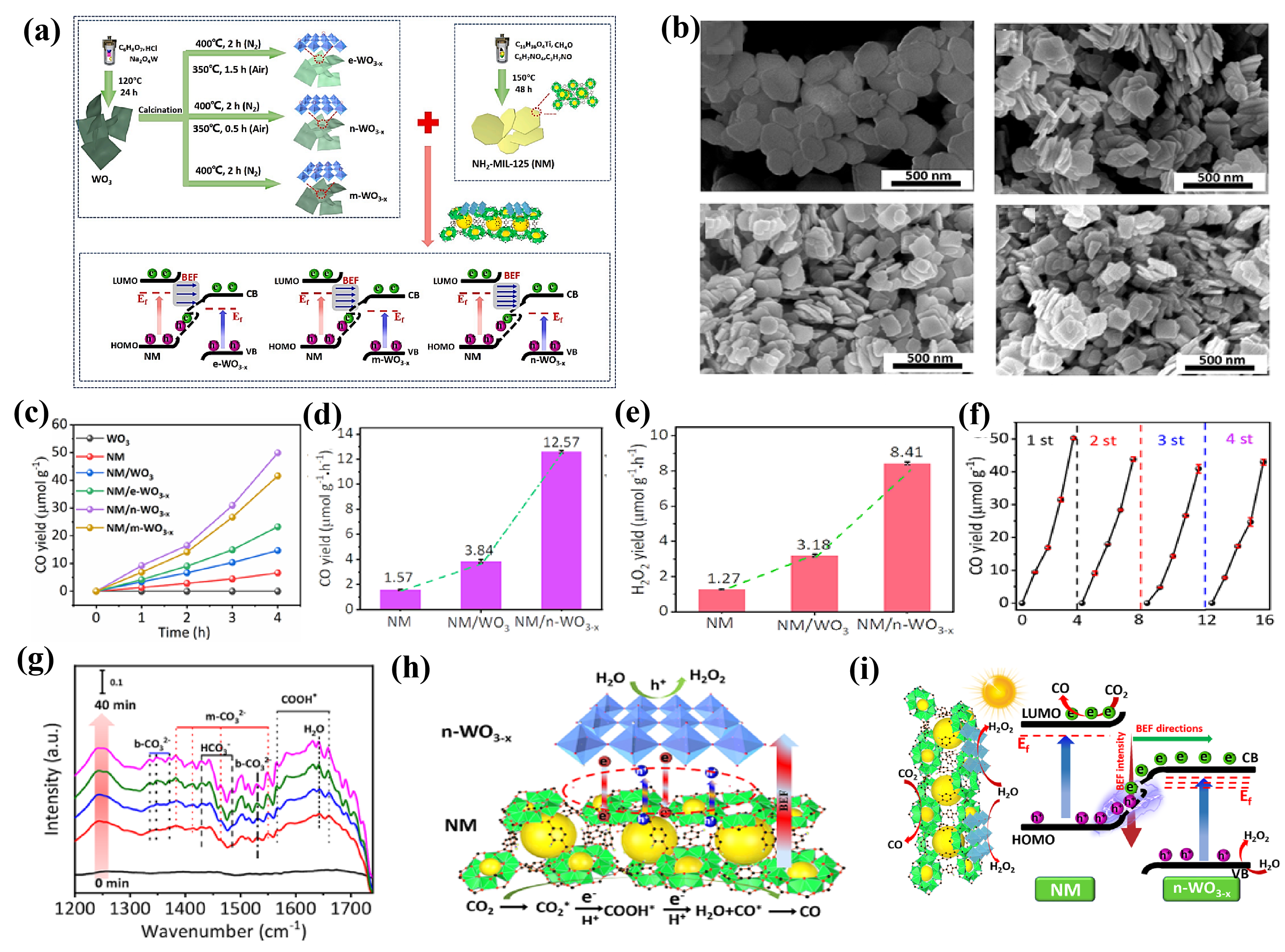
Fig. 15. (a) Schematic illustration of the synthesis process of the NM/WO3-x heterojunction. (b) SEM image of NM. (c) Time-dependent CO production curves of different samples. CO (d) and H2O2 production (e) rates of different samples. (f) Four-cycle stability tests. (g) In-situ DRIFTS spectra of NM/n-WO3‒x under light irradiation. (h,i) Schematic illustration of the CO2 reduction process. Reprinted with permission from Ref. [90]. Copyright 2023, Elsevier.
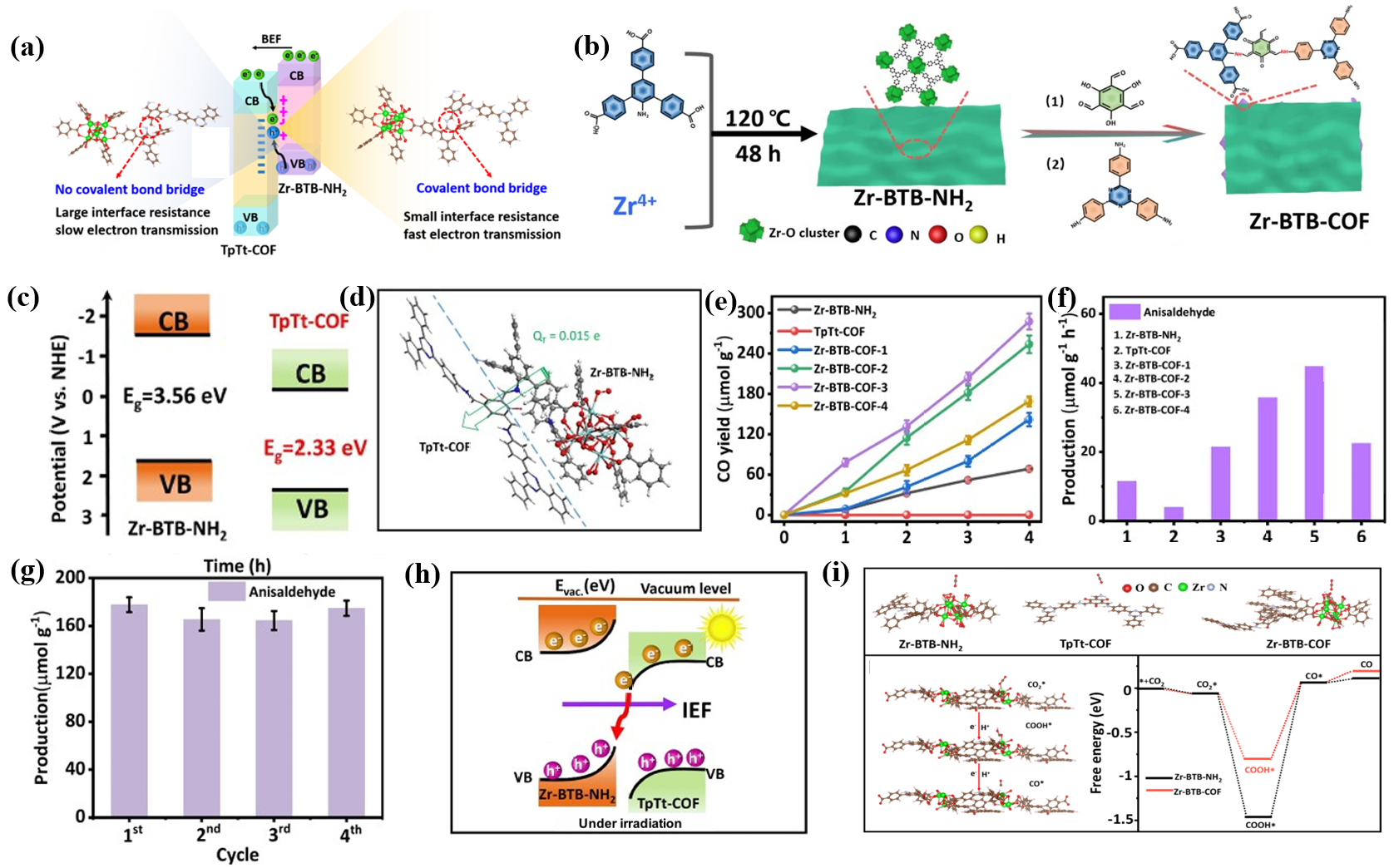
Fig. 16. (a,b) Schematic representation of the construction of a Zr-BTB-COF S-scheme system featuring electron-transport bridge. (c) Band structure diagram of Zr-BTB-NH2 and TpTt-COF. (d) Electron transfer in the Zr-BTB-COF composite. CO production (e) and anisaldehyde production (f) rates over different sample. (g) Anisaldehyde yields of Zr-BTB-COF-3 during four photocatalytic cycling runs. S-scheme (h) and CO2 adsorption and CO2 reduction to CO (i) over Zr-BTB-COF. Reprinted with permission from Ref. [178]. Copyright 2026, Elsevier.
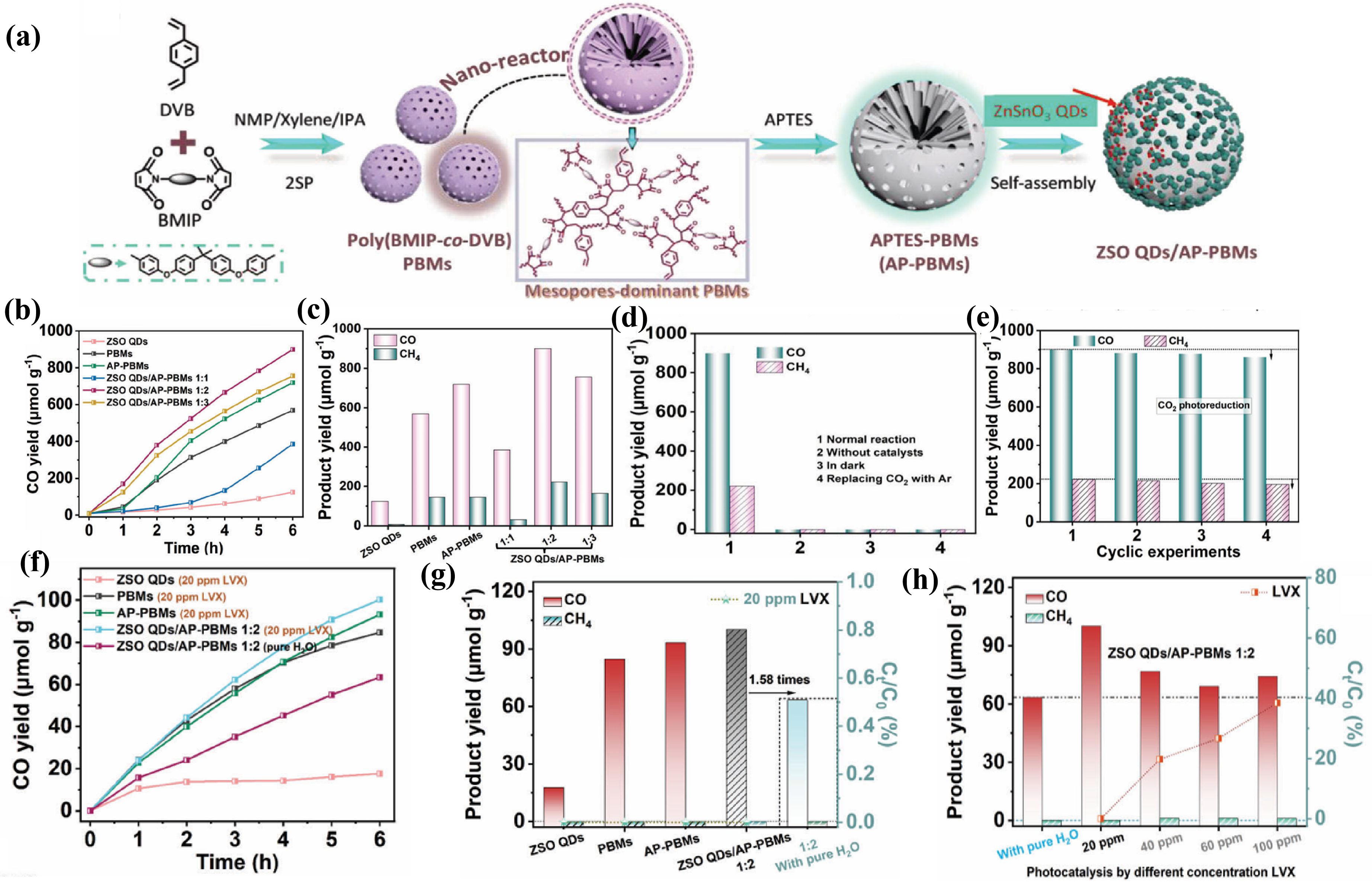
Fig. 17. (a) Schematic illustration of the synthesis process of the ZSO QDs/AP-PBMs composite. (b) CO production curves of different samples (PBMs, AP-PBMs, ZSO QDs, ZSO QDs/AP-PBMs 1:1, 1:2, 1:3, and 1:4) in a 20 ppm LVX solution. (c) CO production curves of different samples. (d) Comparing the photocatalytic activity in LVX solutions with different conditions. (e) Stability of ZSO QDs/AP-PBMs 1:2. (f) Temporal variation of CO production for all photocatalyst samples in a 20 ppm LVX solution in a 20 ppm LVX solution. (g) Product yield of ZSO QDs/AP-PBMs 1:2 after 6 hours. (h) Photocatalytic CO production of ZSO QDs/AP-PBMs 1:2 in LVX solutions with different initial concentrations (20, 40, 60, 80 ppm). Reprinted with permission from Ref. [180]. Copyright 2024, John Wiley and Sons.
| Coupling type | Catalyst system | CO2 reduction product / yield(μmol·g‒1·h‒1) | Oxidation product/performance (μmol·g‒1·h‒1) | Reaction conditions | AQY | Solar-to-chemical efficiency (SCC) | TOF (h‒1) | Cycle stability (Retention after N cycles) | Ref. |
|---|---|---|---|---|---|---|---|---|---|
| H2O oxidation | NH2-MIL-125-Ti/WO3‒x (NM/n-WO3‒x) | CO: 12.57 | H2O2: 8.41 | 300 W Xe lamp, UV-vis light, pure water, CO2‒ saturated, sacrificial-agent-free | 0.17% (365 nm) | — | — | no obvious activity loss after 4 cycles. | [ |
| Alcohol oxidation (4-methoxybenzyl alcohol) | Zr-BTB-COF (Zr-BTB-NH2/TpTt-COF) | CO: 71.9 | p-Anisaldehyde: 44.7 | 300 W Xe lamp, 400 mW·cm‒2, 10% pure water, CO2‒ saturated, sacrificial agent: 4-methoxy- benzyl alcohol solution | 3.75% (365 nm) | — | — | 87% of the initial CO yield retained after 4 cycles | [ |
| Antibiotic degradation (Levofloxacin, LVX) | ZnSnO3 QDs/AP-PBMs (ZSO QDs/AP-PBMs 1:2) | CO: 100.3 μmol·g‒1 (6 h, 100% selectivity) + CH4: 221.7 | LVX degradation rate: 100% (1 h) | 300 W Xe lamp, 20 ppm LVX solution, pure water, CO2-saturated sacrificial-agent-free | — | — | — | no obvious activity loss after 4 cycles | [ |
Table 2 S-scheme heterojunction photocatalysts for photocatalytic CO2 reduction coupled with oxidation reactions.
| Coupling type | Catalyst system | CO2 reduction product / yield(μmol·g‒1·h‒1) | Oxidation product/performance (μmol·g‒1·h‒1) | Reaction conditions | AQY | Solar-to-chemical efficiency (SCC) | TOF (h‒1) | Cycle stability (Retention after N cycles) | Ref. |
|---|---|---|---|---|---|---|---|---|---|
| H2O oxidation | NH2-MIL-125-Ti/WO3‒x (NM/n-WO3‒x) | CO: 12.57 | H2O2: 8.41 | 300 W Xe lamp, UV-vis light, pure water, CO2‒ saturated, sacrificial-agent-free | 0.17% (365 nm) | — | — | no obvious activity loss after 4 cycles. | [ |
| Alcohol oxidation (4-methoxybenzyl alcohol) | Zr-BTB-COF (Zr-BTB-NH2/TpTt-COF) | CO: 71.9 | p-Anisaldehyde: 44.7 | 300 W Xe lamp, 400 mW·cm‒2, 10% pure water, CO2‒ saturated, sacrificial agent: 4-methoxy- benzyl alcohol solution | 3.75% (365 nm) | — | — | 87% of the initial CO yield retained after 4 cycles | [ |
| Antibiotic degradation (Levofloxacin, LVX) | ZnSnO3 QDs/AP-PBMs (ZSO QDs/AP-PBMs 1:2) | CO: 100.3 μmol·g‒1 (6 h, 100% selectivity) + CH4: 221.7 | LVX degradation rate: 100% (1 h) | 300 W Xe lamp, 20 ppm LVX solution, pure water, CO2-saturated sacrificial-agent-free | — | — | — | no obvious activity loss after 4 cycles | [ |
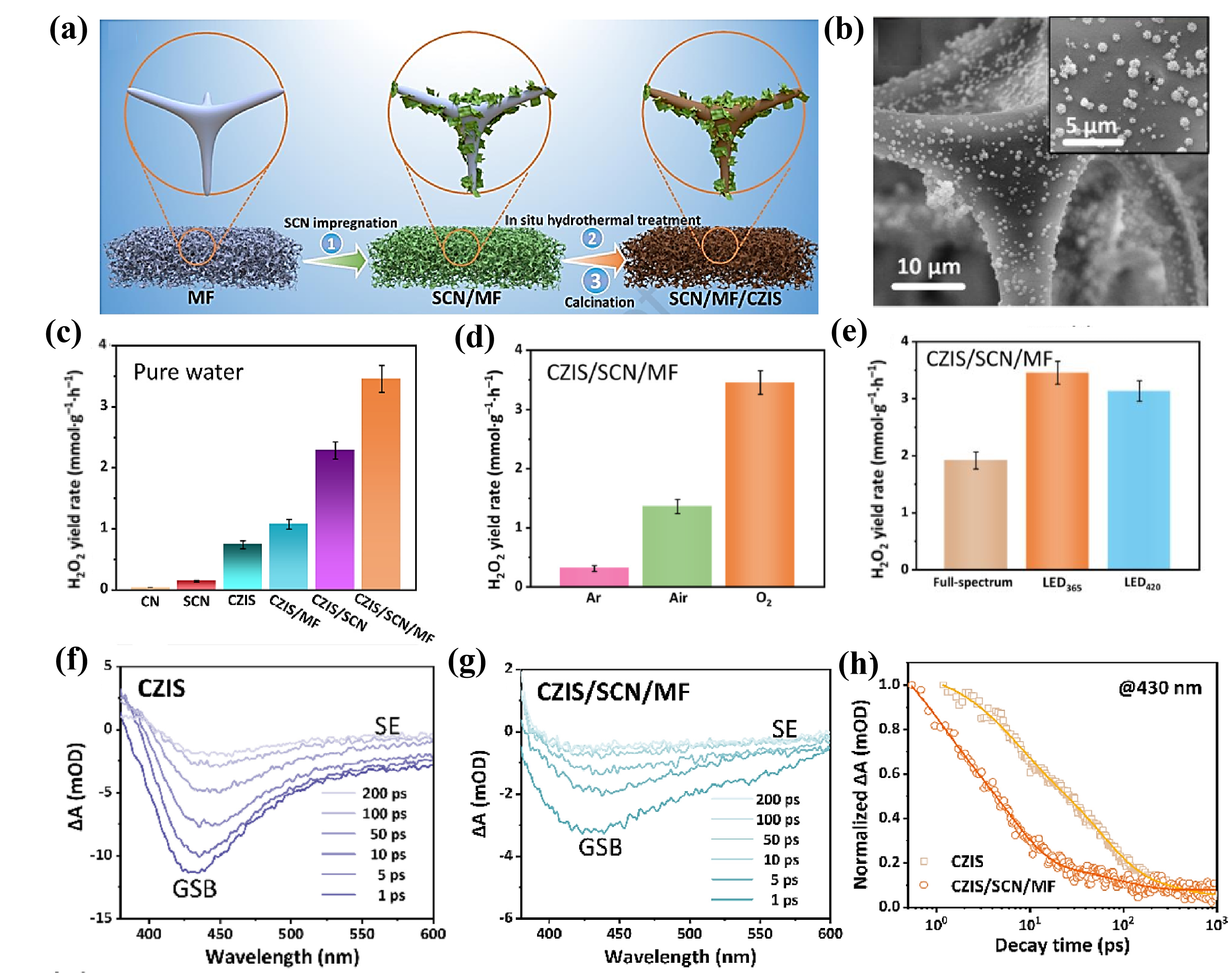
Fig. 18. (a) Schematic illustration of the synthesis process of the CZIS/SCN/MF composite. (b) SEM image of the CZIS/SCN/MF composite. (c) H2O2 production rates over different samples (SCN/MF, CZIS, CZIS/SCN and CZIS/SCN/MF). H2O2 production rates of CZIS/SCN/MF under different atmospheres (d) and different light sources (e). (f-g) fs-TA spectral signals of the samples. (h) GSB decay kinetics of CZIS and CZIS/SCN/MF. Reprinted with permission from Ref. [184]. Copyright 2026, Elsevier.
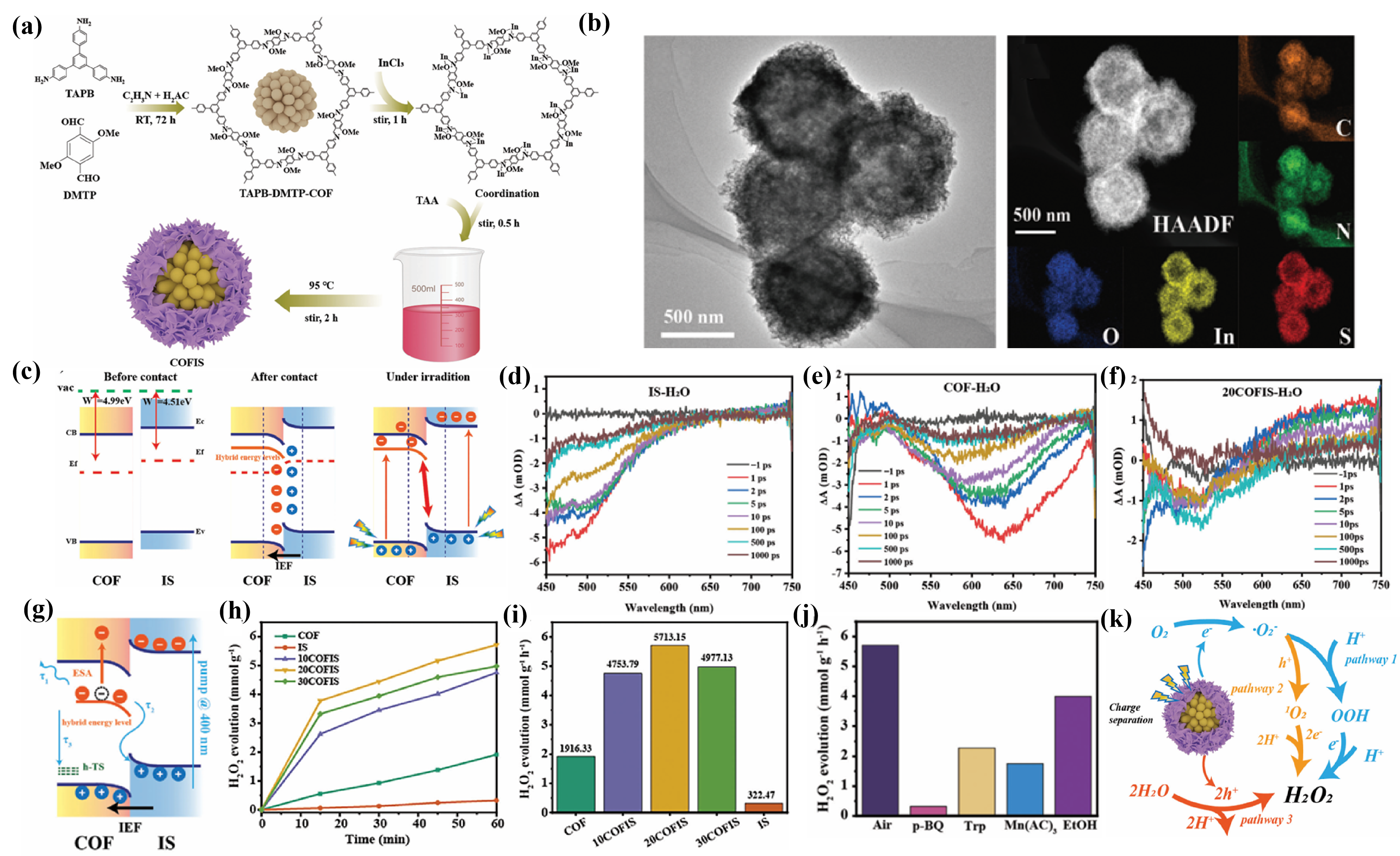
Fig. 19. (a) Schematic illustration of the synthesis process of the COFIS. (b) TEM and HAADF-STEM images of the 20COFIS core-shell structure. (c) Proposed S-scheme charge-transfer mechanism. Fs-TA spectra of In2S3 (d), COF (e), and 20COFIS (f) at different delay times. (g) Photogenerated electron relaxation pathways in 20COFIS. (h,i) H2O2 production of different samples. (j) H2O2 production rates in the presence of different radical scavengers. (k) Proposed reaction mechanism for H2O2 generation over the 20COFIS. Reprinted with permission from Ref. [190]. Copyright 2024, John Wiley and Sons.
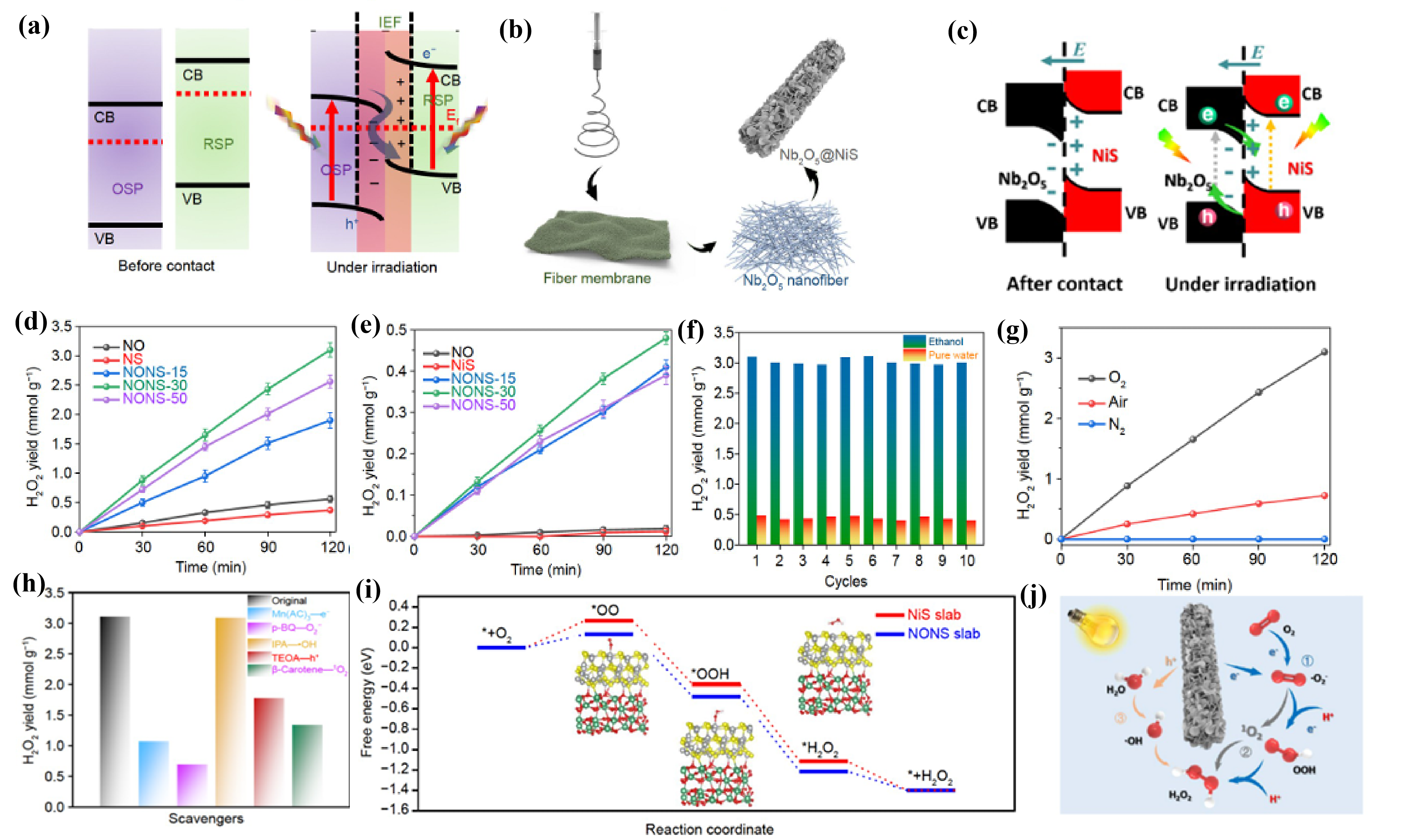
Fig. 20. (a) S-scheme design. (b) Fabrication of NONS. (c) Charge transfer in the NONS S-scheme heterojunction. H2O2 yields of different samples in a 10 vol% ethanol system (d) and pure water (e). (f) Cycling stability test of NONS-30. H2O2 yields of NONS-30 under different atmospheres (g) and in the presence of different scavengers (EDTA-2Na, TEOA, BQ, β-carotene, and IPA) (h). Gibbs free-energy diagram for H2O2 formation (i) and photocatalytic mechanism (j) over NONS catalysts. Reprinted with permission from Ref. [191]. Copyright 2024, Springer Nature.
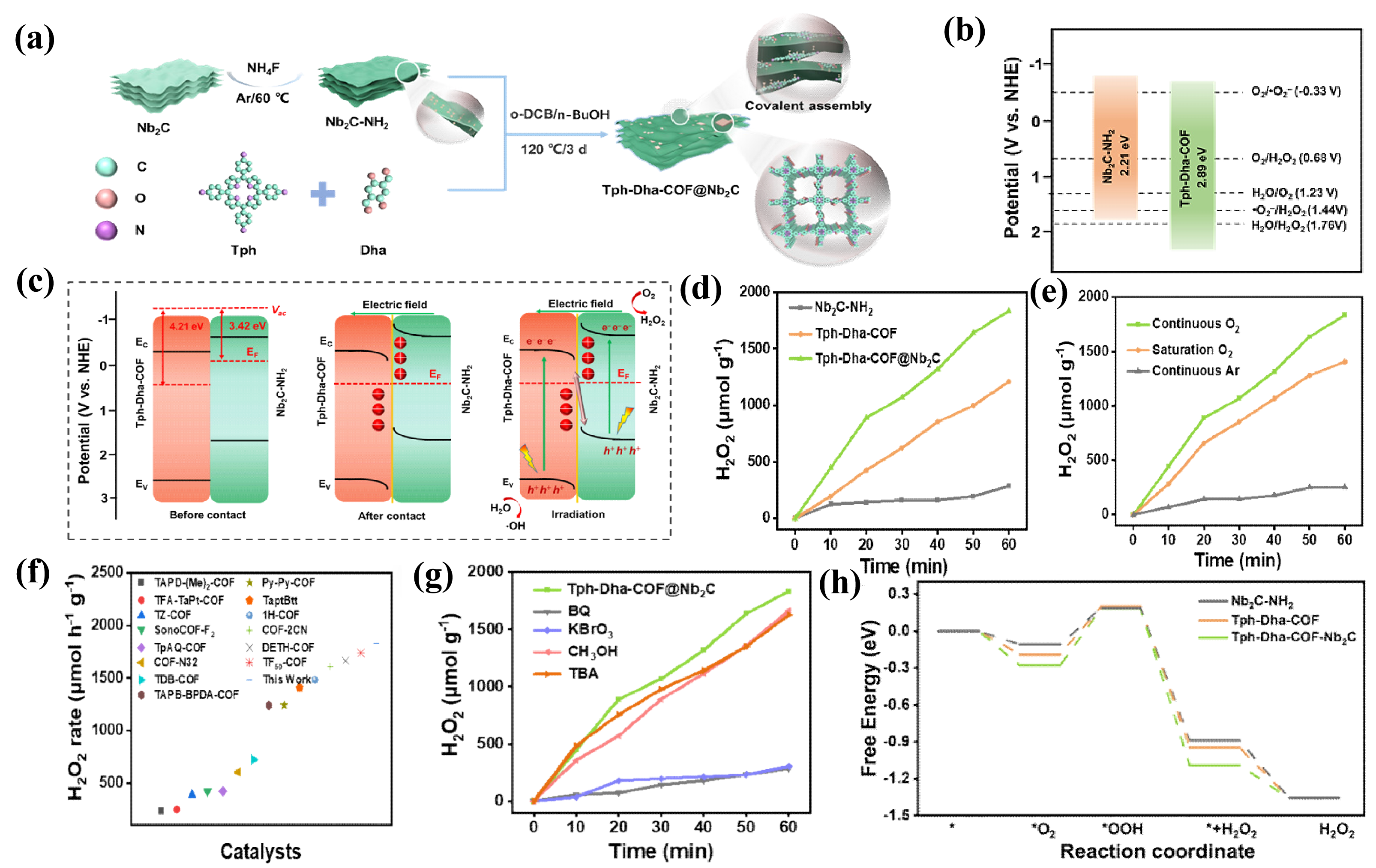
Fig. 21. (a) The synthesis process of the Tph-Dha-COF@Nb2C heterojunction. (b) Band structure diagram of Nb2C-NH2 and Tph-Dha-COF. (c) S-scheme charge-transfer in Tph-Dha-COF@Nb2C. H2O2 production rates of different samples in pure water (d) and under different atmospheres (e). (f) Comparison of H2O2 production. (g) H2O2 yields of Tph-Dha-COF@Nb2C in the presence of different scavengers. (h) Free-energy diagrams of the oxygen reduction pathway over Tph-Dha-COF@Nb2C. Reprinted with permission from Ref. [192]. Copyright 2025, Elsevier.
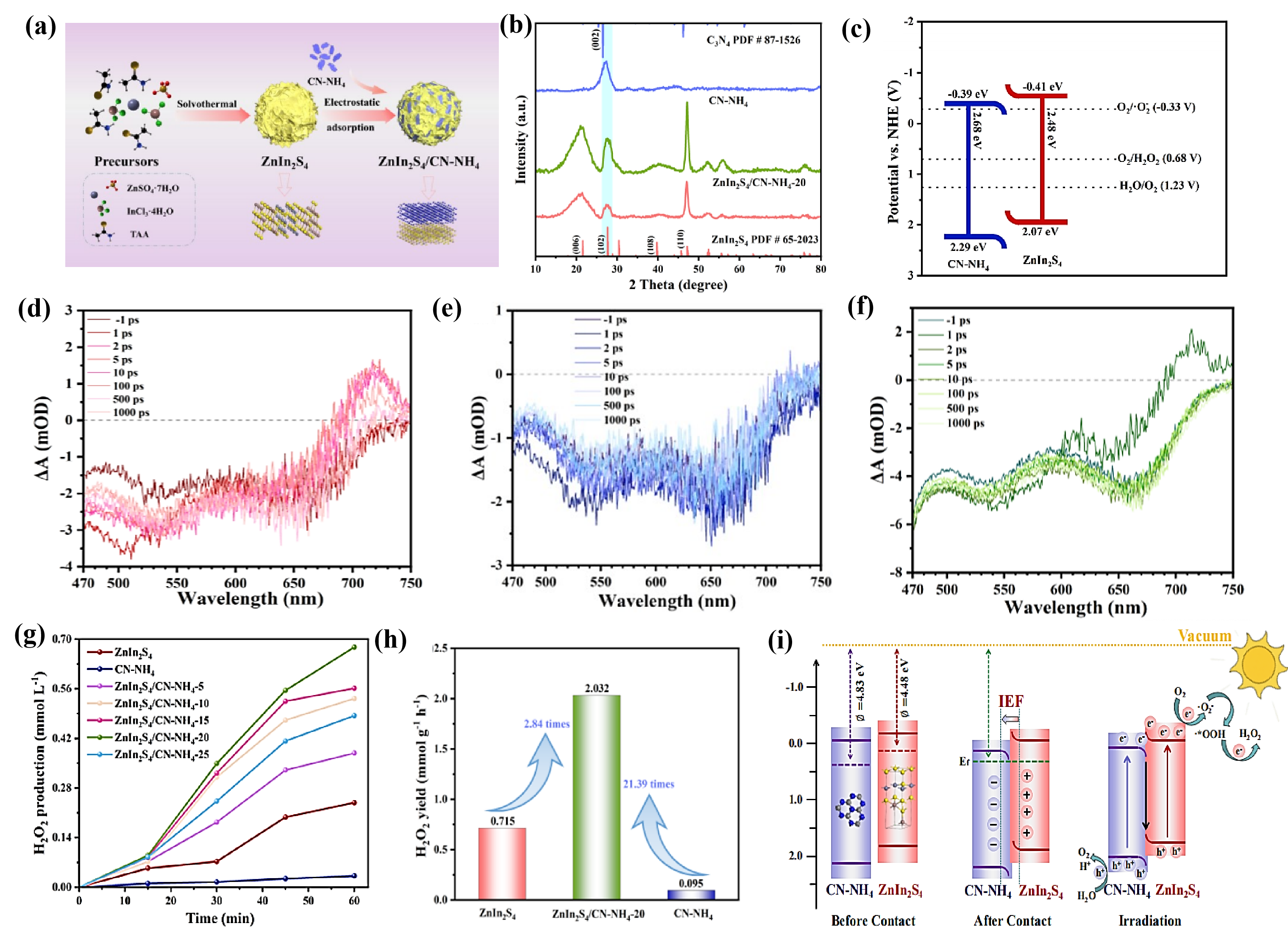
Fig. 22. (a) The electrostatic self-assembly process for constructing the ZnIn2S4/CN-NH4. (b) XRD patterns of ZnIn2S4, CN-NH4, and ZnIn2S4/CN-NH4. (c) Band structure diagram of ZnIn2S4 and CN-NH4. Fs-TA spectra of ZnIn2S4 (d), CN-NH4 (e), and ZnIn2S4/CN-NH4-20 (f). (g) Time-dependent H2O2 over different samples. (h) Comparison of different samples. (i) Proposed H2O2 generation over ZnIn2S4/CN-NH4. Reprinted with permission from Ref. [193]. Copyright 2026, Elsevier.
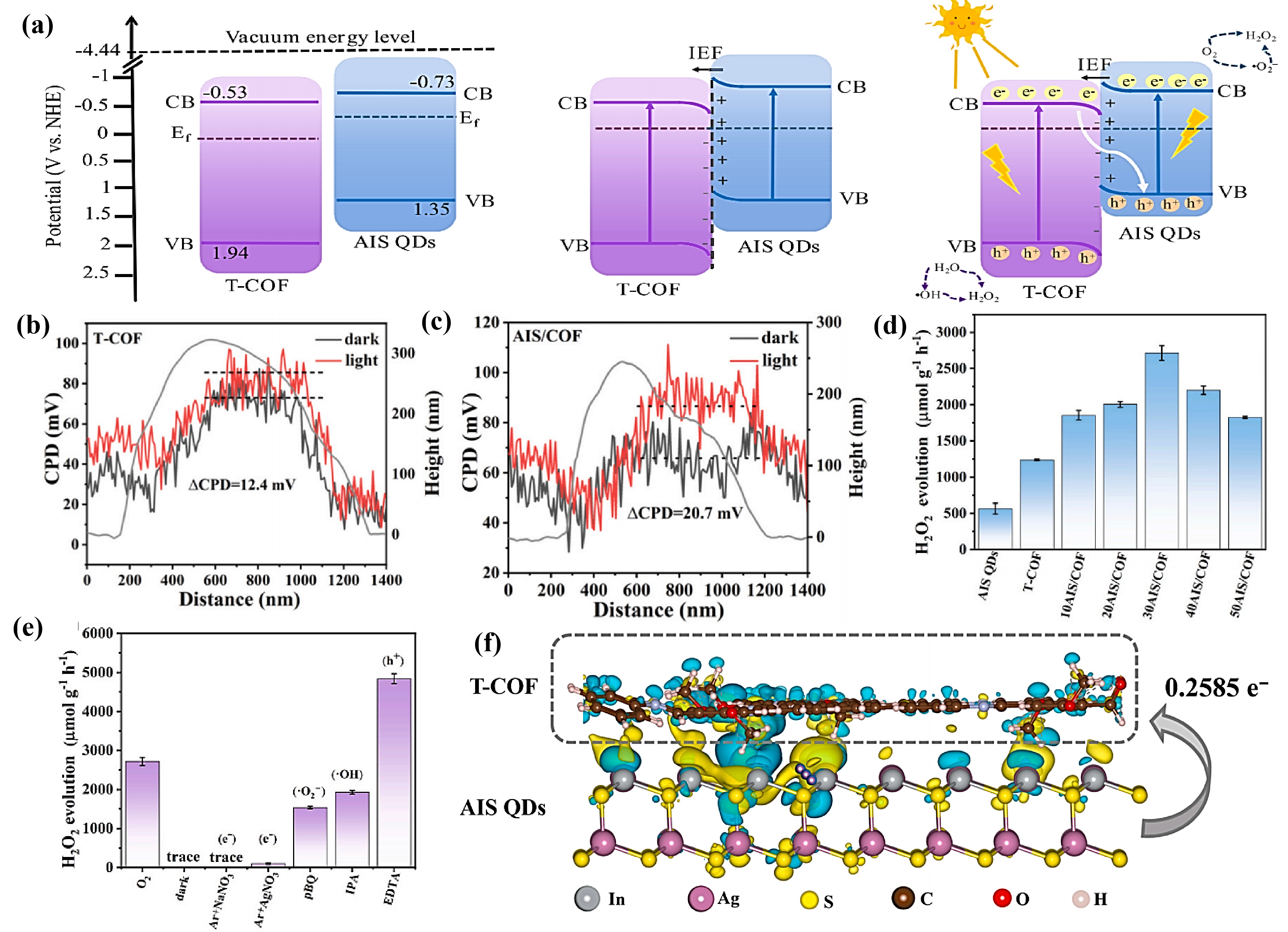
Fig. 23. (a) Band positions of T‑COF and AIS QDs for S-scheme. KPFM of T-COF (b) and AIS/COF (c). (d) H2O2 production rates at different AIS QDs loadings. (e) Radical trapping experiments. (f) Bader charge calculation results of AIS/COF. Reprinted with permission from Ref. [194]. Copyright 2026, Elsevier.
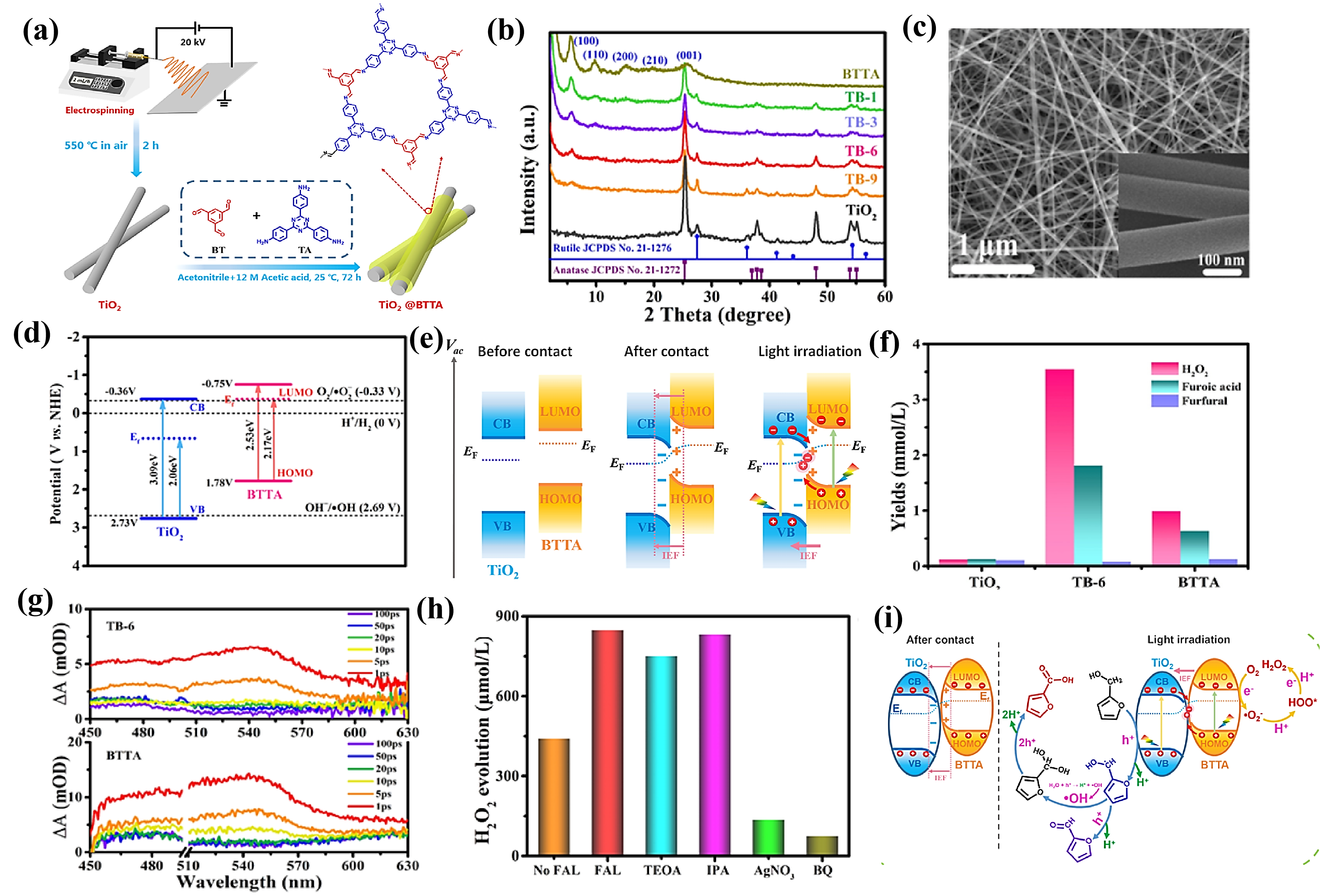
Fig. 24. (a) Schematic illustration of the synthesis process of the TiO2@BTTA core-shell heterojunction. (b) XRD patterns of TiO2@BTTA composites with different BTTA loadings. (c) SEM images of TiO2 nanofibers. (d) Band structure diagram of TiO2 and BTTA-COF. (e) Proposed S-scheme charge-transfer mechanism of TiO2@BTTA. (f) Schematic illustration of the photocatalytic reaction. (g) Fs-TA spectra and carrier decay kinetics of BTTA-COF and TB-6 composite. (h) H2O2 production rates of TiO2@BTTA. (i) Proposed photocatalytic reaction pathway for simultaneous H2O2 production and FAL oxidation over the TiO2@BTTA. Reprinted with permission from Ref. [196]. Copyright 2023, Elsevier.
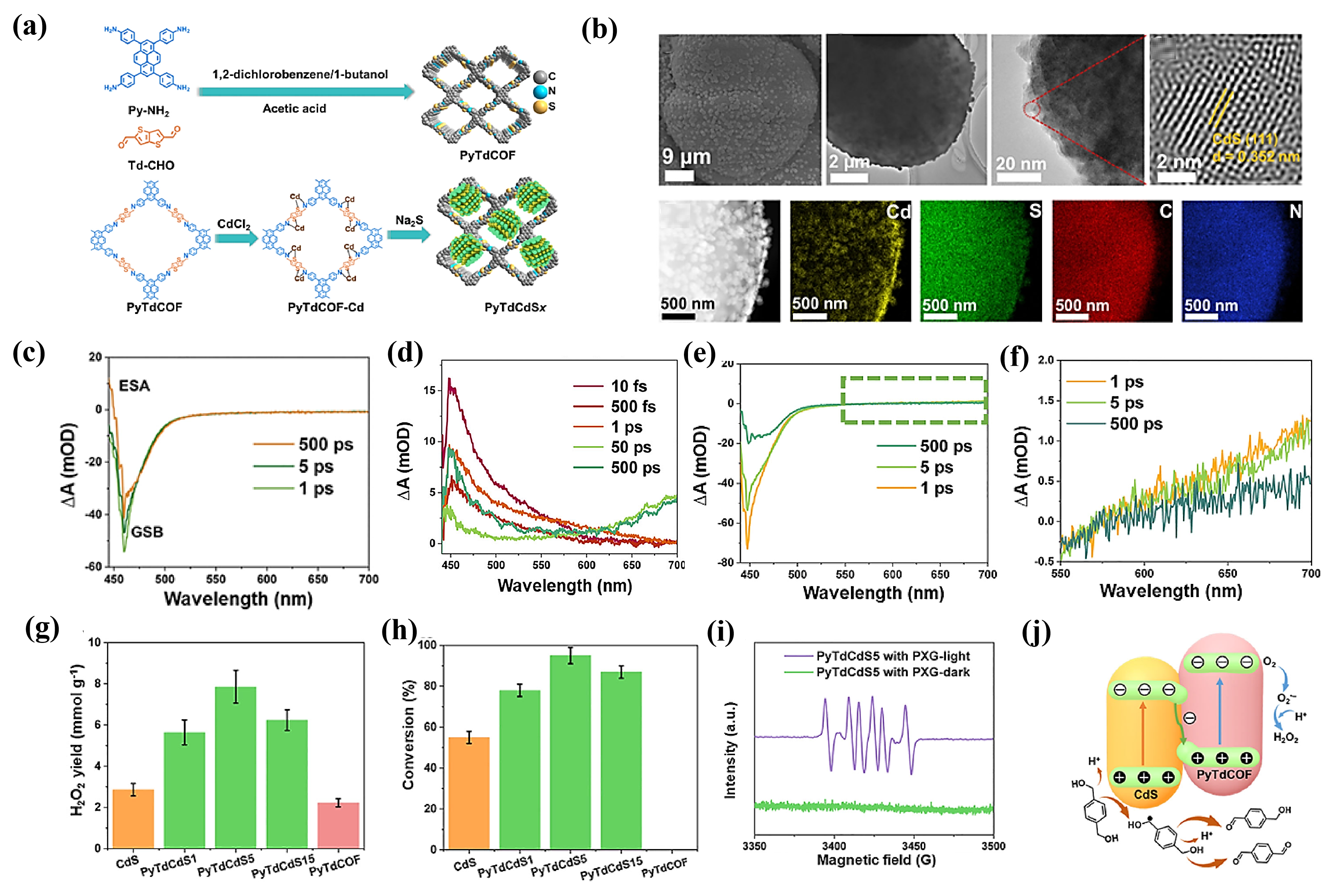
Fig. 25. (a) Schematic illustration of the synthesis of PyTdCOF and PyTdCOF/CdS composite. (b) Morphology of the PyTdCOF/CdS. Fs-TA spectra of pure CdS (c), PyTdCOF (d), and PyTdCOF/CdS composite (e,f). (g) H2O2 production rates of different samples (CdS, PyTdCdS1, PyTdCdS5, PyTdCdS15, and PyTdCOF). (h) Photocatalytic conversion efficiencies of PXG over different samples. (i) EPR spectra showing carbon-centered radical intermediates. (j) Schematic illustration of coupled H2O2 production and PXG oxidation over the PyTdCOF/CdS. Reprinted with permission from Ref. [197]. Copyright 2025, John Wiley and Sons.
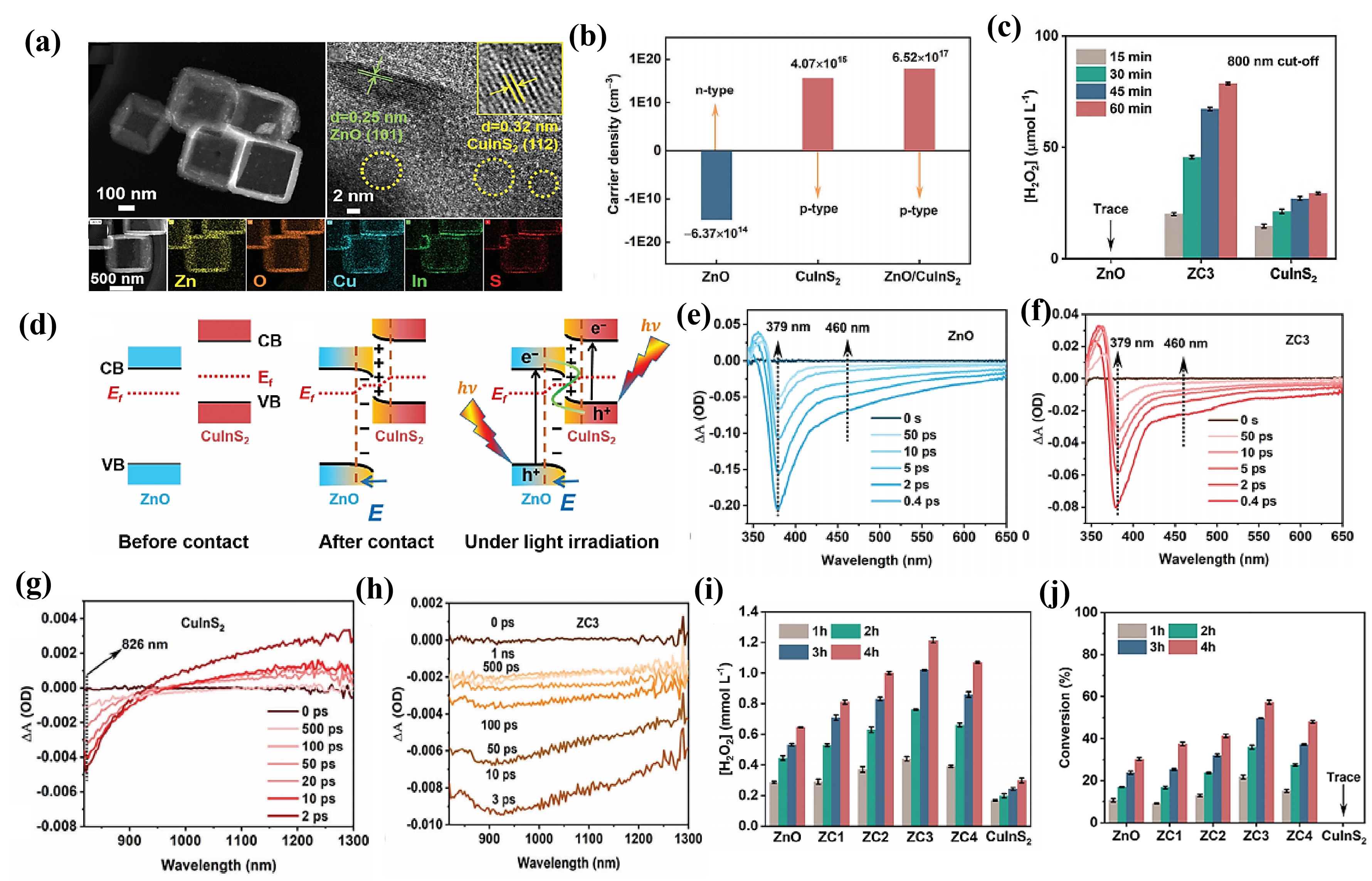
Fig. 26. (a) FESEM, STEM, HRTEM, HAADF images, and corresponding elemental mapping images of ZnO, CuInS2 and ZC3 composite. (b) Carrier concentration of ZnO, CuInS2 and ZC3 obtained from Hall effect measurements. (c) H2O2 production rates of different samples under NIR light irradiation (λ > 800 nm). (d) Schematic illustration of interfacial electron transfer in the ZnO/CuInS2 heterojunction. Fs-TA spectra of ZnO (e) and ZC3 (f) under a 330 nm pump pulse. Fs-TA spectra of CuInS2 (g) and ZC (h)3 in the near-infrared region. (i,j) Photocatalytic H2O2 production curves under UV-vis light irradiation. Reprinted with permission from Ref. [198]. Copyright 2024, John Wiley and Sons.
| Coupling type | Catalyst system | H2O2 yield (μmol·g‒1·h‒1) | Oxidation product performance | Reaction conditions | AQY | Solar-to-chemical efficiency (SCC) | TOF (h‒1) | Cycle stability (retention after N cycles) | Ref. |
|---|---|---|---|---|---|---|---|---|---|
| Pure water | COF/In2S3 (20COFIS) | 5713.2 | — | pure water, O2-saturated, 300 W Xe lamp sacrificial-agent-free | — | — | — | 4 cycles, the H2O2 production activity retains 85% of its initial value | [ |
| Pure water + air | Nb2O5@NiS (NONS-30) | 480 | — | pure water + air, AM 1.5G | — | — | — | slight activity decay after 10 cycles | [ |
| Pure water | Tph-Dha-COF@Nb2C | 1833 | — | pure water, O2-saturated, 300 W Xe lamp, sacrificial-agent-free | 1.94% (420nm) | 0.345% | — | 95% H2O2 yield retention after 5 cycles | [ |
| Pure water | ZnIn2S4/CN-NH4 | 2031 | — | pure water, O2-saturated, 300 W Xe lamp (λ > 420 nm), sacrificial-agent-free | — | — | — | stable interface was kept after repeated cycles | [ |
| Pure water | CZIS/SCN/MF (Cd0.5Zn0.5In2S4) | 3460 | — | pure water, O2-saturated, 300 W Xe lamp, sacrificial- agent-free | — | — | — | H2O2 yield retention >90% after 5 cycles | [ |
| Furfuryl alcohol oxidation | TiO2@BTTA (TB-6) | 740 | Furoic acid: 92% conversion rate | furfuryl alcohol solution, 300 W Xe lamp sacrificial agent: furfuryl alcohol | 5.48% (365 nm) | — | — | negligible performance loss after 4 cycles | [ |
| p-Phenylenedimethanol oxidation | PyTdCOF/CdS (PyTdCdS5) | 7860 (2 h) | p-phenylenedimethanol conversion rate: 95% | p-phenylenedimethanol O2/H2O, solution, λ > 420 nm, sacrificial agent: 1,4-benzenedimethanol | — | — | — | no obvious activity loss after 5 cycles | [ |
| Glycerol oxidation | ZnO/CuInS2 (ZC3) | 450 (H2O2 concentration) | glycerol conversion rate:57.3%, DHA selectivity: 41.1% | pure water, O2-saturated, 300 W Xe lamp sacrificial agent: glycerol | 1.17% (365 nm) | — | — | catalytic activity remained stable after 4 cycles | [ |
Table 3 S-scheme heterojunction photocatalysts for photocatalytic H2O2 production coupled with oxidation reactions.
| Coupling type | Catalyst system | H2O2 yield (μmol·g‒1·h‒1) | Oxidation product performance | Reaction conditions | AQY | Solar-to-chemical efficiency (SCC) | TOF (h‒1) | Cycle stability (retention after N cycles) | Ref. |
|---|---|---|---|---|---|---|---|---|---|
| Pure water | COF/In2S3 (20COFIS) | 5713.2 | — | pure water, O2-saturated, 300 W Xe lamp sacrificial-agent-free | — | — | — | 4 cycles, the H2O2 production activity retains 85% of its initial value | [ |
| Pure water + air | Nb2O5@NiS (NONS-30) | 480 | — | pure water + air, AM 1.5G | — | — | — | slight activity decay after 10 cycles | [ |
| Pure water | Tph-Dha-COF@Nb2C | 1833 | — | pure water, O2-saturated, 300 W Xe lamp, sacrificial-agent-free | 1.94% (420nm) | 0.345% | — | 95% H2O2 yield retention after 5 cycles | [ |
| Pure water | ZnIn2S4/CN-NH4 | 2031 | — | pure water, O2-saturated, 300 W Xe lamp (λ > 420 nm), sacrificial-agent-free | — | — | — | stable interface was kept after repeated cycles | [ |
| Pure water | CZIS/SCN/MF (Cd0.5Zn0.5In2S4) | 3460 | — | pure water, O2-saturated, 300 W Xe lamp, sacrificial- agent-free | — | — | — | H2O2 yield retention >90% after 5 cycles | [ |
| Furfuryl alcohol oxidation | TiO2@BTTA (TB-6) | 740 | Furoic acid: 92% conversion rate | furfuryl alcohol solution, 300 W Xe lamp sacrificial agent: furfuryl alcohol | 5.48% (365 nm) | — | — | negligible performance loss after 4 cycles | [ |
| p-Phenylenedimethanol oxidation | PyTdCOF/CdS (PyTdCdS5) | 7860 (2 h) | p-phenylenedimethanol conversion rate: 95% | p-phenylenedimethanol O2/H2O, solution, λ > 420 nm, sacrificial agent: 1,4-benzenedimethanol | — | — | — | no obvious activity loss after 5 cycles | [ |
| Glycerol oxidation | ZnO/CuInS2 (ZC3) | 450 (H2O2 concentration) | glycerol conversion rate:57.3%, DHA selectivity: 41.1% | pure water, O2-saturated, 300 W Xe lamp sacrificial agent: glycerol | 1.17% (365 nm) | — | — | catalytic activity remained stable after 4 cycles | [ |
|
| [1] | 刘梦萱, 张荣鑫, 张欣, 张艳峰. 具有光诱导双缺陷的WO3/PHI S型异质结用于高选择性光催化CO2转化为CO[J]. 催化学报, 2027, 92(1): 219-236. |
| [2] | 汪施柯, 郎曼, 王锋, 夏鹏飞, 张蝶青. g-C3N4基S-型异质结光催化剂的研究进展[J]. 催化学报, 2027, 92(1): 37-64. |
| [3] | 朱君江, 许凯强. CdS/NiPc S-型光催化剂及其增强的光催化产过氧化氢性能[J]. 催化学报, 2026, 88(9): 5-8. |
| [4] | 李世杰, 李蕊, 刘艳萍, 于欣, 马德运, 姜建辉, 周小松, 庄春强, 赵再望, 姜维. Ag/AgBr/C3N5中LSPR增强S型电荷转移促进活性氧物种生成实现高效光催化降解抗生素废水[J]. 催化学报, 2026, 87(8): 126-139. |
| [5] | 刘梦梦, 张妍, 谢禹成, 潘广学, 操海群, 叶盛. TiO2相结工程促进吡虫啉杀虫剂的界面吸附和催化[J]. 催化学报, 2026, 84(5): 359-367. |
| [6] | 唐克山, 邓莞沂, 王宁远, 夏阳, 吴新鹤, 杨恒. 富含氧空位的三嗪基-COF/TiO2 S-型异质结用于高效光催化CO2还原[J]. 催化学报, 2026, 83(4): 244-257. |
| [7] | 张婧, 张锡东, 王开颜, 王雪飞, 王苹, 陈峰, 余火根. 柠檬酸的定向配位用于高效光合成过氧化氢以及高附加值β-酮戊二酸[J]. 催化学报, 2026, 82(3): 201-211. |
| [8] | Sangeeta Adhikari, Sandip Mandal, Do-Heyoung Kim. S-型Ag2S/Co1-xS@Co9S8@C纳米催化剂用于多光谱太阳能驱动降解持久性有机污染物左氧氟沙星[J]. 催化学报, 2026, 89(10): 310-325. |
| [9] | 郭姿显, 何有杭, 于明飞, 李留义, 毕进红, 于岩, 吴棱. 面向实用光催化的共价有机框架多尺度工程:从异质结结构设计到膜制备[J]. 催化学报, 2026, 89(10): 142-176. |
| [10] | 王啟航, 孟利, 李卓, 杨卓然, 汤意南, 余浪, 李志君, 孙建辉, 井立强. 钴单原子-磷酸功能化还原氧化石墨烯/苝四羧酸纳米片异质结用于高效光催化生产过氧化氢[J]. 催化学报, 2025, 75(8): 192-203. |
| [11] | 张艳峰, 王珊. Mn0.5Cd0.5S/MnWO4中的S型异质结和超晶格界面用于增强光催化产氢[J]. 催化学报, 2025, 71(4): 1-4. |
| [12] | 郭栋稳, 曾国辉, 龙金星, 尹标林. 含氟配体修饰UiO-67-Pd催化生物基糠醇氧化芳基化反应的电子调控效应[J]. 催化学报, 2025, 69(2): 230-240. |
| [13] | 吕佳乐, 褚海亮, 邵春风, 孙立贤, 代凯. 基于分级纳米材料的光催化剂研究进展: 原理、设计及应用[J]. 催化学报, 2025, 78(11): 75-99. |
| [14] | 余文杰, 冯超, 李荣华, 张贝贝, 李严波. 用于光电化学水分解的氮化钽光阳极的研究进展[J]. 催化学报, 2025, 68(1): 51-82. |
| [15] | 付辉, 田金, 张倩倩, 郑昭科, 程合峰, 刘媛媛, 黄柏标, 王朋. 钴单原子修饰的石墨烯助催化剂用于提高卤化物钙钛矿光催化CO2还原活性[J]. 催化学报, 2024, 64(9): 143-151. |
| 阅读次数 | ||||||
|
全文 |
|
|||||
|
摘要 |
|
|||||


